Allan Ahlberg's fanciful tale, paired with beautifully detailed artwork by Gillian Tyler, invites children to see the world from a different perspective.
Here is the story Grandma tells one evening on her wide veranda steps. It has Michael and Hannah and the disappearing baby in it, a tigerish bird, raindrops like sacks of water, and the hugest apple you ever saw. Oh yes . . . and the Snail House. So gather round, climb up now into Grandma’s lap. Darkness is falling, the air is still, and the story is just about to begin.
With rhythmic text and intricate illustrations, renowned author Allan Ahlberg and illustrator Gillian Tyler have crafted a magical tale about the joys of seeing the world up close—and of sharing stories.
Allan Ahlberg was one of the UK's most acclaimed and successful authors of children's books - including the best-selling Jolly Postman series. Born in Croydon in 1938, he was educated at Sunderland Technical College. Although he dreamed of becoming a writer since the age of twelve, his route to that goal was somewhat circuitous. Other jobs along the way included postman (not an especially jolly one, he recalls), gravedigger, plumber, and teacher.
Ahlberg wrote his first book when he was thirty-seven, after a decade of teaching - a profession that he maintains is "much harder" than being a writer. He says that if he hadn't become a writer, he would have loved to be a soccer player. He was married for many years to fellow children's author Janet Ahlberg, with whom he often worked. Their daughter, Jessica Ahlberg, is also a children's author.
5 stars & 5/10 hearts. A hauntingly beautiful and unique little story. The illustrations are gorgeous, whimsical, and so full of detail. The writing style is exactly the same, and the plot is delicious—just a simple little bedtime story told by Grandma about three children living in a snail shell… I read this as a child and never forgot it. I finally tracked it down as a 20-year-old and read it to my siblings. Beautiful picture back and read aloud!
I quite liked this one. It had an interesting blend of storytelling techniques.
The grandmother is telling a story to her two grand children and pulling in elements from the world around them as they are happening and incorporating it into the story. The two listeners are also invested in the story, offering suggestions and improvements, some of which the grandmother weaves into the story. On the other hand, much of the story is presented through art, not through words, so it was like seeing a silent movie, you can put the words and the actions together in your mind. I think this is what makes it quite enjoyable for an adult to read, and rather less enjoyable for kids. They don't quite have the narrative structure down yet, oftentimes, they haven't encountered it enough to create their own from whole cloth. The adult reading the story can tell them what is happening in the pictures, and this might be good because you can practice what the grandmother is doing in real time, taking the things that your child sees and shouts out and incorporating them into the story. I suppose you could call that scaffolding the skill of narrative.
The thing I loved about this book is the art. The art is extremely reminiscent of Miyazaki Hayao. I felt like this was an Americanized version of My neighbor Totoro and Spirited Away. I could have spent hours just looking at the never-quite-actually-existed 1940s kitchen and imagining myself there with all the bits and pieces of what used to be called the modern world. I liked how the art incorporated bits of nature and how the kids lived seamlessly and uncaringly with all the bugs in their little house. I really quite liked this book. Even the shape of it was fun and unique.
A grandma tells her grandchildren a story about becoming really small. So small that they lived in the back of a snail. The book tells of three adventures these tiny children have.
However, I just didn't see the point in the story, other than a grandma telling her grandchildren a story, and a random story with no discernible plot.
Take your time and look at all the illustrations. They really accent the story.
5 star illustrations 4 star story - I liked how ordinary the setting of the story was (grandma watching the grandkids and passing the time on the porch waiting for mom to pick them up), but some of the asides that made this evidence seemed somewhat unnecessary and detracted from the tale a bit.
A grandmother tells her grandchildren a story about how three children, who bear a striking resemblance to themselves, shrink to a tiny size and live in a tiny house in a snail’s shell.
This quiet little book reminded me of my love for stories about miniature people. It's so much fun to imagine the adventures of a bug-sized person in a regular-size world!
My favorite thing about The Snail House are the conversations between Grandma and the children. I love the kids' grammatically incorrect language; the curious questions and the echoing of what Grandma says. It really feels like a conversation with little kids.
The illustrations are lovely too. Well-thought-out little details, like Grandma's colorful fly curtain and its miniature copy, which instantly turns the snail house into a cozy, familiar home. This book really conveys the nostalgic sweetness of spending a summer afternoon sitting outside the house with Grandma, listening to stories and imagining the great big world out there. As an added bonus, the story ends with a quiet evening scene, which makes this a great bedtime story.
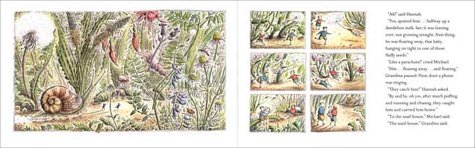
This is a childrens picture book aimed at 5-8 year olds. Ahlberg is perhaps best known for his books ‘eats peach pear plum’ and ‘The jolly postman’. Tyler was originally a natural history artist, which could explain the detail and realism of the illustrations, particularly the plants and flowers. The premise of the story is grandma telling the children that she is looking after (a boy, his sister and their baby brother) a story. In the story-within-a-story there are also three children, a boy, his sister and their baby brother. This suggests that grandma has personalised the story to suit the children, and engage them more by its being about children just like them. In the story the children shrink, move into a house made out of a live moving snail, and have adventures. The book uses the familiar Ahlberg device of a story-within-a-story (see The jolly postman and Goldilocks and the three bears). In the main story we have an omniscient narrator and the book is written in the 3rd person, recent past tense. When the story-within-a-story starts grandma is a non-participant omniscient narrator, using past tense. The implied reader is a child who is familiar with the fairy tale start ‘Once upon a long long time ago’ (p6) to the story-within-a-story and can see that this is where the actual story starts. Fairy tailes are reasonably timeless, so the book should continue to appeal to children. Unlike other many other Ahlberg books there is no intertextuality, with no references to other stories or characters. There are some quite advanced metaphors used, for example on p22 a thrush threatens the snail house. Ahlberg says that ‘for a snail … a thrush was a tiger in that garden’. He later extends this to say that a prowling cat ‘was the tiger in the thrush’s garden’. These concepts may be difficult for a younger reader to understand, and need explanation but will be appreciated by older readers. The book is presented in a landscape format, and contains two types of pictures. Pictures that relate to the first story are all unframed. The ones that relate to the story-within-a-story are all framed. The frames appear to be hand drawn, which tends to give the feeling of life and craftsmanship to them. This makes it easier to differentiate between the two stories. The pictures are full colour and use a slightly muted palette, which gives a painterly feeling. The book uses beautiful watercolor like pictures by Tyler, who was at one point a botanical artist, and gives great realism and life to the flowers and plants Ahlberg makes use of some comic-book like sequences of pictures, which show the story progressing. An example of this is shown on p17, where nine discrete pictures are used to illustrate the very few words. In this case the text does not covering everything, but allows the pictures to tell the story. This book should be enjoyable to children, with an engaging story offering plenty of drama whilst encouraging lots of interaction between a non-reading child and the reader, and still being accessible to the early reader to read on their own.
The charm of this picture book comes from the Grandma telling a story to her grandkids while sitting outside with evening coming on. It mirrors the organic way a story to told to children - with questions and comments from the grandkids while their grandmother weaves a fantastical, nature, earthy store about the snail house.
The three children featured in the grandmother's story are clearly her grandkids from the illustrations. One day, they have the ability to grow small - so small that they can sneak out of their house without being seen. They find this house, on a snail, completely furnished and appropriately sized for them.
The illustrations, while not super bright to attract the younger kids, are earthy and very detailed, representing Nature's surroundings if any of us were Mary Norton's Borrowers. However, the illustrations are too small to be well appreciated. The illustrations appropriately support the grandmother's story with details the story does not cover but the frames are too small to appreciate the pictures. I glanced over them briefly but they did not draw me in.
The children have three close calls - risks of living in the world when one is that small. First, an earthquake caused by a green apple falling from its tree. Then, the baby is lost inside a dandelion. Lastly, the snail is almost eaten by a thrush. At the end of these adventures, the children thank the snail for its house and hospitality, returning home and becoming big again.
I love how the story incorporates nature in its telling, making a fantasy story of creatures that seem everyday to us.
I loved this book, though the boys I watch were less interested. A few kids are shrunk down and end up making a tiny perfect home inside a snail shell until they can get back to normal.
I'm always a sucker for impromptu homes, but the prose was longer and a bit more dense than the boys (aged 3 and 5) are used to. This is not necessarily a bad thing, and I think children should be exposed to longer books at an earlier age, but it is something to keep in mind for a story time program or similar activities.
Lots to look at in these illustrations. Liked the fanciful fantasy of living in a moving, breathing, snail-house. Not really practical for the snail, of course, who would have trouble pulling itself into its shell once people moved in... Grandma shares several short stories relating the adventures of her grandchildren (who shrink down tiny so that they'll fit in a snail shell sized house). These are shorter than short - the artwork is really this book's strongest feature.
The Snail House by Allan Ahlberg, illustrated by Gillian Tyler - publ. in 2000 – Wow, these illustrations were so delicate that I just had to pick up the book. It contained a very special story told by a grandmother to her grandchildren about some kids who shrunk to the size of an ant and had a huge adventure. My favorite part was the snail house illustrations. *Reminded me of Dr. Doolittle’s home….
This book is a delightful story to read to a child. It's a great bedtime story, too. I love the consonance in the sentence structure - it can be so soothing to read this story aloud in a soft tone. I don't think we will ever part with this story.
The version I read is the book in simplified Chinese By Heying Books. The story is heartwarming. Meanwhile the publisher kindly provides original content in English as well. I like the painting style very much.
This was an absolutely charming, lovely book! The illustrations were fantastic and the text was sweet - just like sitting in Grandma's lap. My kids loved studying the highly detailed pictures to see what was happening in the story.
Notes: the art is so unbelievably great, but the story is lacking; instead of Grandma telling the story of the fascinating mini-world, it would have worked better if it was JUST a story on it's own, without Grandma!
Nice pictures. I'm surprised this book received so many 4 and 5 stars. I thought it was messily written - especially as a read aloud book. Poorly punctuated. Unnecessary distractions. I don't want to read it again to my 6 year old.