The Great War has ended, and the army is keen to be demobbed. But Willoughby, the new British High Commissioner in Egypt, has managed to affront the Khedive by refusing to receive rival delegations fueled by rising nationalism. Then, when some Armenians, Copts, and English civil servants are attacked, a state of emergency is declared. Gareth Cadwallader Owen is the Mamur Zapt, the Head of the Khedive's Secret Police. Unlike his British colleagues, Owen works for the Khedive. His is an uncomfortable perch as agitation for political and social restructuring grows. Furthermore, Owen is married to a pasha's daughter, Zeinab, herself straddling a cultural divide. The Khedive has declared a he'll drive around Cairo with his Ministers. Owen, who has spent his career defusing political time bombs, learns the streets have been made dangerous by threats of real bombs. The fi rst order of business is to ward them off. The second is to ensure the safety of an impending major European delegation to the capital. But what does it all have to do with Owen's shiny new motor car?
Michael Pearce grew up in the (then) Anglo-Egyptian Sudan. He returned there later to teach, and retains a human rights interest in the area. He retired from his academic post to write full time.
Egypt just after World War one was a turbulent country. There was a convenient fiction that sustained British power in Egypt: that the British officials there were just advisory. Beside every Egyptian Minister there was a British Advisor, beside every senior Egyptian official, a British one: just advising . . . Owen - The Mamur Zapt, appointed by the Egyptians, but really British, must protect the government while balancing both powers.
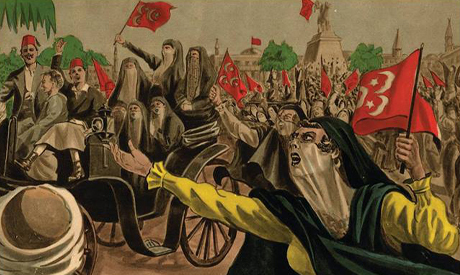
Moving up in the world, with drawbacks. There was to be a procession the following Thursday and they had just been finalising the details. Owen had been against it from the first. For the past three weeks Cairo had been under a state of emergency and this, in Owen’s view, was no time for processions. But the Khedive had been determined.
‘You can have a car,’ said Willoughby generously. ‘I’ve never had a car before,’ Owen confided. ‘Well, now’s your chance. You can have one of your own. And ride at the front of the procession.’ Golden visions swam before Owen’s eyes. But, then, at the very edge of the vision, a dark spot, rather like one of those spots that sometimes runs across in front of your eyes when you’ve got the lids closed. ‘But, hey, if I’m at the front, they’ll shoot me first!’ ‘There is that, of course,’ agreed the High Commissioner.
The unofficial opinion of having a procession through the streets of Cairo just to show the power of the government to the rioters is summed up with one word. ‘It’s lunacy,’ said Owen, when he got back to his office. Nikos, the Official Clerk, rather agreed with him; but then, Nikos was a Copt. The Copts, who had a talent for bureaucracy, had been running Egypt for about three thousand years under a succession of occupying powers, Pharaohs, Greeks, Arabs, Turks, French, and British, and they thought they knew something about the way things worked in Egypt. So did Willoughby, the High Commissioner, but he hadn’t been as long in his job. He was in favour of the procession. ‘It will calm things down,’ he said. ‘We’ll have troops everywhere, and it will remind people of the realities of the situation.’ Owen was rather afraid that it would.
Georgiades was one of Owen’s agents and mostly he slouched around Cairo doing nothing. This was invaluable, since he picked up a lot of information that way. ‘There’s going to be an attempt to blow him up.’ ‘Is that definite?’ said Owen, after a pause. ‘Or just talk?’ Georgiades hesitated. ‘Talk,’ he said. ‘But informed talk. I think we should take it seriously.’ ‘Go on,’ said Owen. ‘It’s going to be in the Sharia Nubar Pasha. Just after the Midan Kanteret. Opposite the Hotel des Voyageurs.’ ‘That’s very specific.’ ‘That’s why we should take it seriously.’
The other sub-plots are Zeinab, Owen's unconventional Egyptian wife, who wants to have a child and also wants to keep her administrative job at the hospital. Also Miriam, who would rather work for Zeinab than become just a housewife. Nearly impossible ideals in patriarchal Egypt of 1919.
The Mamur Zapt, his secret police, a dear old lady in the Mission for Sick Animals, a young man who aspires to be a mechanic, and a group of beggar boys must foil the revolutionary bomb throwers, who wish to take over the Egyptian government.
I liked this more than the earlier Mamur Zapt novel I read; the characterization feels stronger, the dialogue funnier. The political intrigue is lightly sketched but still well done, and there's some critique of colonialism lurking in the background despite Owen's determination to shoulder his white man's burden. And I'm really enjoying who Zeinab is becoming.
So: as a historical (and maybe as a political thriller), this works. As a mystery . . . well, in a mystery novel I expect the detective character to be a little more actively involved in piecing together the clues, and for there to be more red herrings so that I as the reader can't solve it by simple virtue of "if this character wasn't involved in the crime he wouldn't be in the novel" logic. But that's okay. I like historicals more than mysteries anyway.
I totally loved this book, and I'm going to the library to check out others in the series. First of all, though, be prepared to have a dictionary available to look up all of the Egyptian and Middle Eastern words. I even needed to look up Mamur. There's a subtle sense of humor running through the book, which I loved. Throw in a good dose of early 20th century Egyptian history, and you've got a very enjoyable mystery.
The end of the Great War finds the world in a state of flux. For the Mamur Zapt, the nationalism that has smoldered for years in Egypt is coming to a head with threats to the Khedive and the British, exacerbated by all of the other interests in the polygut country. And some of the women of Egypt have taken their cue from the suffragettes and hope for a role in the restructured Egypt.
I enjoy this series very much and always look for anything by Pearce - his writing is very human and funny but with a gentle bite to it, and I love the way he writes about the British in Egypt before and after the Great War. The Mamur Zapt is a Welshman who is head of the Khedive's Secret Service in Cairo - so he's in the unique position of being part of the British colonial government (although Pearce wryly points out that in Egypt, unlike India, it was more of a Protectorate than a Colony, so the British were supposed to be behind-the-scenes - although everyone knew they were in charge and the Khedive more of a figurehead to be mollified). Anyway, Pearce spent many years growing up in colonial Africa and says on the backflap he retains very much a "human interest" in the area, and his writing reflects that compassion for the people and the monumental issues of self-government. A great, funny series for anyone who appreciates M*A*S*H-type humor (but not quite that dark).
Even though this is a book well into a series, it was a fun read on its own, and made me want to go back to the beginning of the series. I loved learning a bit about 1920s Egypt (about which I'm wholly ignorant) and the major characters are pleasant enough, if bland. The plot was engaging, if not a gripping page-turner. I was a little disappointed that the Mamur Zapt is a British guy. I was hoping for an Egyptian detective. But one can't have it all.
The author has been writing this mystery series for a long time and they come further apart but still wonderful. Fast read and the descriptions of Egypt in the early 19th century under British rule are wonderful, very evocative.
I liked this book. I haven’t read any of the other Mamur Zapt books so this was the first time I was reading this author. I found it to be initially slow, not very engaging, and it took me some time to get past the first 70 pages. After that, the story seemed much more interesting to me. Maybe the author hit his stride once the scenes had been set. One thing that I noticed, and it may be due to my not having read any of the other books, was that I did not find it as well set in its location or time as I think a lot of reviews might have. The Egypt in 1918, or the British administrators, did not really come to life.
An okay period mystery. You will learn about Egyptian politics and English governance of Egypt. There are engaging characters. You can feel the climate rise off the page.
Owen is caught up in the middle again: The Khedive on one side, the army on another, Civil Service bending his ear and the police adding their pennyworth. There is a plot to kill the Khedive on the procession he wants through Cairo. At the last minute Owen changes the route, luckily, because a water card has broken down in the road. Is it a simple breakdown or something more sinister? A body is found in a hammam, his clothes have an unusual smell for someone who runs a carrier business so is he all he seems. Zeinab thought she was independent but meeting Aisha, the wife of Mahmoud of the Parquet, perhaps makes her think again. Another atmospheric story in the series. The formatting is also getting better.
A particularly satisfying story set near the first Egyptian Revolution at the end of WWI. A number of historical characters and events are referenced, in particular the Opposition Leader Sa'ad Zaghlul, the Versailles Peace Conference, and the Milner Commission. Pearce successfully captures the atmosphere permeating Cairo and the growth of Egyptian Nationalism. His easy style brings brings the setting to life as we traipse the streets of the city with the Mamur Zapt.
This was an interesting historical mystery. The history of British/Egyptian relations was fascinating and the author described it well. The mystery dragged in parts, but really picked up pace in the end. The ending wrapped up nicely and the final thoughts of Owen's wife added charm to the story.