Piggy lives in a large house with Thomas. Thomas knows exactly what Piggy needs. But a chance meeting with a wild pig changes everything, and Piggy finds out what lies outside the four walls, beyond the fence. A gentle book about freedom and friendship.
This is an unusual story with beautiful illustrations and some thoughtful and philosophical ideas coming across without feeling like you've been taught a lesson.
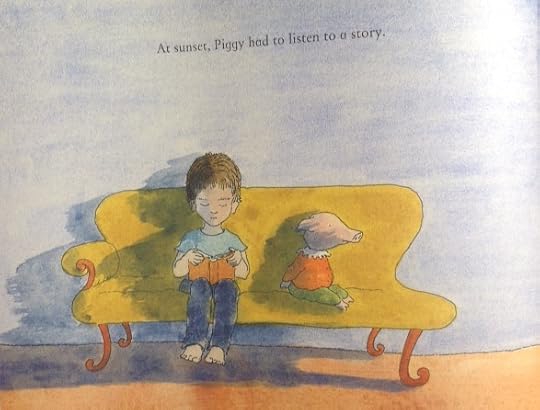
A little boy lives in a big house with a little pig. Whether this is his friend, relation or stuffed toy you never find out but it doesn't matter as you can relate to Piggy's situation. The boy controls what Piggy does, wears and where he goes. He bullies him and belittles him although still wants his company. Piggy is dropped for some time whilst a cousin stays and during this time he goes outside and meets a wild pig who he feels a connection with.
Although it doesn't spell it out, this story shows that having nice clothes and a big house doesn't compare with being happy with someone whose company you enjoy. That people who aren't happy themselves or feel controlled seek to make those around them unhappy and have control over someone weaker. Most importantly it shows Piggy having the courage to escape an abusive friendship. Although these are all heavy themes for a children's picture book they are presented subtly and the story has a lovely conclusion. This was a thoughtful book and a pleasant surprise to come across in my local libray.
Pig lives in a large house with an awful, awfully bossy boy. One day Pig meets a wild pig . . . a pig who doesn't wear clothes, who tells Pig about all that he's been missing by never straying beyond the fence.
A sweet story with lovely watercolor and ink illustrations by the author.
This hit me hard. I'm not even sure I can explain what real life situation the metaphor explores; certainly I've never been that strong a leader nor that weak a follower, but I still ached for the little pig, and rejoiced at the ending.
Originally published in Australia it seems, though the author is from Bulgaria and now lives in Oregon. I found it interesting that the bossy human, Thomas, is not a bad boy. Also he plays dress-up and tea party as well as 'boy' games. And his cousin is dark, enough to be considered by some, I think, indigenous/ aboriginal.
Another MA graduate from the cornerstone of illustrative excellence that is Anglia Ruskin University, Maria Gulemetova’s debut picturebook tells the story of a pig whose character is smothered by that of his friend and the overwhelming yet nervous awakening that can come with freedom. Having seen this book shortlisted for the CILIP Kate Greenway and allured by the landscape/journey format and was struck but its feigned simplicity which hid beneath the surface a work of great depth.
Piggy lives in a grand mansion whose grounds are festooned with stone-wrought fountains, bone china crockery and fine clothes to wear. His only companion seems to be Thomas, a young boy who talks a lot, tells Piggy what to play and what we wear – no questions asked. Piggy gains some reprieve when Thomas’ cousin comes to visit and escapes outside. Here he encounters a Wild Pig who invites him to join him ‘beyond the fence’.
It’s always rare to find a writer and illustrator who knows when the pictures should do the talking or when the words can holder greater power. Gulemetova manages this beautifully. The long, sweeping vistas of the outside contrast so well with the high-ceilings and empty spaces of the inside and the landscape format highlights the ambiguousness that can come when casting off a great part of who you have been and beginning a new journey. For all the material comforts Piggy had surrounded himself with, it is only when he looks deep into his sense of self that he realises that the life he is living does not come close to the life that he deserves.
A cossetted toy pig lives in a big house with the boy Thomas. A chance exploration of the great outdoors brings him into contact with a wild pig and in rebelling against Thomas’s controlling - abusive? - ways, Piggy discovers real friendship and freedom. An uncomfortable little story - the unspoken rules about child and toy affection are taken apart bit by bit, and there is a clear parallel about love and control in human families- this has a resonance for me and maybe a message for all of us about how we find ways to be free, both internal and physical.
One of the best picturebooks about freedom that I have read. A little pig under the restrictive watch of a young boy has never had the chance to run around outside and live without limits. Thinking and decision making has become something that is out of Piggy's control, until an opportunity to make a friend arises, and the possibilities held by life begin to become more clear. There is so much depth to this story which becomes richer with every read. I loved the subtle changes in Piggy's thoughts, as he starts to see the shackles that have held him back, and realises that he deserves more than just the four walls that he has always known. What is left unsaid by Gutemetova's sparse words and long stretching illustrations evoke so much empathy and emotion for the lonely protagonist, aswell as thoughts and questions about troubled young Thomas. Lots to think about with regards to physical and psychological fences that can unknowingly be put in place by those who we think know best.
This is part of my 365 Kids Books challenge. For an explanation see my review for 101 Amazing Facts about Australia You can see all the books on their own shelf.
The jacket flap and the back of the book describe this as "a gentle book about freedom and friendship." Which is odd, because I see it as a book about tyranny, passive resistance, and escape. I'm kind of sorry Piggy didn't burn down the house. It is amusing that the wild boar is gentle and thoughtful and kind, whereas rich boy Thomas is the rampaging monster. Freedom from ruffled collars! Fight the power! Capitalists are the real pigs!
This is an interesting story about a constrained pet pig, who is dressed by his young boy, and pretty much has to do whatever the boy tells him to. Then one day, he meets a wild pig outside the yard's fence. He meets him several more times, off and on, until he finally rips off his clothes and takes off with the wild pig, beyond the fence. The ink and watercolor illustrations are spare, with few details, but they expertly depict the little pig's many moods, and his happiness at finally getting to do something he wants to do. There are some nice spreads of the fields and hills outside the fence, as the house seems to be in a pretty isolated area.
This entire review has been hidden because of spoilers.
A strange and quirky picture book about a little pig controlled by his human friend who meets a wild pig and decides to go his own way in life and do what he wants for a change! I can't decide if this book is quite funny or a bit worrying...but a good reminder that we should all have the freedom to make our own choices in life; to the clothes we're wearing and the people we decide to live with.
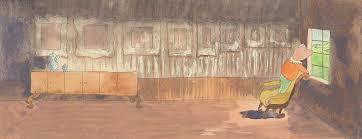
A children's book that expresses just how powerful pictures can be and how much more effective they can be than words alone. This book is about two friends - Piggy and Thomas. Thomas makes all the decisions in their friendship and Piggy goes along with this. That is until he meets a wild pig who shows him a different life he could lead. Piggy no longer wants to stay with Thomas and longs for a live beyond the fence. The images express the loneliness and longing felt by piggy so well, that words would add very little to the understanding gained. I felt this particularly on the double page spread where Piggy was looking out of the window, hoping to see the wild pig. I would use this book with Key Stage 2 children and have mature discussions about the themes this book explores, including friendship, freedom, loneliness and even bullying. A really powerful, emotional story.
I liked the fact that freedom and friendship are explored in this book. This could provide multiple opportunities for book talk around these themes giving the reader the opportunity to connect with the book. I really liked the illustrations and how they provided opportunities for careful observation. A lovely read!!
The watercolor, full page artwork was nice, but I found the story depressing, the ending and message to do more harm than good for a young reader.
Essentially, Piggy, a pig, lives with a human boy who makes all the decisions: what they do, what Piggy wears. One day, Piggy meets a wild pig and eventually runs away with the wild pig.
I find multiple flaws with the story: - never once did Piggy try to tell the human boy Piggy was unhappy. Never once did Piggy try to speak up. - Piggy runs away with another pig: 1) running away from Piggy’s problem without trying to fix it (communicate, stand up for oneself); 2) pigs are happy with their own kind…
On the flip side, I didn’t like that although the human boy lived in a big house and had nice things, material items don’t bring happiness.
This entire review has been hidden because of spoilers.
Beyond the Fence is both written and illustrated by Maria Gulemetova. It tells the story of a domesticated pig whose life is controlled and dictated to by Thomas, his human owner. One day, Piggy meets a wild pig and a friendship between the two is formed. Upon entry back into the house, Piggy realises the reality of his situation when at home with Thomas which he was unaware of before meeting the wild pig. As normal, Piggy is made to feel inferior by Thomas who continues to boss him around and remove his independence. In the end, Piggy decides to abandon Thomas in favour of being a wild pig with his new-found and equal friend. This results in freedom for Piggy. The text has the potential to address serious issues such as feeling trapped within a controlling or abusive relationship. The story is written using many simple sentences which are blunt and to the point. Gulemetova incorporates ellipsis to build suspense and anticipation before the key meeting points of the two pigs (also, the turning points for Piggy's character within the book). The illustrations reveal clues to the reader that aren't made explicit in the text itself. The issue of a domesticated pig wanting to escape for the chance to live a wild life raises the question of whether it is fair for humans to hold the power to demand control of other species in the world. The speech shows a real contrast between the characters' relationships with Piggy and Thomas' speech as heavily non-interactional and Piggy and the wild pig's speech as friendly and responsive.
This is a stark and effective tale of friendship and captivity. Who is a friend? Is it someone who always ‘knows’ what is best for you and what you two should do next? Or is it someone who encourages you to be yourself and likes you for who you are?
Piggy lives with Thomas in a grand house – the illustrations highlight Thomas’ self centeredness and Piggy’s growing despondence, while the text has few words, appropriate to a young audience. One day, Thomas has a cousin come to visit, and Piggy is free to wander. Piggy meets a wild pig, whose freedom and joy make Piggy’s thoughts wander, too.
Reading this may spark some good discussion, even with little ones, about what makes a fun and healthy friendship.
This could be part of a friendship story time, perhaps paired with Marshall’s George and Martha stories, Willems’ Elephant and Piggie tales, or even Frog and Toad by Lobel.
This was unexpected. I thought it would be a cute story of exploration and adventure and it turned into a story of captivity and abusive relationships. The pig lives in a big house with a boy he considers a friend, but the boy is awful to the pig and won't let the pig go beyond the fence that surrounds the house. The pig has to wear only what the boy chooses, they play games the boy wants, and the pig is left feeling bullied and sad and lonely. One day the pig goes for a walk and meets a wild boar who changes the pig's outlook on life and the pig finally gets the courage to leave the house and be free.
Totally not what I thought this book was going to be about when I picked it up, but I am all for empowered characters and finding the courage to go your own way.
First published in the United Kingdom, this book will prompt readers to think about the price of some friendships and whether freedom might sometimes be better than being shackled by the expectations of others. From the opening pages, it's clear that Thomas has the upper hand between him and Piggy. The boy is bossy, controlling, and downright disrespectful to his small pig friend. Although it might seem that the two friends have everything and Piggy, with each unfolding scene, that's clearly not the case. Thomas chooses what Piggy should wear and what they should do each day. Piggy quietly tolerates it all until he happens to take a stroll while Thomas and his cousin are playing. A chance encounter with Wild Pig changes everything for Piggy when he questions what Piggy is wearing and describes the pleasures or running wild and free. Although Piggy must go back home, he promises to return--no doubt thinking about the freedom his new friend seems to promise him. After Thomas's cousin ends her visit and things go back to normal, Piggy has had enough and leaves Thomas far behind, moving steadily beyond the fence that surrounds the property. All that the world has to offer lies ahead now that he's shed himself of his restrictive clothing, his cloying and demanding friend, and his own fears. The final illustration shows just how much there is to life and the world now that he's traveled beyond the fence. The story is deceptively simple but packs an emotional wallop as it reminds readers to be themselves and don't let the expectations of others weigh them down. I also liked the images used her with Piggy's body language revealing his emotions at every turn. Although it's clear that he tries hard to be a dutiful, obedient friend, Thomas makes no efforts of his own to do so. Readers may be inclined to examine their own relationships with others as a result of reading this book.
Beyond the Fence is a book that subtly and successfully tackles these vital and relevant themes that are important for children to become familiar with.
The character piggy, a 'domestic' animal has not once strolled beyond the fence outside of his home. After meeting his wild counterpart, a wild pig who lives a life of freedom beyond the four walls that piggy is caged in, piggy decides its time to explore and take that first step to his freedom. The themes of friendship and freedom are clearly addressed here however also the fear of the unknown (will this step be dangerous and how will I survive?), all life lessons that piggy must and CAN figure out for himself!
This is important for children as it encourages them to think about where we should all be. Is freedom something we are all be entitled to? Should we make informed decisions for ourselves and if so, how to we do that?
As well as being an enjoyable read, this book has the potential to spark some healthy and useful debates in the classroom!
A brilliant example of how the pictures in a book can be more powerful than the words. The illustrations convey the feelings of poor pig so well. The way the pig’s face is looking at the floor, the grey, dark blue and brown colours in the background convey a sense of darkness suggesting pig feels trapped. Furthermore, the pig is often surrounded by very little within the pictures, creating a feeling of ‘emptiness’, possibly a metaphor for how the pig is feeling. A thoughtful story that can be provoke many discussions within a classroom context about friendship and the small pig’s personal journey to freedom. Overall, 'Beyond the Fence' is a thought-provoking and beautifully illustrated book, that has many layers.
My favourite thing about this book is the fact that you get most of the emotion and feeling from the illustrations rather than the text. The way Piggy is drawn and often had his head drooped implies he is sad and something is missing from his life that he then finds when he meets Wild Pig who shows him what pigs should really be doing instead of being dressed up and told what to do by a human child.
The colours when Piggy is with Thomas are quite muted and dark whereas when Piggy feels more free the colours brighten and I think that is a really effective way to show the contrast between the emotions Piggy is feeling.
Simple but effective and a lovely read that I would 10/10 recommend!
This picture book at first may seem as though it is simply about friendship; making sure you do not lose sight of what you want and enjoy for the sake of a friendship. Yet from an adult perspective, pupils can be helped to see the underlying tones of freedom. The pig in the story discovers the empowering freedom of nature. This is a stark contrast to the societal regulations displayed in the house in which his owner lives. Perhaps this book could be used across all year groups - its simple language allows for an accessible way for students to appreciate the world outside of a materialistic life.
A short, simple picture book with a strong message about letting people be independent individuals and express themselves how they wish.
Piggy lives with a little boy called Thomas and has every area of his life decided for him, right down to wearing human clothes. One day, he meets a wild pig who shows him what his life could be if he was free like him. Piggy bravery follows his instincts and leaves his old world behind to be a happy wild pig.
Children would learn about the effect other people can have on someone’s happiness and wellbeing if they don’t let them make their own decisions.
I interpreted the message in the book as, the possible limitations of friendship. The pig and the boy are friends, but the pig is always being told what to do, he never makes his own decisions, so he is restricted to living the life the boy wants to live. When pig meets Wild Pig, he sees that there is a life beyond the boy, where he doesn't have to follow and conform to certain restrictions. This book could be used powerfully within a PSHE lesson where children could discuss the power of friendship, but also the importance of friendship not holding you back. It's okay to make your own decisions and follow your own path, and other should understand this and let you do this too.
Gosh, there's some deep themes explored this picture book and it even reminded me of Raymond Briggs, as not all is rosy in the story. The main character (a subserviant pig) and the boy who tells him what to do and what he likes, are reflective of children every day. Therefore the book sets out the importance of being yourself and not being bullied or controlled.
A poignant story that might not be an every night bedtime read, but is charming, well observed and beautifully communicated in text and pictures. I can see this working well as an atmospheric, animated short movie too.
This is a nice story about letting people be who they want to be and not making them do things they don’t want to. Piggy feels trapped by his friends choices until one day he escapes the fence and is happy and free. There are lots of opportunities for children to make inferences from the book with a good proportion of the story being told by pictures alone. The book could generate high quality discussions about friendships and family and being who you want to be. I would use this book with FS and KS1 children.
Thomas knows exactly what Piggy needs, so he gives it to him. One day Piggy meets a wild pig who talks about being free. When Piggy goes home, he realizes that he is being controlled and has no free will, so runs away with the wild pig.
This is an allegory about repression under a dictator and seeking freedom from it. Using just the right touch, this could be a useful tool in a classroom to demonstrate this concept.
This was one of my favourite picture books that I read this year, but unfortunately it didn't make The New York Public Library's Best Books for Kids 2018 (I was a committee member).
The illustrations remind me of Jane Eyre/Secret Garden and there is so much to unpack here, such as controlling, abusive relationships/friendships. If you enjoy dark, moody picture books check this one out!
I immediately picked this book from the shelf just by the cover and the mystical name. I was not disappointed, the illustrations speak for themselves. The book is based around a pig who is usually taken for granted by a boy called Thomas. Thomas just expects the pig to be there all the time when one day he is not.
This is a great book to teach children about freedom and friendship.
A friendship tale that encourages children to to understand that everyone has different interests and that it's important to make friends who respect you for you. The ending is a bit abrupt and it feels like the story needed a bit more of a resolution, but I enjoyed it just the same.
It's the story of a (pet?) pig who takes his life back from a controlling boy, but it's simultaneously the story of taking control of your own life and destiny. The freedom of choice. The freedom to choose freedom.
The main character is a pet pig, rather like a stuffed animal companion to a young boy who never takes the pig's wishes into consideration. He finally rebels after meeting a wild pig and realizing he's never traveled "beyond the fence". A lesson in freedom to choose and friendship.