Kurt Wiese was a book illustrator. Wiese wrote and illustrated 20 children's books and illustrated another 300 for other authors.
From an early age Kurt Wiese dreamed of being a painter but his family opposed it and sent him to learn the export business. For six years he lived and worked in China selling merchandise. During World War I, he was captured by the Japanese, and turned over to the British. He spent five years as a prisoner, most of them in Australia, where his fascination with the animal life inspired him to start sketching again. When he was released, he returned to Germany where he was able to sell all of the artwork he had created while he was detained, in spite of having no formal training. He traveled to Brazil for three years and then to the United States where he was hired by Collier's magazine.
Between 1927 and 1931 Wiese wrote and illustrated 7 books and illustrated 26 books for other authors. In 1930 he married Gertrude Hansen, a real estate agent, and they bought a little farmhouse near Frenchtown, New Jersey, where Wiese set up a studio in an old blacksmith shop. He lived and worked there until his death in 1974.
In total, during a career of over half a century, Kurt Wiese illustrated over 400 books. He wrote and illustrated 18 books of his own, two of which were Caldecott Honor books.
I really enjoyed the illustrations in this book from Kurt Weise. I had never heard of it before, but it was a great little read between books—and especially nice on Easter Sunday.
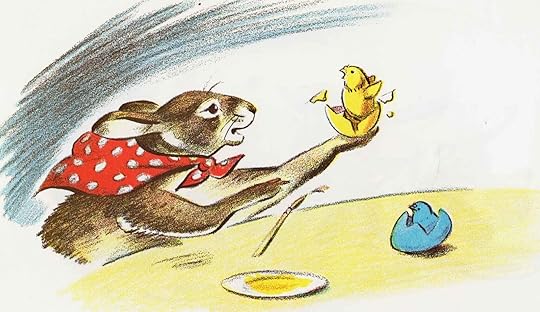
Procrastination leads to all sorts of crazy things happening. Mama Rabbit waited until the day before Easter to color eggs and hide them in people’s gardens. She sent her children off to get eggs from the Red Hen. Red Hen reluctantly gave them a pile of eggs that weren’t hatching. There was a big surprise in store for the rabbits. Young readers will enjoy finding out what happens. This book was originally published in 1952, and I think the simple narrative and sweet illustrations make this a fun book to include in your Easter book collection.
I will not talk about the plot because other people have done that. I will say that, particularly considering the year in which it was written, I think the plot was completely original and completely unique. Also, I just loved the plot.
I just think the illustrations were so attractive and so colorful.
I just loved, loved, loved this book when I read it when I was a young kid.
The relationship between rabbits and chickens can be confusing during the Easter season. Here's one explanation for how the rabbits end up with the eggs. The rabbits are not the cuddly cottontails that are featured in so many books and cards that are printed today.
Dispatched by their mother to bring home eggs that they can color for Easter, a fluffle of young rabbits descend on their neighbor, a hen sitting on her nest of eggs. Reluctant at first, she eventually parts with the eggs, which she had been attempting to hatch for weeks. Bringing the eggs home, the rabbits and their mother begin to decorate them, only to find that there is a surprise in store...
Published in 1952, Happy Easter is the first book I have read that was both written and illustrated by Kurt Wiese, although I have read Marjorie Flack's 1933 The Story About Ping, which he illustrated. I found it charming, appreciating both the simple and humorous story, and the lovely artwork. The conclusion, in which was entertaining and novel, and will likely please younger children. Recommended to picture book audiences who are looking for lighthearted, secular Easter tales, and to anyone who enjoys vintage picture book art.
Short book about some rabbits coloring eggs the day before Easter and then having the chicks hatch. The chicks come out the same color the egg was painted. Kind of a cute story, pictures so-so.
A chicken offers eggs that won't hatch to some bunnies to dye just before Easter. The eggs end up hatching and what comes out is a surprise. A cute story for Easter.
Read with 2/3s and 3/4s and plan to read it with kindergarten. Very short but pretty cute. I would normally read it with younger grades, not who I originally read it with