All'indomani dell'omicidio di John Kennedy, avvenuto a Dallas il 22 novembre 1963, si sarebbero potute trovare fin da subito delle crepe nella ricostruzione ufficiale dei fatti. Ci fu chi volle provarci, nel tentativo di avvicinarsi alla verità. Jim Garrison, allora procuratore distrettuale di New Orleans, venne incaricato delle indagini e questo libro è il resoconto dell'inchiesta delle sue scomode conclusioni. Osteggiato dal governo e dalle testate più influenti, Garrison individuò infatti i mandanti e soprattutto il movente dell'omicidio: a eliminare Kennedy furono i servizi segreti, in connivenza con molti dei personaggi allora al potere, che volevano impedirgli a ogni costo di porre fine alla Guerra Fredda e alla guerra in Vietnam.
Earling Carothers "Jim" Garrison, who changed his first name to Jim in the early 1960s — was the Democratic District Attorney of Orleans Parish, Louisiana from 1962 to 1973. He is best known for his investigations into the assassination of President John F. Kennedy (JFK).
Garrison remains a controversial figure. Opinions differ as to whether he uncovered a conspiracy behind the John F. Kennedy assassination but was blocked from successful prosecution by a federal government cover up, whether he bungled his chance to uncover a conspiracy, or whether the entire case was an unproductive waste of resources.
On the whole, I found this book interesting and thought-provoking – even though I disagree with the author’s premises and conclusions.
Like, I suppose, many other readers, I came to Jim Garrison’s 1988 book On the Trail of the Assassins via Oliver Stone’s JFK (1991), a film based in part on Garrison’s book. While I felt then, and feel now, that Stone’s conspiracy-theory interpretation of the assassination of President John F. Kennedy in 1963 was profoundly wrong, I found JFK to be a cinematic masterpiece.
Watching JFK on the 70-by-35-foot Cinerama curved screen at the Uptown Theatre in Washington, D.C., was an unforgettable experience. I was impressed by the film’s meticulous re-creation of period detail, its use of different film stocks to capture different points in time, and – most of all – the emotionally moving way it captured the nation’s grief and shock at the murder of the young president who seemed to embody so strongly the promise of a brighter American future.
Seeing JFK made me want to read On the Trail of the Assassins, though I went into the book feeling more than a bit skeptical. I knew that Garrison, a long-time district attorney for Orleans Parish in Louisiana, combined a record for tough prosecutions against vice and underworld figures with a reputation for being a publicity-seeker; his Wikipedia entry describes him as “a flamboyant, colorful, well-known figure in New Orleans”. I still disagree with Garrison’s ideas about the assassination of President Kennedy, but he certainly knows how to tell a flamboyant and colourful story.
As Garrison recounts it, his time “on the trail of the assassins” began when an informant advised him that Lee Harvey Oswald might have had ties to New Orleans. What Garrison then discovered was that New Orleans was home to quite a few anti-communist Cold War ultras who had a couple of important things in common. One of those things was a rabid hatred of the late President Kennedy, who they felt had “betrayed” the Cuban anti-communists who carried out the ill-fated Bay of Pigs invasion in 1961.
Early in Garrison’s investigation, a man with the alias of “Clay Bertrand” emerged as a prominent person of interest. Garrison’s efforts to follow this lead brought up the issue of potential dangers to prospective witnesses. At Broussard’s restaurant in the French Quarter, Garrison interviewed Dean Andrews, “a roly-poly lawyer who spoke in a hippie argot all his own.” Garrison had learned that “Clay Bertrand” once spoke to Andrews about representing Lee Harvey Oswald, and Garrison wanted Andrews to furnish “Bertrand’s” real name.
Andrews engaged in one distraction tactic after another – knocking back martinis, pointing out a pretty girl in a red dress, talking jive – and then Garrison lost patience:
“I’m aware of our long friendship,” I said. “But I want you to know that I’m going to call you in front of the Grand Jury. If you lie to the Grand Jury as you have been lying to me, I’m going to charge you with perjury. Now, am I communicating with you?”
Andrews stopped eating his crabmeat and put down his fork. He was silent for a long moment, apparently saddened at the failure of his jive humor. Then he spoke….
“Is this off the record, Daddy-o?” he asked me. I nodded. “In that case,” he said, “let me sum it up for you real quick. It’s as simple as this. If I answer that question you keep asking me, if I give you that name you keep trying to get, then it’s goodbye, Dean Andrews. It’s bon voyage, Dean-o. I mean, like, permanent. I mean, like, a bullet in my head – which makes it hard to do one’s legal research, if you get my drift. Does that help you see my problem a little better?” (pp. 107-08)
“Clay Bertrand” turned out to be Clay Shaw. A New Orleans businessman with an aristocratic manner, Shaw was a pillar of the Crescent City’s business community, well-liked and popular. Garrison, therefore, would not be making any friends by going after Clay Shaw for alleged involvement in a conspiracy to assassinate a President of the United States. But Shaw did have C.I.A. contacts, and Garrison’s investigation eventuated in Shaw’s being arrested and charged, in March of 1967, with conspiracy to assassinate President Kennedy.
The Clay Shaw trial became a media firestorm, and Garrison seems to feel that he and his case were treated quite unfairly:
Some long-cherished illusions of mine about the great free press in our country underwent a painful reappraisal during this period. The restraint and respect for justice one might expect from the press to ensure a fair trial not only to the individual charged but to the state itself did not exist. Nor did the diversity of opinion that I always thought was fundamental to the American press. As far as I could tell, the reports and editorials…were indistinguishable. All shared the basic view that I was a power-mad, irresponsible showman who was producing a slimy circus with the objective of getting elected to higher office, oblivious of any consequences. (p. 200)
Garrison can believe as he believes; but as I was reading these passages, I couldn’t help reflecting that part of the job of the media, in the U.S.A. or any other democracy, is to be skeptical, to play devil’s advocate, to hold the powerful to account – including a district attorney with a controversial new explanation for one of the most notorious crimes in American history. As Garrison complained about an alleged media conspiracy to discredit him, on top of the alleged conspiracy to assassinate President Kennedy, I began to become weary of the conspiratorialism of it all.
The Clay Shaw trial, with the first public screening of the film footage that Abraham Zapruder shot on November 22, 1963, at Dealey Plaza, convened on January 29, 1969. On March 1 of that year, the jury found Shaw not guilty on all charges, after deliberating for less than an hour. It was the only time in U.S. history when an alleged JFK assassination conspirator was put on trial.
This legal reversal, and a later federal trial of Garrison on bribery charges – part, Garrison believed, of a federal conspiracy (another one!) to destroy him for his JFK investigations – left him unbowed. Late in the book, he states quite clearly what he thinks happened on that terrible November day in Dallas:
I believe that what happened at Dealey Plaza in Dallas on November 22, 1963, was a coup d’etat. I believe that it was instigated and planned long in advance by fanatical anti-communists in the United States intelligence community; that it was carried out, most likely without official approval, by individuals in the C.I.A.’s covert-operations apparatus and other extra-governmental collaborators, and covered up by like-minded individuals in the F.B.I., the Secret Service, the Dallas Police Department, and the military; and that its purpose was to stop Kennedy from seeking détente with the Soviet Union and Cuba and ending the Cold War. (p. 336)
Those who are disposed to believe as Garrison did will probably continue to do so. Those who do not believe Garrison will continue to feel as they have always felt about the assassination of President Kennedy. Garrison’s book – subtitled My Investigation and Prosecution of the Murder of President Kennedy – will probably not change many minds, one way or the other.
For my part, I have visited the Sixth Floor Museum in Dallas (it presents the history of the assassination and its aftermath responsibly and with dignity), and I have looked out the window from which Lee Harvey Oswald is said to have fired the fatal shots. I still believe that Oswald committed that dreadful crime, and that he acted alone. Sometimes, unfortunately, a misfit loser with delusions of grandeur can change the course of history for the worse, all by himself. It has happened before. Sadly, it will happen again.
If you believe in the existence of a JFK assassination conspiracy like what Garrison describes in his book, I respect your opinion. I simply don’t share it.
Garrison lost his district attorneyship in the aftermath of his bribery trial, but he remained a colourful character on the New Orleans scene until his death in 1992. Look fast in the scene where Dennis Quaid’s police-detective character goes on trial in the New Orleans thriller The Big Easy (1987), and you’ll see Jim Garrison playing the trial judge. Garrison also has a fun cameo in JFK, playing, of all people, Earl Warren! Yes, Supreme Court Justice Earl Warren, the very person who ran the commission whose findings – that Oswald acted alone – Garrison worked so hard to try to discredit.
I know that I’ll want to watch JFK again. Kevin Costner as Garrison gives a heartfelt performance – the best of his career, I think – and his work is complemented by those of one of the best ensemble casts ever assembled: Kevin Bacon, Tommy Lee Jones, Gary Oldman, Sissy Spacek, Joe Pesci, Jack Lemmon, Walter Matthau, Donald Sutherland, Ed Asner, Brian Doyle-Murray, John Candy, Sally Kirkland, Vincent D’Onofrio, Lolita Davidovich, and John Larroquette (with Martin Sheen narrating). I don’t know that I’ll read On the Trail of the Assassins again. But it can be a salutary thing, a good intellectual exercise, to read the work of a writer with whom one disagrees.
Who pulled the trigger? It’s a question with an answer so why are so many still searching for the ‘truth’. Even if the answer is Lee Harvey Oswald the speculation and conspiracy surrounding the JFK assassination makes for a fascinating story with an infinite number of alternative theories to chew on. Probably the most believable is Jim Garrisons; the only man to bring an alleged JFK conspirator to court and with a theory and investigation that is believable
This was one of the books used for Oliver Stones brilliant film JFK, which i’d highly recommend even if conspiracies aren’t your thing; it’s probably Kevin Costner’s best film. Jim Garrison isn’t the greatest writer as at times his prose seems clunky and awkward but i didn’t start this book looking for a literary masterclass; i wanted intrigue and stories of shadowy goings on in the US government, which he provides relentlessly. Jim Garrison isn’t just another fanatic, spouting theories of Aliens and Warlocks infiltrating the White House; this is a serious and coherent investigation into the probable assassination of a US president by his own government.
If you’re a lover of treasonous schemes then this book is most definitely for you as it’s probably the original great conspiracy. A must read!
This book was unputdownable from start to finish. I never skipped a page and looked forward to the next time I had free to read this completely fascinating book! I’m saddened that it has ended! I truly loved the way that Garrison wrote; he used prose that only gave the answers when it became climactically clear that finality was necessary. On other occasions he allowed the reader to get the truth on his/her own. He used sardonic sarcasm that was entertaining, while thought-provoking. For example, (no spoilers) beginning with Chapter 18 we are now at the trial of the infamous Clay Shaw. On page 231 it reads: Judge Haggerty proudly announced that he had made arrangements for the jury to be able to watch … the “truck parade” …. This important local business taken care of, the trial could now get underway.” There Garrison was trying a man for one of the most important murders in American history and the judge is concerned with a parade! But Garrison put no emphasis on this fact; he allowed the revelation to swell antagonistically in the heart of the reader while he laid the facts of the case down. Also, throughout the book, Garrison gave broad but brief descriptions of the places and people of his narrative while he stuck to the more important things. I’ve come to really appreciate this ability after reading so many authors that focus more on their own writing style than the story. I just want the story – who cares how you artfully you write? I find myself even more intrigued by the now deceased Mr. Garrison than I have ever been. This is by far, the first instance in my life where I have read a book that spawned a movie (Oliver Stone’s JFK, of course) and found that the movie was almost word-for-word taken from said book! I’ve since the end of this book searched for more by Jim Garrison books and have found only one other out of print. But there are other authors of this subject and I’ll look further into this as time goes on. Great book – I’m so glad that I read this!
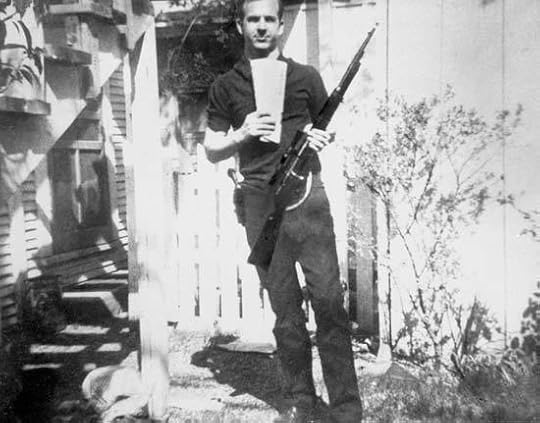
Oswald was not an independently-acting commie loner who singlehandedly assassinated John F Kennedy with his Manlicher Carcano rifle, then shot officer J.D. Tippet with a revolver, after having first posed for history’s most improbably convenient photograph, with the rifle, the revolver and a copy of The Militant, only to utter his final words “I’m just a patsy” before being gunned down by a seedy nightclub owner, who, under the later advice of his attorney, remembered that the reason he did it was to spare Jackie Kennedy from having to testify, and totally not to prevent Oswald from spilling the beans about any sort of - perish the thought - conspiracy.
Because a signed statement saying "No matter what I may have said before someone shot me, I'm telling you I killed Kennedy" would have been maybe just a little too much . . .
That much is obvious to most of America with the fairly dramatic exception of all the members of the Warren Commission. Beyond that, it’s impossible to say what exactly happened during those fateful six seconds in Dallas on November 22, 1963. Unless you are Jim Garrison, in which case it’s crystal clear, but it’s worth noting that Garrison was nuttier than a bag of cashews.
I didn’t go into this book with that mindset. I’ve always had enormous respect for Garrison’s willingness to question the Official Story, an exquisite example of deeply layered bunko and hokum. Possibly even balderdash, with a healthy dose of good old fashioned bullshit thrown in for flavor. I’m convinced that some sort of conspiracy was responsible for JFK’s gruesome murder. But Garrison lost all shreds of credibility with me in chapter 16, in which he describes his appearance on The Tonight Show with Johnny Carson. Or rather, he describes how his appearance on The Tonight Show went in the strange alternate universe inside his brain.
Garrison could not have foreseen the magic of YouTube. Maybe he thought he could get away with some ‘embellishment,’ by which, of course, I mean lying through his teeth, but we modern readers have the benefit of being able to view the interview right here. And we cannot help but notice that it is nothing like what Garrison describes in his book, destroying all credibility he might once have possessed, much as his own star witness lost all credibility when he testified that he fingerprinted his children to outsmart the CIA, who he suspected might secretly replace them with clones. I did not make that crazy shit up. That’s what actually happened at the trial of Clay Shaw, whom Garrison prosecuted for conspiracy to murder Kennedy. And as far as who is more delusionally paranoid, it’s a toss-up between the witness and the prosecutor.
This is a shame, because I’m convinced there really was a conspiracy of some sort, but when the most prominent voice disagreeing with the Official Story is irrational and dishonest, it tends to discredit by association anyone else who voices disagreement. You may have had a similar experience taking a reasonable centrist position on some issue, critiquing the viewpoint of some extremist wackjob, only to have an equal and opposite idiot derail your entire line of reasoning by agreeing with you.
But then again, the people who organized JFK’s assassination were certainly very clever and cunning. They are well aware of this phenomenon. What better way to throw off suspicion of a conspiracy than to orchestrate a major investigation by a self-described relentless pursuer of truth who is, upon further examination, revealed have so many bats in his belfry, the guano is virtually spilling out his ears? Maybe Garrison was at the center of the conspiracy from the very beginning!
If this theory had occurred to Jim Garrison , I have little doubt he would have undertaken an investigation of himself.
Then again, I may be a little delusionally paranoid. This is a must-read for anyone remotely interested in the Kennedy assassination, but, much like Don Delillo’s Libra, (which I read immediately before this and will review next) it’s probably better classified as a work of fiction.
On the Trail of the Assassins is Garrisons beginning to end recollection of his investigation of the JFK assassination. Garrison deserves a lot of credit for uncovering as much as he did but as far as his final conclusion I think its too simple to say it was just a bunch of ring wingers and anti-communists within the CIA that had Kennedy iced and the buck stops there. The one guy who he had charges brought against may very well have been involved but to try to put him at the top of the conspiracies food chain doesn't quite add up either. Besides that going in Garrison should have known that he wasn't going to get a conviction. At this point the water is so muddied I don't think the truth will ever be known but if your researching the Kennedy assassination you more or less have to read Garrisons book.
When I heard the news about the shooting in Pennsylvania, I told my wife, "Hey, Steff! They tried to kill Trump!" Her first response was, "Who's 'They'?"
And I thought about that. Yeah, who is this nebulous collective 'They' of which I speak?
Well, we don't really know yet who the person was that actually pulled the trigger, grazing Trump's ear and killing an attendee at the rally. We have seen video of a man appearing to be lying on a flat roof with a rifle who was shot by a sniper. But we don't know details. And I'm willing to bet that no matter what answers we get, we'll never know the whole truth, and even if we do, there will always be folks who will never be satisfied. The JFK assassination embodies this reality for much of the Western world.
I'm not even talking conspiracy theories here. As someone who worked in government for almost a decade, I learned that our systems are just as fallible as human beings are. So the failures that lead to political violence as a result of pure incompetence or mistakes are more likely than a planned military elimination of a powerful figurehead. But such clandestine murderous conspiracies do happen all across the world.
So the first prime suspect, besides the lone gunman, is political interest groups or a government itself. To not question every minute detail of an attempted or successful act of political violence for its cause, whether conspiracy or incompetence, is the equivalent of putting our collective heads in the sand.
That's why Garrison's investigation of the JFK assassination in Dallas continues to be of vital importance for study and consideration. My father was indirectly involved in the investigation, and his best friend was one of Garrison's crack team. Now, my dad thought Garrison was disingenuous, a New Orleans D.A. looking for national attention. If that were the case, Garrison sure chose an elaborate way to go about it. No, from my reading, I think Garrison was truly trying to find answers as to how such a thing could happen in America, but his search led to him finding a snake under every rock. Likely, most of these snakes had nothing to do with the killing of a president, but the realization that we were living in a nest of them drove Garrison to be hyper alert and hyper vigilant. Ultimately, he was unable to crawl out of the rabbit hole.
Garrison was never able to reveal definitively for many people the identity of the collective "They". But I think he did scare the shit out of a hell a lot of snakes who went scurrying for other shelters.
Within an hour of the Pennsylvania rally shooting, I began watching live coverage on CNN and NBC. I heard the pundits hypothesizing that a firearm of one of the attendees accidentally discharged, broke a piece of glass from a teleprompter, and scared Trump, who fell. Now, I understand that without any firm details, a prudent journalist wants to be careful about labeling something like this an "assassination" attempt. But then why hypothesize at all? Is that being prudent? And then I started to hypothesize as well, but not about what happened to Trump. I started wondering what kind of prejudices and preconceived notions about the kind of people that would attend a Trump rally might have led to such assumptions. I can think of one: "Rednecks who are all about gun rights accidentally almost kill their own candidate with one of their stupid guns. Wouldn't that make a great story?" Too often journalists say what they feel rather than just what is.
Back when Garrison's book was published, Americans had a lot more respect for journalism than they do today. Not that journalism never had a history of getting things wrong, or of being guilty of propaganda, but there was certainly more goodwill for the media than was had for Garrison himself. But Garrison's work was just one of many planted seeds of distrust that not only took root, but blossomed by the time Oliver Stone made this book famous in the Nineties. So the media could be another candidate for the elusive "They."
Then there's the TikTok video of the young girl ranting in her car about how "we were one centimeter away from half the problem being gone." We? Who is this We? My ten-year-old son came running up to me after he saw the news, saying "Well, Trump may be a felon, but he shouldn't be shot at!" Now, my son can't tell me of what crime Trump was convicted, but he knows he's guilty. That's okay, he's ten. But most of us adults don't really know either. Half of us are just thrilled that Trump was just convicted of something, while the other half are convinced the sudden onslaught of legal action against him before the election is the result of a weaponized legal system. So I think I know who "We" is. It's blind allegiance to "our side."
And when we adhere to our side, we lack self-reflection and mindfulness. A rap video holding an orange clown at gunpoint, Kathy Griffin holding an effigy of Trump's severed head, Representative Dan Goldman saying Trump is unfit to be president and must be eliminated (for the sake of democracy, don't you know), Maxine Waters encouraging her supporters to harass the Trump cabinet at restaurants and gas stations like it was Salem, Massachusetts in the 1600s. Trump's own rhetoric certainly didn't help people stop comparing him to Hitler, with his previous campaign against Hillary Clinton partly consisting of "Lock her up!" But then we say that political violence is bad! How deluded are we? That's like being surprised that your pit bull (I'm sorry--your "terrier") killed your grandma.
The girl on the TikTok video didn't know what she was saying as much as she didn't know to pull the hell over and stop driving while she's working herself into a frenzy in front of the camera. But humans don't consider the big picture or consider others when it comes to "our side," just like a would-be hero doesn't consider who they'll likely kill when they fire their "pew pew". Think about Reagan's press secretary. Or the three people sitting in the crowd at the Trump rally, two of which are critically injured and one dead.
But the girl unwittingly gave us another candidate for the identity of "They." "They" is "We." They is Us.
And I think that is the most meaningful answer. My wife was being snarky when she asked, "Who's 'They'?" But it was a good question. Perhaps I should have said, "WE tried to kill Trump!"
I thought it timely to bring up this book now, not just for the obvious comparisons between what happened in 1963 to today, but to get people thinking about what happens in a country divided. Kennedy was not nearly as divisive as Trump, but he sure pissed off a lot of people in government and the military, and after his death, the country was pulled into Vietnam and became as divided as it had been almost exactly a century prior. And decades later, more investigations carried Garrison's torch. Now lone gunmen and grassy knolls and men with umbrellas and strip club owners and suspicious overpasses and the Mafia and Cuba and Russia and the CIA and French Quarter eccentrics are all in the mix of the collective "They."
I've read this book almost a half dozen times, mostly because my father's stories about this period in history got me so fascinated, but also because I tended to hang out in underground industrial music culture communities in the Nineties who ate this stuff up. We didn't trust the government or the American aristocracy, no matter what their political affiliation. Just like the media, or the girl in the TikTok video, we wanted what was in our heads to be true. But as I read this book today, I still can't say I trust the government or the aristocracy any better than I did as a twenty-something wearing makeup and black fetish leather, but I do approach it differently, and recommend you do the same.
Use it as a mirror. Look at yourself and whether or not your actions are part of the ongoing rhetoric of violence and division. If you still feel you want to be a part of that, then this book can also help you play it forward by giving you a glimpse of the future through the past. Do we know today who killed JFK? Why haven't we learned anything since? For all the common ground we have, why are we still divided?
As of yesterday, this book may find some renewed popularity, which is not a bad thing if it is read for reflection instead of reaction. Because whenever a shot is taken at a president or a presidential candidate, no matter what you might think of them, they (whoever they might be) are taking a shot at you. And we all need to be careful we are not the ones loading the gun.
To those who don't want the truth about Kennedy's assassination to become known, the very repetition of a charge lends it a certain credibility, since people have a tendency to believe that where there's smoke, there's fire.
Jim Garrison
Where to start with this review, the JFK assassination has to be one of the biggest blunders in America's recent history. Was there a conspiracy? 100% without a doubt. I use the term all the time, plausible deniability. I first encountered this book in the form of the film JFK by Oliver Stone, it was a book I never could access at the time due to the small library at the time. The movie stays extremely close to the book which is nice, the book of course is the true source of the material so it's interesting to see the depth from the author himself. The best thing you need to remember when reading this book is that this was 60s/70s, could you imagine the capabilities an agency has now, Edward Snowden comes instantly to mind. The novel is a straight forward depiction of the events leading to the trial of Clay Bertrand (not calling him Shaw), who is the only person trialled for the assassination of JFK. The most interesting part of the book was the after trial issues the government caused to Jim Garrison, the purposely went out of their way to fabricate evidence to destroy him, one would only assume to demonstrate to everybody else. You speak of a governing body who floundered the murder of their President, this is one of the worst investigations in known history, the Warren Report is and will always be a piss on the grave of JFK. How anyone can say there was justice served here is an understatement, this is like a documentary or podcast for old cases, it's so hard to believe it was this mishandled. The one thing I think this book accomplishes which the film didn't was the who behind the curtain, CIA. Everything leads back to the intelligence agency, much like Killers of the Flower Moon, there is a link to everything. The connections were clear and the Warren Commission allowed for all the leads to run cold by ignoring some of the key evidence. I totally agree with Garrison in the statement that Oswald did not kill anyone on that day. Was he a patsy? Most certainly. Was he involved? At some level yes. Just the eye witness accounts of Oswald in the book depository should have caused reasonable doubt, not the key evidence that showed he had no residue on him to suggest he even fired a gun that day, weird considering he supposedly killed two people. The CIA or a rogue section of this agency had conspired and successfully killed JFK. You can see it clearly in the way there is so much unknowns in the case, it's one of those cases where it is almost to hard to believe. The shooting of Oswald in custody, the parade route being changed, the disappearance/deaths of key witnesses, the missing President brain which would show the entry and exit, secret service cleaning the car and the smear campaign that has left only one person guilty in the eyes of the world. No one believes he acted alone, the Zupruder film kills that theory in seconds, that is one of the hardest films to watch. They reopened the case and the result was yeah, there might have been two shooters. Are you kidding me? Is the US government so systematically flawed it won't spend millions to find out who actually did it? They spend billions on military every year, to keep themselves safe. JFK saw the bigger picture with Russia and knew in his heart, we were heading straight for destruction. Stephen King wrote Oswald as the killer in 11.22.63 and once the hero stopped the assassination it caused a giant nuclear war. It is this kind of narrow minded foolish thought that was the final nail in JFK's coffin. The government wanted to win the cold war with military action, that much is clear, Bay of pigs invasion and the stand off with Russia. JFK wasn't the puppet they expected him to be, he didn't follow the instructions of the advisors, he thought outside the box and that was his undoing. I believe he could have been a President to remember, not fall the assassination and conspiracy that has shadowed what he achieved. He was looking to shut down Vietnam, a war that affected Australia just as much as America. In conclusion the book is full of facts and is a must read. I have a few other books on the topics but the two theories that annoy me are the Cuba connection and mafia connection. That might have supplied the shooters but the depth of the conspiracy is too great. This book doesn't supply all the answers but its a great true story about truth seeking at time when the government was doing its best to conform the nations. It's funny how everybody was afraid of communism, we are nearly living in a world just like it, technology is breaking our privacy everyday. We tend to think we have free speech and free choice, but do we?
The next book is one I have already started and intend to finish this week, American War
Very well written, endlessly fascinating, and ultimately quite depressing. I used to think that Oswald didn't act alone; after reading this and other books on the assassination, I'm convinced he didn't even pull the trigger at all that day. Knowing the lengths to which the government went to cover up so much of what happened in Dallas that day, not to mention events before and after, makes it difficult to have faith in any government institution.
On the Trail of the Assassins is a history book only in that it's about Jim Garrison's unsuccessful prosecution of an alleged conspiracy to murder President Kennedy. The trial did occur in New Orleans, led by Garrison when he was District Attorney of that parish, and in that sense this is a book of nonfiction. Otherwise, I recommend anyone picking up On the Trail to read each chapter with a critical eye, and to be prepared to challenge and research just about every assertion Garrison makes.
My most generous evaluation is that Jim Garrison honestly believes his tangled tale of plotting and assassination, which he called a "homosexual thrill-killing" to journalist Jim Phelan (one more damning piece of evidence of just how wrongheaded Garrison's investigation was). My more caustic view is that this book was authored to burnish Garrison's stained legacy, work that came to fruition when it was adapted by Oliver Stone into the movie JFK.
Where to begin? Just about every charge Jim Garrison makes should have an asterisk or footnote beside it, one that indicates there are two or more sides to his story. You don't have to be a stooge or a CIA agent or a blind defender of the Warren Report to think Garrison's off-base, wrong, or lying, you just need to do a little research to see how thin his theories really stand. And I do mean theories in the plural, as Garrison doesn't present a single cohesive theory, but rather long handfuls of loosely associated notions and suggestions, holding them up like an aging fan dancer hiding her wrinkles and blemishes from the audience.
My personal favorite is his chapter on Kerry Thornley. Thornley served in the marines with Lee Harvey Oswald. After being discharged he wrote a Catch-22-esque novel featuring a character based on Oswald before the assassination occurred (only published after Oswald became a household name). Thornley went on to become a sort of Forrest Gump of the American counterculture throughout the 1960s and 70s, even writing a column for Factsheet Five in the zine's waning days. Garrison takes Thornley's long strange journey and concludes, with zero evidence available, he was a body double for Oswald and in the pay of the CIA. (Kerry Thornley, who was dragged before the Warren Commission and then put under the hot lights in Garrison's office, had some sharp words for the New Orleans District Attorney.)
These kinds of logical leaps would be howlers if they weren't coming from a district attorney who later went on to become a judge in Louisiana's 4th Circuit Court of Appeal. We expect more primary references in a high school essay than Garrison is able to muster for his explosive allegations. Yet Thornley is only an example of Garrison's investigative methods, flailing about and dragging any character he can find into the conspiracy, like a novice camper throwing more and more cordwood onto the fire hoping the pile will ignite.
In the process Garrison smeared a number of individuals, including Clay Shaw, a New Orleans businessman, civic leader, and patron of the arts. Garrison essentially outed Shaw and wrecked his good name. This book isn't merely the idle speculations of a conspiracy author. In his vain grab for glory, Garrison destroyed lives.
Oswald was, in his own words, 'a patsy' - this is without question. He was just a part of an elaborate conspiracy to murder President Kennedy; not only is there no evidence that he was 'the lone gunman', there is forensic evidence that proves he never even fired a gun on that fateful day...
'Magic Bullets', 'Clay Betrand / Shaw' and even Oswald himself are just distractions from the central fact that someone shot JFK, and later Officer Tippett; we may never know who that actually was, or why, or on who's orders, but it remains a fact that it happened and the case that Jim Garrison presents is a clear indication that the official explanation is a mockery of the facts. Facts are what are important in any conspiracy - strip away the conjecture and look at the evidence, which is what this books does well. Naturally, to bring a legal case certain procedures and protocols have to be followed, certain proofs and connections, and it's a shame that Garrison never had that opportunity to bring Oswald or Ruby to question, but instead was left grabbing at the outer edges of those who were themselves only pawns in the game. Shaw could never have admitted to what he clearly didn't know and was acquitted because the jury could find no reason for him to be involved in such an act. But he never fired a gun, and likely had no idea who did. His motivations were his own, and if that helped others, those who brought him into this web, then all the better.
This book is the main source of 'JFK', which is a great watch...but as a film cannot present all the facts, all the nuances, and indeed takes dramatic liberties...so if you want to know why the Warren Report is nonsense, and why Oswald was a 'patsy', this is great place to start...
Jim Garrison was the District Attorney in New Orleans in the 60s and later a federal judge. As DA, he investigated and brought to trial conspirators related to the assassination of JFK.
There is a lot of material covered within the book, systematically dismantling the US government’s official Warren Commission report that Led Harvey Oswald acted as a lone gunman, and the much later government report that there was a second shooter but still no larger conspiracy. Garrison shows how unlikely it was that Oswald was involved and how likely it is that elements within the CIA and anti-Castro Cuban exiles orchestrated the murder.
Oswald’s proven activities are so unusual and his ties to the intelligence community so obvious, that the story that he was an angry, washed up nut job doesn’t make sense. Garrison shows the means, motive, and opportunity line up for the CIA.
I couldn't read this book fast enough. Quite a page-turner. While I'm skeptical on a lot of conspiracies, I have to admit that Garrison (a New Orleans DA at the time of the investigation and later a judge for the Court of Common Appeals) writes a pretty compelling argument that Oswald (although contradicting The Warren Commission) was not the shooter and that there were possibly other shooters (particularly in other buildings and behind the grassy knoll). Along with this is the plausibility that the CIA had pulled many strings in helping to set up JFK's assassination (and framing Oswald) in hopes of reversing JFK's stance on Cold War policy. He alludes to this by evidencing a good amount of people who had CIA ties in the New Orleans area and who also knew Oswald (who was probably working closely with the ONI) and who later titled himself a "patsy." The book is interesting in showing how many pieces of evidence and critical papers were either burned or just went missing by those in charge and the bureaucracy Garrison encountered in his investigation. Later, in the 70s, a House Select Committee investigated and found that a conspiracy to murder JFK was plausible. In short, I can't say that the book was biased or too sensational in formulating a conspiracy. It seems very much a book which lays out the facts and lets you decide on your own why there were so many inconsistencies and questionable actions in both The Warren Commission and Dallas's investigation. While the trial of Clay Shaw was not successful, I think it was a milestone for future generations to look at. In terms of Garrison's writing style, I really enjoyed it. I thought the book was going to be dry, but instead, I found it pretty literary. I believe Garrison is a well-read man because he has a knack for writing and likes to quote other famous writers as well. He also seems like a heck of a lawyer and critical thinker. In closing, I'm aware that there are many books on the JFK assassination, but I feel this is probably the best one.
When you're sick in London over the winter holidays, this is the kind of thing you pluck off the walls of your grandparents copious political bookshelves. I'd seen the film back when it came out, and aside from the crazy almost avant-garde film making of Stone, I came away still confused as ever, and seemingly with an entirely different take of the assassination of JFK then what Garrison lays out in his book.
While I admit to having a mild fascination with this sort of stuff (ie. Zodiac, Nazis, etc., please no UFOs) I'm a neophyte, so usually this stuff is confusing and hard to follow. Perhaps since Garrison was a D.A. or just a good writer, I found reading through his evidence and experiences on the case I could for the first time come up with a least some sort of picture (who knows how correct) on what the hell may have happened. I'm curious to see them film again and how it jives with the book, and perhaps read a critic of Garrison. I
guess it's also worth mentioning, that Garrison's book was different in that you never had the feeling he was giving you only as much as he wanted to see on a particular fact, that at least what he was presenting, he was presenting from all sides. Much too often was this type of stuff, I find you are give a 'fact' with next to no context other than the one the author provides to shore up their case. This brings up a lot of "but hey, what about x, or y, or z?" moments, but with Garrison's book I found this only happened a couple of times. Maybe I'm just thick.
I much preferred this account to the one, Heritage of Stone, which Garrison published eighteen years earlier. Both are accounts of his office's work in pursuing the New Orleans connections to the assassination of President Kennedy, but this one has the advantage of greater hindsight, many of the earlier allegations having received support in the succeeding years (such as Clay Shaw's CIA association). Additionally, there is far more autobiographical material, later harrassments and prosecutions of prosecutor Garrison being detailed.
For viewers of the Oliver Stone film, JFK, this book provides either a guide to that rather dense presentation or a review and refresher. It's also, of course, a corrective in that films must needs simplify. Again, it serves these purposes better than the earlier Heritage of Stone.
Finally, Garrison's style is to be complimented. Not only is the book well and clearly organized, but some of the text is actually beautifully descriptive. Garrison's writing style had improved with age.
Excellent eye-opening book on the JFK murder. Written In 1988, four years before his death, Garrison put on paper his thoughts on what happened in 1963. It clearly inspired Oliver Stone’s movie some years later, but the book has more depth and is not intended as the semi-thriller movie that JFK (1993) is. There probably will never be another ‘official’ investigation on JFK’s murder, but Garrison’s book provides more than enough arguments to safely say that especially the Warren Commission’s intention was to just bring closure on all speculations as soon as possible with Oswald as only scapegoat.
Great book! Garrison was right all along, he was on to something big & that is why he was targeted. Sadly, he is right about something else too - that is what our government does to people who challenge their official story. I wish I could read some of Garrison's other books but trying to get a hold of one now is hard, plus they are so expensive. Maybe if some publisher would start printing them again, they'd see a rush on purchases.
Este libro trata sobre las conspiraciones al rededor de la muerte de Kennedy, pero más que nada, sobre la posible falsa incriminación a Oswald, que sólo fue un chivo expiatorio y mucho más. Muy interesante. Después de leerlo vi muchos videos sobre las conspiraciones, sobre Oswald y el asesinato, y pues este libro es bastante sensato y le creo. Ahora también quiero ver la película basada en él.
Este libro relata y refuta muchas de las teorías generadas durante el asesinato de John F. Kennedy . Recomiendo bastante este libro porque muestra una versión más realista en cuento lo que sucedió el 22 de noviembre de 1963.
"If we cannot end now our differences, at least we can help make the world safe for diversity. For, in the final analysis, our most basic common link is that we all inhabit this small planet. We all breathe the same air. We all cherish our children's future. And we are all mortal." - excerpt of John F. Kennedy's speech at American University - June 1963.
Woodrow Wilson once said: "If you want to make enemies, try to change something"
Jim Garrison's book is an essential insight into JFK's assassination: the history, motives, key figures, similarities behind methods of coup d'etats used by intelligence agencies in foreign countries and how the events in Dallas in 1963, were akin to a coup. What makes the book valid and damning, is that it is written by Garrison himself – the New Orleans District Attorney – responsible for bringing the only trial in the assassination of John F. Kennedy. The books plays out in vivid investigative detail, writing the book with a great deal of real evidence and the first-hand witness testimonies that he recorded at the time.
My own interest in the book came from watching Oliver Stone's excellent film JFK (1991). Whilst a great film in it's own right, it presents a valid argument against the long-established lone gunman theory prescribed in the US government's findings in the Warren Commission. If you don't have the time for the book, make time for the film at least, it's well worth a watch.
Garrison's investigation starts with his personal reaction to JFK's murder in 1963, investigating Lee Harvey Oswald's background, presence and movements in New Orleans in the years prior to 1963, finding out that the media representation of Oswald and the Warren Commission's somewhat fictional myth of the lone gunman theory, did not hold up; finally leading to the trial of Clay Shaw in 1969.
November 22nd 1963 - John F. Kennedy's assassination was a national tragedy for America. The loss of a very different kind of president for the short term that he held office: an advocate for peace during the Cold War; an exit strategy for the complete withdrawal of American troops from Vietnam in 1963; the signing of the nuclear test ban treaty; lack of air support during the Bay of Pigs invasion in Cuba; action memos that took power away of the intelligence agenicies (mainly the CIA) and gave more accountability for covert and paramilitary actions to the joint chief of staffs. These were just some of the policies he started to execute as the 35th President of the United States of America. JFK was a charming leader for the US who the general public were inspired by. The reversal in foreign policy did worry many sections of the general public who took to the red scare propaganda, viewing the USSR and Communism as real national and global threats; JFK's policies for peace to many seemed like the holding-of-hands with the enemy. Ultimately, the real detractors for his policies were those of the intelligence agencies and the military-industrial complex, the ones who stood to lose their exuberant influence and economy in global strongholds.
So what does this have to do with JFK's assassination? Whilst only part of the bigger picture, it has everything to do with it and serves to some degree as a cautionary tale of the vested interests of those who watch over us, and only hints at the power they have. The power held and policies enforced under the guise of national security.
"Treason doth never prosper: what's the reason? Why, if it prosper, none dare call it treason." - John Harrington
The word 'conspiracy' has a certain paranoid stigma attached to it - attached perhaps when theories may seem far-fetched or difficult to comprehend. The difference between so-called conspiracy theories and Garrison's recounting of the work he and his legal team put in in attempting to bringing a conviction in the murder of JFK, is that he was there at the time and was a proponent against the government's stance/conclusions from the Warren Commission. He took the professional and personal risks in the hunt for truth, to find out who conspired to kill JFK.
He asked the American public to look further, ask more questions, read between the lines: presenting real evidence, finding real connections between Lee Harvey Oswald's actions and his links to individuals in the American intelligence agencies; Oswald's role as the alleged "patsy" and scapegoat. Garrison's writing makes the investigation and evidence all-encompassing, raising very important questions that still linger to this day. What power do intelligence agencies have in domestic and foreign policies? How far are they willing to go when policies are executed that diminish their power and control?
It's a true testament that Garrison didn't crumble under the amount of pressure and work it took in getting to the point of bringing a prosecution and trial of Clay Shaw. It's truly unprecedented for the time, much more considering the New Orleans public kept him in office as the D.A. for three consecutive terms. His impact was huge, his findings and investigation damning of the government's fictional version
With the key questions being asked and answers explored with the evidence that Garrison presents, perhaps the most revelatory part of this book, are the numerous 'did you know' facts.
Did you know: -on November 17th 1963 (five days before the assassination), the FBI received an internal TELEX warning message that was not acted upon. This was later uncovered under the Freedom of Information Act in 1976. -nitrate tests were run on Lee Harvey Oswald, the results of which were shown to be negative that proved that he did not fire a rifle in the 24 hours prior to the assassination -Jack Ruby was spotted up on the grassy knoll unloading an unnamed man carrying a rifle case – a witness testimony who saw this was later altered by the FBI; Dallas police officers were also in the nearby vicinity, seemingly unperturbed by this -there was evidence to suggest that Lee Harvey Oswald was actually impersonated in various locales such as New Orleans and New Mexico leading up to 1963 – the appearances drawn some discrepancies between his registered height and appearance versus the man the public saw on their TV sets -standard operating procedure for crime scene investigations weren't followed in Dallas: the Secret Service essentially hijacking the president's body for a military autopsy to be carried out in Bethesda, Maryland directly contravening Texas law that the autopsy be carried out within the state that the crime was committed in; the limousine was cleaned and cleared without the collection of key evidence e.g. bullet holes, bullet traces, fragments and shell casings (which serves as a basis of one of the chapters in Garrison's book) -JFK’s brain had disappeared a short while after the autopsy – having the brain would have provided certain insight into the rifle fire that was encountered, direction of bullets, causes of death
"The organizing principle of any society, Mr. Garrison, is for war. The authority of the state over its people resides in its war powers." - X – JFK (1991)
Garrison makes the evidence relatable even today, as he writes the intricacies of each part of the case and it's overarching effect. Each unveiling and presenting of evidence goes deeper, going from questions on a micro level – key individuals, connections to intelligence agencies, vested interests of those in high seats of power – to a macro level – who had the ability to enact and execute these orders at the time? How was the media able to build a seemingly false profile of Lee Harvey Oswald and his actions? How the media managed to manipulate audiences into believing the lone gunman theory, the sabotage of Garrison's investigation in the later chapters.
With so many moving parts to this investigation, it's hard sometimes to not think about the governments of today. In our current turbulent times and events worldwide, we look to them and their attempts at worldwide peace. However, their attempts to do so, may actually contradict ideas of peace amongst nations and the countries themselves, often making certain questionable choices. But more recently, serious questions have to be raised in relation to the power structures of intelligence agencies, enforcing national security policies to further certain agendas. Garrison was on the trail of such individuals who had taken advantage of their prestigious power and footholds they have in such affairs.
I'm no historian and I can't claim to be fully informed having just read one book and watched one film on the assassination of JFK. But nonetheless, conclusions can be drawn from the evidence at hand here in Garrison's writings. The book and the closing moments of the JFK film explain that the redacted and classified files and records of the House Select Committee on Assassinations are locked away until the year 2029. What remains to be seen is whether or not any conclusive evidence that was hidden away, may answer any of the lingering questions that have been raised since 1963. It may all be too late, however the history is what's important to take away here. Those 'did you know' facts only just scratch the surface of the motives behind that history, of the people involved and the supposed "facts" that the American public were presented with at the time. Garrison's intentions in the book are clear: raise awareness and illuminate younger generations with the truth.
"Kings are killed, Mr. Garrison, politics is power, nothing more. Oh, don't take my word for it, don't believe me. Do your own work, your own thinking." - X – JFK (1991)
When I was in college, I had to write a historiography research paper about an event and provide the different perspectives. I chose the Kennedy Assassination. I covered the Lone Gunman Theory and, of course, The Conspiracy Theories.
One of the books I used for the conspiracy portion was On the Trail of the Assassins by former New Orleans District Attorney Jim Garrison. I decided to look at the book again. I was a conspiracy theorist at one time, but I lean towards Lee Harvey Oswald was the assassin now. However, if something comes out to show that this was a cover up and a conspiracy, well, the evidence will have me convinced that the Warren Commission and Oswald was the assassin was wrong and a lie. This book did nothing the first time in 2011 to convince me it was a conspiracy and it did not change my mind the second time.
Garrison became interested in the case because "the accused assassin Lee Harvey Oswald, had resided in New Orleans the summer before the assassination, I was immediately drawn to the case." Garrison wrote about witnesses that saw another gunman on the Grassy Knoll and hearing gunshots from there. He said these witnesses were ignored.
As the book continues, Garrison's argument falls apart like his prosecution of innocent man. One of his witnesses had his daughter fingerprinted to ensure she was not abducted by aliens. Another witness was threatened by two of Garrison's staff and they threatened to put "hot lead" up his rectum.
Some of Garrison's staff resigned in disgust because of the way Garrison handled the prosecution of Clay Shaw. Researchers who believe that JFK's death was a conspiracy rejected Garrison. Robert Sam Anson, a conspiracy theorist, stated, "Years would pass before anyone would take the notion of conspiracy seriously again.” G. Robert Blakey, an American attorney, believed organized crime killed JFK and called Garrison "a fraud" because he did not look into the Mafia as being behind the slaying of the thirty-fifth president. Well, it is possible Garrison had connections to organized crime since he did not really go after them. He was hardly at the trial as well. Jim Garrison was not Kevin Costner's character in the 1991 movie JFK.
If you would like to read conspiracy theories regarding the Assassination of JFK, I would not read this one.
Teeters frequently on the edge of crackpot and reality, which is the tell of a truly compelling conspiracy. It’s hard to read so many discrepancies that Garrison backs up and still believe Oswald had any part in the assassination. A good book changes you, or so the proverb says. Long-winded and raving but in a intriguingly fanatical way. I’ve bombarded myself with JFK content lately, so I will say this took me longer to read than expected due to a saturated brain. However, when I got chugging along in certain passages, this thing was nearly impossible to put down.
The MOST exhaustive, clear, simple, and thorough investigation of Kennedy's murder I've ever read. Oswald couldn't even physically fire the rifle, let alone be at the sixth floor when it happened. And in order to kill Tippit he would have had to run a 2 minute mile to be at the murder scene in time. The whole official story is ridiculous. Garrison does an excellent job of demonstrating that very fact.
1) L’Itaglia è una democrazia, a quanto pare fondata sul lavoro. In oltre, noi Itagliani, abbiamo inventato molte cose tra cui: la Magnagrecia, gli etruschi, i romani, l’impero romano, i Comuni, le Signorie, il Rinascimento, il Risorgimento, la Ducati e la Ferrari, e tutte queste cose ce le invidiano tutti all’estero. Invece, gli Americani, poverini, non hanno inventato quasi niente, però la democrazia ce l’hanno anche loro, e siccome sono più grossi dicono che loro sono La Più Grande Democrazia Del Mondo.
2) Noi Itagliani, andiamo a votare ma non crediamo mai a niente di quello che dicono i politici. Qualche Itagliano crede a Padre Pio, qualc'unaltro alla Lotteria di Capodanno. Invece, gli Americani, loro credono in Dio: infatti, c’è scritto sui loro soldi. Credono anche molto ai politici, anche se li votano più o meno quanto noi. Ci credono così tanto, che quando gli viene il dubbio che un politico dice le bugie, gli fanno il processo.
3) Noi Itagliani, c’abbiamo i servizi segreti come ogni stato Importante, ma non sappiamo cosa fanno di preciso. Qui c’è una somiglianza, perché neanche gli Americani sanno cosa fanno i loro servizi segreti. Però, siccome che loro sono La Più Grande Democrazia Del Mondo, i loro servizi segreti sono molto generosi e vanno ad aiutare i popoli più sfortunati a trovare la Democrazia anche loro, aiutandoli con le buone, ma quando occorre anche con le cattive. E siccome sono generosi, non chiedono neanche grazie, anzi dicono: Caro popolo sfortunato, fai finta di non conoscerci, noi non vogliamo ringraziamenti pubblici.
4) Noi Itagliani, non lo sappiamo di sicuro cosa hanno fatto i servizi segreti a Ustica, a Piazza Fontana, alla stazione di Bologna, nel rapimento Moro etc., però noi siamo sicuri che loro centrano e che prima o poi ce lo racconteranno come hanno fatto a fare tutto. Invece, gli Americani, poverini, non solo non lo sanno come hanno fatto i loro servizi segreti ad aiutare la Democrazia in Congo, in Guatemala, a Cuba, in Vietnam, in Persia, in Iraq, in Afghanistan (e qui mi fermo sennò facciamo notte e poi ho un foglio protocollo solo), ma non si accorgono neanche se i servizi segreti fanno qualche cosa in casa loro, anzi si arrabbiano moltissimo se qualcuno fa 2 + 2 e glielo fa notare, agli Americani. Il signore che ha scritto questo libro è un tipico esempio di questa abitudine degli Americani di non voler pensare mai male dei loro servizi segreti anche quando erano gli unici che avevano il potere, il movente, l’occasione, le armi e tutto l’ambaradàn, e quindi, invece di ringraziarlo, la maggior parte degli Americani gli ha sputato in faccia, a questo signore qua.
5) L’ultima differenza che mi viene in mente, anche se non riguarda la democrazia, è che nei film itagliani non succede mai niente e cè sempre uno che si lamenta. Al contrario, nei film americani, succedono tante ma tante cose, e cè sempre uno che dice a un altro “Andrà tutto bene” e quando lo dice ci crede veramente.
I recently - last semester - took a class strictly on the conspiracies surrounding the JFK assassination. A whole 3 credit course with a legitimate letter grade in the end. I had my expectations of a ruse of a class taught by a professor who ate his popcorn while the kernels were still popping. I, however, was surprised to learn a great deal from a wonderful professor about not just interesting conspiracy theories, but the historical atmosphere of the time. That being said, one of the books we were supposed to read was Jim Garrison's "me trying to save the world" book. Garrison was so adamant about finding the truth about the assassination he feigned evidence to bring an innocent man to trial. Throughout his book he is paranoid of federal agency interaction into his plot to uncover JFK's true killer, which is mental. His bias shines through the pages of the book, for Garrison never makes a mistake in his probing for the truth. Frankly the book reads like fiction. That being said, the one thing Garrison did was to highlight the poor job the government did in collecting substantial evident on Oswald or discovering JFK's true killer. But falls short by using the same tactics the government agencies did by poorly throwing together some evidence to push their agenda.
I have wanted to read this book for a long time and it was surprisingly hard to come by. It was worth the wait. Like many people, I have long been fascinated by the JFK assassination and then when JFK the movie came out in the 90s, in part based on the writings contained within this book, it only intrigued me further. Ever since then I wanted to get my hands on this book and just never got around to it. Well, I finally did. I absolutely believe there was a conspiracy to kill Kennedy. In fact, at this point, I don't even understand how it's considered a conspiracy when it seems so blindingly obvious. Sure, we don't know all the ins and outs and the who's - but we sure figured out the why as time went by. That was pretty obvious too. Just look at how the Vietnam War played out. I would go so far as to say, you can't be a serious thinking person and actually believe that Oswald acted alone. The magic bullet theory alone, combined with the Zapruder film, completely puts that ridiculousness to bed. One last note before I get into the book - I have been to Dealey Plaza and I have toured the 6th Floor museum. It is a remarkable piece of history and I would encourage anyone who hasn't been, to go. There have been minimal changes to the plaza which is remarkable considering it has been 60 years since the assassination. In some ways, it's like stepping back in time to be there. A worthwhile experience that will give you goosebumps. HOWEVER - I found it completely insulting....but hardly surprising.... that they treat the conspiracy in that museum as an afterthought. Like you have to be wearing a tin foil hat to believe in it. Like it should be swept under the rug and never spoken about again. It's a ridiculous way to treat how a majority of the public has viewed the event for a LONG time now. To the book - Garrison lays out his Case to the best of his ability. And what I mean by that is he was limited in so many ways. In time, in funds, in man power, in technology of the time, by corruption working against him. But he is not just some random guy. A Lawyer, a National Guardsman, a three term District Attorney when all was said and done, and a member of the FBI .... Garrison knew what he was talking about when it came to knowing how the Government operated, and he was thrust into the assassination by the proximity of several key players into his New Orleans jurisdiction. No, this was not just some ordinary person to take this all on. There are many intriguing aspects of his investigation, but even allowing for eye witness statements to be ignored .... we've learned over time that eye witness accounts can be unreliable.... there is just so much that points to irregularity surrounding the incident. From the last minute change of the parade route which caused the procession to slow, to the total disregard of the credible threat of an assassination that came days ahead of time - so much so that the Secret Service was never even alerted - to the original autopsy report being burned, to years later discovering that another bullet had been found in JFKs body during the original autopsy, to Kennedy's brain disappearing, to his body being illegally removed from Texas to begin with, to the Governor's suit being laundered and his car cleaned (!!!!) instead of being thoroughly investigated, to how things were, and maybe more importantly, WERE NOT handled from an investigative standpoint overall, both on the ground in Dallas with potential players and witnesses and later with the Warren Commission. Too many coincidences and irregularities start to emerge in too many places to believe that ONE GUY pulled this off. Not to mention all the suspicious activity around Oswald himself, such as the strongly held belief that he was impersonated and more than once, specifically the occasion in Mexico City where he supposedly contacted Russia - the infamous photo of him with the shotgun that plainly looks doctored - and his own admission that "I'm a patsy." The path to his set up is easy to see the more you step away from it, both in proximity and in years. It's hard to blame anyone at the time for falling into this trap. The Zapruder film wouldn't be seen publicly until well after the assassination and by then Oswald was long dead anyway. It was all neatly tied up and delivered by the Warren Commission with a bow. Years later when the House Select Committee on Assassinations revisited the Warren Commission they at least acknowledged that there "probably" was a conspiracy, however they also laughably came up with, Yes, there was a shooter in the grassy knoll, but that their shot missed. Right. It was a step forward, but a baby one. I could go on and on but really, the whole tale is best and most eloquently delivered by Garrison himself in this text. Read it for yourself, decide for yourself. I'm certain we'll probably never get the answers definitively which is a tragedy, but I'm most sad that Garrison never got them before he died. If he had been able to acquire all the information that he had at the time he wrote this book back in 1967 when he was trying to hold Clay Shaw accountable on trial, things may have gone very differently. But at least he tried, which is more than can be said for most. B/c the public at that time in history just couldn't possibly believe their own government could have been involved in such a deception. They weren't ready. If only the public had been aware of the CIAs role in removing or trying to remove other world leaders at the time, they may have raised more questions. In a lot of ways, this book is really not even about the assassination. It's about a soldier, a lawyer, a family man, a government official ...losing faith in all the institutions that he held so dear, in real time. It's a story about lost innocence. For the entire country. A compelling read start to finish.
Garrison lays out in detail and in clear prose the evidence that led him to believe that JFK was killed by a cabal of men from the CIA, the FBI, the secret security and the the Dallas Police. Maybe one of these days, when the government finally releases all of the papers on the subject, the world will be allowed to know the truth.