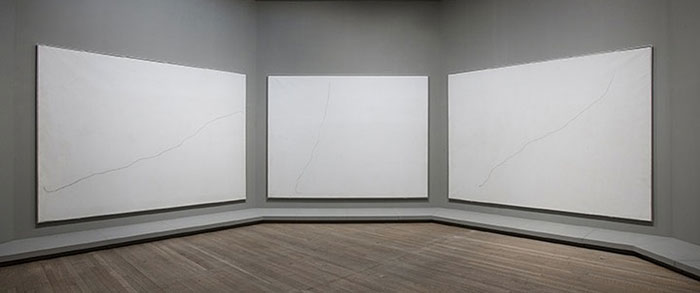
“The painting seems to be the type of random arrangement that a five-year-old might come up with. However, it emerged from the mind of an intellectual” (p64); this is only the most annoying of innumerable nearly identical statements in this book that confuse what an artist produces and what an artist claims to be producing.
“So although this work might initially appear to be a childish scrawl, it actually conveys the preoccupations of the time” (p71), Hodge writes, actually citing the artist’s statement as her source. But of course this is not what the work “conveys.” If the work “conveyed” meaning, we would not need an artist to explain what it was about, or Hodge to blindly accept and repeat it.
This entire book is a hymn to the intentional fallacy. “No child would have created this work with the same intentions as Tinguely” (p22). While, for her part, Rist’s “reasons went much deeper” than children’s reasons would (p53). Time and again we are assured that an artist acted intentionally (pp 138, 216, etc.), consciously (pp 59,181, etc.), or, especially, deliberately (pp 65, 154, 171, 172, 181, 207, etc.); we are asked to consider the artist's objective (149), objectives (165), or aim (47, 140, 169), what an artist was seeking to communicate (202), intended (84, 124), aimed at (61, 128, 140), or planned deliberately (81) as a preconceived statement (119) for meaningful reasons (125).
How “meaningful” can these “reasons” get? Check out these examples of the kind of symbolism modern art offers:
•“The artist's inclusion of two skulls indicates the prospect of death” (p162).
•“The cut-up sleeves of a denim shirt represent the fisherman's clothes” (p143).
Could a five-year old have come up with those bits of metonymy?
As with the skulls and the denim, there is a bizarre literalness at work in this book. Could a five-year old have painted this Magritte? No, because “no child could possibly reproduce Magritte’s meticulous and realistic painting style” (p14). Could a child have created Emin’s “My Bed”? No, because although “Children may often leave their beds unmade and their rooms a mess…a close look at this installation reveals that the bed and strewn items belong to an adult” (p130). These explanations seem to miss the point — no one’s ever stated that a five-year old could paint like Magritte, and no one who’s ever dissed “My Bed” would feel refuted by the fact that children don’t wear pantyhose. You might as well say that children couldn’t paint the upper half of Gorky's "Year after Year" because they’re too short.
"A child could not slash a canvas because children are not allowed to play with knives," is a parody of a statement from this book and not an actual statement from this book.
Mainly, though, Hodge just falls back on her beloved intentionalism: “any five-year-old could have deposited his own excrement in a can…Manzoni, however, was making several points that few children could make” (p116).
What this book does not offer is an explanation for why the artworks reproduced are not trash—I’m not saying they are trash, just that the book does not explain, or even attempt to explain why they are not. As an apology for modern art, it addresses only straw-man arguments and makes modern art seem safe, boring, and redundant. It also doesn’t really get into why a five-year old could not have made most of the works reproduced herein. In fact, it often stumbles backwards into admitting that a five-year old could have.
• “A five-year-old could make a structure like this, but they [sic] would not be scrutinizing so many elements at the same time” (p29).
•“A child could make a pretend plate of food but would not be able to incorporate the subtle implications or the strands of humor, creativity, and reality that are inherent in this piece” (p24).
•“Any child could do that but none would do so in order to make statements about [blah blah blah]” (p67).
But, once again, don’t be confused! “The ambiguities in the image are deliberate, unlike a child’s arbitrary scribble” (p62). I think we can all agree that the problem with children is that their scribbles do not contain “countless intellectual, mystical and spiritual implications that allude to various complex issues, including intrinsic emotions and tensions” (p56).
I know I’m repeating myself, but this book is very repetitive; I’m also being mean, and I can’t really justify my bad behavior except by assuring you the book is filled with quotes like these:
•“Yet surreptitiously and incisively [Gonzalez-Torres] invoked viewers to reconsider, to contemplate the past, present, and future, just as the work reaches the senses of sight, touch, and taste” (p36).
•“By arranging mass-produced objects on shelves, [Steinbach] creates tensions between anonymity and desire” (p44).
If you hate modern art, this book will reassure and flatter you; if you like modern art, you won’t after reading this book—unless, I guess, you have long hoped that someone would create tensions along the anonymity–desire axis.