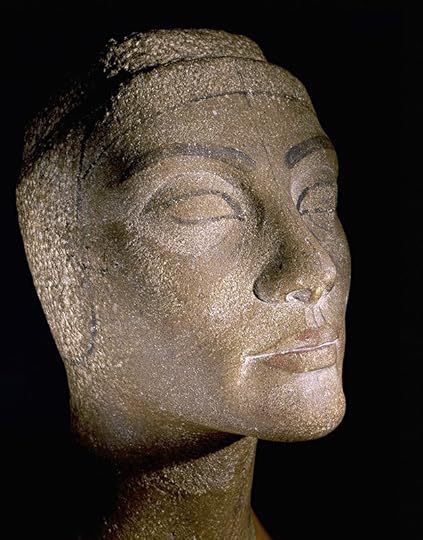
Rating 3.5 stars. What wonderful books the Metropolitan Museum of Art in New York produces! These are not just catalogs for the prestigious exhibitions it has on offer, but they also add a lot in terms of content. That is also the case here. The focus of this book is limited: the images and sculptures of women produced during the exceptional Amarna period, the period when the 'heretical' pharaoh Akhenaten was in power, roughly from 1350 to 1330 BCE. Apparently that was also a time of exceptional creativity, as evidenced by the rich collection of images discussed here. It also indicates that - despite the 'iconoclasm' that erupted after the reign of Akhenaten - a lot of material from that time has been preserved. More in my History account on Goodreads: https://www.goodreads.com/review/show...
And oh, the book can be downloaded - for free - on the MET-site!
Almost everyone knows the bust of Nefertiti, now in the Egyptian Museum in Berlin. It is one of the most famous sculptures in the extraordinary rich collection Ancient Egyptian art. To my surprise, as I learn from this book, this sculpture has hardly been studied, which is to say that neither the material production nor the question of where this image fits into artistic evolution has been paid attention to. One of the contributors (and the editor), Dorothea Arnold, does do this here, and in great detail, also for other sculptures.
What is exceptional about Nefertiti is that in most scenes she is depicted as the equal of her husband Pharaoh Akhenaten, while women in almost all other Egyptian periods were depicted as smaller. The six daughters of the royal couple also receive exceptional attention in the many reliefs that have been preserved. Arnold concludes: “femininity was of crucial importance to Akhenaten – not simply on a personal level but as a basic to the structure of his thinking and his faith.” Arnold especially praises the exceptional craftsmanship of the Amarna artists, as evidenced by another, incomplete bust of (probably) Nefertiti (see image). She also sees a stylistic evolution from an initial expressionist phase in which the ugly and distorted aspects of the royal figures are consciously emphasized, to a softer, more lively style.
As a layman, I still have the impression that Egyptian figurative art kept on having a rather formalistic, even stiff aspect, also in the Amarna period, though less so than in other periods. Arnold confirms that. For example, she notes that the physical appearance of the royal figures, including the female ones, was interchangeable; they remained types rather than individuals. And although the Amarna art is clearly based on very precise observation, the intention remained to transcend the human sphere and emphasize the superhuman in the pharaoh and his family. In that respect, it didn’t differ that much of other periods in Ancient Egypt.
A lovely book full of art from the Eighteenth dynasty, lots of photographs and essays. Catalog from the Metropolitan Museum's exhibition of the early 2000's, this is worth the price and time to find it.
Filled with beautiful pictures and information about Akhenaten's religious revolution that was previously unknown to me. A great read! Very informative about Amarna's beautiful art styles.