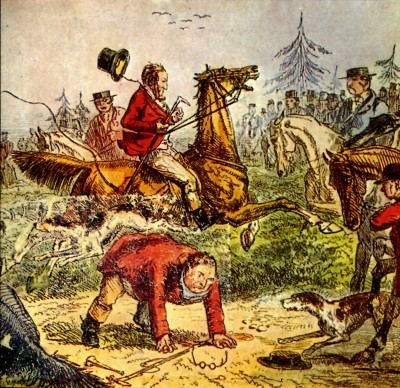
"It was a murky October day that the hero of our tale, Mr Sponge, or Soapey Sponge, as his good-natured friends call him, was seen mizzling along Oxford Street, wending his way to the west." So begins the marvellous tale of Mr. Sponge, or rather the tales of the many characters which feature so vividly in this delightful volume. From the author of Handley Cross and many other sporting novels, this light-hearted romp through the countryside is a fine example of Surtees' craft.
Many people think of nineteenth century literature as Austen, Dickens, Bronte, Eliot, shading off into Hardy. I don't think that diet gives us much of an insight into the real lives of people then, and that is the strength of Surtees. He can't construct a plot for toffee, though this novel does have a glimmer of beginning and end, and subtlety is an unknow commodity, but the action leaps off the page, the characters are horribly solid, and the sense of life to be grabbed at and enjoyed is palpable. This novel thankfully lacks the longer graphic hunting scenes - most that take place end in humiliation for the human participants - and there is actually a genuinely moving moment near the end. One to reread, definitely.
I picked this up, and eventually read it, on a whim, mostly because of the Dickensian imagery (including the fantastic art work of 90 original illustrations from the first printing) and the overall description. And ultimately, it is best described as Dickens Light. It’s long, features a wide array of rogues, pompous idiots, salty workers, comely daughters looking to be married and even the occasional decent bloke, the big difference compared to Dickens being it was fully absent a Hero. Just imagine Nicholas Nickleby or David Copperfield without Nicholas Nickleby or David Copperfield, but with everybody else. The main character, Mr. Sponge, is a bit of a cad and swindler, and an anti-hero throughout, not a lot better or worse than most everyone else in the novel. That did mean there was less heart and soul, rooting interest and plot than with Dickens, but there was definitely no less fun, eccentricity, or satire. And the plot mostly just consists of following Sponge on a series of Country Manor stays with the upper class, from conned invites to hand-offs to self-invites, and detailed descriptions of multiple Fox Hunts. The dude evidently wrote a ton of long books, mostly about Hunting, and seemingly as much for his own entertainment as anyone else’s. I assume this is why the writing style is so idiosyncratic and self-indulgent at times, including some really odd punctuation, and the heavily detailed, in depth description of everybody’s clothes. Also, a lot of the time, Mr. Sponge’s dialogue reads like he’s Stewie from Family Guy at his most indignant (including repeated use of the delightful phrase “What the deuce?!?”). But the really enjoyable indulgence here, for both author and reader, and also the strongest link to Dickens, is the amazing cornucopia of gloriously absurd names (I mean, what do you expect from a book written, like most of his books, at a place called Hamsterly Hall?). For example, Mr. Sponge’s first name is evidently Soapey, and he crosses paths with: Mr. Waffles, Lord Scattercash, Miss Glitters, Mr. Joggleberry, Superintendant Grabberton…I could actually make this review nothing but these names and I’d be perfectly happy, so here are a few more: Lord Legbail (son of the Marquis of Loosefish), the hunting party of Mr. Slapp, Mr. Guano, Mr. Lumpleg, Mr. Crane and Mr. Blossomnose, Captains Seedybuck and Cutitfat and Ladofwax, Mr. Leather, Mr.Peastraw ,Puddingpote, Mr. Spigot, Mrs. Springwheat, and Masters Brick, Basket and Bulgey, just to name a few. Despite having zero inertest in Hunting or the culture surrounding it, the time, place and all those idiosyncrasies combined made this sooooo oddly compelling I still think about it (and smile). Recommended for all fans of Dickens and/or Fox Hunting. A happy, surprising 89/100.
I believe I was in college when I dreamed up the concept of developing fifty-two friendships that I could then parlay into visits later in life, one week each through the course of a year. With this scheme, I could avoid rent, living on the generosity of acquaintances. In exchange, I would offer seven days of constant, sincere appreciation, nested with appropriately gauged superlatives – not too many, mind you. Naturally, I never tested this brazen idea. Mr. Surtees beat me to the punch, however. More than a century before my birth, he used a variation of my plan with Mr. Sponge’s Sporting Tour, a mildly amusing introduction to English country pretensions.
We are never given Sponge’s real first name; we only know that it begins with the letter H. To his pals on the street in London, he is known as Soapey Sponge – I guess because he is considered a slippery character. We soon learn that Sponge does know how to sponge and sponge well. I have long thought that the best way to lift an American’s wallet is with a British accent, especially if there is a whiff of nobility in the air. Mr. Sponge finds the best way to gain an Englishman’s hospitality is through horsemanship, especially when applied to fox hunting. Estate doors open miraculously to a rider who knows his way with the hounds.
To begin, Sponge acquires on favorable terms two unruly horses with histories, Hercules and Multum in Parvo (Latin for “much in little”), and hires a man named Leather, who worked for the horse trader, as a groom. Thus set, Sponge makes his way to a hunt at Laverick Wells. From there he ingratiates himself into the homes of a series of duped hosts, each soon coming to regret their largess. In this way, we meet Mr. Jawleyford, Lord Scamperdale, Mr. Puffington, and Mr. Jogglebury Crowdey along with their retinues and families. In one instance, Sponge finds himself on the losing end of his enterprising efforts with Facey Romford, a man who knows how to manipulate playing cards to the great financial disadvantage of his opponents. Sponge quickly extricates himself. The tale ends as Sponge marries and returns to London, opening a cigar and betting parlor on Jermyn Street.
As you may know, I am always seeking solid reading recommendations. Sponge offers up the purple-backed Mogg’s Ten Thousand Cab Fares. When life challenged, there was always Mogg’s to comfort. There is not much in Mr. Surtees' work for a reader today. Still, I enjoyed following Mr. Sponge’s antics.
This is a light hearted beautifully written book. The "hero" Mr Sponge is a delight and the description of the other characters and ways of life. The fact that Mr Sponge passes his evenings reviewing the timetable of "buses" in London is just one of the funny things. The description of the horses and their nasty nature and the toffs etc is brilliant. Even the ending is a delight.
The main character's name is appropriate, as he tours around, sponging off his hosts, overstaying his welcome until his hosts are thoroughly sick of him - and he's thoroughly sick of his hosts. The different characterizations are quite entertaining, as are the situations where Mr. Sponge tries to gain the upper hand, while avoiding those trying to take advantage of him.
How could anyone resist such a title? Or the gorgeous decorative cover and illustrations by John Leech? But beware: unless you are a fan of long, discursive Victorian novels, you'll have a hard time with this one. Surtees' novel, published in the 1830s, was the harbinger of Dickens' Pickwick Papers: a loose narrative of adventures with plenty of humorous characters along the way.
It was a murky October day that the hero of our tale, Mr Sponge, or Soapy Sponge, as his good-natured friends call him, was seen mizzling along Oxford Street, wending his way to the west.
For my Nutty NUUT
This entire review has been hidden because of spoilers.
This has been an interesting read. It describes a forgotten world at first hand. There are a lot of terms that are a bit obscure, eg Brecknel and Turners on the table, "Shell and Tortoise" soup, Mogg's guide and bagged foxes. The characters are aptly named. Mr Sponge, who sponges off people, Mr Scattercash and Viscount Hardup. To be fair, the story is mainly about the different hunts and a description of the characters. It is not a gripping tale but it is unusual. The illustrations, some of which are in colour are really beautiful
Mr Sponge is a bit of a sleaze. His profession is essentially the long con, where he invests time in latching onto various gullible rich people in the hope of conning them out of their money.
He’s not very successful - after 500 pages he comes away with a couple of fox tails, a gold watch and a bit of cash (and a pretty girlfriend).
But it’s not the end destination but the journey that counts, and Sponge’s (mostly horseback) journey includes lots of comedy figures, many heart-pounding fox hunts, and some poignant tragedy too. Strangely exhilarating but oddball Dickensian-style read.
A transport to another world. Unlike many of the established Victorian classics, Mr Sponge’s Sporting Tour makes no pretence at social commentary and makes no notes on the human condition. Surtees writes for his and his audience’s entertainment. It’s picaresque, rambling and absolutely fascinating.
I haven't finished it yet but so far I love this book. It's hilarious. It's equal to The Diary of a Nobody, the Lucia-Mapp books, Pickwick Papers, Tom Jones, etc. I am happy that it's a long book because I don't want it to end.
Excellent and, at times, very funny satire on English country life in the 19th century. The characterisation is first class as is Surtees' obsevations on society and especially the huntn' set.
Mr Sponge's Sporting Tour is one of the best books Surtees ever wrote for one very simple reason. Unlike Handley Cross which requires a fairly decent knowledge of foxhunting in order to understand it, this book is far less concerned with the actual hunt and more interested in the social life that surrounds it. This makes it accessible to a much wider audience than some of Surtees other works.
Positives The best thing about Mr Sponge's Sporting Tour is the plot. While it is still a little vague in places, it is much less so than some of Surtees other work like Handley Cross. Essentially it concerns the titular Mr Sponge's journey across England, hunting as he goes, and describes the people that he meets. Other than that, the next best thing is Mr Sponge himself. Unlike Surtees most famous creation Jorrocks, Sponge is far more of an anti-hero. As with most novels of this period, the clue is in the name. 'Soapy', as he is known, is a bit of a trickster; he sells horses with considerable behavioural flaws (like the 'playful rogue' Hercules who has the inconvenient habit of kicking all and sundry off his back), stays for long uninvited visits at people's houses and has the long-term goal of marrying for money. Despite this, Sponge is not an unlikable character. This may partly be down to the fact that the people he deceives are just as eager to deceive him, if only they can get an opportunity. While not so talkative as Jorrocks, Sponge is also capable of coming up with some wonderful one-liners: 'Women never look so well as when one comes in wet and dirty from hunting' is a personal favourite of mine. Then there are the wonderful array of side characters; Lord Scamperdale (a man who rides 'as if he had a spare neck in his pocket'), Lucy Glitters (ex-circus performer and equestrian goddess) and Mr Benjamin Buckram (Sponge's horse dealing accomplice, described as having the 'advantage of looking like a respectable man'). All in all, this book is a definite step up from the previous ones.
Negatives Surtees stock in trade was a definite tendency for cynicism when observing Victorian society. This is prevalent in all novels of the period, with both Dickens and Trollope frequently commenting on their characters intentions in uncomplimentary ways. However, Surtees takes this to a new level; almost every character, whether male or female, have hidden motives which they are doing their very best to fulfil. Whether it's Mr Jawleyford's endeavours to appear hospitable (without actually being so), Mrs Jawleyford's aim of marrying off her daughters or Mr Puffington's efforts to look like a great sportsmen without having to undergo the expense, Mr Sponge is well suited to the society in which he moves. Most of the time, this is quite amusing but occasionally, one does get slightly fed up! Surtees had a particular distaste for the matrimonial schemes of young women and the efforts of the Miss Jawleyfords to court anything in trousers make them extremely unlikable. One does feel that if Surtees had occasionally toned down his cynicism, then his satire might have been more penetrating when he utilised it.
Conclusions Overall, this is a very good story. Witty, funny and full of charming characters, this book is a delight whether you have any knowledge of foxhunting or Victorian society. Surtees clearly knew his subject very well and the rich descriptions together with penetrating character studies make this the literary equivalent of eating a bowl of warm soup.