In the heat of late summer, two New Orleans familiesâ one black and one whiteâ confront a storm that will change the course of their lives.
SJ Williams, a carpenter and widower, lives and works in the Lower Ninth Ward community where he was born and raised. Across town, Craig Donaldson, a Midwestern transplant and the editor of the city's alternative paper, faces deepening cracks in his family. When the news of the gathering hurricane spreadsâ and when the levees give way and the floodwaters comeâ the fate of each family changes forever.
This is a fictionalized version of the Katrina experience for a handful of locals. Piazza begins by painting a picture of what life in the Big Easy was like for his characters prior to the disaster. This tells us a bit more of what was lost, or at risk, from an unforgiving mother nature, and an uninvolved government. He shows us details of the storm and it’s aftermath both physical and emotional, following the trail of his characters as they survive or not, leave or try, and confront decisions about whether or not to return.
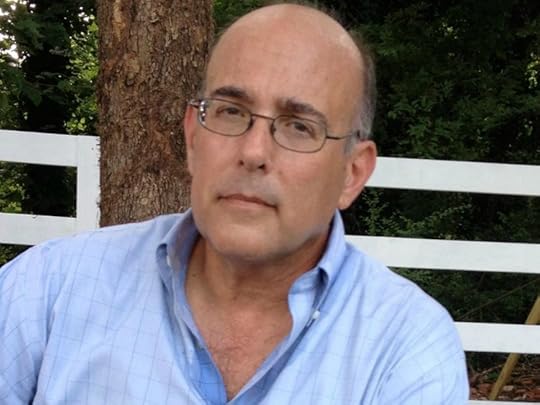
Tom Piazza - from Dig Baton Rouge
This is a very personal, moving treatment of a horrific event. His characters are alive, complex, multi-shaded, coping with tragedy and struggling with hard decisions. We get some sense of what it means to love the city, an idea about what it is that its residents so value. This book is worth the trip for the peek we get into the city and satisfying for the humanity, the accessibility of Piazza’s characters. It certainly showed me things I had not known about New Orleans, and increased my appreciation of it.
=============================EXTRA STUFF
Piazza, a New Orleans local, was a writer for the HBO series Treme. Here are links to the his personal, and FB pages. He has written twelve books.
It's halfway there; you can feel it on the very first page. There you meet a rich panoply of players: one supporting, one tragic, and one, sort of, principal. That order of import is reflected in Piazza's writing style/s, as the book progresses: he starts out strong, and finds his flow again and again as he cruises along on the shoulders of his twinned stories' main drags: these are too brightly lit, and so signage saturated you can watch the characters worry that another might miss a turnoff for all the reflective preoccupations. The black folks navigate by feel, and by holler; the white people are so busy with adolescent identity angst that they can hardly - except for that very first scene - talk to people they live with, let alone any Others.
There are two stories here, overlapped inconsequentially, just enough to provoke some good old postmodern angst. Each is told by an omniscient third person narrator: not a half-bad choice. He knows the heart and soul of one family so well that we, by reading, feel part of it; the other is like lava to his psyche, and tephra at best to the reader. Piazza's style slips, falls flat, and grabs onto the crutch of exposition and keeps it close at hand. Over and over, as he follows this is-it-or-isn't-it-decaying nuclear family, he stumbles and slips, then finally slithers into what seems sincere, if slapped-together, self-hatred.
Act I (they are marked, to help us recognize the arcs of the text), Chapter I sets expectations high: ir's filled with opulent, off-the-cuff characterizations and you-are-there immediacy, in setting-driven snippets. But almost immediately -- these scenes intrude on one another wherever they find gaps -- the writing degrades into a series of ill-placed, insular, exposition gags.
This could be forgiven, if it happened just once or twice, especially if they led to something like tangents. If it only occurred when new characters arrived, well, I'd still hate it, but the information provided here, in instance after instance, is exactly the sort of thing one should show and not effing tell. We might observe characters' potentials, their shifting places in the world, via interactions with sidewalks or streetcars or plates of red beans, and especially with the other people whose social fabric is here woven, there unraveled. Instead we are told, in awkward, tantrum-like inbursts, how different the world is from each individual's preferred, out-of-context, never otherwise presented, set of props and routines.
The men of this City are heroes: they answer calls to action, they wander, they doubt, they act, they find fellowship, their ideals are proven and their souls fulfilled.
Women, while more diverse in paths, endeavors, and choices, do not fare so well. These vaguely repellent icons either start out gritty and end up dust, give of themselves with substance-free selflessness, or proceed from prim and protected to pashmina'ed pragmatist. (So we are told, in dream-pinch expositions, but her unseen actions clash with the villainy thrust upon her -- especially her crucial supporting role, off camera, in that opening: this is a girl who, babe in arms, goes ahead and lays claim to a stretch of Lower Ninth parade-day sidewalk, while her husband idly ambles in and out of strangers' homes.
That opening scene, like so many in this book, is a rarified dream in which narrative and dialogue are both so spot-on and perfectly timed that almost anyone can know what it feels like to be there, and recall their place in similar circumstances. This is the narrative that had me ready to love this book, and to place it on the canon shelf, alongside James Baldwin and Harry Crews. But too soon, and too often, the art gives way to artifice, and fiction faux pas spoil the fugue. While half of this tome was a lonely memoir of cultural tourism and sloppy mysogyny.
For anyone who didn't personally live through Hurricane Katrina, I think this is the closest you can come to viscerally feeling what it was like for the people of New Orleans.
I couldn't bring myself to read this when it was first published, because my own scars from that event were still too raw, and honestly I am in awe that Mr. Piazza was able to write it at that time. I read it 15 years after Katrina (during the horrible year of 2020), as I was catching up on books for the Tournament of Books Super Rooster.
All of you who know me know about my Katrina experiences, and you know that for those of us who live in New Orleans, Katrina isn't over. It is a part of our daily existence. We talk about it every day and we describe our lives as "before the storm" and "after the storm." I own most of the books written about Katrina, but I began collecting books about my beloved city of New Orleans long before the deluge (and thankfully most of them survived). City of Refuge, by Tom Piazza, is a novel about two families from New Orleans and their very different experiences with the 2005 hurricane. The families are different--one black, one white; one less affluent than the other; one choosing to evacuate, the other not. Their stories and the many others told in this work of fiction are so familiar to me, to the point that I sometimes had to put this book down for a few days and return to it when I stopped hyperventilating because of the memories it triggered. I can't say it was a happy or satisfying read, but it was compelling and I'm glad I read it. I wonder what readers from other parts of the world think of it, though. It received a somewhat negative review from the New York Times because the reviewer said that Piazza's love for the city overshadowed the story. To me, that is not a problem because I share that love. It was hard for me to read this as a novel because it was so true to what actually happened, but I'm curious about what people not personally involved with Katrina think of this book as a work of fiction.
It was almost like reliving the nightmare that was Katrina, all over again. But a powerful look at the tough choices so many folks made during those days — or at least those who had choices.
On a side-note, if you're writing a story told against the backdrop of a real place and a real event, stick to truth. We all know that the "Gumbo" is really the "Gambit." And Rosies is really "Molly's." And another thing — no one in New Orleans has a crawfish boil in August. That's just dumb, assuming you could find live crawfish at that time of year.
In a beautifully written illustration of very real stories, Tom Piazza has managed to draw an incredibly vivid picture of what it was like for two families living through and after the greatest man-made disaster this country has known. Make no mistake about it, this was a man-made and preventable disaster. New Orleans has weathered many storms, literally and metaphorically, and has survived. People have been screaming for years before Katrina that the levies weren’t suitable to handle these storms, that the cracks and poorly engineered systems needed to be fixed, that catastrophe was always one storm away. In the words of Will Hoge’ “Washed By the Water” tune:
“Damned old levees, well they knew that they would go. Been talking ‘bout it since before my daddy’s born…but ain’t nobody listen to what a poor man has to say.”
1,836. One thousand, eight hundred and thirty-six. That’s the number of lives lost from Katrina and the levees failing. Stop and think about that for a minute. Almost two thousand people. Thousands more evacuated from the only place many have ever known. Entire house – entire families – washed away.
City of Refuge is a novel about two families from New Orleans and their very different experiences with the tragedy that was Katrina. The families are drastically different and this is highlighted in the way the aftermath of the levy breaches . One black, one white; one doing well financially, the other living week-to-week; one choosing to evacuate, the other not – or more accurately, one able to evacuate, one not.
This book is hard to read at times and you know what? Good. That’s the way it should be. It should be hard to read about the fictional characters that are living very real stories that happened to very real people that were treated as less before this storm and even worse afterwards. Piazza digs into this through these two families and their experiences after the storm – one watching from Chicago after being able to evacuate in plenty of time, one that wasn’t able to get out and watched as the water rushed into the home he built himself and filled the entire first flow. Nothing in this book is fake (except crawfish boils in August, maybe) despite it being fiction.
It’s about loss and love. It’s about strengths, weaknesses, emotional attachments and survivor’s strength. It’s about family we’re given and family we choose, about selfishness and selflessness. It’s about faith in your God, your home, your community, your people. It’s about falling down and getting back up. It’s about falling down and wanting to give up. It’s about life. It’s about starting over and ending chapters. It’s about history and the present and the mingling of the two. It’s about New Orleans.
You’ll be better off for reading it. I promise you that. And when you get the chance? Go to New Orleans. It’s still beautiful. It’s still chaotic and tranquil, fueled by alcohol and faith and music and silence and bars and cathedrals and, and, and, and…
It’s still there. It always will be. Maybe molded a bit differently, maybe with some new shapes or colors. Some parts may look a little different, some parts will always be the same. But New Orleans? It’s been to hell and back and it’s still standing. That’s a lesson many of us could follow.
You can stop reading here if you just wanted my thoughts on the book. The rest of this is something I wrote in 2010 after my third trip the city. A love letter of sorts to NOLA and all it has to offer a girl. It seemed fitting to include it here.
* I had heard and read things where people would say, “oh I fell in love with that place.” I blew ‘em off at the time, probably rolled my eyes. In love with a place? Infatuated with a particular local? Riiight. I’d laugh to myself and think they must’ve had a good time on vacation but eventually it would wear off. They’d fall back into their normal routines of daily life and forget about the place they were “so in love with.” For them, it usually did wear off and fade away. A once upon a time never to be revisited.
Then… Then there was us. It was a quickly agreed to plan in a tent at a fair that first led me in your direction. Like most of the greatest destined-to-be things in life, I didnt know what I was agreeing to at the time. I figured, at the very least, it would be a fun roadtrip for the best friend’s birthday. A nice little “remember that one time” story we could laugh about when we were older. I’d go, I’d visit, I’d take in your sites, have a good enough time and be on my way.
But me and you, Nola? It was love at first sight for me. From your slate walks of the French Quarter to the muddied brown of your Mississippi River, to the way even the light seems a little bit different – I fell in love with a city that first trip. A city! The same thing I’d secretly scoffed at other people for saying, I was now doing myself. I’m happy to say that the feeling hasn’t faded at all. Three visits in as many years and I still feel the way I did on that first night we shared. Filled with wonder and amazement and any other cliche I could throw at it, but each one is true. You cut through to the core of me in a single day.
I came back about a year later, wondering if you’d changed since the last time I saw you. Wondering if that magic that I felt would still be there. Full of anticipation and fear and excitement and nervousness. Were you the same? Was I? Was it possible to match the experience we shared last time? Could we ever top that or would I be let down and disappointed and the magic lost? Would the fact that it wasn’t our first dance make it less magical? The car drove over that last final hill on I-10 leading to you and there you were… There you were.
The fear that you’d be different, that *I* would be different all disappeared the very moment I could see that familiar roof of the Superdome in the distance and even from the expressway I knew then… This was love. You were there for me still and you always will be. I knew it. It was like a second date, we were a little familiar with each other but still had so much to learn. So much to dig in to, to really get to the heart of the matter and discover even more. Sure we both love music more than any one person should. Sure we both love your Spanish ironwork, your balconies, your hidden courtyards. Sure we both love the limitless forms of art and artists that call you home. Sure we have these things in common, but was there more? I had to find out.
We laughed so deep we cried, we drank some of your famous concoctions, we ate food people world-wide try to duplicate but never get quite right, we listened to some of the best live music one will hear. Wandering the streets without thinking twice, you made me feel free. I didn’t know what that word meant before you. Free. Free to stop in the middle of the street and breathe. Free to stop in the middle of the street and DANCE. Free to finally, finally just be.
It’s not every day that something, someone, somewhere can make you feel that alive. Somehow, Nola, you do it with ease. Time and time again. Just walking down your streets makes something in my blood pump a little differently. A little smoother. A little slower.
You’re not without your flaws and I’m not without mine. Some people look at you and all they see are your flaws, your scars, the things you may not be able to overcome in the shortterm. But overcome you will. You do. You always have. Like when you were nearly washed away by thirty feet of water with no help for FIVE days, I cried for you. I didn’t know you then but I cried for you. This shouldnt have happened, there were warning signs that were ignored, people that cried out that your levees couldn’t handle a Category 5 storm and they were ignored. But we knew that somehow, if and when the water finally subsided, if there was anything left, you’d survive. You’d overcome. You will, there’s still a long long road ahead in that recovery. You’ll never quite be the same, no one could be after such tragedy. But you will overcome. It is, afterall, what you do. I didn’t know you before that disaster but somehow feel like I did. I wish I had. But I know you now, and because of that I’ll never be the same.
The flaws people see — sure they’re there. For some that’s ALL they can see – the alcohol, the debauchery, the crime, your poor. But people who get it, who get you – also see your sense of pride that compares to no other, your sense of community, your belief in God and your belief in the person standing next to you. And maybe most importantly your belief in yourself. You welcome strangers like they’re lifelong friends and they leave feeling like they are just that – lifelong meant-to-be companions. Souls that were meant to have shared that moment in time and both were changed forever because of it.
There are people that judge you without knowing you, that think all you are made of is those flaws, people that believe that the only things you’re made of are what they’ve seen on tv. That you’re only poor broken down ghettos and drunken debauchery of your world famous Bourbon Street. They don’t get it, they don’t get YOU. They’ve never sat on the curb of Royal and listened to a brass band play in the street. They’ve never walked down St. Ann’s and heard a lone trumpet playing just the right tune – not begging for attention or money or anything from you other than your ear. Those people, the naysayers and non-believers, they’ll never experience you in the right way, in the way everyone should at least once. They’ll never sit across from Jackson Square on those stone steps and be still long enough to take in the sounds of the Mississippi behind them, of horse-drawn buggies clip-clopping their way down Decatur, of watching artists hang their life’s work on the iron fence of your epicenter. I feel sorry for those people, sorry for those that will never really know you. Dammit if they’re aren’t missing out. If they could only get a quick glimpse, a small taste of what you have to offer, they’d be hooked too.
Our third and most recent whirlwind was the best yet. I began counting down the days six months out, letting that excitement build more and more as the time grew closer. I couldn’t wait to get back and knew you wouldn’t disappoint. It was, afterall, the time your star shines brightest – Mardis Gras. Carnival.
Your peoples’ favorite holiday, when a city that knows how to throw a party manages to outdo itself. Weeks of parades and festivals leading up to the big day. Costumes and floats and beads and doubloons. It’s early in 2010 and you’re already having a hell of a year. Your Saints won the Superbowl for the first time in history. It was more than a trophy and a championship, it offered hope to a city in desperate need of something good, in desperate need of a break. I cheered from my couch over 1000 miles away when that confetti fell over the team you’re so proud of. This was bigger than points on a scoreboard and a newspaper headline. This was your chance to start anew. I got into town five days later and you were still celebrating, and as a lady in a shop put it to me, “Honey, this is New Orleans. We’ll be celebrating this till NEXT football season.” I hope she’s right. You deserve to do just that. You brought your “Who Dat” chants to a nation, and I pray that the spotlight cast upon you because of it helps bring more than just tshirt sales to you and yours. Your Saints are on top, you celebrated with a parade of 800,000 lining your streets and carried it through to Carnival.
We ate in your restaurants and drank in your bars, we listened to live jazz, walked your streets and took more pictures than one could ever really need – trying somehow, searching for some way, to capture just a hint of your magic. We threw beads from your balconies and stood along your parade routes crying “Hey Mister, throw me something.” We made new friends in minutes, sang along to songs that will always remind me of you, and we toasted. Toasted to a perfect moment in life, toasted to the amazement that yes this is in fact our life at this very moment and how lucky are we? Toasted to Mardis Gras, your Carnival. Toasted to music and freedom and we toasted to you – New Orleans. Our dear, deeply loved New Orleans. Two words that meld into one as they roll off your tongue and always, ALWAYS, bring a smile to my face. It was every bit as chaotic and amazing as I’d expected and you managed to blow me away. Again. Like you always do.
I read in one of dozens of books I’ve read about you, “Some people will come visit and think it’s nice enough. Some people will visit and they *get* it. They get New Orleans and New Orleans gets them. Those people that get it? They fall in love and spend each of their days wanting to be back here.”
Truer words were never spoken. Some may visit and not get it, not understand what’s so great that it would cause someone to write a love letter of sorts to a city. I don’t know what those people were doing, but whatever it was, they were doing it wrong.
As for me? Well… I’m already counting down the days till I get to load back into a car with one of the best friends a person could ask for and drive through night to get back to you. I get it. I get you.
This isn’t a fling between you and I, Nola. It’s a long term love affair.
City of Refuge is the story of two families in New Orleans, their love of the city and its culture, and the wrenching decisions they have to make in the wake of Hurricane Katrina. I am advising my dear friends in New Orleans not to read this book; for them, the pain is too close to the surface and some of those decisions are still being made. I am encouraging everyone else I know to read it ASAP.
I found myself quickly wrapped up in these people and their lives. The book is filled with vivid detail - their friends and neighbors, the routine of crawfish boils and red beans and rice, the Mardi Gras Indians, the patois of the neighborhoods, the music and the parades. I found myself agonizing right along with them as they tried to decide what to do next. City of Refuge does a marvelous job of making you really understand their situation in a way that no news report ever could.
Politics and blame are minor characters in this story. It's really about people and their ability to face disaster and put their lives back together. It's about our connection to our homes, a connection that the people of New Orleans feel more deeply than perhaps any residents of any other city in this country. It's about love and loss and hope and rebuilding and I strongly recommend you add it to your to-be-read list.
I was so excited to read this book; I couldn't wait to get my hands on it. I went to Barnes and Noble months ago to get it, because I had gift cards, and was so upset when I was told they had cleared the shelves of the hardback copies to make room for the softcover copies (which they weren't going to get for another month!)
But anyway, I finally got a copy. And while I did like it, I didn't love it. It fell a little short of my expectations. I guess I expected to get more feeling from it; I thought it would affect me in the same way that all the television coverage did. But it seemed more sparse than I would have wanted, especially in the descriptions of the storm itself, and directly after the storm. I did care about the characters, and I did feel their struggles, but I was still left wanting to feel more.
I wanted more description of what people went through during the storm, what it was like to ride out the storm in the Superdome, or the aftermath at the Convention Center. We saw it on television; I wanted to "hear" the voice of someone experiencing all of that. For example, Wesley basically slept through the storm. SJ was taken to the Superdome after the storm, but that is all we know. It was only mentioned.
For me, the best part of the book was the last 50 pages or so. I liked the fact that the two families crossed paths at the beginning and ending of the book. I would have liked even more of that interaction.
This entire review has been hidden because of spoilers.
It's really hard for me to judge this novel specifically as a novel, because I can't get past the horrible reality behind it - namely, what happened in to/in New Orleans during/after Hurricane Katrina. I read much of this book in public in London - on the tube, in a coffee shop - and everyone must have thought I was totally deranged as tears were running down my face nearly the entire time. It's horrible to think what happened to the city and its people and what continues to happen today. And the fact that much of it was preventable.... Tom Piazza is clearly writilng about a city he knows and loves very, very deeply, and the wound is still open - he's angry, and it shows. (And that's fine with me!) The parts about how some people said the city deserved it, it was filled with lazy people living off of welfare... I know it might seem a stretch, but as a New Yorker, that reminds me of some post 9/11 comments, and it fills me with rage that there are people sitting out there judging people who have just been hit by tragedy, and deciding that clearly, they deserved it.
Thank you, Tournament of Books! Without you, I would never have read this.
I think anyone who visits New Orleans leaves feeling like they belong there. I personally think there is a bit of N.O. in everyone. After spending a month in the city this last year the city called my name and my wife and I seriously considered moving there. That's the primary reason I scooped up City of Refuge. I wanted to remember a bit of what I felt when I was there. It's a book about Katrina and how it affected two families from very different sides of the socioeconomic spectrum but it's also about that magical thing you find in New Orleans that plants itself in your soul when you go there.
Tom Piazza is from New Orleans and his writing reflects that fact. His love and passion for the culture and city permeates through the pages and makes the story a pleasure to read. It is a very painful and heart-wrenching story but it is told in a beautifully poetic way.
I'm certain that a big reason I enjoyed this book so thoroughly is because of my time spent in the city soaking up the culture but it is simply a fantastic book. I highly recommend it to anyone - even those not particularly interested in reading about the events of Katrina.
Tom Piazza is an amazing writer and the characters he creates dance off the pages and into your life. This book describes New Orleans as well as any I’ve ever read. Possibly the best. The New Orleans lifestyle is impossible to understand if you haven’t lived it and I’ve been lucky enough to live here since the 80s.
We are different. It’s different here and it’s not for everyone as this book demonstrates. I was never able to read this book, which is about Katrina, until now. I knew it was going to be good and sad and devastating and tragic, but also good. It was all those things, some of it was so hard to read but we did persevere and here we are. If you want to learn about New Orleans, read this. It’s next best thing to living here.
A fictional story about 2 separate families in the weeks before and the months after Hurricane Katrina. Piazza does an excellent job in focusing on the thousands of people who were displaced geographically as well as psychologically. It’s just incomprehensible to me that the damage of Katrina was not because of Mother Nature, but because of humankind who did not care enough to do their jobs.
Utterly devastating. As it should be. We must never forget Katrina, what it said about New Orleans and about America. And this book will help us do that.
With 1,836 lives lost due to the hurricane and subsequent flooding, Hurricane Katrina was one of the five deadliest hurricanes in the history of the United States and the costliest in terms of property damage. City of Refuge is the story of how the hurricane affects two very different families living in New Orleans.
SJ Williams, his sister Lucy and her son Wesley were all born and raised in the Lower Ninth Ward. New Orleans is their place and they are proud to have made lives there. The widowed SJ owns his own carpentry and repair business, loves to read and cook while watching over his family. Lucy struggles with drug and alcohol dependence while scraping by working odd jobs where she could find them. Nineteen year old Wesley is at the point in his life where he’s no longer a boy but not yet a man. He feels smothered by his Uncle SJ’s subtle pressure to become more than just another thug in the neighborhood.
Craig Donaldson is married with two small children. He and his wife Alice are both New Orleans transplants. Nobody had ever had more of a crush on New Orleans than Craig. As editor of Gumbo Magazine he reveled in the rich musical history and the characters found in neighborhoods throughout the city. However more and more lately his wife is feeling a restlessness coming from giving up her own painting and teaching career to the increasing violence and decaying infrastructure of the public school system. Now once again faced with packing up and evacuating the kids Alice is more convinced than ever that it’s time to leave New Orleans and doesn’t hesitate to make this clear to Craig.
From a few days before the hurricane to first Mardi Gras celebration six months after the devastation Piazza documents the lives of both families with raw emotion and genuine feeling. During the first night of the storm SJ is prowling the house checking rooms sealed up like tombs to the raging outdoors and you can feel the worry coming off the pages. While staying with relatives in Chicago, Alice has made the decision that Craig himself can’t come to terms with. It’s time to leave New Orleans and make a new life for their family. You get a true sense of Alice’s need to protect her family while still feeling the anguish that’s pulling Craig in two directions.
The book is a true homage to the author’s love of the city and I enjoyed getting to know these characters and be a part of their lives. I would recommend this book to book clubs who will have much to discuss about the book, the city and social differences of the characters.
After reading many books regarding New Orleans and Hurricane Katrina, I think this is the best to date.
Written in novel form, the author obviously loves and understands the culture of New Orleans. Comparing and contrasting two families impacted by Katrina, the reader journeys to the lower ninth ward and the horror of those who could not flee, who, because of government ineptitude were stranded for days without food and water.
SJ Williams is a hard working family man. Living in the ninth ward for most of his life, he built the home he owns. Widowed and still grieving, he is able to count the blessings of a sister and nephew. His sister chooses a life of drugs and his nephew is of great concern to SJ as he watches his choices that lead to crime and danger.
When Katrina hits his sister is with him as the water dangerously fills the house, forcing them to flee to the attic. Finding a boat, he takes her to a bridge on higher ground and returns to bravely rescue those stranded and dying.
Through SJ we feel the mounting terror as the leeves break and the helplessness in realizing that the infrastructure of NO is, and always has been, inept and corrupt, and necessary, life saving assistance isn't going to come in time.
In addition, we travel with Craig Donaldson and his family. Of different socioeconomic status, they have transportation and flee New Orleans with thousands of others whose cars are barely chugging along the crowded causeway leading out of the destruction.
Both Williams and Donaldson families share the fact that they are scattered and long for any sense of normalcy.
I have only been to New Orleans twice, so a total of about 10 days of my life have been spent there, but there's just something about that city that gets under your fingernails and into your soul in a matter of minutes and never, ever leaves you. If you've been there then this book is a must read. If you haven't, you may not feel it as deeply as those who have visited will, but it's still a great book.
I can tell that the author was speaking from personal experience as he writes about the white family and the black family and how what happened to them during Katrina was very similar, yet so very different. The images the author creates of the flooding were almost too real to read, it was horrifying to watch on television, imagine living it.
As I read about what drove them to decide if they'd come back to NOLA after Katrina or stay in Houston or Chicago, I kept asking myself over and over and over again...what would you do? I hope I never have to find the answer to that question.
I have not been back to NOLA since Katrina and I almost feel guilty about that. If I had had the means at the time I would have been down there in the months following the hurricane to help.
I'm now reading his book, Why New Orleans Matters, and I think it's a great follow up to this work of fiction based on oh so much fact.
Loved it, and it made me want to go have a Mufelatta at the Central Grocery or the Court of Two Sisters Annex on Bourbon Street and have a horny gator (or 12) at the Funky Pirate and listen to Big Al sing those nasty songs :-)
Tom Piazza grew up on Long Island, New York, but has lived in New Orleans for the last 14 years. A graduate of the Iowa Writers’ Workshop, as well as an ardent jazz fan and historian, Piazza fell in love with the Crescent City, which spawned not only jazz itself, but also some of the most unforgettable works of American literature.
In the weeks following Hurricane Katrina, Piazza wrote his ode to the city, Why New Orleans Matters, which was published by HarperCollins just three months after the storm. He is the author of eight other books, including the short story collection Blues and Trouble, the novel My Cold War, several collections of jazz writings (Understanding Jazz, The Guide to Classic Recorded Jazz and Blues Up and Down: Jazz in Our Time) and a portrait of bluegrass music great Jimmy Martin (True Adventures with the King of Bluegrass). He is currently at work on two new novels, one of which is set in New Orleans.
Piazza spoke with STOP SMILING this past spring about what has become of his favorite American city.
"But what fiction does that no other genre can do is provide a kind of coordination, or mediation, between characters' most internal experience and their lives as members of a community" - Tom Piazza
A book about something as intensely devastating as Hurricane Katrina seems like it could only be written by Tom Piazza: A New Orleans resident who had already been writing about New Orleans before the catastrophe. Someone who is accustomed to writing non-fiction, who has that focus to write about what happened while also fully fleshing these characters into real people. Hurricane Katrina was that horrendous combination of natural disaster plus man-made mistakes, yet Piazza does a fantastic job focusing on the characters. The sheer amount of the people that were displaced from their homes is surprising to me all these years later. All of us watched the news while Katrina was happening, but less so after... when so many were living in Houston, Chicago, so many places far from home.... The cameras couldn't follow ALL of these displaced families. Piazza does a great job of covering before, during, after: following one black family, one white. One family who flees New Orleans, one family that stays. Essential New Orleans reading. A worthy second placer in The Morning News Tournament of Books: https://themorningnews.org/tob/2009/
This is the first novel of this type I've read in a while. Straight-up story with third-person omniscient narrator, chronologically linear timeline, etc. I must be reading too much CanLit! It actually took me a while to get used to the style -- I kept looking for the angle, or the twist.
But the story sucked me in. Like everyone else I know, I read everything I could about Hurricane Katrina, including Joseph Boyden's articles in Maclean's, which were similar to the ones written by one of the characters of City of Refuge. So I thought I knew. But reading of the events as they may have unfolded for two very different families was shocking all over again, and the politics made me angry again, and the callousness of thoughtless, mindless people to the residents of the ninth ward of New Orleans.
It's a city I've long wished to visit because of it's roots in jazz and blues, and the book didn't disappoint in that area either. That thread is woven through Craig's story (the journalist)and resonates through the other as well. Recommended for a rainy day on the couch.
Piazza tells the story of Hurricane Katrina partly in a journalistic style, and partly through the experiences of people who live through it. This adds a slightly sour meta note to the story, because one of the two main characters is a journalist writing about Hurricane Katrina. Other than that this is a moving story (how could it be otherwise) of New Orleans and various aspects of the people who lived through the devastation of the city . Piazza is one of the writers of the HBO series Treme, and I can read the series through this narrative, making it warmly familiar to me. I can still hear the music.
I could see that there was an important story in there but I spent most of my reading time arguing with the writing style, largely screaming “show, don’t tell!” I did not enjoy the author spelling out every thought his characters had and every emotion that they felt, particularly in the scenes where Craig and Alice were arguing.
New Orleans is absolutely the stand out character in this novel and it was heartbreaking to read in breathtaking detail the horrors that befell the city but I found the human inhabitants to be flat stereotypes in comparison.
this was an interesting way to look at the happenings in NO after Katrina. It was about two different characters/families and what they went through. It encompases several of the circumstances that we heard about in Houston, (the NO Superdome, the Houston Astrodome, the flooding, the bridge, the people on the roof tops). I had a biased opinion of those who stayed behind, but changed my outlook after reading.
In the way that Piazza'a Why New Orleans Matters felt like a rushed attempt to list his favorite things should he never see them again in his fear he may forget, City of Refuge deepens the details. By following 2 families pre/post-Katrina you get a better feel for the flavor of the city. While it's considered fiction, it stems from pure fact and still helps you to appreciate the city.
As I was reading it reminded me very much of the HBO series Treme. No surprise to me to find that Piazza wrote a few of the episodes for that. He is able to capture the unique essence of New Orleans and the heartache, spirit and resilience of its people. It brought me to tears several times -sad and happy tears
This is just an incredible book. The characters are so beautifully drawn, and the city of New Orleans is so vivid. The storm just breaks your heart, and the aftermath, which is actually most of the book, is even more tragic. I think everyone should read this book.
Interesting, fictional portrayal of two families, one black, one white during Hurricane Katrina. The writing was descriptive and vivid and juxtaposition of the two families captured the tragedy of Katrina. I kept waiting for a bit more of a climax.
I have no idea how this book got onto my "to-read" list, but I'm glad it did. It does a good job of capturing the heartbreak of Katrina without making it smarmy - it focuses on the loss and heartbreak and difficult decisions made in the aftermath.
The City of Refuge is a powerful novel about the devastation of New Orleans by Hurricane Katrina and its effect on the inhabitants of New Orleans. There are 2 storylines in the novel---one involving an African-American family and the other involving a white family. SJ is an African-American carpenter who is doing relatively well with a crew working for him. He is also a Vietnam veteran and a widow. His sister Lucy and her son Wesley are his closest relatives and they all live in the Lower Ninth Ward. Lucy has had problems with both drugs and alcohol but is devoted to both SJ and her 19-year old son Wesley. Wesley is still trying to find out what he wants to do with his life. Craig is the editor of an alternative newspaper and is a transplant from Minneapolis, MN. He and his wife, Annie, moved to New Orleans approx 10 years before and they have 2 young children. Craig loves everything about New Orleans but Annie has grown to hate it with the arrival of their children. The novel begins a couple of days before the hurricane hits New Orleans and ends with the first Mardi Gras celebration held after Hurricane Katrina. In that time period, one family evacuated out of New Orleans at the onset of the storm and moved in with relatives in the Chicago area. One family stayed, was caught up in the flooding and sent to Texas to live after being rescued. Both men eventually had to decide whether or not they would return to New Orleans.
Although I had read and viewed much about the devastation of Hurricane Katrina, this novel really brought it to life for me---not only through both the detailed descriptions of the flooding, the destruction of the homes and buildings but also through the descriptions of the emotional dramas played out by both families. Piazza's descriptions are amazing!
The novel does much more than just describe the hurricane's effects but also gives the reader a feeling of what New Orleans is all about---the people, the traditions, the sensual atmosphere.
My review doesn't begin to give justice to this novel but hopefully gives at least some semblance of what it is about.
Those of us who do not live there, who are not a part of New Orleans or that area of the Gulf region will probably never fully understand the impact Hurricane Katrina had. But Piazza’s fictionalized account of two families, one Black and of modest means and the other white upper middle class; one from the region and the other outsiders with a conflicted relationship to the city, gives us the best glimpse we will probably get. So much of that city’s culture comes through, from the Second Line dances to the hopeful note struck by the Mardi Gras parade towards the end. I’ve traveled to Lafayette Louisiana, and while that place is not exactly the same as New Orleans it is similar enough that I had the experience of random people taking my hand and bouncing with me on the dance floor, or just talking to me as if they’ve known me for years. There seem to be no more hospitable folks in the country. They suffered because of that storm and the neglect that allowed its effects to be so amplified, but they came back faster than many other parts of the country would have been able to. I felt that Piazza did a fantastic job inserting his fictional families into real events and eve more so using his words to paint a scale of the devastation, with one sentence that read like the kinds of freestyle poetry you hear at open mic nights and expanded over almost an entire page, effecting the reader emotionally as it builds and builds momentum. In short, this is a very good book that captures disaster and human resiliency better than I’ve ever seen.