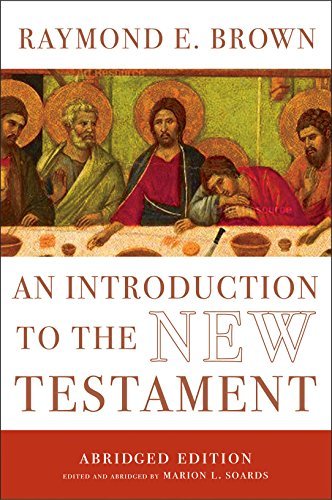
Brown was a very highly regarded academic. Bruce Metzger (who among a lot of other things helped translate and edit the Oxford Annotated Bible) stated that this was the NT Introduction to have, which is enough for me. Brown specialized particularly in Johannine stuff. You should know that he was also Catholic. There seem to be several other really good NT Intros out there, so you should shop around and see which vibe seems best to you.
This is a rigorous introduction to the NT (900 pages packed with substance) that covers each of the twenty-seven books in light of their textual evidence, cultural circumstances, import, and more. There is also a brisk but meaty overview of biblical studies (as of '97, so yes pretty dated, but if you know as little as I do it will still be rewarding) that outlines different forms of criticism (redaction, form, textual, historical, etc.).
To get the most out of it, you should either be prepared to read through the NT as you go through Brown's book, or already have a decent level of knowledge of the NT.
Brown gives a succinct summary of manuscript evidence and delves into textual intricacies to a head-spinning extent. For example, you might have a general awareness of the posited Q document that along with Mark forms the basis of material for Matthew and Luke, but let me assure you that this is just the beginning of the textual confusion. Scholars posit, among other things, a proto-Q text that fed into Matt/Luke and then a later, separate Q doc that fed only into Luke (and maybe even John!), and that thus explains the parables and other material that is unique to Luke. Biblical scholars continually have to work backwards from the extant manuscripts to such conjectured origins, then come up with theories that are based on the tenuous evidence of what’s at hand.
Brown seems to think that the Church intentionally placed books side by side that do not share the same outlook. I think that part of this is that ancients were not concerned with contradictions and inaccuracies in the same way we are. It is difficult to imagine an ancient being distressed that Luke’s local geography is a little off, or that the chronologies of events in two books don’t match up. But also Brown says this since he is on the side of the canon, on the side of the early Church’s decisions, so you should be wary of this as you read. Not to say he isn’t rigorous, fair, and thorough, but when the breaks happen to fall in the Church’s favor, he’s happy to point it out to you.
Brown really likes Paul, who is really hard to like. He is not content with exhaustively analyzing Paul’s letters and the details surrounding them as he has the other books in the NT: He also offers up an impassioned “appreciation” of Paul, this person who did more for Christianity than anyone else outside of JC. For Brown, Paul is directly responsible for opening the religion up to the outside world, and thus eschewing the Jewish rights and traditions that James (the brother of Jesus) and likely Peter wanted to maintain. Thus, if it weren’t for Paul, Christianity may have remained a Jewish sect, or disappeared altogether. The image of Paul is usually of a downtrodden man utterly alone. This is put well by Brown, who becomes uncharacteristically poetic when discussing Paul:
“One cannot help but recognize the grandeur and power of Greco-Roman culture.... Yet here was a Jew with a knapsack on his back who hoped to challenge all that in the name a crucified criminal....” He also calls Paul a “babbling ragpicker of ideas.”
Paul has alienated his own people; but he is also mocked by the Gentiles. He is in constant danger (see II Corinthians, 11:23-29 for an astounding passage). He had been stoned, whipped, nearly drowned, imprisoned, and threatened several times over. Violence and hostility were simply a part of his life.
In Romans, Paul differentiates between “strong” and “weak” Christians. The former deems it unnecessary to honor holy days and are convinced they can eat anything and drink wine at their discretion. The latter are cautious about what they eat and drink and observe all holy days. I think Paul might evoking the contrast btw JC and John the Baptist: JC came “eating and drinking” while JBap fasted and abstained; JC was strong, JBap weak. What you can infer from this is that the strong need not be bound by man-made laws, as JC himself was often indifferent to such laws.
So it’s fascinating to consider that most sects of Christianity have a rigorous system of observances that they tell their congregations they should follow (in Catholicism more than any other). Hence, it’s clear that most Christian sects treat their congregations as if they are in the “weak” camp (and I envision that this mischievous Pauline passage is not read in many church services).
Brown does a good job emphasizing that each of Paul’s letters was written to a specific community undergoing specific problems. A particular letter was not intended to provide a codified bulwark on which to put the religion. He notes that Paul contradicts himself, and that his views are more elastic than is often credited. But still, no amount of verbal somersaulting will disguise the fact that Paul was drearily patriarchal and homophobic (anachronisms, sure), fanatical, unbalanced, and of course relentlessly dogmatic.
The part on the Book of Revelation (Rev.) is good reading since that book more than any other requires a detailed glossing. What you come away with is that Rev. was a book primarily condemning the Roman Empire for, among other things, its persecution of Christians. Rome wants its people to be subservient, to worship the emperor like a deity. Jews and Christians usually refuse to do this. Rev. is a not entirely wholesome promise that revenge will come to mighty Rome (along with this is the childish idea that God “is on our side” and will make the bad guys pay). Rome = Babylon. 666 = Nero Caesar (the letters of his name add up to the number; also, it may actually be 616, Neron Ceaser). The “seven churches” are all communities in Asia Minor. Such point-to-point correspondences should help you not get carried away. There was an entire genre of apocalyptic writing back then. It seems that the end of the world was on a lot of people’s minds. (But maybe this is always the case. Are some generations/time periods more apocalyptic than others? And how does this vary by region?) Seen as an antiRome tract, a kind of revenge story with God as the eternal avenger, a lot of the mystery of Rev. is taken away.
One of the hard-to-grasp aspects of Rev. are the two tiny verses (Rev. 20.4-5) that describe the 1,000 year reign of Jesus and his saints that is to occur before the final resurrection. The Catholic church rejects even a mitigated form of such millennialism (as Brown is quite pleased to point out, not that I blame him), which is remarkable because it flies directly in the face of these two verses. It’s as antifundamentalist a stance as you can have. What’s illuminating is that Rev. has always been given a lower status than other books in the Bible. Even Luther saw it as second-tier scripture, and other early Christians and then later Protestants didn’t even accept it as part of the Bible. It has, according to Brown, the worst Greek of any book in the Bible, to the point of being ungrammatical.
The chronology, not to mention the very concept, of the millenary earthly reign of Christ is quite wacky, but as Brown shows, it’s clear that this belief arose out of a desire to reconcile OT prophecies about the restoration of a Davidic kingdom on earth with latter-day apocalyptic thought. This way, you get it all: Christ reigning on earth for 1,000 years (Davidic-like kingdom), and then shutting up shop for good at the final End Times (Armageddon).
Brown notes that the imagery of Rev. could be seen as putting the contemporary Roman propaganda on its head: instead of the Emperor slaying the dragon, the Emperor is now the tool of the dragon. (Both Augustus and Nero portrayed themselves as Apollo at times. And Apollo killed a dragon at the island of Delphi, which is not far from Patmos, where the Book of Rev. was written. The world is interesting.)
The end of Brown’s book is an appendix dedicated to eviscerating the pop academics who took part in the “Jesus Seminar.” Brown can barely contain his contempt for their project. And this is not due to Brown’s Catholicism; rather it’s due to what Brown sees as the travestying of actual scholarship that the Seminar undertook in order to grab headlines. As Brown notes: “From the beginning the seminar has sought popular media coverage to an extraordinary degree.... Thus, after almost every seminar session bombshell announcements are released to catch the public’s eye....”
Anyhow, Brown notes that actual real-life scholars who won’t appear on the local news or afternoon talk shows have had devastating judgments against the Seminar, stating, among other things, that it is “methodologically misguided” and “insignificant.”