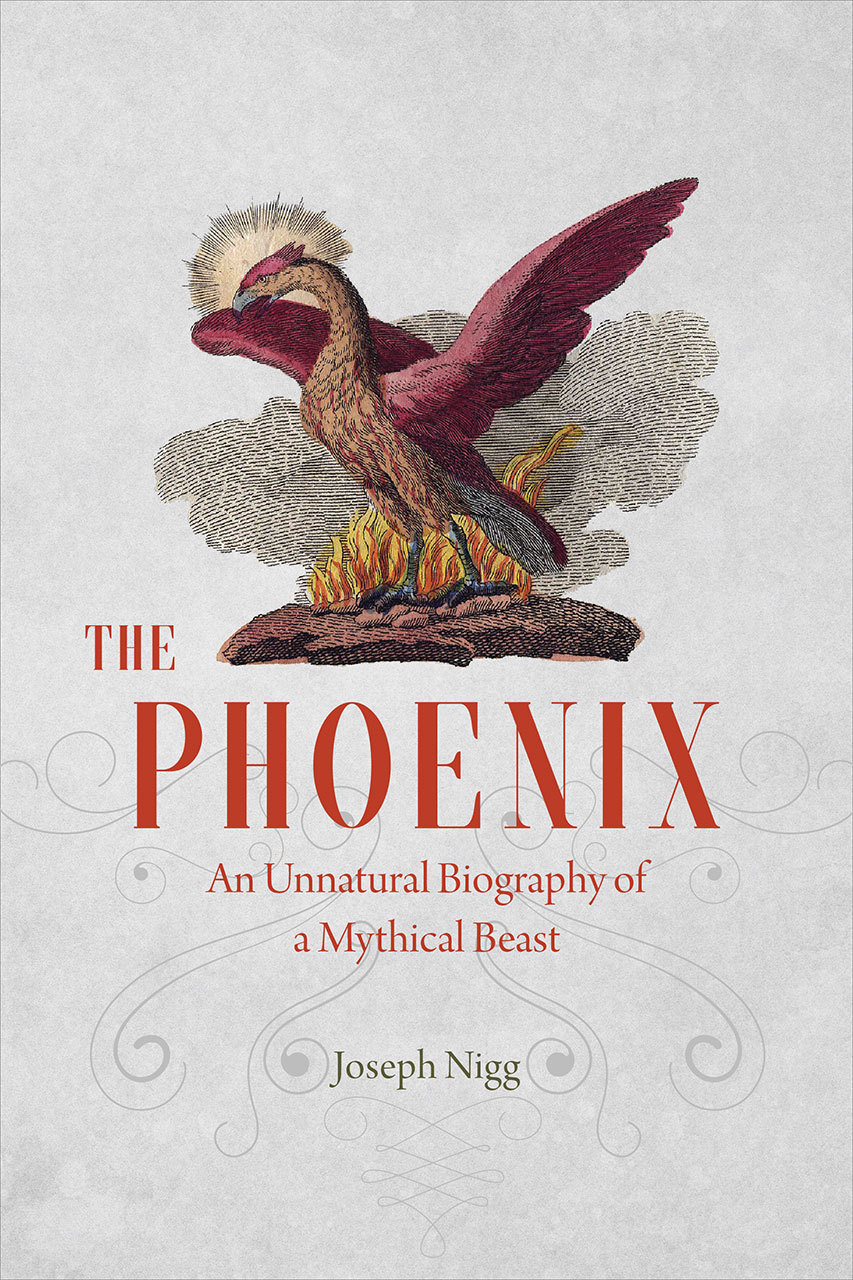
Arising triumphantly from the ashes of its predecessor, the phoenix has been an enduring symbol of resilience and renewal for thousands of years. But how did this mythical bird become so famous that it has played a part in cultures around the world and throughout human history? How much of its story do we actually know? Here to offer a comprehensive biography and engaging (un)natural history of the phoenix is Joseph Nigg, esteemed expert on mythical creatures—from griffins and dragons to sea monsters.
Beginning in ancient Egypt and traveling around the globe and through the centuries, Nigg’s vast and sweeping narrative takes readers on a brilliant tour of the cross-cultural lore of this famous, yet little-known, immortal bird. Seeking both the similarities and the differences in the phoenix’s many myths and representations, Nigg describes its countless permutations over millennia, including legends of the Chinese “phoenix,” which was considered one of the sacred creatures that presided over China’s destiny; classical Greece and Rome, where it can be found in the writings of Herodotus and Ovid; nascent and medieval Christianity, in which it came to embody the resurrection; and in Europe during the Renaissance, when it was a popular emblem of royals. Nigg examines the various phoenix traditions, the beliefs and tales associated with them, their symbolic and metaphoric use, the skepticism and speculation they’ve raised, and their appearance in religion, bestiaries, and even contemporary popular culture, in which the ageless bird of renewal is employed as a mascot and logo, including for our own University of Chicago.
Never bested by hardship or defeated by death, the phoenix is the ultimate icon of hope and rebirth. And in The An Unnatural Biography of a Mythical Beast , it finally has its due—a complete chronicle worthy of such a fantastic and phantasmal creature. This entertaining and informative look at the life and transformation of the phoenix will be the authoritative source for anyone fascinated by folklore and mythology, re-igniting our curiosity about one of myth’s greatest beasts.
Since the early 1980s, Joseph (Joe) Nigg has explored the rich cultural lives of mythical creatures in a variety of styles and formats for readers of all ages. His books have garnered multiple awards, and his current international bestseller, "How to Raise and Keep a Dragon," has been translated into more than twenty languages.
"Griffins, the Phoenix, dragons, unicorns, and other traditional animals of the imagination are all around us in words and images," Nigg writes. "But when you delve into the histories of these creatures, you'll find an incredible wealth of cross-cultural lore intertwined with history, myth, religion, art, literature, science, and specialized areas such as alchemy and heraldry. While looking beyond the popular presence of mythical beasts, you'll discover as much about the history and dreams of the human race as about our animal creations."
Nigg has been writing about fabulous beasts ever since he became intrigued by a fantastic animal figure on an antique lamp in his study. The winged lion with a fish tail eventually led him to the local art museum, where he was allowed to hold an ancient Persian silver cup embossed with griffins. That experience resulted in his first book, "The Book of Gryphons" (Apple-wood Books, 1982), a lavishly illustrated history of the eagle-lion beast. Since then, his scope has broadened to the entire host of fantastic animals worldwide. After twelve years of research and writing, Nigg recently completed THE PHOENIX: A CULTURAL HISTORY. The most comprehensive Phoenix study to date, the book traces the transmission and transformations of the mythical bird from ancient Egypt to the present.
He was born in Davenport, Iowa, and grew up throughout the Midwest. Holding an MFA from the Iowa Writers' Workshop and a Ph.D. in Creative Writing from the University of Denver, he taught at several colleges and served as the executive editor of a global network before writing full time.
So while I found a few things in here interesting, as a whole I just didn't care for this book too much at all. For one it was way too dry and factual. It was boring. And the author kept repeating the same myth stories about the phoenix over and over with slight little changes (as there were different versions from different groups of people) as if these tiny changes were some big deal. Well they are not a big deal to me. I don't need to hear the same basic story numerous times. I am just curious about various mythological creatures but I don't want to read a big dissertation on them that includes every little quote from every little paper written on the subject going back to the ancient Greeks. I mean that gets pretty boring!
And another odd thing is as far as I can figure the author himself doesn't seem to have an opinion on the creature. I want to know what does HE think on the phoenix? Does he think it was a real bird? Does he think it could actually live 500 or 1000 years? He is only quoting passages from other books and manuscripts. In fact that is all this book is. Quoting other books. It's like an essay! It's not really a book you read. And it doesn't answer the questions reading this brings up at all.
For example: many of the myths claim the phoenix dies and then a worm comes out of it's body. I certainly never heard that bit before! But the story says this worm then develops wings and in time it turns into a new phoenix. Well, that is NOT a bird. Birds don't start out as worms and they certainly don't do a metamorphosis! If that would count as a metamorphosis. But how can the author not discuss this in the book?? I mean what animal class does this change? Insects, amphibians... Something else? But it's not a bird. I just don't understand how you can write a big old fat book on this and totally ignore this - only repeat the old stories? I want to hear discussions and ideas and thoughts! Ideas that try to EXPLAIN what the ancient Greeks or Egyptians had seen! Try to guess! Because that would be interesting! But this book is nothing like that. It just repeats passages from old manuscripts, saying X said this in X year and Y said this in Y year. Its all very "factual" according to historical manuscripts. But also very boring. No imagination. No trying to explain anything.
The myths were interesting when I first read them in here. But then they are repeated over and over! They get old. Some say it looked like a eagle. Others say it looked like a water bird. No one can agree. Or on the colors it was. Did it actually carry the nest with the dead parent bird to the City of the Sun? And I really liked the version where the phoenix was protecting the earth (the inhabitants of the earth to be more precise) with its body as the sun was pulled across the sky. But the book is very dry and towards the end it gets even worse. More dull and boring.
Very thankful this was a library book so I can return it!
Only made it halfway through before it had to go back to the library. WAAAAAY heavier deep-dive into history than I anticipated - so this can surely function as the go-to compendium reference guide thing for anyone who needs to know all there possibly is to know about this beast's global origins. Didn't seem to function quite as well as a narrative, which is more the direction I'd hoped it would go. ah well.
This was by far the most joy I've ever taken out of a textbook-style book. I love how the exposition took me on a journey through history leading me to finally understanding how we obtained the mythical beast we have today: The wonderful-fiery Phoenix bird!
It was the modern interpretations of the Phoenix myth that really piqued my interest and led me to search out a book that could inform on where the heck this creature really comes from. I found this piece, and it was abundantly informative.
I learned a thing or two, both about history and the wonderous bird I'll tragically never get to see. Despite being a fan of almost solely fiction, this book has earned itself the honor of being one of my all-time favorites. If you have an interest in both knowledge and mythical creatures, this book is most definitely for you!
This book is exactly what I had expected: a thorough dive into the history and lore of the Phoenix bird across time and spanning multiple cultures, from the ancient Egyptians to the modern day. It is not a typical storybook or light-hearted fair. Instead, it is dense and academic-like, the type of book that you would cite in an academic paper or to give yourself inspiration to write a story of your own involving phoenixes, both literal and metaphorical.
But I was disappointed that there was no mention of a certain fictional defense attorney named after this bird, haha.
I was expecting a semi light hearted romp through history but got basically a history textbook. Full of interesting facts, it also has lots of long quotes and tangits into people or books that are minor. Would have been a much more readable book slightly condensed, but still interesting. Prepare yourself for the long haul though.
DNF The book started off very well but the author seemed to be too anxious to get to the Christian/European part of the Phoenix's story and left out the Persian part of the story.
A charming and fun biography of the mythical bird Phoenix.
One thing the book does not mention, that I discovered through an old cyclopedia is that during the early 1930s local Egyptians were claiming that a Phoenix actually existed and traveled to the city of Heliopolis (this city is not found on a modern map, but it does indeed exist, it has some of the oldest religious statutes; the statues have been photographed by National Geographic in the early 1920s). Their tale of the Phoenix was quite witty and probably fooled many people.