An Asiatic Greek in the time of Augustus, Strabo was a keen voyager that explored the four corners of the ancient world and compiled an important ‘Geography’ in seventeen books on his travels. Offering a window into the lost world of classical Rome and Greece, Strabo’s ‘Geography’ is a major source for the study of ancient geography, while providing important information on Greek cultic history and early theories of the nature of the world. Delphi’s Ancient Classics series provides eReaders with the wisdom of the Classical world, with both English translations and the original Greek texts. This comprehensive eBook presents Strabo’s complete extant ‘Geography’, with beautiful illustrations, informative introductions and the usual Delphi bonus material. (Version 1)
* Beautifully illustrated with images relating to Strabo's life and ‘Geography’ * Features the complete extant works of Strabo, in both English translation and the original Greek * Concise introduction to the ‘Geography’ * Includes H. C. Hamilton and W. Falconer’s translation previously appearing in Bohn Classical Library edition of Strabo * Excellent formatting of the texts * Easily locate the sections you want to read with individual contents tables * Provides a special dual English and Greek text, allowing readers to compare the sections paragraph by paragraph – ideal for students * Features a bonus biography – discover Strabo's ancient world * Scholarly ordering of texts into chronological order and literary genres
CONTENTS:
The Translation THE GEOGRAPHY
The Greek Text CONTENTS OF THE GREEK TEXT
The Dual Text DUAL GREEK AND ENGLISH TEXT
The Biography INTRODUCTION TO STRABO by Horace Leonard Jones
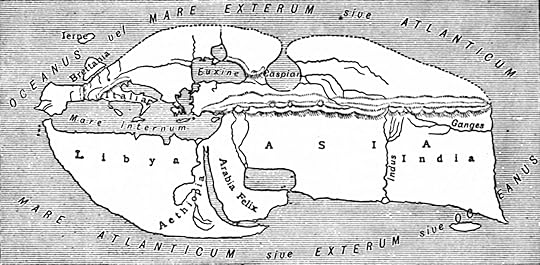
Strabo (63 BC – 23 AD) Geographica (3rd edition 2017- German translation by A. Forbiger) This edition is a treasure trove for scholars in Ancient Greek handwriting, provided with extensive footnotes. Strabo was a Greek philosopher, historian and geologist. He travelled extensively, as he says: "Westward I have journeyed to the parts of Etruria opposite Sardinia; towards the south from the Euxine to the borders of Ethiopia; and perhaps not one of those who have written geographies has visited more places than I have between those limits." He also spent much time in the famous library in Alexandria taking notes from "the works of his predecessors" and made use of ancient writings, always faithfully mentioning origin and author. Book 1: Justification and intent of the author’s work. Strabo requests his future readers to be philosophers with good knowledge of ancient literature and geography. His geography came to reach back in time to the Trojan war, to Homer, Hesiod and other poets of early written history. In Strabo’s time, the earth's shape as a globe was well established. However, it was believed the Universe and the Sun were rotating around the motionless earth. Book 2: A world map from the author's era was rectangular. From Iberia (Spain) and the Columns of Hercules (Gibraltar) as the Western border, it reaches as far as India in the East. Thule (Iceland) is the most northern point known and to the South it is beyond the Libyan deserts that the world ends in the outer Atlantic Ocean in the south.
In Strabo’s mind: “The Geologist only researches the inhabited part of the world.” Book 3: Spain. The author proceeds with the journey in clockwise order, starting at the far western point the “Pillars of Hercules” near Gibraltar and then Iberia (Spain). Descriptions of Bätica, Turdetania.Lusitania, Tha Balearic islands. Book 4: Gallia. His geography of Gallia has relatively few historical inputs, but he refers to some geography found in Julius Caesar’s ‘Gallic Wars’. A special description of Narbonensis and Aquitania. Gallica Belgica. Special notes on Brittanica and Thule (Island). Book 5: Italy as per Strabo’s time but with a start in history and evolution from a modest beginning as Latium, Sabinum, origins of Rome. Book 6: Lukanium, Bruttium; inner Greek countries. Book 7: Germany; On one side of the Rhine dwell the Gallic and toward the East are the Germans who are little different from the Gallic; physically as well as in their lifestyle; therefore, I think the Romans give them the name Germans, as in the Latin language Germani means ‘The same’… Book 8: Hellas; Geography from ancient legends, mythology, poetry and history as they were commented on by Homer and other poets as well as rich information from ancient philosophers, travellers, sailors and explorers. Describing historical events many ancient authors have some geography into their works, like Ephoros and Polybios, others like Poseidoneios and Hipparchos in their physics and mathematics. These are easy to evaluate, but with Homer, we go into more details, as the poet has often described geography in poetical ways and did not speak from present time places but from ancient ones, which time has altered or destroyed. Book 9: Megaris, Attika, Salamis. Böotia, Thessalia, Book 10: Euböa. Aitolia, Arkania, legends about the sects of the Curetes, description of Creta, islands of Cyclades and Sporades, Book 11: Asia. North of the Caucasian mountain ridge. Lake Meiotic, Pontos Euxeinos, Colchis, Iberia, Albania, Caspian Sea, Parthia, Media. Tauros, Euphrat, Tigris, Armenia. Book 12: Cappadocia. Kingdom of Pontos, Bithynia, Galatia, Mysia, Phrygia Book 13: Troas, the homeland of the Iliad is mentioned with large inserts from the poem by Homer. Book 14: Ionia. From Erythrai was Sybillah, the wise and holy woman telling prophecies in ancient times. Book 15: India is the part of the world, where Strabo uses large portions of reports written by philosophers taking part in Alexander’s Eastern exploration and submission conquest. No other Greek nor Roman had ever come this far to the east. The most unbelievable and fantastic stories were told. Strabo tries to consolidate the tales and legends dating from Herkules, Dyonisos, Kyros, Semiramis, up to more credible historians, like Eratosthenes, Onesikritos, Nearchos, Aristobulus. The size of India is said to be larger than the whole of Europe, from the Caucasus to the plains of the southern seashores, the largest rivers ever seen, over five thousand cities, peaceful populations, ruled by kings or holy men; seemingly endless rainy seasons flooding low countries; unknown food and wildlife; rich cultural traditions; abundance of gold, silver and precious stones. Book 16: Assyria, Babylonia, Mesopotamia. Syria, Phoenicia, Judäas. Strabo is mentioning Moses as an Aegyptian priest, a religion (Christian) that had a good beginning but ended badly. Book 17: Egypt, Strabo is mentioning his personal visit and experience in Aegypt. Ethiopia, and Libya. Description of Lybia, Mauretania, Numidia, Karthagho, Kyrene.
My view of Strabo’s work. I had not intended to repeat the headers of the 17 books, but it seems the only way to prepare a future reader for the special order by which the author presents his geography. Strabo’s writing style evolves for the better book after book. He may have spent decades preparing and produce them. In addition to geographical details, he provides rich information about the population in every country, their lifestyles, languages, physical appearance, clothing, food resources, agricultural and fishing, cultural traditions etc. Bounties of nuggets of historical treasures are revealed, sometimes rare or even unique. Indeed, the author was right to have some pre-requests for his readers if they want to get the most profit from it. Ancient Greek authors, like Homer’s Iliad, Hesiod’s Works and Days, Apollonius’ Argonautica, Pausanias works, Herodotus, Pindar’s poetry, Xenophon. Latin authors like Julius Caesar, Sallust, Velleius Paterculus, A.Florus, Caton, Tacitus, Lucan, Seneca, Plutarque, and others. All this literature will appear in some place or other in Strabo’s work and will make the reader feel at home, and make this book, after a difficult beginning an incredibly enjoyable reading experience. In the end, I would have liked it to continue.
Strabo intended his “Geography” to be a handbook for leaders of the early Roman Empire as well a contribution to scholarship in its own right. He often presents a bewildering cascade of names and places, but just as often folds in fascinating cultural, historical, and mythological insights and speculations. His work is a landmark achievement and an intriguing snapshot of an ancient world which no longer exists, but which was every bit as complex and colorful as our own.
A dry read end-to-end, but invaluable for getting a sense of what the early Roman Empire knew about the world. The translation is clear (I cannot judge its faithfulness), and the work is heavily footnoted.
A fun read, though I did skim a bunch in the middle. I made many highlights for future reference. I will say it was a pleasure in that I would consult Greek, Latin and English versions of the Iliad & Odyssey when Strabo referenced them. Classicist fun!
What did the world look like in the days of Jesus?
We actually have a source who is an early contemporary of Jesus and who wrote an account of how they saw the world: the Geography of Strabo of Amaseia.
Strabo wrote in the days of Augustus, perhaps around 20 CE. After setting forth his agreements and disagreements with former geographers, he covers the known world to the ancient Romans, starting with western Europe, going through the rest of Europe, Asia Minor, the rest of Asia, Egypt, and the rest of Africa.
Strabo was from Cappadocia and seemed to have been well-traveled; his information about Italy, Greece, and Asia Minor seem to come from first hand experience. He will give distances as they understood them, sometimes cultural information, sometimes historical data.
The greatest detail is provided for Greece. Even though Strabo is Cappadocian and thus “Asian” by birth, he maintains the Greco-Roman posture of seeing Asia primarily in terms of Asia Minor. It’s challenging for us to think of it that way since we look at much more detailed maps and from a different way. But imagine you don’t know much about the world much past the Caucasus, and the Anatolian peninsula was the closest point to you and the gateway to Asia for you.
It’s very interesting to see how Strabo, and by extension, Greeks and Romans in Augustus’ day, saw the world.
The Delphi Classics edition is well-formatted and provides either just the English translation or the dual Greek and English; I enjoyed the latter so I could check what the original was at various points.
A must read source for the classical period of minor asia history because whatever you read about this period, strabon is referred somehow. As the book was written before the political sovereignity of Roman empire upon this region, the most detailed part of the content is troas region as a natural result of those days most essential myth, İliad.
Amasya lı Strabon antik çağ Anadolu coğrafyasını çok güzel anlatmış. Heredot un tarihini, Ksenophon un Anabasis ini okumak isteyenler için kesin okunması gereken bir kitap. Strabon un anlatımına diyeceğim yok ama kitap kesinlikle daha güzel basılmalı ve mutlaka haritalar ile desteklenmeliydi. Okurken internetten antik çağ haritalarını aramak zorunda kaldım.
Of course, this is a reference book as opposed to something you can read end-to-end. A reference for scholarly types interested in broad geographic outlines of the world of Mediterranean antiquity, also with a treatment of Near and Middle East and Central Asia.
The good part about this book is that it is the newest translation available, and the notes are quite detailed. There is an enormous amount of work invested in the project. Strabo is as reliable and comprehensive as they come, and in this sense this book has no real competitor.
There are also weaknesses. As a reference book, one wants to have it in hardcover. This is quite expensive, and you simply have to buy the book of commentaries with it as well. The binding is solid, but the format and thickness of the book suggest you better treat it with great care for it to stay with you for a while. The online map, which used to be very helpful, does not work for me anymore with Chrome or Edge. Roller's prose is not particularly fluid. As far as the commentaries go, I am happy so far, but I did encounter one surprisingly weak point over time. In the discussion of Oxos vs. Ochos rivers, Strabo says "Some say that they differ in their mouths" which is a very interesting comment given the well-known variable course of Amu Darya--but somehow Roller is confused about this and does not alert the reader to what every Turkmen and Uzbek knows.