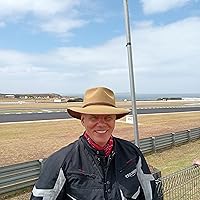
Murray Bail (born 22 September 1941) is an Australian writer of novels, short stories and non-fiction.
He was born in Adelaide, South Australia. He has lived most of his life in Australia except for sojourns in India (1968–70) and England and Europe (1970–74). He currently lives in Sydney.
He was trustee of the National Gallery of Australia from 1976 to 1981, and wrote a book on Australian artist Ian Fairweather.
A portrait of Bail by the artist Fred Williams is hung in the National Portrait Gallery in Canberra. The portrait was done while both Williams and Bail were Council members of the National Gallery of Australia
An interesting, entertaining, historical fiction novel set in 1950s and 1960s Australia, in mainly Adelaide, Sydney and Canberra. It is about the life of Holden Shadbolt up until he is 34 years old. Holden has an eventful life where he associates with a number of larger than life, unique characters. Holden is a guileless, steady, matter of fact man who can be relied upon. He is swept along by events that are driven by people he befriends. Holden has a photographic memory. In Adelaide he lives with his uncle Vern, a proofreader for the Adelaide Advertiser. Vern sticks to the facts and commissions statues for his backyard in the Adelaide hills. Soldier Frank McBee takes over Holden’s home where his mother takes on boarders. McBee initially deals in scrap metal, then sells cars and becomes a successful politican. Holden moves to Sydney on a whim and finds work as an usher and bouncer in a Manly cinema. There he comes under the eye of Senator Hadley who employs Holden as his chauffeur and security officer.
Holden is a passive, very tall, fit man, who is a good mechanic and doesn’t seem to need to spend money. He is a man who consumes words, reads and observes. He is not a mover and shaker.
A novel where lots happen, with many odd, absurd situations. Senator Hadley is bedding every public servant’s wife in Canberra whilst running three departments. Alex Screech turns a pile of Australia shaped vomit into a tourist attraction.
There are lots of descriptions of life in this period. For example, the author describes the demise of trams in Adelaide in the early 1950s and the effect of television on movie theatres during the late 1950s and early 1960s.
An enjoyable, satisfying reading experience.
Here is a quote from the first page of the novel: “When the last of the city’s trams were removed with their poles and bells and the industrial paraphernalia of lines imposed on the mind’s eye, it was though a great net had been lifted clear of the city, letting in light. The trams had been inflicting all kinds of untold damage, running amok at will. Anyone living there beyond a certain length of time was in danger of becoming marked, ruled by inner groves.”
This book was shortlisted for the 1987 Miles Franklin Award.
It can be difficult to enjoy a novel when the principal character has virtually no personality and few skills apart from a photographic memory, a stoic tolerance of boredom and an ability to keep his mouth shut.
Such is Holden Shadbolt, a young man growing up in Adelaide, with his mother and sister (his father was killed on the job as a tram conductor by American soldiers on R&R leave during the war). In his late teens, Holden visited Sydney, decided to stay, gaining employment as a bouncer in the Epic Cinema, which showed only black and white newsreels.
Coming to the attention of a government Minister, Holden relocated to the nation's nascent capital, Canberra, firstly as a driver to said Minister Hoadley, and later as a body guard, responsible for the safety and security of the Prime Minister and visiting heads of state.
It was exactly Holden's (lack of) personality, his physical size and his uncomplaining tolerance of tedium that made his so well suited tho these occupations.
But if Holden seems boring, the novel certainly is not (neither is Holden really), in the deft and skilled hands of Murray Bail.
This novel, which was shortlisted for the Miles Franklin in 1987 (beaten by Dancing On Coral by Glenda Adams), is my first taste of Bail's witty and incisive writing, and I was mightily impressed. Bail later won the Miles Franklin in 1999 with Eucalyptus, which is sitting on my bookshelf awaiting its turn.
The novel covers the period from the years of WWII until the mid sixties, ending chronologically with a reference to the drowning death of new Prime Minister Harold Holt.
What Bail has captured so eloquently, with an amazing set of characters apart from Holden, is the emergence of sleepy Australia after the war, overcoming a period of sacrifice and privation, finding a new entrepreneurial spirit and drive to build prosperity across the nation.
Corporal Frank McBee, who moved in with the Shadbolts during the war, and who courted Holden's widowed mother, and later his sister, is the bold and brassy face of this go-ahead spirit, a man who is awake to every lurk and perk available to a street smart operator in this post-war economy.
The shift from Adelaide to Sydney and Canberra introduces the reader to the period of conservative politics that dominated more than two decades of the post-war period, focusing on the philandering Minister Hoadley (for whom Holden drives) and with several references to Prime Minister Menzies, (whom Bail refers to as R G Amen). And, of course, there is no holding back McBee, whose personal ambition also drives him in to the worlds of state and federal politics and influence.
There are so many great characters in this novel, which is written with verve, wit and incisive humour, and provides wonderfully evocative insights into the Australian culture of the post-war period.
I've read a bit of Murray Bail - Eucalyptus of course, but also Homesickness and The Voyage. I enjoyed all three in some ways, but I'm not sure I enjoyed them as much as I enjoyed Holden's Performance, written just before Eucalyptus, even though the latter has a tighter structure.
Holden's Performance is the life story (up to age 34 anyway), of Holden Shadbolt, from his childhood home in Adelaide, through soujourns in Manly and Canberra, as he absorbs the world of the forties, fifties and sixties Australia through his photographic memory, aided by constant updates from the news via his Uncle Vern, a proofreader for the Adelaide Advertiser. Bail's novels are always filled with wild characterization, and Holden's Performance is no different. Vern sticks to the facts and commissions statues for his backyard in the hills, the soldier Frank McBee takes over Holden's house, mother, and daughter as he rises from dealing scrap to selling cars to political notoriety, Senator Hoadley, bridge lover, gourmand and serial adulterer who falls from grace, Colonel Light, leader of the Prime Minister's security team and one who comes closest to Holden. Not to forget Alex Screech, owner of the Epic Cinema in Manly, the man who offers Holden his first job, and Harriet, his love-interest.
Via this cast of misfits we traverse the end of the war, when people could make fortune out of scrap if they were quick on their feet, the fifties and the beginning of car-culture, when trams were seen as passe, through to the sixties and the beginning of the counter-culture. Holden, huge and passive, takes it all in his stride, no matter how strange the events. His passivity in the face of outrageous events taking place all around him is hard to grasp. Even when he shoots at McBee or makes love to Harriet he doesn't really feel any excitement, merely acceptance.
This to me is typical of the novels of Bail's that I have read. The main character is swept along by events that are driven by the "minor" characters, all of whom seem to have more life than the protagonist: while I enjoyed this book, I never really warmed to Holden. Bail's strength is to write the absurd and make it seem believable. From McBee getting his one-legged friend to sign-write in the sky, to Hoadley bedding every public servant's wife in Canberra while running three departments, to Colonel Light living in a tent on Black Mountain, to Alex Screech turning a pile of Australia-shaped vomit into a tourist attraction, Holden's Performance as a rollicking ride of nonsense, but a ride I didn't want to climb off.
So the characterization and episodes have strength - what of the plot? Here is where Bail stumbles. Unlike Eucalyptus, Holden's Performance lacks a narrative arc. This is not necessarily a problem for any particular novel, but I think it is here: so many things happen to Holden - we see his life change in very definite ways about five times - but the novel just peters out; Holden becomes too big for Australia, but we as the reader leave him just as he is beginning his biggest adventure. I was left feeling unfulfilled, which is a shame, as there is much to recommend this book.
As for a theme, unlike some of Bail's other work, I struggled to find one - perhaps the Americanization of Australian culture is one, but if so it is lightly donned. I feel that again like some of his other work, Bail had lots of ideas and crammed them all into one book without thinking too much of how they fit together or what story they tell.
While I'm not sure that Holden's Performance is the best Murray Bail novel, it's the one that I've enjoyed the most.
I really don't know what it is that is so fascinating of Murray Bail's writing. I seem to not particularly care of the plot or characters but yet I can't seem to put the book down. I kept being drawn on and on to read. I think it's the way he describes life in general or rather life in Australia in general. The way he puts things into particular perspective that really speaks to me.
I'm still wondering how this title, "Holden's Performance", applies... You'd expect this Holden to be some extraordinary man and the thing is, there was nothing spectacular in his background or upbringing except for his photographic memory. In the end, his overall blandness made him exceptional.
I picked up a copy of this book in a London book stall on Holloway Road after reading the preface. I had no knowledge of Australia other than it was on the other side of the World but something grabbed about the story. I finished the book in short time and never having heard of a Holden car had no idea it was related.
The description of Adelaidians living under the oppressive canopy of tram cables had me hooked and it remains one of my favourite reads.
Bizarrely, I now live in Adelaide and they installed trams a few years ago. No Lcpl McBee though.
A fantastic book! I love the way the book was written - and the sly commentary on Australia after World War 2, especially the way the author managed to do this through other characters' points of view, and not through the main character, Holden - who is a staunch, unmoving man. This book reminded me of The Hundred Year Old Man by Jonasson - I really enjoyed this book.