Rumi was a thirteenth century poet, philosopher and mystic whose works have been studied for centuries, and still speak to us today. Some of his songs have been put to music by contemporary Western artists, and now this book brings a wise story about true love into the English language in book form.
This is a retelling of a Persian folktale, about a merchant likes to keep her pretty birds all locked up in cages. The parrot is unhappy, and misses his companions.
So, when the merchant gets ready to go forth again, she asks the parrot what he would like from his travels, and he says he would like to hear word from his friends.
In the end, the parrot finds a way to not be cadged, as that is what he has been this whole time.
And the merchant learns that having the parrot free is not that bad.
A cute tale about freedom and imprisonment.
Thanks to Netgalley for making this book available for an honest review.
Another from Tiny Owl’s ‘Rumi’ series; I do hope there are more to come. This story tells of an extremely wealthy Persian merchant, Mah Jahan, whose most treasured gift is her caged parrot. After asking her servants what they would like her to bring them on her travels back to India, the parrot’s homeland, she turns to her beloved bird and makes the same request. In reply, the parrot asks her mistress to visit her fellow parrot friends from home. True to her word the merchant does so and what unravels is a clever little story about wit, guile and unpredicted freedom.
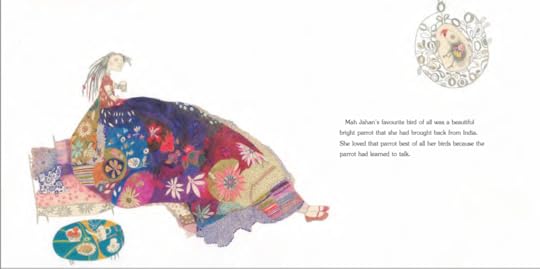
I enjoyed this story and found Marjan Vafaeian’s illustrations beguiling. The female merchant and her refineries dominate the pages whilst her servants and objects are merely chorus-like specks in the background. Images will intrigue and excite and with all of Tiny Owl’s Iranian artists will mostly be a style and format that most children will have yet to encounter.
I actually laughed at this, such a smart story with some really good undertones of morality and freedom in it. I would definitely get this books for my class.
This book is based on a 13th century poet called Rumi. It tells the story of a merchant from Persia who buys and sells things all over the world. She collects lots of birds on her journeys, her most precious being the parrot she got from India. At the end of the book, using the advice the other parrots gave the merchant on her visit to India on how to make the parrot happy again, the parrot becomes free. A message of the importance of freedom is shown in this book and how if you truly love something, you can set it free. The illustrations in this book are beautiful and i liked how the merchant is the biggest image on each page, with her servants shown a lot smaller - this shows the hierarchy. I look forward to reading more tales by Rumi in the future.
Vafaeian's illustrations and re-telling of Rumi's poem is quite entertaining and fun. I love reading old stories, retold for modern readers. The Parrot and the Merchant has a theme that many books do: if you truly love something, you set it free. I love the story, but do not really care for the illustrations. They are nice, but the one-eyed merchant illustrations are just odd.
Thank you NetGalley and Tiny Owl Publishing for the opportunity to read an advance reader copy.
It's a short translated and illustrated work of Rumi intended for children. A very small edit is done to the original content to give a feminist perspective and I definitely liked it.
Adapted from a story by Rumi, a thirteenth century Persian poet, this one has an ending that will surprise readers. Mah Jahan is a wealthy merchant who travels a great deal in order to find new goods to sell and in order to see the wares she has. She collects birds and is particularly fond of her talking parrot. When she sets off on another journey, she promises to bring back presents for her servants and to give the parrot's regards to its other parrot friends. The trip goes well except that when Mah Jahan visits the other parrots living in the wild, one falls from the branch on which it is sitting. Even though she doesn't want to bring this sad news to her beloved parrot when she returns home, she does. Her parrot immediately falls from its perch, causing Mah Jahan to open its cage and try to bring it back to life. As it turns out, the bird was only playing possum so that it could find a way out of its captivity. While Mah Jahan is sad to lose her bird as it flies home to India, she is also happy for it. The illustrations are filled with lovely colors, a rich tapestry that bears looking at more than once, while the story itself contains an important message as it reminds readers that treating those we love with respect and the same care we would want for ourselves is essential.
Marjan Vafaeian retells the old fable by Rumi in a contemporary way. Organizing the text in simple sentences, the author also uses a lot of fine illustrations to make the story more interesting. The theme that the story highlights is about the importance of freedom. The story describes how imperative it is to give freedom to your loved ones even if it means letting them go. With lucid language, the author successfully conveys such an important message.
The book is well suited for children in the 1st or 2nd grade. Keeping that in mind, I felt the illustrations were superfluous. For an instance, the cover design might not be understood by the children. Even on the inside, the illustrations are too complicated to comprehend. This might be a different form of art (apology for my unawareness) but it will not be comprehensible for the children.
Another drawback of the book was the price; the book is priced at 175 INR which seems more for a mere 12 pages.
I received an electronic ARC from Tiny Owl Publishing through NetGalley. Highly detailed illustrations support this retelling of the legend by Rumi. The merchant loves birds and keeps them in cages. She is especially fond of the parrot who talks with her. When the merchant prepares for a buying trip to India, she asks the parrot what she wants brought back. The parrot asks that she speak with the parrots there. The merchant does so and brings back the tale of a parrot dropping "dead" from sadness. The parrot drops as well and is freed from her cage. The message of freedom is universal. Early readers will appreciate the colorful illustrations and story. Older readers will appreciate the story and the message beyond the story. The translation seems true to the original story and lesson to be shared.
The story is simple and teaches us the importance of feelings that even birds have. The language is simple and the illustrations are beautifully done. I loved the story and would recommend it to all parents to read to their young children.
My Thoughts This is a clever tale retold so very well to fit the here and now and its audience as well. A female protagonist replaces the original merchant to lend a twist to this story. It is retold simply and sweetly while still retaining its original mood and message.
This book shows how timeless and universal stories can be. Vafaeian’s bright, gorgeous yet quirky illustrations are full of color and details and oddities you don’t want to miss. I know I want to hold the physical copy of this book to enjoy the illustrations over and over again.
A story that teaches of love , of freedom, and of letting go without being preachy; and with eye-catching illustrations is certainly one worth reading – for all ages.
Note: Some of the illustrations seem a bit gloomier or darker (sometimes a little creepy though not to the point of being scary), but they complement the text perfectly.
In Summary A book that is a wonderful gift for yourself or others. A great addition to any library.
The Parrot and the Merchant . Publisher : Penguinindia Written by : Ali Seidabadi Retold and illustrated by: Marjana Vafaeian Rating: 4 out of 5
The parrot and the merchant is based on a fable by RUMI .
The parrot and the merchant revolves around the story of a merchant named Mah Jahan of Persia .She loved to collect birds and used to cage them .........Her most lovable bird was A parrot from India who could talk .......
Mah Jahan was taught a lesson by her parrot that the happiness of our loved ones lies in their enjoying freedom ...and not by securing them with us for our enjoyment ......
How did the parrot teach the lesson? To know more read the full story of The parrot and the Merchant :)
Although this is based on a tale by 13th century poet Rumi, Marjan Vafaeian has opened a window to what many might consider a "folk tale".
Mah Jahn, a Persian merchant, travels to buy and sell beautiful things. For herself, she collects beautiful birds and puts them in cages or on chains. Before one of her trips to India, her talking parrot asks her to say hello to his parrot friends and to ask if they have any advice for him. She is surprised by the clever answer she delivers to her parrot. Vafaeian's illustrations have a strong sense of place and culture, supporting the story well.
An excellent choice to add to folklore collections or studies about the Middle East (particularly Persia).
This book touches on two key universal values: love and freedom, and how one cannot exist without the other. This is a great way to introduce children to such an important philosopher as Rumi. Ancient teachings are so important. They are timeless as well. This book is perfect for doing bird freedom campaigns, it can be used in a community read-out-loud activity for children, for example. I come from a country where unfortunately having birds in cages as pets is common and people are especially fond of talking parrots just because they might say the same lovely phrases we teach them back to us, but that doesn't mean that the animal is happy.
Based on the original tale by 13th Century philosopher Rumi - this tale is a gorgeously illustrated with a quirky style that makes the picture book unusual and engaging. The artwork is captivating and the storyline is unique - it really transported me into the world of the Rich merchant woman, Mah Jahan and her collection of wondrous birds. The idea of love and letting go are powerful and will make readers of all ages think.
The original story is written by a renowned poet Rumi. The story was adapted and illustrated by Marjan Vafaian. The casting of a female lead as a merchant gave a new twist to the story and I could not guess the ending until the middle of the story. The artwork by the author is unique. I loved the colorful dresses of the merchant. I feel that this book would be more beautiful in physical form rather than reading it digitally.
Clever, clever tale! All ages will enjoy this story! I love when people rewrite Rumi's works to fit their own cultures. Rumi was truly a gifted writer with universal appeal. The illustrations were wonderful. I think this is a book for both my private collection and a suggestion for my library! I received a Kindle ARC in exchange for a fair review.
A clever story about a parrot and its merchant owner who freely travels to many countries trading goods, collecting birds and gifts for her servant. She treasures her parrot but knows he is unhappy, so asks what gift he would likes from her trip to India. Little does the merchant know but when she arrives back from her trip, all her parrot wants is freedom.
It’s quite a heart stirring page turner, the kids and I were blown away by the colourful illustrations. So vivid and so magical, woven almost like a beautiful Persian carpet.
A beautiful tale of love and finding joy in letting go of someone you love.
This is a story based on a tale from Rumi. It has a good moral: to work together for freedom. I disliked the distorted artwork of the people and parrots in the book.
This book is a lovely tale about a merchant who locks her birds up. The storyline provides so much discussion and hidden meaning such as animal cruelty and even immigration. The illustrations are beautiful and colourful. I highly recommend this book
The Parrot and the Merchant is an old legend tells with stunning illustrations and a focus on how we show our love to others. When a merchant catches and keeps things she loves, she doesn't realize how much pain she is causing them. On one journey she asks her most beloved parrot what he would like and he asks for advice from his friends he left behind. Through an odd exchange the Merchant's parrot and up free and she realizes it is the right thing to do because she loves him.
I’m not exactly sure how I feel about this book. The illustrations are so unusual, especially in a children’s book. The story is sad. It's a centuries old fable retold for today's generation. A parrot is captured and taken to another land. When its captor asks if it wants anything from its homeland, it requests messages of help from his parrot family. All the parrot wants is to be free. It eventually gets free, and the woman who captured him is happy because of love, but … there is just something that turns me off.