Jump to ratings and reviews
Rate this book

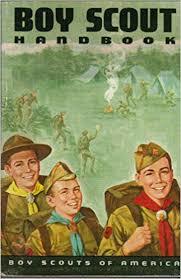
The Boy Scout Handbook and Other Observations

Rate this book
A collection of literary, cultural, social, ethical, and political commentary by the noted critic explores a wide range of diverse topics, events, activities, objects, and beliefs

294 pages, Paperback

First published January 1, 1982

Loading...
Loading...

About the author

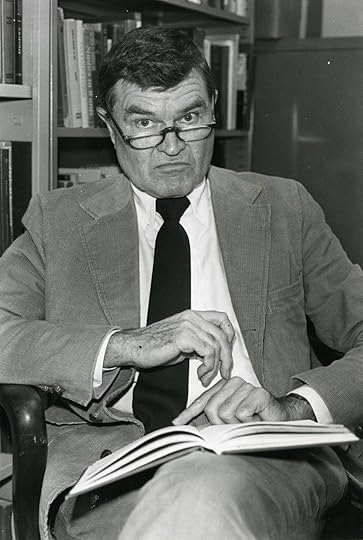
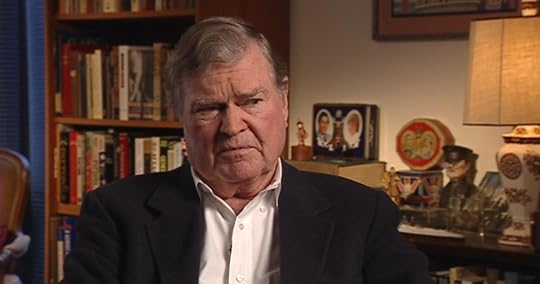
Paul Fussell

50 books142 followers
Paul Fussell was an American cultural and literary historian, author and university professor. His writings covered a variety of topics, from scholarly works on eighteenth-century English literature to commentary on America’s class system. He was an U.S. Army Infantry officer in the European theater during World War II (103rd U.S. Infantry Division) and was awarded both the Bronze Star and the Purple Heart. He is best known for his writings about World War I and II.

He began his teaching career at Connecticut College (1951–55) before moving to Rutgers University in 1955 and finally the University of Pennsylvania in 1983. He also taught at the University of Heidelberg (1957–58) and King’s College London (1990–92). As a teacher, he traveled widely with his family throughout Europe during the 1950s, 60s and 70s, taking Fulbright and sabbatical years in Germany, England and France.


Ratings & Reviews

What do you think?
Rate this book

Friends & Following

Create a free account to discover what your friends think of this book!

Community Reviews

5 stars
12 (28%)
4 stars
27 (64%)
3 stars
3 (7%)
2 stars
0 (0%)
1 star
0 (0%)
Displaying 1 - 5 of 5 reviews
Profile Image for Quo.
364 reviews
December 22, 2021
Reading an anthology of essays cover to cover can be likened to reading a cookbook in its entirety; more often than not, one chooses specific essays depending on the topic, one's mood or the length of an individual essay, not worrying about continuity. However, in the case of Paul Fussell's The Boy Scout Handbook And Other Observations, there is a surprising cohesion among the 34 essays and also an interesting progression that I'd missed at 1st glance.

Many years ago, I chanced to find the initial essay in this anthology, "The Boy Scout Handbook" in an anthology for college freshmen published by Macmillan, an essay I found exceedingly interesting, especially given my own long association with Scouting.


Fussell's anthology begins with a thorough look at the Handbook For Boys as one might a more formal document, examining its cultural aspects but also its long-standing place in the moral development of older boys on the threshold of manhood.

He notes the background of founder, Lord Baden Powell & the evolution over time of the Scouting movement in America, commenting that "like the Roman Catholic Church, the scout movement knows the difference between cosmetic & real change, and it happily embraces one to avoid any truck with the other."

Fussell notes that the guidebook for scouts uses words like biosphere, ideology & ecosystem, assuming an audience prepared by a good high-school education. Further, there is a very conscious focus on diversity within the American landscape & "a kind of religiosity that is so broad that it's harmless", another attempt to embrace those who are not necessarily white or protestant. There is mention of Harriet Tubman & Martin Luther King as well as the Roosevelts, Samuel Gompers & Einstein.


Indeed, The Boy Scout Handbook
is among the very few remaining popular repositories of something like classical ethics, deriving from Aristotle & Cicero. And, if the book adheres to any politics, they can hardly be described as conservative but are better described as slightly archaic liberal.

Some advice is even intellectual & pleasantly uncompromising: Reading trash all the time makes it impossible for anyone to be anything but a 2nd class person. Therefore, learn to think, gather knowledge, have initiative, respect the rights of others.

A scout tells the truth. From such suggestions, Paul Fussell infers that a scout does not designate his fellow citizens as "shits" (as Nixon did during Watergate) & then lie about it. There is also the recommendation that a scout take a 2 hour walk about his neighborhood, making note of the things he likes & those that require improvement, devising a plan for their enhancement.
This anthology was compiled some 30 years ago & much has changed since then but I suspect that the most recent edition of The Boy Scout Handbook would still meet with Fussell's approval, remaining as he declared it "a book about goodness."

And as mentioned, there is a continuum that binds the essays. The author's experiences as a young man in the American military during WWII were critical to his development & he uses the word Irony with great frequency, having survived several years of devastating combat but with something like residual PTS even after later becoming a tenured professor at Rutgers & the University of Pennsylvania.

Fussell comments that "to become disillusioned, you must earlier have been illusioned!" His war experiences were traumatic but Fussell indicates that the military induced in him a compulsion for classification, with academic hierarchy seen as akin to that in the military & an abiding need to type everyone by their job specification, by social position, status, cultural gradations, etc.

And because he was gifted at explaining things to other soldiers, from field artillery & other weaponry to reading maps, he decided that he might be qualified to pursue a career in education
following the war.


In an essay on travel, "Footwork as Scholarship", Fussell distinguishes between an explorer, a traveler & a tourist, with Sir Aurel Stein detailed as an example of the vanishing breed of explorers, one who stands as a model of intellectual curiosity. In "The Regrettable Decision of Herman Wouk", that once-popular author is denigrated, being "crude & sentimental as a novelist, a master of cliches & characters without a complex inner life but when writing as a historiographer occasionally admirable."

Meanwhile, W.S. Maugham is belittled as "the Hearst of literature", someone who while growing old was an international spectacle on the order of Dorian Gray. Graham Greene is faulted for his use of the English language, deemed highly improper by the author but Evelyn Waugh teaches us "something we greatly need now: namely, the usefulness of the objective comic vision in transforming anger & violence into verbal art & verbal play."

In "The Persistent Itchings of Poe & Whitman", Fussell exhibits a kind of literary criticism that is at a rather inaccessible remove for many readers but as an analytical appraisal of the personalities of both poets, he is masterful.

Much is made of the coverage of war in general & particularly WWII and Paul Fussell comments that while Americans who experienced combat tended to write novels, British veterans were prone to write memoirs of their war experiences. Vonnegut & Pynchon stand out as the novelists who seem to be elicit the most praise in terms of their war-based fiction, perhaps because they offer literary coverage of war that has an ironic touch.

There is a seemingly condescending nature to at least some of Fussell's commentary, or perhaps the author merely asks the reader to aim a bit higher, to extend beyond his normal literary reach. Some would call this elitist but again, the author seems not so much snobbish or pompous in his approach to writing but often just very protective of the English language. The "bitchiness" toward other authors is less easy to tolerate.

One of my favorite essays in this anthology is "Sincerity Abroad", an account of a "peace initiative" in which Henry Ford & a group of eccentric pacifists, cranks, "divines" & Paul Fussell's own father set off from New York en route to Oslo in 1915, attempting to convince the European combatants that war was a fool's gambit.

In an ironic twist, the "Oscar II", the ship they sailed on was sold to the Japanese for scrap in 1930 & used to build battleships, while many of the ideas for a peaceful resolution of WWI that the motley group of Americans espoused were later adopted in the post-war peace pact.


The last essay is entitled "My War" & is a very personal account of Fussell's combat experiences:
I find the word combat embarrassing, carrying as it does chivalric overtones. But the synonyms are worse: fighting is not accurate because much of the time you are being shelled, which is not fighting but suffering; battle is too high & remote; in action is a euphemism suited more to dire telegrams than description. "Combat" will have to do & my first hours of it I recall daily, even now.

They fueled, & they still fuel, my view of things. After a night of almost constant shelling, I awoke to find that the objects I'd almost tripped over in the dark were the bodies of dozens of dead German boys in greenish-gray uniforms, killed a day or two before in the first shelling. I suddenly knew I was not & never would be in a world that was reasonable or just.

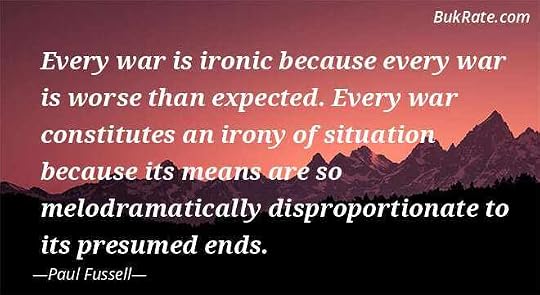
Irony best describes the emotion, whatever it is, occasioned by perceiving some great gulf, half-comic, half-tragic, between what one expects of life & what one finds. For example, because the war had been expected to be over by fall, soldiers were not properly protected against winter exposure with decent mittens & gloves, fur-lined parkas, thermal underwear. The result of ignoring the Boy Scout injunction, "Be Prepared" was 64,008 casualties from "cold injury"--not wounds but pneumonia & trench-foot.

Those who fought on the line in the war, especially if they were wounded, constitute an in-group forever separate from those who did not. They have an instinctive skepticism about pretension, publicly enunciated truths, the vanities of learning & the pomp of authority. They know a secret about themselves & it's not very nice.
Paul Fussell's best-known work is The Great War & Modern Memory, winner of the National Book Award. If anyone chances upon the essay anthology I've just sought to describe, I suspect that they will find the quality of writing of interest. However, even more than that, the reader will come to understand how someone who has experienced several years of warfare is forever marked by the constant daily exposure to the very thin between life & death.

*The Boy Scout Handbook & Other Observations includes a few B&W photos, chief among them being those in the essay "What We Look Like".
Profile Image for Tim.
1,232 reviews
June 25, 2009
A fine collection of Fussell's short essays and book reviews. Always entertaining as he writes about Boswell, Waugh, Theroux, Nabokov, and Graham Greene (wondering if he can actually write English) among others. He takes apart the Time-Life series on World War II, noting "they have earned their popularity by delivering a version of the war falsely dramatized and falsely cheerfulized." (225). He praises the Boy Scout Handbook as "something like a repository of classical ethics" where "the constant moral theme is the inestimatable benefits of looking objectively outward and losing consciousness of self in the work to be done." (6) The book also contains short essays that point to his wonderful book on class and to his book Wartime, on World War II.

In the book's last essay, "My War," he asks:
How did I pick up this dark, ironical, flip view of the war. Why do I enjoy exhibiting it? The answer is that I contracted it in the infantry, and I suspect I embraced it with special vigor once I found how it annoyed people who had not fought at close quarters in terrible weather and shot people to death and been hit by a shell from a German gun. My view of the war is a form of revenge. Indeed, the careful reader will have discerned in all the essays in this book a speaker who is really a pissed-off infantryman, disguised as a literary and cultural commentator. He is embittered that the Air Corps had beds to sleep in, that Patton's Third Army got all the credit, that non-combatants in the Medical Administrative and Quartermaster Corps wore the same battle-stars as he.... These are this speaker's residual complaints while he is affecting to be annoyed primarily by someone's bad writing or slipshod logic or lazy editing or pretentious ideas." (254) It is good to listen to Paul Fussell's complaints.
1,031 reviews20 followers
October 21, 2014
The obvious inspiration, freely admitted by Fussell, for "The Boy Scout Handbook" is Orwell, in particular Orwell the essayist. Orwell is best known for his fiction these days but he spent much of his time writing, and writing really well, about literature, with a simple, straightforward style and a brilliant knack for analyzing what the books we read say about us. Fussell, being a professor of English rather than a journalist, is slightly more formal and technical and tends to write about more "literary" topics -- Poe and Whitman rather than schoolboy stories -- but he is clearly aiming to produce a similar effect. The resemblance is heightened by the fact that both writers have their own, occasionally cranky, ideological niches: just as Orwell's idiosyncratic socialism led him to reject most other socialists, so Fussell's idiosyncratic liberalism leads him to reject most other liberals. Fussell stakes out this terrain in the opening and title essay of this collection, in which he defends "The Boy Scout Handbook" (the actual one) from liberal charges of conservatism and militarism. For Fussell, the Handbook represents a type of "archaic liberalism", one that he endorses by implication (one is reminded of Orwell's endorsement of Dickens' 19th-century liberalism against the "smelly little orthodoxies" of the '30s). Alas, from a political point of view Fussell's ideas are much less clear than Orwell's, and his archaic liberalism has a tendency to dissolve into curmudgeonliness. Some of this is doubtless deliberate: one of things Fussell dislikes about the modern world (that is, the '70s and early '80s, when the essays in the book were written) is what he sees as a tendency towards sincerity at the expense of irony, and there's no question that he enjoys playing the part of a cantankerous old man, and does it quite well. Still, this means that certain of these essays do not age well, as Fussell's denunciations of the modern world of the '70s have considerably less effect 40 years later. For instance, an indignant essay about the way that Booth Tarkington's "Penrod" was bowdlerized to remove Tarkington's patronizing racism is no longer quite as topical and trenchant as it once was. Fussell is certainly correct to be indignant -- in this particular case, because this process also removes Tarkington's rebuke to a more virulent racism, and in general because editing books in this fashion never leads to anything good -- but it's hard to get worked up about it because this battle has long since ended and also because "Penrod", and Tarkington, have faded into obscurity. Other essays are about literary figures of the past who were obscure in Fussell's day -- Baron Corvo, Ivor Gurney, Harry Crosby -- and have vanished now. Few modern readers are likely to have any particular idea who these people are or why we might care, but Fussell's short essays take some such knowledge on the part of his readers for granted and so can be difficult to get much out of. And his piece on the perfect locale for convalescence, "A Place to Recuperate", sounds quite frankly like an idealized dream of foreign travel in the '20s or '30s, something which he was not old enough to have experienced: it takes playing the part of the grumpy old man lamenting the decline of civilization a little too far.

Nonetheless, Fussell is a fine writer, and many of the topics remain interesting: for instance, his notes on social class in America, though now out of data, are a fun read, even if you disagree with some of his conclusions. And the last section of the book, devoted to essays about World War II, suffers from none of the faults that the previous essays occasionally fall into. Fussell doesn't abandon irony but there are no curmudgeonly poses here, no cases in which a deliberately old-fashioned sensibility becomes irrelevant. As Fussell himself says, "the careful reader will have discerned in all the essays in this book a speaker who is really a pissed-off infantryman" (he was an infantry lieutenant in France in the war) (I think it would actually take a reader of supreme care to deduce this) and when it comes to writing about the war, or about others' writing about the war, it's clear that, even at his most ironic, he is deadly serious. As in "Wartime", his book about WWII (which the last section of this work can be regarded as a kind of appetizer for), Fussell's main concern is to demystify and deromanticize, to present us with the "real" war, the one that impressed on him that we none of us live in a sane, rational world. The climax of this is "My War", Fussell's story of his own time in the war: as his experience demolished the cliches that his younger self believed in, his narration of the experience does the same to our belief in those same cliches. While the general argument in this section is developed in considerably more depth in "Wartime", the writing here is powerful enough to stand on its own as an indictment not so much of the war -- it may have been a horrible mass insanity, but it was also, Fussell feels, necessary -- but of any attempt to render the war as anything other than the horrible mass insanity it was.
Profile Image for Fred.
509 reviews9 followers
June 22, 2021
Paul Fussell was a man of a different generation. He was raised in Pre-WW2 California, served in the infantry in Europe in 1944 where he was wounded, and came of age as an intellectual in the fifties. In this series of essays his views as a Pre-TV intellectual and combat veteran are evident on every page. There is a confidence in evaluating literature, describing class or addressing social situation that feels very modern, but not- post modern. It was illuminating and I can tell why he must have been a valued professor both at Rutgers and U Penn. His prose is clear and unadorned. He does not suffer fools and has no problem telling you what he thinks as simply as possible. It was a tonic to my heart and mind to spend time with someone from another era even if that era preceded my own by only a generation and a half. The real treasure in this book is the last essay "My War," where Fussell shares exactly what happened to him in combat and how he felt about then and since. It is deeply moving. Any thoughtful intellectual writing as a "pre-Boomer, pre-Hippy" (I think if Joan Didion this way as well) feels amazingly fresh and almost foreign. Fussell's award winning WW1 book "The Great War and Modern Memory" is be part of the historical canon. These essays are less timeless and for that reason, enjoyable in a different way.
Profile Image for JB.
512 reviews
December 21, 2018
As always brilliant, insightful, and surprising. Hampered only by the essay-collection format, which brings together literary history and criticism with gruelling reflections on war, and other sections with precise fixations. All are excellent, though they’d have made more sense grouped together in a book devoted thematically.
Displaying 1 - 5 of 5 reviews