A prolific American children's author and teacher, Verna Norberg Aardema Vugteveen - more commonly known as Verna Aardema - was born in 1911 in New Era, Michigan. She was educated at Michigan State University, and taught grade school from 1934-1973. She also worked as a journalist for the Muskegon Chronicle from 1951-1972. In 1960 she published her first book, the collection of stories, Tales from the Story Hat. She went on to write over thirty more books, most of them folkloric retellings. Her picture-book, Why Mosquitoes Buzz in People's Ears, won co-illustrators Leo and Diane Dillon a Caldecott Medal. Aardema was married twice, and died in 2000 in Fort Myers, Florida. (source: Wikipedia)
A little lamb continually outwits a not-so-wily coyote in this adaptation of a Mexican folktale.
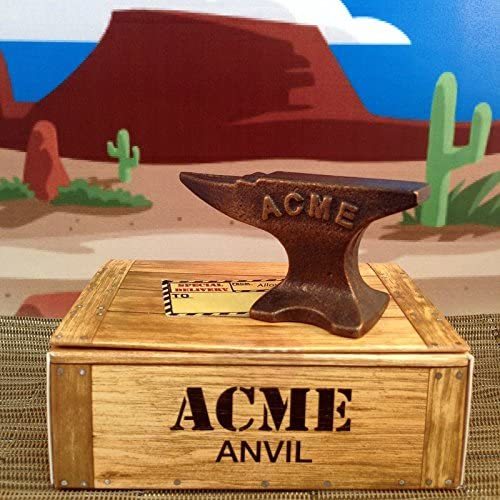
Brought to you by ACME. When you need an anvil for dropping on your quarry's head, why not use the best. Choose ACME. *
*Your results may vary. ACME and its subsidiaries are not responsible for untoward outcomes such as an anvil bouncing off a trampoline, and accidentally turning the user into an accordion.
A little lamb outwits a hungry wolf - children will enjoy this book and I see a clear contrast to how to handle bullies. I think it is so important for children to be exposed to conflict resolution at an early age; I am convinced that much of the violence in society today is due to the fact that individuals have not been exposed to conflict resolution - and resort to what they have been exposed to in the past.
Petra Mather's illustrations are bright, and actually rather sweet, if not cute, and I do much appreciate the idea that a little lamb is able to cunningly outsmart a cunning and stalking coyote (the coyote reminds me a bit of the big bad wolf, so common in European folktales and culture). That being said, there also appears to be somewhat of an inversion of the Native American trickster tale present here. In many of the former, Coyote is a trickster, and usually cleverly victorious, so it is somewhat ironic and amusing to read a Mexican folktale variation where Coyote the trickster is outsmarted. However, in the majority of Native American trickster tales, Coyote is more often than not depicted as a noble trickster, a Prometheus-like figure who uses tricks and subterfuge for good and even noble purposes. With Borreguita and her coyote stalker, however, this noble aspect of Coyote is missing, as the coyote is simply a big bad carnivore, relentlessly stalking a defenseless little lamb.
While I generally rather enjoyed Borreguita and the Coyote, Verna Aardema's (translated) tale of Borreguita using her wits to outsmart her coyote stalker, I would not ever consider this type of story a personal favourite. As I have always had a soft spot for wolves and coyotes, I tend to have some problems with folktales depicting these animals as inherently bad and cunningly evil (and certainly, many folkltales about wolves and other canids do have this tendency). And I am actually quite convinced that the generally negative attitude many humans had/have regarding wolves has contributed greatly to their indiscriminate slaughter and subsequent extirpation from much of Europe and North America (brought about at least partially, no doubt, by the often negative description of these animals in both culture and lore).
And one must also remember that wolves and coyotes are carnivores, so they are generally supposed to consume meat. Hunting and stalking a lamb or another type of domestic animal is therefore not evil, it is part of the nature of these animals. However, this is never (or hardly ever) mentioned in the "big bad wolf" type of folk and fairy tales. No, the wolves (or other canids) are more often than not portrayed as evil (or at least, evilly cunning) and not as natural predators, stalking their prey for sustenance. I know that in some of these tales, the "evil" wolves might, in fact, be symbols or something or someone else, but it still tends to bother me somewhat.
Furthermore, by portraying the wolf (or in this tale, the coyote) as the only culprit, responsibility for the plight of the victims is also often taken from those who are meant to care for and protect those in their charge. I know that the mother goat in the Grimm's tale of The Wolf and the Seven Little Kids does warn her children about the wolf, but she also leaves them home alone. And Little Red Riding Hood's mother actually sends her daughter on a solo errand into a dark forest rumoured to be full of wolves. Similarly, the farmer/owner of Borreguita, the little lamb (whom we actually only encounter on the first page of the tale) basically abandons her to her own devices. She must face the coyote by herself because the farmer is either unable or unwilling to even attempt to protect her.
What I really did and continue to enjoy about this particular offering is that the coyote is not simply killed, is not slaughtered in the end. He will never bother Borreguita again, but he does not have to pay for hunting and stalking the lamb with his life. And this minor but essential factoid ansolutely makes Borreguita and the Coyote so much more acceptable than many of the other "big bad wolf" type of folktales, where the wolf more often than not ends up dead (and usually killed with extreme violence, and in the most horrid way imaginable).
Borreguita is a little ewe lamb who fools a coyote out of eating her in this trickster tale.
The story and illustrations both are quite amusing. The lamb getting the coyote to hold up the mountain was really funny, as were some of the other tricks played.
This is a tale from Ayutla, Mexico, and there is a very short glossary of Spanish words (not really necessary to enjoy the story but a nice touch) in the front of the book.
I didn’t quite buy the ending though; I wouldn’t have thought the coyote would have given up at that point, but at least there is a true ending.
Today, I do feel just a bit sorry for the coyote, but as a child I would have been somewhat frightened by him, and would have been wholeheartedly rooting for the lamb, which I basically was now too.
I think I do prefer Aardema’s African tales books. This was cute and funny but not one of my favorite tales.
I read this for the Picture Books group at the Children's Books group; this month's theme is North American folk tales.
3.5 STARS. I was hoping for more from this book, especially since I love some of the author's other work (Bringing the Rain to Kapiti Plain: A Nandi Tale) so this was a little lackluster in comparison. But, I do really enjoy books that show the underdog (sheep) outsmarting the big bad villain (in this case, the coyote) with intelligence. I wasn't a big a fan of the ending; I would have preferred if Bourreguita kept using her wiles rather than resorting to physical attack. And, of course, poor coyote really just needs to eat and if he doesn't eat Bourreguita, he'll have to eat something else! But, of course, these tales weren't meant as natural history lessons and I think the "message" of keeping ones wits in the face of fear is a good one. The illustrations are interesting and fit the story nicely even if they aren't quite my cup of tea.
When I first heard this story on an episode of “Reading Rainbow,” I was immediately impressed with this story! “Borreguita and the Coyote” is a Mexican folktale retold by master storyteller Verna Aardema along with illustrations by Petra Mathers and it is about how a young lamb named Borreguita manages to outwit a hungry coyote in many attempts. “Borreguita and the Coyote” is a brilliant folktale about cunning that children will enjoy for many years!
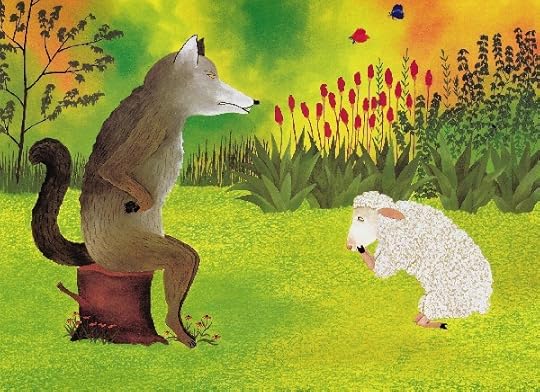
Verna Aardema has done an excellent job at retelling this folktale as the story is both hilarious and clever at the same time. Verna Aardema does a great job at making Borreguita a truly clever and cute little lamb as Borreguita shows children that even the smallest person can prove to be extremely resourceful and clever towards bullies and also, the coyote is shown to be slightly menacing as he repeatedly threatens to eat Borreguita, but is always foiled by Borreguita’s quick thinking, which helps develop so much humor for this story. Verna Aardema has also done a great job at providing helpful definitions at the beginning of the book which will greatly help many small children understand the Spanish language being used in this book and also help many children understand the culture of Mexico. Petra Mathers’ illustrations are both beautiful and hilarious at the same time as the background are colorful, especially of the images of Borreguita out on a clover field as there are red dots that indicate flowers drawn all over the green and grassy meadow. Petra Mathers also makes the coyote look both menacing and goofy at the same time as the coyote has yellow and slanted eyes and is colored in a dark grey color which makes him look a little intimidating, however whenever the coyote is tricked by Borreguita, he shows a shocked expression on his face which will make children laugh so hard.
“Borreguita and the Coyote” is a truly hilarious story for children who love books about animals and Mexican folktales and will be an instant hit for children everywhere! I would recommend this book to children ages five and up since smaller children might not understand the Spanish language in this book.
A fluffy little lamb named Borreguita outwits a hungry coyote many times in this charming trickster tale from the Mexican town of Ayutla. Young readers will appreciate the humorous role reversal here, in which the coyote - often a trickster figure himself in folklore - is fooled time and again by the seemingly innocent Borreguita.
Verna Aaredma, perhaps best known for her adaptations of African folklore, here turns her attention to Mexico, with happy results. Petra Mather's bright illustrations, with their sly little details - the coyote salivates, the lamb bounces happily off after convincing the coyote to "hold up" the mountain - will charm and entertain. Another worthy addition to any folklore enthusiast's shelf.
Oh, this one's ending made me chuckle! I enjoyed how the little lamb used her wit to defeat the coyote. It made me think of an adult crime/mystery writer who points out through her characters that the cops don't catch the bad guys because the cops are so smart, but instead, because the bad guys tend to be stupid. I admit I was nervous though, about whether the little lamb's trickery would do her in. But no - brain prevailed over brawn.
I found that the illustrations fit the story very well - my favorite was one with the little lamb standing on the ledge looking down over the valley with the coyote looking for her way below. Lots of bold, bright color, artful landscapes, and just the right amount of comic touch and lightheartedness.
Borreguita and the Coyote was such a fun folktale! It is the story of a little lamb (borreguita is little lamb in Spanish) that tricks a coyote so that it does not eat her. This folktale came from Ayutla, Mexico. This story has a classic folktale feel because of the classic theme it follows, tricks. Even though I have not read this book before recently, I felt like I already knew it because of this theme. For me, it kind of felt along the lines of the three little pigs. I loved the fun language and the creativity of the lamb. The way that she tricked the coyote was interesting and I think it would make kids laugh. This is definitely a folktale that I would have in my classroom. It is also a great tool because it would incorporate another culture into the class. I really enjoyed reading how the lamb escaped the coyote!
This is a fun story, with a smart little ewe lamb (Borreguita) out-foxing the coyote. Our girls enjoyed the story, even though it was a little long for me to read to them at one sitting. It even has just a little bit of Spanish woven into the story, as it is set in Ayutla, Mexico.
Borreguita and the Coyote was a enjoyable folktale. I liked that it started off with a glossary. The illustrations were entertaining. There were some folk art pictures in the front and back of the book that I found myself staring at over and over trying to figure out what those colorful balls were; connected to the head of a dog, coming out from the eyes of a dog, under a sheep, and floating around the pages. I may have been too tired the times I chose to look at them. Maybe I missed something. I like two of the members of the wonderful Children's Picture Book Club enjoyed the trickster character switch. Some of those quick ideas that little lamb had were pretty clever and humorous.
I loved this book! It was similar to the old stories of the coyote and the road-runner. This book is about a little lamb tricking the coyote out of eating her. The lamb is very clever and the coyote is very gullible. I would recommend this book to children because they would enjoy the humor.
Title: Borreguita and the Coyote Author: Verna Aardema Illustrator: Petra Mathers Genre: Mexican Folktale Theme(s): Trickery between animals who speak to one another. Opening line/sentence: On a farm at the foot of a mountain, there lived a little ewe lamb. Brief Book Summary: : A little lamb lived in the mountains while a hungry coyote greeted her. The smart lamb tricks the coyote into sparing her life throughout the tale. In the end, the lamb wins and the coyote leaves her alone. Professional Recommendation/Review #1: CCBC (Cooperative Children's Book Center Choices, 1991) Hungry Coyote thinks that Borreguita, the little lamb, would make a tasty meal but every time he meets her she manages to outsmart him, leaving him not only hungry but humiliated as well. Petra Mathers' glowing, boldly colored illustrations are ideally suited to this well-paced retelling of an amusing Mexican folktale about brain winning out over brawn. CCBC categories: Folklore, Mythology And Traditional Literature; History, People And Places; Picture Books. 1991, Alfred A. Knopf, 32 pages, $15.00. Ages 4-8. (PUBLISHER: Knopf:Distributed by Random House (New York:), PUBLISHED: 1991.) Professional Recommendation/Review #2: Deborah Abbott (Booklist, Sept. 15, 1991 (Vol. 88, No. 2)) This tale from Ayutla, Mexico, uses the common folklore theme of a small animal--borreguita means "little lamb" in Spanish--outsmarting a larger and more powerful one. A coyote decides a lamb is a perfect meal. The lamb pleads her case--she will taste better after she has eaten the entire field of clover. Next she tricks the coyote into eating a round of cheese (actually the moon reflected in a pond). The lamb leaves the pond after the coyote jumps in. In their third encounter, the lamb pretends to hold up a rocky ledge and offers to run for help if the coyote will take her place. Finally, the coyote demands to eat the lamb, who convinces him that his mouth is large enough to swallow her whole. She catapults into his open mouth, and the jolt causes the coyote to lose his balance and run away in pain. The lamb is free at last. Aardema's brief retelling is a fine combination of chatty dialogue and comfortable description. Mathers' sparkling color drawings expertly show the exasperation and determination of the coyote and the pluck and ingenuity of the appealingly resourceful lamb. Lovely panoramas of Mexican landscapes in vibrant blues, greens, oranges, and yellows transport the reader in time and place. Endpapers embellished with Mexican scenes and symbols and a simple glossary add to the reasons preschoolers will request this story again and again. Category: For the Young. 1991, Knopf/Borzoi, $15 and $15.99. Ages 3-6. (PUBLISHER: Knopf:Distributed by Random House (New York:), PUBLISHED: 1991.) Response to Two Professional Reviews: Both reviews give a brief summary to the tale of the Borreguita and the Coyote. The second review gives a more thoughtful response when it comes to the illustrations in the story, mentioning the vibrant colors for a Mexican setting. I agree with both reviews as to this tale being great for young children, they will enjoy the chatty back and forth dialogue between the lamb and coyote. Evaluation of Literary Elements: The literary elements in this tale include animals who can speak to one another, giving them a human characteristic, this will engage young readers. The children will also be able to easily identify the good and bad characters in the story through the dialogue. The bright illustrations create a setting in the Mexican mountains, creating an understanding for readers where these animals may live in this country. Consideration of Instructional Application: I would connect this story to a Spanish lesson. While reading the story, I would pick out words or phrases that may be from the Spanish culture. I would write these on the board, and as a group we would learn the meaning. It would be fun to bring in a Spanish-speaker to incorporate more words and phrases for the class to learn. I would have a globe for students to look at to understand where this story takes place.
Borreguita and the Coyote is the retelling of a Mexican folktale where a little lamb must outsmart a hungry coyote in order to save himself. The little lamb, Borreguita, lives on a farm and one day is approached by the coyote who states that he is going to eat her. The Borreguita invites the coyote to come back and eat her after she herself has eaten all the clover in the meadow, stating that she will then be fat and will better fill up the coyote. The coyote decides that he would rather eat a fattened-up borreguita and leaves with idea of returning after several days. When he returns to the meadow, he finds a fatter Borreguita and gets ready to pounce. The Borreguita tells the coyote about a food called cheese that is much more tastier than lamb. The coyote is curious and decides to meet the Borreguita later and taste this mysterious cheese. The Borreguita leads the coyote to a pond and tells him that the moon's reflection is the cheese and that he must jump into the pond to taste the cheese. When coyote does this he ends up with a mouthful of water, and upon returning to the shore, finds the Borreguita gone.
The story continues with the coyote being outsmarted by the Borreguita several more times until he is finally defeated and gives up his dream of eating the little lamb.
I love the colorful artwork as well as the mixing of the Spanish and English languages throughout the story. I also appreciated the glossary which defined the Spanish words used and provided a pronunciation guide. This would be extremely helpful to use in preparing to read this book aloud to your students. This book would be appropriate for kindergarten aged children up through third or even fourth graders.
This entire review has been hidden because of spoilers.
bookshelves: etec545class3, Folktale, Traditional Literature, Motif: Trickster animal avoiding being eaten/hurt
CSULB 545 Class 3: Folktale - Borreguita & the Coyote
Aardema, Verna. Borreguita and the Coyote. Illus. Petra Mathers. New York: Scholastic, 1991.
[May contain spoilers]
Target Audience: grades Pre K - 2
Curriculum ties: folktale units; animal story units
Neither the prose style nor the illustrations offer too much to praise, but still this is a very fun read. Clever Borreguita the lamb must avoid being eaten by the coyote, and manages this through a series of tricks. Borreguita is the trickster in this story, outsmarting the coyote time after time, until the final trick takes the form of a physical assault to the mouth. Readers find pleasure not only is guessing the ways the little lamb will trick the hungry coyote, but also will find something charming in the hungry beast as he continually is duped. Although the coyote wants very badly to eat out protagonist, he also does not want the mountain to fall down, and it is that which keeps us engaged and laughing through the pages. Coyote stories are part of Mexican folklore, and this is just one of many stories world wide that feature an underdog trickster animal avoiding being eaten or hurt. Trickster tales are entertaining, and though the characters can be naughty, they are typically very likeable, as is little Borreguita.
Borreguita and the Coyote by Verna Aardema, illustrated by Petra Mathers, ia a retelling of a Mexican folk tale about a clever lamb who tricks a hungry coyote numerous times. The role reversal is fun, with the usual trickster coyote being the one who is tricked. This telling is clever, fun, and attractively illustrated.
The story is well retold by Aardema. The humor of the story is expanded by the illustrations. One quibble: while the farmer leaving Borreguita tied up alone moves the plot along, it's not very responsible of the farmer.
Mathers' bright illustrations are highlights, with details such as the frequently drooling coyote and beautiful scenery. Another of my few quibbles is that coyote is shown as a thug-like carnivore, more like a wolf than a thin, active, curious, real coyote. My interest in animals makes me hope that children who hear this story will eventually learn the value of predators in a balanced environment: hopefully readers/listeners will someday peruse nonfiction animals books and those about the environment. Themes include animals and cleverness.
For ages 4 to 8; lambs, coyotes, cleverness, folktales, & Trickster tales themes; read-alouds, and fans of Verna Aardema and Petra Mathers.
Grade/Interest Level – Primary/ Learn to read Reading Level: 560L Lexile Genre: Traditional Literature & Multicultural Literature Main Characters: Borreguita, Coyote Setting: A farm in rural Western Mexico POV: Narrator
This story is a tale about a hungry coyote and a clever lamb, Borreguita. Coyote was very hungry and always threatened to eat Borreguita. In a panic, she tricked the Coyote into eating something better than her, cheese! She took him out to the lake one night and the full moon shone like a big round ball of cheese on the lake. She told him to jump and take a big bite, but to Coyote’s disappointment all he got was a mouth full of cold lake water. Angry, Coyote came to her again threatening to eat her, but Borreguita tricked him into staying on the mountain until she could get far away from him. Coyote came a third and final time ready to eat Borreguita, but cleverly escaped Coyote by lunged into him head first knocking him over. This book uses a lot of Spanish words and has a glossary, so it would be good to use as a multicultural text in a classroom with Spanish speaking students. Also, the story is very suspenseful and students will enjoy the humorous twist of events and how the little ewe lamb cleverly gets out of everyone of Coyote’s threats to eat her.
Borreguita and the Coyote is the story of how a little lamb decides he wants to trick the scary coyote into not eating him. The entire story takes place on a farm like open valley somewhere in South America. The two characters play a game of cat and mouse (Tom and Jerry) to see who will win the ultimate battle of survival. Borreguita outsmarts the coyote time after time, but in the end, will senor Coyote get fed up with Borreguitas tricks and finally eat her?
This book had a multicultural undertone to it. It has spanish words and phrases and uses spanish references in the beginning when it talks about the cheese on the farmer's daily tacos routine. The first and last cover pages have hispanic burial customs and references to the Day of the Dead. I think its great having a children's book that had different cultures in it because it makes it fun for kids to read and they get to experience something new.
Personal Reaction: When doing the folk literature project, this was my favorite book from the Mexican culture. I really enjoyed the story of the lamb outsmarting the coyote. I did research on the culture, and a coyote is supposed to be a wise and strong animal. So it was very fun to see the book poking fun of that aspect and allowing the smaller animal to win.
Purpose: This book would be good for students from 2nd-3rd grade. It's a good representation of Mexican culture and can be used paired with a lesson on that topic. Like I said about the coyote, a lot of the things in the book have a deeper meaning. A common theme is tricking/cleverness. The students could compare this book to others in the culture and find similarities between different themes. The coyote is also a very common character among the literature, so the students will be able to find more information about what that character means as a whole.
Published: 1998, Dragonfly Books Age: 4-8 This is a cute Mexican trickster tale about a little lamb and a coyote. Borreguita means little lamb in Spanish. The coyote wants to eat him but the sly lamb fools the coyote. The hilarious text typical of Verna Aardema, is matched with the perfect illustrations by Petra Mathers. The pictures are colorful full page watercolor illustrations and you have to love the expressive coyote with his tongue hanging out and drooling. The landscape is also luscious and brings you to somewhere in Ayutla, Mexico you would want to visit. The artist has drawn some mixed up art inside a border on the inside and backside covers that is very interesting and kids will love to look at. They will also want to hear this story over and over.
Based on a Mexican folktale. It's a story of the tactics one sometimes must try in order to survive. I think that's a tricky lesson to teach children, since we stress honesty but them see the lamb lie in order to stay alive. There's a cute part where it shows one reason why coyotes may howl at the moon.
There is a glossary at the beginning which I know is meant to be helpful but is really unnecessary since the concepts are all explained in the story.
I know that the illustrations are based on the folk art style, but I found them a little disturbing.
Aardema shares a tale from Ayutla, Mexico. A coyote is hungry and wants to eat the little lamb nearby in a field. Borreguita, which means little lamb, is very clever and tricks the predator. Yet the coyote returns again and again until she rams him right in the head. He tumbles backwards and he never bothers Borreguita again.
An excellent readaloud for a wide range of ages. A storyteller could easily adapt this tale to use with puppets as well.
Theme: Native American tales Additional themes: trickster tales, lambs, coyotes
When the Coyote wants to eat Borreguita, she is left with no choice but the trick the Coyote. First, she tells him that he should eat cheese instead of eating her and she leads him to the pond to eat the cheese (which is the sun reflecting on the water). Second, she pretends to be holding up two rocks and makes the Coyote use all his effort to not let the rocks fall. Third, she tricks the Coyote into thinking he has won, but ends up head-butting him. A comical story about the underdog tricking the Coyote.
This folk-tale reminded me of "One Thousand and One Nights" with the trickery used by our little lamb. It was a fun story to read, and it kept you guessing on what trick our lamb would use next to trick the coyote. To say the coyote was persistent would be an understatement, but he also wasn't all that bright either. It definitely left room for some laughs.
I can see little ones enjoying this, particularly if you paired this with a cartoon short of the tale after. You could even have them draw a scene if how they would trick the coyote. Then you can hold a conversation about what the overall lesson of the story was and have students figure out what they learned from it besides being a funny story.
1. N/A 2. 1-4 3. A story about a lamb that is trying to avoid being eaten by a coyote. The lamb is clever and tricks the coyote numerous times. 4. The illustrations are bright and colorful along with this unique tale. I love that this is a Mexican folk tale and teaches lessons set from another culture. 5.This could be used in a lesson learning about folk tales and listening to stories from other cultures.
i loved the opening pages encouragement concerning pronouncation of the main characters and phrases. that felt touching and embracing of diversity. overall i found the moral fine enough. when threatened the lamb tricks the coyote twice then head butts ths predator as a final lesson. i like the positioning of such a serious moral with a multicultural kids book.
This entire review has been hidden because of spoilers.
My five year old was given this book for me to read to her for one of her assignments. Cute book! It's about a wolf who is trying to eat a lamb, but the lamb is always outsmarting the wolf. Would recommend!