Whether in the sky, on the land, or in the sea, animals live in all sorts of fascinating environments. Discover six of the most intriguing habitats, and have fun pinpointing the camouflaged critters hiding within them in this interactive and informative picture book full of furry, feathery, and ferocious creatures.
Steve was born in 1952 in Hickory, North Carolina. His father, who would become a physics professor and astronomer (and recently his co-author on a book about the Solar System), was in the military and, later, working on science degrees at several different universities. We moved often. Steve lived in North Carolina, Panama, Virginia, Kansas, and Colorado. Wherever he lived, he kept a menagerie of lizards, turtles, spiders, and other animals, collected rocks and fossils, and blew things up in his small chemistry lab.
Because he moved often, Steve didn't have a large group of friends, and he spent a lot of time with books. His parents read to him until he could read himself, and he became an obsessive reader.
His interest in science led me to believe that I'd be a scientist himself. At the last minute, he chose instead to go to art school in North Carolina, where he studied graphic design. After graduation he moved to New York City, where he worked in advertising and design, first in large firms and then with his wife, Robin Page, in their own small graphic design firm. Robin, also an author and illustrator, is his frequent collaborator — they've made sixteen children's books together.
Their daughter Page was born in 1986 and our son, Alec, two years later. They began reading to them when they were just a few months old, and Steve became interested in making children's books himself. My wife and I read to our two older children almost every night until hisdaughter was 12 or 13, long after they were reading on their own. It was, in many ways, the best part of the day.
In 1994 they moved to from New York City to Boulder, Colorado, where they work in a studio attached to their house, which was built in the 1880s and often functions as if it were still the 19th century.
Their youngest son, Jamie, was born in 1998. The questions his children asked over the years have been the inspiration for many of their books.
Librarian's Note: There is more than one author with this name in the Goodreads database.
Husband-and-wife team Steve Jenkins and Robin Page, who have also collaborated on such titles as What Do You Do With a Tail Like This? (which was chosen as a Caldecott Honor Book) and How to Clean a Hippopotamus: A Look at Unusual Animal Partnerships, present six habitats from around the world in this engaging work of natural history for the younger set. From the dry desert landscape of the American Southwest, to the steamy jungle of the Amazon Rain Forest, the residents of these diverse terrains are at first half-glimpsed, behind flourishing flora, before being revealed in all their glory, on the subsequent page.
An immensely engaging book, one that is both informative and entertaining - children will enjoy hunting for all the animals, on each initial page (as well as the ant that appears in each scene), before seeing just what is hidden in plain sight - I See a Kookaburra!: Discovering Animal Habitats Around the World is the kind of book that makes science and natural history appealing to young readers. The appealing cut-paper collage illustrations are beautiful, and add to the sense of fun, with the detailed afterword gives plenty of additional information about each species mentioned. High recommended to all young animal lovers and would-be naturalists, as well as to fans of Steve Jenkins' artwork.
Steve Jenkins and Robin Page show groups of animals in six different parts of the world in a seek-and-find format. The first page of each habitat shows the animals hidden while the next page reveals all eight animals that had been hidden. There is a paragraph of information about each animal given at the back. The first part of the book would work well with younger children, while the dense information given at the back would work best for older children.
I enjoyed looking for and finding the ant on each page. How did he make such tiny ants with such skinny legs out of paper? He is truly an artistic genius!
There was SO much information given at the end of the book! I learned a lot of new information, although I also felt like I already knew some of the facts from reading other Steve Jenkins books. But what a great way to use research already done! I thought the format of grouping animals by habitats and also the seek-and-find aspect brought something new as well. I would love to read this with some kids and see how they respond to it.
As always, here are some of the facts I learned while reading this:
* The Gila monster, one of only two poisonous lizards in the world, can store fat in its tail and can go for months without eating.
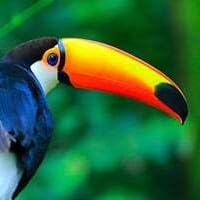
* The bill of the toucan is often as long as the rest of its body. No one is sure why it is so large and colorful.
* The elephant shrew can be 12 inches long. Even though it looks like a rodent, it belongs to an ancient group of animals and is not closely related to any other mammal.
* The naked mole rat is the only mammal that lives in colonies like those of ants, bees, and termites. Each colony includes a queen, who gives birth to all young, and includes soldier mole rats and worker mole rats. They are only about three inches long, almost hairless, and nearly blind.
Six different habitats (from various parts of the world) with eight animals each are shown and covered in this book. Many have natural camouflage and part of the experience of this book is to search for the various animals before they’re shown and described.
As is typical with Jenkins’ books, the illustrations are a huge part of the main part of the book, and then more detailed text information is given at the back of the book, a densely informative section; in this book extra information is given about both the habitats in general and about all the animals that have appeared earlier in the book.
Very young children can enjoy the first part of the book and older children will learn from and appreciate the extra information. There were a few animals included that I first learned existed when I read the book and I learned a lot about many other animals. Not too much is written about the habitats and I basically knew the information given, but it is interesting information, and for some readers it will be new information. There is also a map showing the location of the habitats and a short additional reading list on the last page of the book.
Not all the continents are covered, and I would have appreciated even more habitats and animals (and maybe some plants too) but I guess there is only so much that can easily fit into one picture book.
The book itself is not very exciting but it is very informative. Students are learning about habitats without even realizing it. Each picture on the pages are very detailed and the colors are amazing!
This interactive nonfiction book by Steve Jenkins is about the animals that live in the various habitats of Earth and what adaptations they've developed to survive. For each habitat, the author includes a page where animals are hidden or camouflaged and asks readers to try to spot some animals. On the following page, he reveals which animals live in that habitat and what unique features they have that allow them to survive. I love this book because it shows readers that non-fiction doesn't have to be boring books filled with facts. They can be interactive, fun to read, and interesting; like this one. The vocabulary Steve Jenkins uses allows readers to learn about animals and habitats in an easy way, while still remaining factual.
I would recommend this book to all grades in Elementary school. There are some great fun facts learned and students get to interact with the images of the book. Students can use this book to do research on habitats and ecosystems for science class. It also allows students to use their background knowledge to draw inferences and conclusions about these animals and habitats.
In I See a Kookaburra by Steve Jenkins & Robin Page (Houghton Mifflin, 2005), the authors show six unique habitats with eight animals. With first a two-page spread showing animals in the habitat and then a spread introducing the unique animals, the book becomes a seek-and-find book as the reader looks for the named animals in their habitats. A small note in the front also teaches that ants are found worldwide, so look for an ant on each page too!
Jenkin’s collage illustrations layer foliate over and around the animals, giving a three-dimensional look to the landscapes. The pond scene even shows wet, fibrous paper to make it look underwater. The unique habitats are labeled with the location of that specific place: the desert is in the American Southwest, the tide pool is on the southern coast of England, and the forest is in Western Australia, for example. Other habitats include a rainforest, a savanna, and a pond.
While each habitat page gives an action phrase about the illustrated animal, the end matter provides a more detailed paragraph about each one. I like how this book highlights specific unique habitats in a variety of biomes around the world.
Jenkins does a marvelous job with creating a book that becomes more of a game. In this story, readers experience 6 different habitats and are asked to identify 8 animals in each one. Once you have spotted as many animals as you can, readers can flip the page to learn more about the animals in the habitat. It blows my mind the different animals that are shown in this book. Furthermore, the information and facts that Jenkins shares with us about the animals, make it all the more intriguing to read this book over and over again. We learn about survival and what animals will do to adapt to their habitats, to ensure survival. This book would be great to introduce to children of all ages. I could see myself using this book as a great cross-curricular tool (connecting to science and literature).
This book is very colorful and full of life! This book shows different habitats that animals live in. Picture descriptions are given of each animal which is helpful. It gives you a nice idea of animals that live in the desert, rain forest, and the savanna. Students can read this book and classify different types of animals. This book would be great when discussing the eco-system and different habitats around the world.
Kinda neat interactive book. On one page the animals are camouflage and on the next you can see exactly where they were and the names. The first page is all text but very little text throughout. At the end there is small print with a paragraph for each animal so you can learn more if you would like. My children got really in to finding the animals and guessing what they may be. They loved searching for the ant in each habitat.
Each two page spread shows a beautiful collage hiding native animals in a specified habitat. The whole family had fun pointing out what animals were hiding and trying to guess what they were. On the next page, all is revealed, and at the very end is a paragraph giving even more detail about each animal. Bonus fun was to be had searching for the hidden ant on each page! An education seek-and-find for all ages to enjoy.
Jenkins' collage-style illustrations engage the reader as they discover the different animal habitats that exist around the world. Each doublespread of a habitat is followed by individual illustrations of the animals found in that habitat, which are accompanied by flowing text that becomes a part of the photos. It is educational while keeping kids engaged and enjoying the book.
This picture book features six different habitats, each containing eight different animals.
The illustrations are cut and torn paper collage.
The location of each habitat and a detail or two about each animal are given within the text, and more detailed information is provided at the end of the book.
My Kindergartener loved this story! It was fun to try to decipher what we were seeing hidden in the pictures. Flipping the page to find out was fun! The animals chosen are a little random, and the information beside them was sometimes too much of a tidbit to stop for between "what's next?!" All in all, a winner. I think it'd be excellent for students reading alone or for a rousing story time.
A seek and find book with information about animals. Short information in the text, more information in the endpapers. Good to span ages because the younger kids will like just the main text, whereas older kids can return to it and add the information from the back matter.
Great interactive nonfiction read-aloud. Each full page spread depicts a habitat with 8 animals hiding. Students will have fun finding and identifying all of the animals (answers on following page). Recommended for 1st-3rd
This book has cool illustrations and lots of great facts, but it isn’t set up in enough of a story style to entertain my toddler and keep her interested in reading the story. As a result, this was a tough book for us to get through, but I can see this book being a great fit for the right reader.
Informational picture book that talks about the different animals that live in different habitats (jungle, forest, desert, ocean, etc.) It also gives a unique characteristic about each animal.
Incredible detail in the collage art, the book is fun for children to learn about different habitats around the world and find animals amongst the natural elements.
I See a Kookaburra! By: Steve Jenkins and Robin Page
1. Junior Book Genre: Informational
2. Brief Summary: I See a Kookaburra features six distinct habitats from around the world and highlights eight magnificent animals that can be found in each habitat. With luminous illustrations and rich detailed descriptions students have an opportunity to first see the habitat while trying to locate the animals and then the immediate page following give simple details of each animal featured in the habitat. While the illustrations are brilliant it is the information in the back of the book, following the presentation of the six habitats and regions of the world, that give students the most data and detail about the specific animals. The habitats, or regions, featured include: the desert, the tide pool, the jungle, the savanna, the forest, and the pond. The animals, on the other hand, range significantly from insects such as the water spider to bird like the cassowary and from mammals like the javelina to amphibians like the green iguana. It is the combination of wonderful illustrations and detailed information that makes this book a great choice for students researching habitats and various animals. 3. A. Area for comment: It is difficult to distinguish which element of the book is the best – either the illustrations or the detailed information and map in the back of the book. Both the bright illustrations and the detailed information add to the overall success of the book and makes learning truly fun! B. Professional Evaluation: There is no question that I See a Kookaburra is a great resource for students as it includes detailed information about six different habitats found in the world while featuring eight animals in each habitat! From the illustrations to the information in the glossary the book is both full of knowledge and fun to read! Students of all ages would truly appreciate the quality of this book. C. Specific Example: I found the illustrations to be not only fun to look at in this book but also a great way to talk to students about how animals adapt and camouflage themselves to hid from predators while living in their natural environment. The illustration that stands out for me the most is the one of the forest which features a frilled lizard hiding in the bushes ready to attack, a dingo in the tall brush, a koala fast asleep high in the trees and a cassowary peering out from the leaves. These are just some examples of the excellent way the authors used the illustrations to covey how animals truly live in their habitat!
4. Curriculum Connection: It is obvious that this book can be used by students when learning about different habitats and animals found within those specific regions. Students are able to visually see in rich detail the animals’ habitat and how they survive by hiding in their natural environment while simultaneously learning a great deal about each animal by using the back glossary. It would be a great lesson for students to compare and contrast each region and to see how different animals survive through the process of adaptation. Overall, there are a number of great uses for this book that go beyond merely doing research but can include truly learning about various habitats and regions of the world.
Jenkins, Steve & Page, Robin. I See a Kookaburra! Houghton Mifflin Company, 2005. 32 p. Gr. 2-5.
Plot Summary: Get ready to take a trip around the world and explore six diverse habitats that house a wide array of distinctive animals. Starting with the vast, dry desert in Southwest America the reader discovers the animals’ native to that region, such as the sly kit fox and the dangerous diamondback rattlesnake. Afterwards we uncover the creatures that lay within the shallow waters of a tide pool off the southern coast of England, then we take a turn towards the world of camouflaged wonders in the Amazon River basin of South America to explore the home of the slithering emerald tree boa. The dry and scorching savanna of central Africa is the next destination, followed by the wooded forest of eastern Australia, with a kookaburra cackling up high in the trees. Lastly, we loop back around to the ponds of Midwest America, discovering the beauty of the great blue heron. All of the critters’ can be found again in the back of the book, accompanied by a detailed description on what makes them unique and a map of where to find them.
Classroom Connections: I See a Kookaburra is nonfiction informational book that would be perfect for a classroom setting, whether the lesson is on living organisms or geography. One application within the classroom would be for students to research their favorite animal, answering questions such as-Where does it originate? What does it eat? What is unique about it? To make their research interdisciplinary, the students should draw a realistic picture of the animal and write down the facts they discovered while researching it on the back. The teacher can create a jungle like atmosphere in the classroom by displaying their animals around the classroom for other students to walk around and explore.
I See a Kookaburra! can also be applied towards geography within the classroom, by assigning each student a country to research and the animals that inhabit it. Students will create a collage of 5+ animals that are native to that area with a brief description of each and information about their habitat, mirroring the setup of the book. This activity can easily be designed to fit the needs of each grade level and students who need differentiation, such as ELLS or students with IEP’s.
This is one of our favorite books to look through. The illustrations are bright and colorful, and it's fun to try and find all of the hidden animals in each habitat before turning the page to the big reveal. This book has helped to expand my daughter's animal vocabulary, and piqued her interest to learn more about the animals featured in this book.
Plot Summary: -In the nonfiction informational picture book, “I See a Kookaburra!” there are six different parts of the world represented and described along with eight of the animals that live in them. Each part of the world starts with “In the ____, I see….” and it describes what that type of the world is. Then on the following page is shows 8 animals in that habitat along with what they are and what they do. This book chooses a lot of unique animals that you would not typically talk about and is a great opportunity for children to learn about other habitats and animals then their own.
Criteria: -The accuracy and authenticity of this book is shown in the back of the book where each animal is described thoroughly in a paragraph. The content of this book is very appropriate for children because it is not overwhelming at all and is very informative on animals they are not necessarily used to hearing about. The style and organization of this book with “In the___, I see…” and the scattered pictures and descriptions that follow on the next page are organized and uncluttered while also keeping children interested. The visual format of this book is very age appropriate because it is not too much information for a young student, but just enough for them to become informed and learn more.
Classroom Connection/Reader’s Response: -I would connect this book in my classroom by pairing it with a fiction text about one of the animals in this nonfiction text. I would that fiction text that I am hoping to be humorous to my students. Then I would ask them to compare and contrast in a Venn Diagram as a class how the fiction animal and the nonfiction animal are the same and different.