

What do you think?
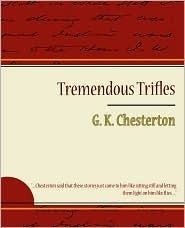
Tremendous Trifles
Chesterton has been called the Prince of Paradox. His works include journalism, philosophy, poetry, biography, fantasy and detective stories. Chesterton has great fun satirizing the Victorian sleuths such as Sherlock Holmes . These 39 tales will delight the reader. Chesterton said that these stories just came to him like sitting still and letting them light on him like flies. Some of these tales are just for fun while other are filled with good common sense.
Gilbert Keith Chesterton (1874-1936) was an English literary and social critic, historian, playwright, poet, Catholic theologian, debater, mystery writer and foremost, a novelist. Among the primary achievements of Chesterton's extensive writing career are the wide range of subjects written about, the large number of genres employed, and the sheer volume of publications produced. He wrote several plays, around 80 books, several hundred poems, some 200 short stories and 4000 essays. Chesterton's writings without fail displayed wit and a sense of humor by incorporating paradox, yet still making serious comments on the world, government, politics, economics, theology, philosophy and many other topics. Chesterton uses his compilation of essays in Tremendous Trifles as a guide to reflect on everyday life. Among this collection: A Piece of Chalk -where a drawing exercise turns into a lesson on the nature of truth, Twelve Men -an explanation on why we have juries made of our peers and not professional jurors, The Dragon's Grandmother -on why we should read fairy tales to our children along with many more endearing reflections.
Gilbert Keith Chesterton (1874-1936) was an English literary and social critic, historian, playwright, poet, Catholic theologian, debater, mystery writer and foremost, a novelist. Among the primary achievements of Chesterton's extensive writing career are the wide range of subjects written about, the large number of genres employed, and the sheer volume of publications produced. He wrote several plays, around 80 books, several hundred poems, some 200 short stories and 4000 essays. Chesterton's writings without fail displayed wit and a sense of humor by incorporating paradox, yet still making serious comments on the world, government, politics, economics, theology, philosophy and many other topics. Chesterton uses his compilation of essays in Tremendous Trifles as a guide to reflect on everyday life. Among this collection: A Piece of Chalk -where a drawing exercise turns into a lesson on the nature of truth, Twelve Men -an explanation on why we have juries made of our peers and not professional jurors, The Dragon's Grandmother -on why we should read fairy tales to our children along with many more endearing reflections.
144 pages, Paperback
First published January 1, 1909
About the author
G.K. Chesterton
4,171 books6,050 followersGilbert Keith Chesterton was an English writer, philosopher, lay theologian, and literary and art critic.
He was educated at St. Paul’s, and went to art school at University College London. In 1900, he was asked to contribute a few magazine articles on art criticism, and went on to become one of the most prolific writers of all time. He wrote a hundred books, contributions to 200 more, hundreds of poems, including the epic Ballad of the White Horse, five plays, five novels, and some two hundred short stories, including a popular series featuring the priest-detective, Father Brown. In spite of his literary accomplishments, he considered himself primarily a journalist. He wrote over 4000 newspaper essays, including 30 years worth of weekly columns for the Illustrated London News, and 13 years of weekly columns for the Daily News. He also edited his own newspaper, G.K.’s Weekly.
Chesterton was equally at ease with literary and social criticism, history, politics, economics, philosophy, and theology.
He was educated at St. Paul’s, and went to art school at University College London. In 1900, he was asked to contribute a few magazine articles on art criticism, and went on to become one of the most prolific writers of all time. He wrote a hundred books, contributions to 200 more, hundreds of poems, including the epic Ballad of the White Horse, five plays, five novels, and some two hundred short stories, including a popular series featuring the priest-detective, Father Brown. In spite of his literary accomplishments, he considered himself primarily a journalist. He wrote over 4000 newspaper essays, including 30 years worth of weekly columns for the Illustrated London News, and 13 years of weekly columns for the Daily News. He also edited his own newspaper, G.K.’s Weekly.
Chesterton was equally at ease with literary and social criticism, history, politics, economics, philosophy, and theology.
Ratings & Reviews
Friends & Following
Create a free account to discover what your friends think of this book!
Community Reviews
Displaying 1 - 30 of 167 reviews

September 19, 2017
One thing I like about our public library is the presence of old books - I mean, really ancient books. The current tome from G. K. Chesterton is from 1910. I mean, the book is from before the Soviet Union and the two World Wars - and when it was published, many of today's nations didn't exist! It was like looking down a time tunnel.
G. K. Chesterton is known for the unusual sleuth Father Brown - the Catholic priest who hunts down criminals to save their souls. But this book is different. This is Chesterton the journalist being flippant about important things and profound about trivial things. And as with the Father Brown tales, this is also compellingly readable.
The title is apt. Taking a trivial incident from everyday life (missing a piece of chalk, lying idly in the bed in the morning) or a stray thought, Chesterton rambles on about life, death and the universe in general, philosophising the mundane in the most irreverent fashion. I enjoyed most of the pieces, even though some of them were too topical to the timeline of the book's publishing and therefore somewhat incomprehensible to a person who is not very astute historically. But some of them were really profound, worth savouring in one's idle moments.
Some excerpts:
G. K. Chesterton is known for the unusual sleuth Father Brown - the Catholic priest who hunts down criminals to save their souls. But this book is different. This is Chesterton the journalist being flippant about important things and profound about trivial things. And as with the Father Brown tales, this is also compellingly readable.
The title is apt. Taking a trivial incident from everyday life (missing a piece of chalk, lying idly in the bed in the morning) or a stray thought, Chesterton rambles on about life, death and the universe in general, philosophising the mundane in the most irreverent fashion. I enjoyed most of the pieces, even though some of them were too topical to the timeline of the book's publishing and therefore somewhat incomprehensible to a person who is not very astute historically. But some of them were really profound, worth savouring in one's idle moments.
Some excerpts:
Being a nation means standing up to your equals, whereas being an empire only means kicking your inferiors.
---
Folk-lore means that the soul is sane, but that the universe is wild and full of marvels. Realism means that the world is dull and full of routine, but that the soul is sick and screaming. The problem of the fairy tale is - what will a healthy man do with a fantastic world? The problem of the modern novel is - what will a madman do with a dull world? In the fairy tale the cosmos goes mad; but the hero does not go mad. In the modern novels the hero is mad before the book begins, and suffers from the harsh steadiness and cruel sanity of the cosmos.
---
Fairy tales, then, are not responsible for producing in children fear, or any of the shapes of fear; fairy tales do not give the child the idea of the evil or the ugly; that is in the child already, because it is in the world already. Fairy tales do not give a child his first idea of bogey. What fairy tales give the child is his first clear idea of the possible defeat of bogey. The baby has known the dragon intimately ever since he had an imagination. What the fairy tale provides for him is a St. George to kill the dragon.

March 25, 2011
This is simply essential reading for any fan of Chesterton. It's vintage. A collection of essays on all sorts of topics: lying in bed, forgetting white chalk, being expelled from a Hansom Cab against his will, Picking his own pockets, robbing a French restauranteur, and all sorts of typical Chesterton absent-minded brilliance. His prose here tends to be more playful than in his fiction, making him the essay writer that is the exception to Lewis' rule in Horse and His Boy.
I still cannot comprehend exactly how he does what he does with words. It isn't forced or strained, as he produced a staggering amount of material, he just sees the world in a wholly different way than anyone else. He knew of his reputation for paradox, but seemed somewhat exasperated by it, as he comments that he isn't the one that made the world stand on its head.
He really is a chap that I would have loved to have met, to have simply followed around, or to have been able to record what his brain did and where his imagination took him in the course of any given hour. As it is, I'm surfacing for air and reminding myself that other authors exist (paltry and pasty beings though they be after the ferocious life and blinding colour of the Fat Catholic), and then I shall dive again when my lungs can sustain me longer. Perhaps one day I shall find--and this is an eternal dream of mine--than not only have I become a good man, but a Chestertonian one: one who knows, loves and lives the absurdities of our Triune God.
I still cannot comprehend exactly how he does what he does with words. It isn't forced or strained, as he produced a staggering amount of material, he just sees the world in a wholly different way than anyone else. He knew of his reputation for paradox, but seemed somewhat exasperated by it, as he comments that he isn't the one that made the world stand on its head.
He really is a chap that I would have loved to have met, to have simply followed around, or to have been able to record what his brain did and where his imagination took him in the course of any given hour. As it is, I'm surfacing for air and reminding myself that other authors exist (paltry and pasty beings though they be after the ferocious life and blinding colour of the Fat Catholic), and then I shall dive again when my lungs can sustain me longer. Perhaps one day I shall find--and this is an eternal dream of mine--than not only have I become a good man, but a Chestertonian one: one who knows, loves and lives the absurdities of our Triune God.

October 15, 2010
The world will never starve for want of wonders … but only for want of wonder.
– Gilbert Keith Chesterton
I do sincerely love the Early Reviewers giveaways on Librarything. It was through this that I received Tomato Rhapsody, for which I am deeply grateful; and it was through this that I received On Tremendous Trifles, by G.K. Chesterton. GKC is perhaps best known as the author of the Father Brown mysteries, but wrote so very much more – reams and sheaves and shelves, including essays for The Daily News, twenty-one of which are gathered here.
This is a small, slender trade paperback from Hesperus Press, which just feels pleasant to the hand, with its matte finish and front and back flaps. (The margins could be wider, but I’m half Scot; more words to the page I understand.) It is foreworded by Ben Schott – who is clearly someone I need to follow up on soon; the foreword was as much fun as one of the essays.
And when I say it’s as much fun, that’s a tremendous compliment, because these essays are great fun. I’ve laughed out loud reading them more often than during any other book I can think of recently; the best word I can associate with this book is “delight”. A turn of phrase here, the turning upside down of a phrase there, a philosophical conceit somewhere, a purely GKC insult elsewhere – I love it.
One essay in particular, "A Piece of Chalk", was especially delightful in that I can honestly imagine it as having inspired two of the giants in my reading pantheon, Dorothy L. Sayers and J.R.R. Tolkien. For JRRT: I found myself grinning as GKC played “what have I got in my pockets” – “Once I planned to write a book of poems entirely about things in my pockets. But I found it would be too long; and the age of the great epics is past…” I can just imagine a thought process whereby that subliminally influenced the beginning of the Ring story. (Then, of course, the 12th essay in the book is actually called “What I Found in My Pocket”.) And for DLS: suffice to say without spoiling anything that something forgotten in this essay is almost exactly identical to something that helped give Lord Peter the tip that an artist’s death was murder, no accident, in The Five Red Herrings. From what I can find, DLS certainly read Chesterton; it’s no great stretch of the imagination that Tolkien did as well. I love it. (Head canon accepted!) (Also, his preference is exactly the way I like to draw, in every detail.)
Throughout, the essays provoke laughter, and nodding of my head, and blank stares as a new way of looking at things unwinds behind my eyes. They’re essays about his sprained ankle – and thus the advantages of having a leg; and the wind in the trees, or is it the trees in the wind?; and a cab-man’s mistake, which becomes a metaphysical question about what is real. There is the hansom cab that throws him out, and the cows which gather to consult about his strange behavior, and the croquet game which alarms him (which was one of my favorites), and, of course, his pocket contents … I would start listing my favorite quotes, but that would encompass most of the book. What a gift and treasure this book is. Everything else I own by him just moved up a great many rungs on the “need to (re)read soon” ladder.
Wikipedia: “Chesterton is honored with a feast day on the liturgical calendar of the Episcopal Church (USA) on June 13.” (Why not the 14th, which is the anniversary of his death in 1936? Oh – the 14th belongs to Basil the Great, Bishop of Cae.) But how did that happen? *Did* it happen?? I’m not seeing it on calendars I can locate online … Perhaps it’s in the works. This will bear further looking into. What fun. There’s a saint I could feel utterly comfortable calling upon. Though his response might be somewhat erratic…
– Gilbert Keith Chesterton
I do sincerely love the Early Reviewers giveaways on Librarything. It was through this that I received Tomato Rhapsody, for which I am deeply grateful; and it was through this that I received On Tremendous Trifles, by G.K. Chesterton. GKC is perhaps best known as the author of the Father Brown mysteries, but wrote so very much more – reams and sheaves and shelves, including essays for The Daily News, twenty-one of which are gathered here.
This is a small, slender trade paperback from Hesperus Press, which just feels pleasant to the hand, with its matte finish and front and back flaps. (The margins could be wider, but I’m half Scot; more words to the page I understand.) It is foreworded by Ben Schott – who is clearly someone I need to follow up on soon; the foreword was as much fun as one of the essays.
And when I say it’s as much fun, that’s a tremendous compliment, because these essays are great fun. I’ve laughed out loud reading them more often than during any other book I can think of recently; the best word I can associate with this book is “delight”. A turn of phrase here, the turning upside down of a phrase there, a philosophical conceit somewhere, a purely GKC insult elsewhere – I love it.
One essay in particular, "A Piece of Chalk", was especially delightful in that I can honestly imagine it as having inspired two of the giants in my reading pantheon, Dorothy L. Sayers and J.R.R. Tolkien. For JRRT: I found myself grinning as GKC played “what have I got in my pockets” – “Once I planned to write a book of poems entirely about things in my pockets. But I found it would be too long; and the age of the great epics is past…” I can just imagine a thought process whereby that subliminally influenced the beginning of the Ring story. (Then, of course, the 12th essay in the book is actually called “What I Found in My Pocket”.) And for DLS: suffice to say without spoiling anything that something forgotten in this essay is almost exactly identical to something that helped give Lord Peter the tip that an artist’s death was murder, no accident, in The Five Red Herrings. From what I can find, DLS certainly read Chesterton; it’s no great stretch of the imagination that Tolkien did as well. I love it. (Head canon accepted!) (Also, his preference is exactly the way I like to draw, in every detail.)
Throughout, the essays provoke laughter, and nodding of my head, and blank stares as a new way of looking at things unwinds behind my eyes. They’re essays about his sprained ankle – and thus the advantages of having a leg; and the wind in the trees, or is it the trees in the wind?; and a cab-man’s mistake, which becomes a metaphysical question about what is real. There is the hansom cab that throws him out, and the cows which gather to consult about his strange behavior, and the croquet game which alarms him (which was one of my favorites), and, of course, his pocket contents … I would start listing my favorite quotes, but that would encompass most of the book. What a gift and treasure this book is. Everything else I own by him just moved up a great many rungs on the “need to (re)read soon” ladder.
Wikipedia: “Chesterton is honored with a feast day on the liturgical calendar of the Episcopal Church (USA) on June 13.” (Why not the 14th, which is the anniversary of his death in 1936? Oh – the 14th belongs to Basil the Great, Bishop of Cae.) But how did that happen? *Did* it happen?? I’m not seeing it on calendars I can locate online … Perhaps it’s in the works. This will bear further looking into. What fun. There’s a saint I could feel utterly comfortable calling upon. Though his response might be somewhat erratic…

June 11, 2013
A collection of essays in which Chesterton holds forth on all sorts of topics -- some actually trifling, some not -- in a vast, expansive manner. Not for people not in a mood for whimsy.
An extended metaphor about the wind and the trees and the realities of life: "You cannot see a wind; you can only see that there is a wind."
A mediation on the pleasures of lying in bed, "Lying in bed would be an altogether perfect and supreme experience if only one had a coloured pencil long enough to draw on the ceiling."
The time he found himself stymied for a piece of white chalk until he remember he was sitting on a rock in Sussex -- it was made of chalk, that rock.
The time he went on a trip:
And his experiences on a jury, and how he found himself on a train carrying a dead man, and much more.
An extended metaphor about the wind and the trees and the realities of life: "You cannot see a wind; you can only see that there is a wind."
A mediation on the pleasures of lying in bed, "Lying in bed would be an altogether perfect and supreme experience if only one had a coloured pencil long enough to draw on the ceiling."
The time he found himself stymied for a piece of white chalk until he remember he was sitting on a rock in Sussex -- it was made of chalk, that rock.
The time he went on a trip:
More than a month ago, when I was leaving London for a holiday, a friend walked into my flat in Battersea and found me surrounded with half-packed luggage.
"You seem to be off on your travels," he said. "Where are you going?"
With a strap between my teeth I replied, "To Battersea."
"The wit of your remark," he said, "wholly escapes me."
"I am going to Battersea," I repeated, "to Battersea viâ Paris, Belfort, Heidelberg, and Frankfort. My remark contained no wit. It contained simply the truth. I am going to wander over the whole world until once more I find Battersea. Somewhere in the seas of sunset or of sunrise, somewhere in the ultimate archipelago of the earth, there is one little island which I wish to find: an island with low green hills and great white cliffs. Travellers tell me that it is called England (Scotch travellers tell me that it is called Britain), and there is a rumour that somewhere in the heart of it there is a beautiful place called Battersea."
"I suppose it is unnecessary to tell you," said my friend, with an air of intellectual comparison, "that this is Battersea?"
"It is quite unnecessary," I said, "and it is spiritually untrue. I cannot see any Battersea here; I cannot see any London or any England. I cannot see that door. I cannot see that chair: because a cloud of sleep and custom has come across my eyes. The only way to get back to them is to go somewhere else; and that is the real object of travel and the real pleasure of holidays. Do you suppose that I go to France in order to see France? Do you suppose that I go to Germany in order to see Germany? I shall enjoy them both; but it is not them that I am seeking. I am seeking Battersea. The whole object of travel is not to set foot on foreign land; it is at last to set foot on one's own country as a foreign land. Now I warn you that this Gladstone bag is compact and heavy, and that if you utter that word 'paradox' I shall hurl it at your head. I did not make the world, and I did not make it paradoxical. It is not my fault, it is the truth, that the only way to go to England is to go away from it."
And his experiences on a jury, and how he found himself on a train carrying a dead man, and much more.

May 23, 2010
Absolutely wonderful. I've been carrying this book around at work the past couple of weeks, and reading the very short chapters ("trifles") on my breaks has been a big part of what's kept me sane. Chesterton is so good for one's perspective. He is such a healthy human being. He takes joy in the ordinary, unravelling the divine in the contents of his pocket and in the chaos of a train station. His whole premise is that there are two ways of viewing the world: as a giant, to whom the Himalayas and Niagra Falls are nothing more than specks on the landscape... or as a nymph, to whom a box garden on the balcony of a city apartment is an alien landscape, vast and unfathomable. As far as Chesterton is concerned, the latter is the only honest way of living (and I'd agree with him). The world is a strange, uncommon place, and we are uncommon creatures in it. As he writes, "The world will never starve for want of wonders, but only for want of wonder."

January 2, 2021
Some classic GKC to start off 2021 and make me nostalgic for the halcyon days of SFU’s G.K.Chesterton club. No one writes as effortlessly, whimsically, and wisely as Chesterton. I haven’t read him at length for ages but my admiration of him persists. As with any collection of articles, there are hits and misses.

April 29, 2026
ENGLISH: This is the first time I have read this collection of 39 essays by Chesterton, originally published in the Daily News newspaper, and in 1909 in book form.
For me, one of the best essays is X. On lying in bed. XXIV. A tragedy of twopence is an interesting annecdote about the difficulty to communicate abstract ideas without knowing the language. XXVII. Some policemen and a moral denounces English snobbishness. And there are many interesting quotes:
IV. ...the weirdest circumstance that ever occurred to me occurred a little while ago. It consisted in nothing less than my playing a game, and playing it quite well for some seventeen consecutive minutes. The ghost of my grandfather would have astonished me less.
V. I opened my intellect as I opened my mouth, in order to shut it again on something solid... And as I truly pointed out, it would look uncommonly silly if I went on opening my mouth infinitely, for ever and ever.
XIII. There has been something in our most recent civilisation which is mysteriously hostile to... healthy and humane symbols.
XXII. Those thinkers who cannot believe in any gods often assert that the love of humanity would be in itself sufficient for them; and so, perhaps, it would, if they had it. There is a very real thing which may be called the love of humanity; in our time it exists almost entirely among what are called uneducated people; and it does not exist at all among the people who talk about it.
ESPAÑOL: Esta es la primera vez que he leído esta colección de 39 ensayos de Chesterton, publicados originalmente en el periódico Daily News, y en forma de libro en 1909.
Para mí, uno de los mejores ensayos es Estar tumbado en la cama. Una tragedia de dos peniques es una anécdota interesante que ilustra sobre la dificultad de comunicar ideas abstractas sin conocer el idioma. XXVII. Algunos policías y una moraleja denuncia el esnobismo inglés. Y hay muchas citas interesantes:
...hace poco sucedió la circunstancia más extraña que jamás me ha ocurrido. Consistió simplemente en jugar a un juego, y hacerlo muy bien durante diecisiete minutos consecutivos. El fantasma de mi abuelo me habría sorprendido menos.
Yo abría mi intelecto igual que abría la boca, para cerrarla sobre algo sólido... Y como bien señalé, sería ridículo si siguiera indefinidamente con la boca abierta, para siempre jamás.
Hay algo en nuestra civilización más reciente misteriosamente hostil a los símbolos saludables y humanos.
Quienes no creen en dioses suelen afirmar que el amor a la humanidad les bastaría; y tal vez así sería, si lo tuvieran. Existe algo muy real que podemos llamar amor a la humanidad; en nuestra época se manifiesta casi exclusivamente entre las personas sin educación; y no existe en absoluto entre quienes hablan de él.
For me, one of the best essays is X. On lying in bed. XXIV. A tragedy of twopence is an interesting annecdote about the difficulty to communicate abstract ideas without knowing the language. XXVII. Some policemen and a moral denounces English snobbishness. And there are many interesting quotes:
IV. ...the weirdest circumstance that ever occurred to me occurred a little while ago. It consisted in nothing less than my playing a game, and playing it quite well for some seventeen consecutive minutes. The ghost of my grandfather would have astonished me less.
V. I opened my intellect as I opened my mouth, in order to shut it again on something solid... And as I truly pointed out, it would look uncommonly silly if I went on opening my mouth infinitely, for ever and ever.
XIII. There has been something in our most recent civilisation which is mysteriously hostile to... healthy and humane symbols.
XXII. Those thinkers who cannot believe in any gods often assert that the love of humanity would be in itself sufficient for them; and so, perhaps, it would, if they had it. There is a very real thing which may be called the love of humanity; in our time it exists almost entirely among what are called uneducated people; and it does not exist at all among the people who talk about it.
ESPAÑOL: Esta es la primera vez que he leído esta colección de 39 ensayos de Chesterton, publicados originalmente en el periódico Daily News, y en forma de libro en 1909.
Para mí, uno de los mejores ensayos es Estar tumbado en la cama. Una tragedia de dos peniques es una anécdota interesante que ilustra sobre la dificultad de comunicar ideas abstractas sin conocer el idioma. XXVII. Algunos policías y una moraleja denuncia el esnobismo inglés. Y hay muchas citas interesantes:
...hace poco sucedió la circunstancia más extraña que jamás me ha ocurrido. Consistió simplemente en jugar a un juego, y hacerlo muy bien durante diecisiete minutos consecutivos. El fantasma de mi abuelo me habría sorprendido menos.
Yo abría mi intelecto igual que abría la boca, para cerrarla sobre algo sólido... Y como bien señalé, sería ridículo si siguiera indefinidamente con la boca abierta, para siempre jamás.
Hay algo en nuestra civilización más reciente misteriosamente hostil a los símbolos saludables y humanos.
Quienes no creen en dioses suelen afirmar que el amor a la humanidad les bastaría; y tal vez así sería, si lo tuvieran. Existe algo muy real que podemos llamar amor a la humanidad; en nuestra época se manifiesta casi exclusivamente entre las personas sin educación; y no existe en absoluto entre quienes hablan de él.

July 13, 2021
Soy muy fan de Chesterton y esta recopilación contiene artículos que me han hecho pensar, sonreír y prácticamente (sin exagerar) ser feliz. Siempre me ocurre con este escritor. Posee una inteligencia y un sentido del humor excepcionales ; es capaz de hacerte pensar mientras te ríes. No siempre es necesario ser pesimista para cambiar el mundo. Eso pensaba Chesterton y estoy de acuerdo con él.

December 5, 2024
Truly and Tremendous Trifle. A collection of short stories, some hilarious, some leave you banging your head of the table. G.K. Chesterton is truly a master of short stories, even tho he is very wordy.

Read
June 22, 2014Fifty years before the New Journalism, Chesterton joyfully and openly fiddles the facts in the columns collected here. He's often in as altered a state as Hunter S T ever managed, too - albeit a far more genial visionary. Alternately, one could almost consider this a proto-blog, given the introduction in which he says a diary kept for the public, and which keeps him in bread and cheese, is the only sort he could ever keep. Either way, he puts most of his successors to shame with the grandeur and delight he can pack into a brief piece. Oddly heartening, too, to be reminded of how much remains constant over a century: even then, the Daily Mail was a byword for the worst of England.

May 26, 2021
I read Chesterton because I get great *smileage* when I do. That is, smiles per hour.
August 26, 2025
This is a new top 10 book, and I knew it would be one by page 3. I think I will add this to the set of books I regularly buy for friends. It’s in “The Will to Believe” territory of high-payoff-to-pages ratio. And it’s probably the most *under-rated* book I’ve ever read, because I don’t know anyone who’s ever mentioned it or read it before. (I found it because long ago I had read one of the stories in it and liked it, so I bought the whole collection of stories.) I put 28 book darts in this book, in 143 pages—probably the highest ratio ever. Half of them are for hilarious sentences and half of them are for deep truths.
It’s C.S. Lewis level writing and written in a similar style— both deep / philosophical and also hilarious at the same time. From this book I see how and why Chesterton was a major inspiration for Lewis. It’s a collection of 2-page essays about everyday objects or activities, including items in one’s pocket, eating lunch, a piece of chalk, and the French. Somehow it also had shoutouts to many topics that I love or that are currently relevant to my life, including the Bank of England, why Brussels is horrible, why we can’t sing in banks, why one must always argue from first principles, David Copperfield, and the French.
A few stories, especially “The Twelve Men”, remind me of “The House of Asterion” by Borges, in that the whole time you’re reading it you think that it’s just a cute little story, and then at the very end the actual point dawns on you. (Edit: Wikipedia says Borges cited him as a major influence, and that completely makes sense to me.)
I will probably come back to add quotes to this review later because I will definitely be writing them down.
It’s C.S. Lewis level writing and written in a similar style— both deep / philosophical and also hilarious at the same time. From this book I see how and why Chesterton was a major inspiration for Lewis. It’s a collection of 2-page essays about everyday objects or activities, including items in one’s pocket, eating lunch, a piece of chalk, and the French. Somehow it also had shoutouts to many topics that I love or that are currently relevant to my life, including the Bank of England, why Brussels is horrible, why we can’t sing in banks, why one must always argue from first principles, David Copperfield, and the French.
A few stories, especially “The Twelve Men”, remind me of “The House of Asterion” by Borges, in that the whole time you’re reading it you think that it’s just a cute little story, and then at the very end the actual point dawns on you. (Edit: Wikipedia says Borges cited him as a major influence, and that completely makes sense to me.)
I will probably come back to add quotes to this review later because I will definitely be writing them down.

January 12, 2020
Some chapters were fantastic like 34th or any of which I pulled out citation. Some chapters I couldn't understan the point of, some didn't resonate, some were uterly boring. And, like always, Chesterton is paradox, sometimes his writing is hevenly, sometimes so bad I ask myself why am I even reading.

October 29, 2020
Quando o livro chega ao fim, ficamos surpreendidos. Nem damos pelo livro "passar."
A escrita de Chesterton é muito rica. Cada encontro e cada acontecimento são importantes. Uma das obras mais luminosas do autor. Muito bom.
"... falar de forma racional sobre os próprios problemas reais é a forma mais rápida de perder a cabeça. Mas as pessoas com grandes problemas falam sobre os pequenos, e o homem que reclama da pétala de rosa amassada tem, com frequência, a carne cheia de espinhos. Porém, se um homem tem habitualmente uma vida diária, muito calma e feliz, então acho que temos o direito de lhe pedir que não transforme tocas de toupeira em montanhas. Não nego que as tocas de toupeira possam às vezes ser importantes. Pequenos aborrecimentos têm em si esta maldade, de que podem ser mais abruptos porque são mais invisíveis; não projectam sombras diante de si, não têm atmosfera..."
[as vantagens de ter uma perna]
A escrita de Chesterton é muito rica. Cada encontro e cada acontecimento são importantes. Uma das obras mais luminosas do autor. Muito bom.
"... falar de forma racional sobre os próprios problemas reais é a forma mais rápida de perder a cabeça. Mas as pessoas com grandes problemas falam sobre os pequenos, e o homem que reclama da pétala de rosa amassada tem, com frequência, a carne cheia de espinhos. Porém, se um homem tem habitualmente uma vida diária, muito calma e feliz, então acho que temos o direito de lhe pedir que não transforme tocas de toupeira em montanhas. Não nego que as tocas de toupeira possam às vezes ser importantes. Pequenos aborrecimentos têm em si esta maldade, de que podem ser mais abruptos porque são mais invisíveis; não projectam sombras diante de si, não têm atmosfera..."
[as vantagens de ter uma perna]

September 9, 2024
4.5 ⭐️. I’ve never read anything quite like this wonderful assortment of entries in which Chesterton masterfully spotlights the profound lurking in the ordinary. This book was funny, clever, beautiful, insightful, and inspirational all at once. Oh, and rellectantly quotable. I’ll keep this one at the bedside table both because I’m not convinced I’ve found all the truth buried in it yet, and the truth I have found is worth coming back to. My only quibble is that some of the entires were entirely lost on me due to my lack of historical knowledge and other dummy qualities. Perhaps I should deduct a half a star from myself instead of the book.

December 5, 2021
One of my favorite collections thus far.

December 4, 2024
Chesterton is brilliant- some of these essays I think about often. There are others that are so entrenched in their time that it is hard as a modern reader to understand.

December 1, 2023
Good Chesterton articles
Standard Chesterton fun. Some really great articles and stories in this collection. His view of the world is refreshing. He makes you see things in a new way.
Standard Chesterton fun. Some really great articles and stories in this collection. His view of the world is refreshing. He makes you see things in a new way.

August 7, 2014
Tremendously written essays on a vast array of trifling subjects. Brilliant and thought-provoking, yet also good humored and charming. Chesterton somehow manages to come across as being inordinately humble and likable, while still giving the impression of being one of the wisest men ever to walk the Earth. Modern intellectuals can't even come close to matching Chesterton's wit, brainpower, and literary sophistication. In comparison, guys like Christopher Hitchens and Dinesh D'Souza seem like the Dark Ages.

July 31, 2018
Acierto seguro para los fans de Chesterton. Es un topicazo decirlo pero algunas de las situaciones descritas son plenamente actuales.

January 3, 2020
Chesterton writes like CS Lewis meets PG Wodehouse, I have never enjoyed essays more. Fantastic.

February 15, 2018
G.K. Chesterton's Tremendous Trifles is one of my favorite collections of the author's essays. Published in 1909, it contained essays published in The Daily News, which GKC contributed to until 1913.
So many of the essays have a refreshing offhand quality, as if they were dashed off in a pub while its author was quaffing an ale. (That could be true.) Some of them are classics. Perhaps my favorites are "The Red Angel" and "The Dragon's Grandmother," both defenses of reading fairy tales. In the former, Chesterton begins:
So many of the essays have a refreshing offhand quality, as if they were dashed off in a pub while its author was quaffing an ale. (That could be true.) Some of them are classics. Perhaps my favorites are "The Red Angel" and "The Dragon's Grandmother," both defenses of reading fairy tales. In the former, Chesterton begins:
I find that there really are human beings who think fairy tales bad for children. I do not speak of the man in the green tie, for him I can never count truly human. But a lady has written me an earnest letter saying that fairy tales ought not to be taught to children even if they are true. She says that it is cruel to tell children fairy tales, because it frightens them. You might just as well say that it is cruel to give girls sentimental novels because it makes them cry. All this kind of talk is based on that complete forgetting of what a child is like which has been the firm foundation of so many educational schemes. If you keep bogies and goblins away from children they would make them up for themselves. One small child in the dark can invent more hells than Swedenborg. One small child can imagine monsters too big and black to get into any picture, and give them names too unearthly and cacophonous to have occurred in the cries of any lunatic. The child, to begin with, commonly likes horrors, and he continues to indulge in them even when he does not like them. There is just as much difficulty in saying exactly where pure pain begins in his case, as there is in ours when we walk of our own free will into the torture-chamber of a great tragedy. The fear does not come from fairy tales; the fear comes from the universe of the soul.Actually, most of the essays are wonderful -- and just the thing to make you feel better if you are down in the dumps. In fact, if you have not previously read Chesterton, I recommend Tremendous Trifles as a good place to start reading his voluminous work.

April 10, 2018
These 39 essays were fascinating. G. K. Chesterton puts things in such interesting ways that both marvel and please me...I only wish I could understand his brilliance better.
One of my favorite chapters was his writing about his experience as a juror. After he entertains you a bit he lays out a powerful argument on why it is so important that juries are made up of ordinary people. "The horrible thing about all legal officials, even the best, about all judges, magistrates, barristers, detectives, and policemen is not that they are wicked,...not that they are stupid,...it is simply that they have got used to it." He says that they don't see the prisoner in the dock but the usual man in the usual place. "Our civilization has decided, and very justly decided, that determining the guilt or innocence of men is a thing too important to be trusted to trained men. It wishes for light upon that awful matter, it asks men who know nothing more of the law than I know, but who can feel the things that I felt in the jury box."
I smile at his love affair with fairy tales. He tells of a time when he was browsing and noticed so many new novels and soon grew tired looking at them until his eyes alighted on "Grimm's Fairy Tales". He says he gave an indecent cry of joy. "Here at last was a little common sense." He says that fear does not come from fairy tales; the fear comes from the universe of the soul. "What fairy tales gives the child is the first clear idea of the possible defeat of the bogey."
There is so much more. Chesterton never disappoints.
Excellent insights in each essay.
One of my favorite chapters was his writing about his experience as a juror. After he entertains you a bit he lays out a powerful argument on why it is so important that juries are made up of ordinary people. "The horrible thing about all legal officials, even the best, about all judges, magistrates, barristers, detectives, and policemen is not that they are wicked,...not that they are stupid,...it is simply that they have got used to it." He says that they don't see the prisoner in the dock but the usual man in the usual place. "Our civilization has decided, and very justly decided, that determining the guilt or innocence of men is a thing too important to be trusted to trained men. It wishes for light upon that awful matter, it asks men who know nothing more of the law than I know, but who can feel the things that I felt in the jury box."
I smile at his love affair with fairy tales. He tells of a time when he was browsing and noticed so many new novels and soon grew tired looking at them until his eyes alighted on "Grimm's Fairy Tales". He says he gave an indecent cry of joy. "Here at last was a little common sense." He says that fear does not come from fairy tales; the fear comes from the universe of the soul. "What fairy tales gives the child is the first clear idea of the possible defeat of the bogey."
There is so much more. Chesterton never disappoints.
Excellent insights in each essay.

June 23, 2023
I wouldn’t say dailies are the medium best suited to Chesterton’s style; he is better when allowed to get straight to the argument he wants to make and propound upon it. As it is for this book, the articles he is writing are mostly autobiographical of his inner life as he ponders over many of the exceptional ideas he would later write out in full in books like “Orthodoxy” and “The Everlasting Man.” In these dailies, the circumstances in which he finds himself often do not lend themselves quite neatly to the points he is clearly itching to make and, I would say, in a small portion of them, he makes himself look a little off-balance.
My, the poetry is so wonderful. I truly wish that I could write poems so freely and brilliantly as Chesterton does, frequently able to find the full expression of a wandering thought in twenty lines that are witty, profound, ingenious, and subtle. Seeing him place the poem in the inmediate context of the experiences that led to it only makes the whole thing that much more exciting. Though it seems incredible to me, I hope in my heart that he is telling the truth when he mentions that he penned the lines in the few brief moments after the inciting incidents. The art of poetry might be one of the most neglected arts nowadays. At that time, it seemed to be more of a garden-variety skill that aesthetes and literary types took more or less for granted.
Many excellent essays here, including some that make you laugh out loud with their wit and good humor, some that inspire you to philosophical and romantic reflection, and some that are just plain confusing.
My, the poetry is so wonderful. I truly wish that I could write poems so freely and brilliantly as Chesterton does, frequently able to find the full expression of a wandering thought in twenty lines that are witty, profound, ingenious, and subtle. Seeing him place the poem in the inmediate context of the experiences that led to it only makes the whole thing that much more exciting. Though it seems incredible to me, I hope in my heart that he is telling the truth when he mentions that he penned the lines in the few brief moments after the inciting incidents. The art of poetry might be one of the most neglected arts nowadays. At that time, it seemed to be more of a garden-variety skill that aesthetes and literary types took more or less for granted.
Many excellent essays here, including some that make you laugh out loud with their wit and good humor, some that inspire you to philosophical and romantic reflection, and some that are just plain confusing.

May 14, 2023
Milujem to, keď dočítam Chestertonovu knihu, pretože viem, že tam, kde končí moje čítanie danej knihy, začína čítanie mnohých ďalších jeho diel. A som rád aj vtedy, keď si od Chestertona na chvíľu odpočiniem a potom sa k nemu vrátim, pretože človek musí na chvíľu opustiť svoju vlasť, aby v nej potom mohol naozaj naplno žiť.
Po dlhšom čase som si prečítal nejaký originálny text od Chestertona a zistil som, že je skvelý aj na krátkej ploche (táto kniha je zbierkou jeho krátkych esejí, alebo skôr denníkových zápisov). Možno je to tak preto, lebo na menšom javisku všetky drámy vyznievajú veľkolepejšie, v uliciach starej Florencie si Dante dokázal peklo predstaviť jednoduchšie, ako keby žil napríklad na anglickom vidieku. Veľké texty v sebe majú prirodzene čosi prozaické, pretože sú príliš dlhé na to, aby v nich vynikla poézia a jednoduchá radosť zo života a drobností okolo nás.
Človek si pri čítaní denníkových zápisov takého velikána, akým G. K. Chesterton bezpochyby bol, uvedomí, ako veľmi je vďačný za existenciu ľudí väčších ako je on sám, pretože z perspektívy mravca vyzerá aj steblo trávy ako zázračná stavba, no z pozície obra vyzerá aj mesto nudne. G. K. Chesterton mal obrovský dar nezmeniť sa na obra, no napriek tomu vidieť veci s nadhľadom. Možno mu k tomu dopomohlo aj to, že celý život od svojho obrátenia vnímal existenciu toho Najväčšieho.
(Všetky paradoxy použité v tomto krátkom výleve o Ohromných maličkostiach pochádzajú z Ohromných maličkostí. :) )
Po dlhšom čase som si prečítal nejaký originálny text od Chestertona a zistil som, že je skvelý aj na krátkej ploche (táto kniha je zbierkou jeho krátkych esejí, alebo skôr denníkových zápisov). Možno je to tak preto, lebo na menšom javisku všetky drámy vyznievajú veľkolepejšie, v uliciach starej Florencie si Dante dokázal peklo predstaviť jednoduchšie, ako keby žil napríklad na anglickom vidieku. Veľké texty v sebe majú prirodzene čosi prozaické, pretože sú príliš dlhé na to, aby v nich vynikla poézia a jednoduchá radosť zo života a drobností okolo nás.
Človek si pri čítaní denníkových zápisov takého velikána, akým G. K. Chesterton bezpochyby bol, uvedomí, ako veľmi je vďačný za existenciu ľudí väčších ako je on sám, pretože z perspektívy mravca vyzerá aj steblo trávy ako zázračná stavba, no z pozície obra vyzerá aj mesto nudne. G. K. Chesterton mal obrovský dar nezmeniť sa na obra, no napriek tomu vidieť veci s nadhľadom. Možno mu k tomu dopomohlo aj to, že celý život od svojho obrátenia vnímal existenciu toho Najväčšieho.
(Všetky paradoxy použité v tomto krátkom výleve o Ohromných maličkostiach pochádzajú z Ohromných maličkostí. :) )

October 28, 2025
A Piece of Chalk was my first introduction to Chesterton, and I think it's still my favorite essay of his (so far). Honorable mentions:
-The Perfect Game
-On Lying in Bed
-The Twelve Men
-In Topsy-Turvy Land
-The Red Angel
-The Toy Theatre
-Humanity: An Interlude
-A Somewhat Improbable Story
Notes I took while reading that may or may not turn into a coherent review:
Often says something lovely and thought provoking and then follows it up with something absurd or funny
Even when I wholeheartedly disagree, like on the matter of wallpaper, I'm entertained
Killer last lines
Connects the mundane to big ideas
Love for the same reason I love Textbook Amy Krouse Rosenthal
Emphasizes the quotidian
A couple instances of racist language (unfortunately not uncommon for the time, but still uncomfortable to read today)
Beautiful scenery descriptions
Some political stuff is hard to follow and relate to
He often presents an argument to a listener (often a friend) who disagrees or is disinterested. He doesn't act like everyone will see the world the way he does, but the exercise of expressing his perspective is valuable, regardless of how his audience takes it
Witty humor that is either exaggerated or understated
-The Perfect Game
-On Lying in Bed
-The Twelve Men
-In Topsy-Turvy Land
-The Red Angel
-The Toy Theatre
-Humanity: An Interlude
-A Somewhat Improbable Story
Notes I took while reading that may or may not turn into a coherent review:
Often says something lovely and thought provoking and then follows it up with something absurd or funny
Even when I wholeheartedly disagree, like on the matter of wallpaper, I'm entertained
Killer last lines
Connects the mundane to big ideas
Love for the same reason I love Textbook Amy Krouse Rosenthal
Emphasizes the quotidian
A couple instances of racist language (unfortunately not uncommon for the time, but still uncomfortable to read today)
Beautiful scenery descriptions
Some political stuff is hard to follow and relate to
He often presents an argument to a listener (often a friend) who disagrees or is disinterested. He doesn't act like everyone will see the world the way he does, but the exercise of expressing his perspective is valuable, regardless of how his audience takes it
Witty humor that is either exaggerated or understated

June 3, 2026
This was my first introduction to Chesterton’s essays. These snack sized essays contain a world of thought. I really enjoyed the essay format and will look for other collections of essays! Chesterton’s first essay from which the book gets its title, Tremendous Trifles, sets up the whole collection. And in the about the span of a couple paragraphs, he paints a vision of enhancement for those who never leave a small radius or their backyards for that matter. It reminded me that the most wonderful (wonder full) man that ever lived, Jesus, spent the majority of his life in a contained area. He never boarded a plane or bought a plane ticket to a destination spot. He walked and sat a lot.
Chesterton helps us perish the thought that wonder is “out there” somewhere. Wonder might be found in your pocket, on your bedroom ceiling, on a train, or on the rock that you’re sitting on.
Here is the quote that gripped me and hasn’t left.
“But the object of my school is to show how many extraordinary things even a lazy and ordinary man may see if he can spur himself to the single activity of seeing. For this purpose I have taken the laziest person of my acquaintance, that is myself; and made an idle diary of such odd things as I have fallen over by accident, in walking in a very limited area at a very indolent pace. If anyone says that these are very small affairs talked about in very big language, I can only gracefully compliment him upon seeing the joke. If anyone says that I am making mountains out of molehills, I confess with pride that it is so.” “Everything is in an attitude of mind; and at this moment I am in a comfortable attitude. I will sit still and let the marvels and the adventures settle on me like flies. There are plenty of them, I assure you. The world will never starve for want of wonders; but only for want of wonder.”
Chesterton helps us perish the thought that wonder is “out there” somewhere. Wonder might be found in your pocket, on your bedroom ceiling, on a train, or on the rock that you’re sitting on.
Here is the quote that gripped me and hasn’t left.
“But the object of my school is to show how many extraordinary things even a lazy and ordinary man may see if he can spur himself to the single activity of seeing. For this purpose I have taken the laziest person of my acquaintance, that is myself; and made an idle diary of such odd things as I have fallen over by accident, in walking in a very limited area at a very indolent pace. If anyone says that these are very small affairs talked about in very big language, I can only gracefully compliment him upon seeing the joke. If anyone says that I am making mountains out of molehills, I confess with pride that it is so.” “Everything is in an attitude of mind; and at this moment I am in a comfortable attitude. I will sit still and let the marvels and the adventures settle on me like flies. There are plenty of them, I assure you. The world will never starve for want of wonders; but only for want of wonder.”
May 25, 2020
Publicado em 1911, reúne crônicas do autor publicadas em jornais que giram em torno da ideia de que não existem coisas desprovidas de interesse, mas apenas pessoas que não se interessam suficientemente por elas, e ele nos convida a ver nas pequenas coisas não sua beleza, mas sua grandeza. Ele parte de pequenos acontecimentos do dia-a-dia e através deles expõe sua visão de mundo. Só não me envolvi mais com esses pequenos textos pois não consegui assimilar a maior parte de seus pensamentos, talvez por ele falar de fatos e pessoas que não conheci. Mas alguns são bem interessantes e divertidos.
Histórico de leitura
17/05/2020
"A maioria de nós já ouviu a interminável discussão que persiste entre socialistas e abstêmios totais. Estes dizem que a bebida leva à pobreza; aqueles que a pobreza leva à bebida."
"Era uma vez dois meninos que viviam principalmente no jardim da frente, pois sua vila era do tipo projetado."
Histórico de leitura
17/05/2020
"A maioria de nós já ouviu a interminável discussão que persiste entre socialistas e abstêmios totais. Estes dizem que a bebida leva à pobreza; aqueles que a pobreza leva à bebida."
"Era uma vez dois meninos que viviam principalmente no jardim da frente, pois sua vila era do tipo projetado."
October 28, 2022
3.5 rounded down. Here's a series of newspaper columns based on well, just about anything Chesterton thought of, no matter how trivial such as "What I have in my pockets" (spoiler alert, no train ticket). There's some political commentary, but I just skimmed over that since I had no idea who the people were.
But his comments run deeper than say, Erma Bombeck's, and he dabbles in religion, philosophy and art as much as traveling in a hansom cab. He not only speaks to being selected for jury duty ("snatched up") but how the legal system needs 12 ordinary men vs 12 trained men, because "the more a man knows about a thing, the less he knows it. He goes on seeing less and less of its significance," he writes.

A free read for Kindle from Amazon.
But his comments run deeper than say, Erma Bombeck's, and he dabbles in religion, philosophy and art as much as traveling in a hansom cab. He not only speaks to being selected for jury duty ("snatched up") but how the legal system needs 12 ordinary men vs 12 trained men, because "the more a man knows about a thing, the less he knows it. He goes on seeing less and less of its significance," he writes.
A free read for Kindle from Amazon.

April 22, 2023
I don’t remember which book was my first encounter with Chesterton, but for those who haven’t met him yet, this would be a wonderful place to start. This book is a collection of 39 newspaper articles on various topics from deep in the mind of Chesterton—drawing with chalk, what he discovered in his pockets on a carriage ride, and several outlandishly hilarious outings and personal interactions that only a person as outlandish as Chesterton could have had. The columns are short and thought-provoking, and I think he is overall less political and esoteric here than is in some of his other works. These articles give a glimpse into the mind that worked like maybe nobody else’s in the world. His love of story and his undiminished wonder of creation makes him a joy even when I don’t understand him.
Displaying 1 - 30 of 167 reviews