Despite his protests, Anne Gilchrist, distinguished woman of letters, moved her entire household from London to Philadelphia in an effort to marry him. John Addington Symonds, historian and theorist of sexual inversion, sent him avid fan mail for twenty years. And volunteer assistant Horace Traubel kept a record of their daily conversations, producing a nine-volume compilation. Who could inspire so much devotion? Worshipping Walt is the first book on the Whitman disciples--the fascinating, eclectic group of nineteenth-century men and women who regarded Walt Whitman not simply as a poet but as a religious prophet.
Long before Whitman was established in the canon of American poetry, feminists, socialists, spiritual seekers, and supporters of same-sex passion saw him as an enlightened figure who fulfilled their religious, political, and erotic yearnings. To his disciples Whitman was variously an ideal husband, radical lover, socialist icon, or bohemian saint. In this transatlantic group biography, Michael Robertson explores the highly charged connections between Whitman and his followers, including Canadian psychiatrist R. M. Bucke, American nature writer John Burroughs, British activist Edward Carpenter, and the notorious Oscar Wilde. Despite their particular needs, they all viewed Whitman as the author of a new poetic scripture and prophet of a modern liberal spirituality.
Worshipping Walt presents a colorful portrait of an era of intense religious, political, and sexual passions, shedding new light on why Whitman's work continues to appeal to so many.
This is a book about what Rexroth called "the old free America." He was talking about Carl Sandburg's socialist Chicago, the America of the Haymarket Riots, but Philadelphia has in it that America, too, and Michael Robertson is a very good scholar, so he tracks Walt Whitman's democratic vistas all the way back to Anne Gilchrist's Philadelphia house, where Whitman set up headquarters after Drum Taps (it's probably where he wrote "When Lilacs Last . . ."), though it culminates in the friendship Socialists Horace Traubel and Eugene Debs established in Whitman's name, and that is a crucial link between Whitmanian adhesiveness and the leftism the neo-folk revivalists of late fifties Dinkytown scene (in Minneapolis) felt that they had to break from.
This is a useful book. Working biographically, Robertson traces Whitman's reception through his disciples, who are a varied and fascinating lot: The subjects are Peter Doyle, William O'Connor, John Burroughs, Gilchrist, R.M. Bucke, Edward Carpenter, and Traubel. Especially Traubel, whom poets in MFA programs are taught to treat with contempt. And sure, he was a bad writer, though not at all a bad critic (there is, alas, a difference).
What is reading for? Art is an invitation to connect with another human being. Michael Robertson described his copy of Walt Whitman’s original, 1855 edition of Leaves of Grass. I ran to my bookshelf. There it was, the same book, with introduction by Malcolm Cowley. Someone else turned these pages. As Walt wrote:
I too walked the streets of Manhattan island, and bathed in the waters around it, I too felt the curious abrupt questionings stir within me.
Truly this is the Prophet who is to come into the world. When Walt’s fresh poetry found readers in America and Britain, some left their business to follow him, like the apostles of Jesus. They traveled great distances to meet the author in person. Richard Maurice Bucke, a Canadian psychiatrist, said of his first meeting with Walt:
I was, by it, lifted to and set upon a higher plane of existence, upon which I have more or less continuously lived ever since.
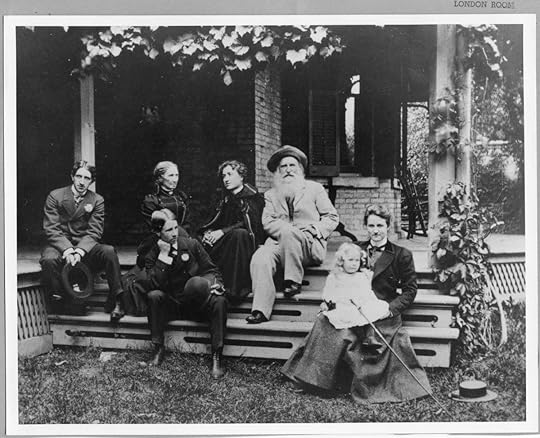
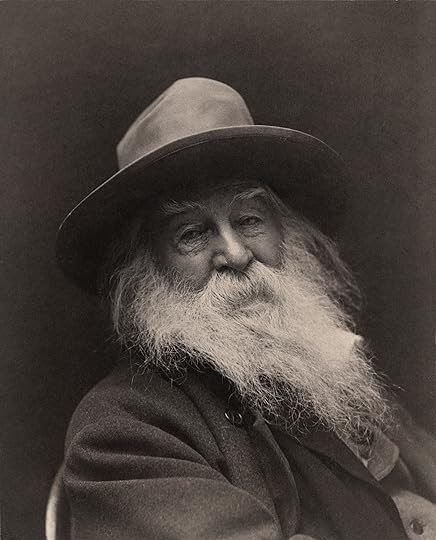
Soon after, Bucke grew a long beard, wore a big hat and walked with a cane, virtually impersonating the poet in his physicality.
Richard (center)
Walt
Anne Gilchrist, an English widow, was so enthralled with Walt’s writing she determined to marry him. After exchanging letters, Anne gathered her children and furniture, boarded a ship and sailed to America and a terrified poet. Anne forgave Walt for disappointing her romantic plans, and they remained friends for life.
Michael attributes these unusually potent reactions to the religious component in Walt’s writing, in passages such as:
I hear and behold God in every object, yet understand God not in the least, Nor do I understand who there can be more wonderful than myself.
Why should I wish to see God better than this day? I see something of God each hour of the twenty-four, and each moment then; In the faces of men and women I see God, and in my own face in the glass; I find letters from God dropt in the street—and every one is sign’d by God’s name, And I leave them where they are, for I know that wheresoe’er I go, Others will punctually come forever and ever.—Song of Myself
The ‘god’ he refers to is not the object of traditional Christian veneration, either Catholic or Protestant. Instead of ascending to Heaven and kneeling before a throne, Walt descends to the fecund earth beneath his feet. He exalts the lowest, bringing Heaven to earth, and from a misty future to the trembling present.
In place of Christianity’s condemnation of the flesh and elevation of the soul, Whitman offers a sensual spirituality, or a spiritual sensuality, that refuses to recognize any distinction between body and soul.
Reading isn’t enough, let’s make a cult Finding inspiration in poetry is wonderful. Falling in love with an author is a bit less wonderful, but sometimes necessary. If Anne Gilchrist had not fallen in love with Walt Whitman and his Leaves, she would not be remembered now. The tragedy occurs when inspiration ferments into personal devotion. Readers get stuck there, they can't move on to their own, independent ambitions.
[Horace] Traubel wanted to establish an international Whitmanite institution, with Camden as its Rome, and himself as pope.
Hero worship—or book worship—may be an acceptable beginning, but it’s a tragic ending for one’s life. The danger is amplified by our strong desire to make one person or one book the last prophet, the final answer to all human questioning. Walt himself recognized this:
It is queer, how the whole world is crazy with the notion that one book, one ism . . . is to save things.
Camerado, I give you my hand Therefore, go forth with love in your hearts, O Whitmanites, but think for yourselves. Walt wrote great poetry because he embraced the time in which he lived, but his time is not our time. Do not stop reading. There are yet other voices.
I happened on this book because, after re-reading Leaves of Grass (the 1855 edition, tremendous), I became interested in what seemed to me spiritual and religious dimensions that I'd not picked up on earlier. Specifically, I felt at points Whitman was intentionally echoing Old Testament prophets.
Google led me to this book. I had no idea of the rich history in regards to readers sensing a spiritual dimension to Whitman's poetry. These people were really obsessed, and while I don't think I'd go so far to call WW the reincarnation of Jesus or anything, this book helped me come closer to their perspective of a supreme tolerance and compassion in Whitman's poetry that can feel religious in it's calming effects (for me anyway).
Be warned that this is not literary criticism, which may or may not be what you are expecting. Instead, it is a sort of narrative biography which ties together the lives of a diverse background of readers who felt uniquely drawn to Whitman and his poetry in some way. For Anne Gilchrist, she imagined him an ideal husband, for others, he was literally the reincarnation of Jesus. It was interesting to overlay the unique perspectives of these 'disciples' and try to understand how they'd come to such often radical conclusions.
I did find the book began to waver just a tad towards the end, right before the chapter on Horace Traubel where Robertson began writing about an official Whitman committee which had formed in England. That bit felt like it got a little far from Whitman and too into the political sphere, that of Britain specifically.
But then the book ends on two strong notes, the first being Horace Traubel, the person who was seemingly Whitman's closest friend by the end of his life. The second is a wonderful afterward that finds Robertson traveling America and abroad to find people with a similar if not as exaggerated reverence for Whitman as these 'disciples' did ~130 years ago. It was interesting to see how modern people have adopted Whitman's egalitarian message into their own lives. In general, I thought that this afterword did a very nice job in helping contextualize the at-times radical perspectives held by people such as Anne Gilchrist and Horace Traubel by bringing them into a modern context in a way that reshapes our own, modern readings of Whitman and his work.
A beautifully written, very thoroughly researched book that is sure to interest not just fans of Whitman, but who are interested in the ways in which modern science and religion clashed in the mid 19th century, how that affected people then, and how that intersection and conflict is still affecting people today. 4.5/5
There seems to be no other word to describe the coterie that formed around Walt Whitman. The devotees were more than fans, they saw Whitman as a prophet, and framed his impact in terms usually reserved for religion. Each feels their life was totally changed by having read Whitman. I had not thought of his prose as it compares to the content and sound of the Psalms, but the disciples have a point.
Writing in the exact middle of the Victorian era, his words were surely a tonic to those tired of the prudishness of the times. Whitman gave those surrounded by a culture of guilt and shame permission to be natural, free and have some self-esteem. For some, this may have been their first exposure to ideas we take for granted today.
Whitman, who must have had enormous charisma, is portrayed as aloof from all this adoration. He is slow to answer mail. He does not encourage visits, but once the visitors come, he develops deep friendships. Unlike Frank Lloyd Wright who developed discipleship into a business The Fellowship: The Untold Story of Frank Lloyd Wright and the Taliesin Fellowship, Whitman asks nothing of these worshippers.
This is a fascinating little volume. Well placed photos help to tell the story. It is not only the story of these disciples, but also a story of the times. The people profiled are not exactly average, but they are not the heroes in the history books. Through their profiles we also learn something of everyday life of the time.
This book was a surprisingly delightful read. Of course, I do enjoy well-written narrative history. Robertson draws upon a wide variety of historical sources to depict this set of primary disciples of Walt Whitman. And he writes in an accessible style; no dense scholarly prose here. He portrays the major characters vividly as impassioned, intelligent, albeit flawed persons. While I've always had an interest in Walt Whitman because of the male-male camaraderie and love that weaves through his poetry, Robertson paints Whitman's life in a larger socio-historical context through these various disciples in the U.S., Canada and England. I came away with a more well-rounded understanding of Whitman and his place in U.S. history, literature and religion.
I wanted this to be something that it wasn't. I was hoping that, through biographical sketches of the Whitman disciples, there would be some new and exciting aspect of Whitman, himself, revealed. Unfortunately, that wasn't the case. These really are just a few collected biographical pieces on people who might have otherwise been forgotten had they not shared the common thread of Christ-like worship for Walt Whitman (aside from Oscar Wilde, who is included here in the book's most intriguing chapter). This is an interesting read, if not a wholly consuming one, and a must for those who devour any and all information related to Whitman. But for those of us who are casual Whitman fans, it can become tedious.