An Indie Next Selection of Independent Booksellers • One of the most anticipated novels of the fall from New York magazine, Glamour, Lit Hub, Boston magazine, The Millions, and BookPage
David Federman has never felt appreciated. An academically gifted yet painfully forgettable member of his New Jersey high school class, the withdrawn, mild-mannered freshman arrives at Harvard fully expecting to be embraced by a new tribe of high-achieving peers. Initially, however, his social prospects seem unlikely to change, sentencing him to a lifetime of anonymity.
Then he meets Veronica Morgan Wells. Struck by her beauty, wit, and sophisticated Manhattan upbringing, David becomes instantly infatuated. Determined to win her attention and an invite into her glamorous world, he begins compromising his moral standards for this one, great shot at happiness. But both Veronica and David, it turns out, are not exactly as they seem.
Loner turns the traditional campus novel on its head as it explores ambition, class, and gender politics. It is a stunning and timely literary achievement from one of the rising stars of American fiction.
Teddy Wayne is the author of the novels "The Au Pair" (2026), "The Winner" (2024), "The Great Man Theory" (2022), "Apartment" (2020), "Loner" (2016), "The Love Song of Jonny Valentine" (2013) and "Kapitoil" (2010) and is the recipient of a Whiting Writers' Award, an NEA Creative Writing Fellowship, the PEN/Robert W. Bingham Prize runner-up, and a finalist for the Young Lions Fiction Award finalist and the Dayton Literary Peace Prize.
I feel like such a loser. I hate when publishers compare books to another book, this book doesn't even do that. I did it. I read the blurb and was hoping for some of that Joe magic from You. I'm very ashamed of myself. Not. I love that creepy stalker.
David Federman is the main character in this book, and we see it from his point of view. He comes to Harvard after leaving his highschool (where no one knew who he was) with high hopes of finding his "tribe." He wants to fit in and then he sees her. Veronica Morgan Wells. He knows that they should be together and that she is most likely his ticket to all he wants in his life.
The thing is...David annoyed the ever loving crap out of me. Carla joined us and talked about Freshman Week activities, but all I could think about, running in a loop, was Veronica Morgan Wells, Veronica Morgan Wells, Veronica Morgan Wells. The quadrisyllable that halves its beats at the middle name, dividing again at its pluralized terminus of subterranean depths. The percussively alert c drowsily succumbing to the dozing s.
He "talks" like that most of the time, especially in the beginning of the book. I know you as a reader are not supposed to side with the weirdo stalker...but dang. I just wanted to face punch him. My teeth were being grinded at an alarming rate. There is just no way in the world that I could picture this loser inserting himself into any clique.
He has a habit (that of course he thinks is a talent) of transposing names and words into being backwards. If you think that's going to annoy you..be prepared. It happens a lot. Then the mentions of Harvard. I hope this books gets a dollar every time that place is mentioned...because annoying as fuck is what it was. I KNEW THEY WERE AT HARVARD.
So to get close to his "you" he starts inserting himself into outskirts of her life. Like by pretending to be into her room-mate. ...This guy is a total turd-head. But he thinks he is the smartest person ever. After awhile the book did kind of grow on me. I ended up turning pages pretty fast to see how in the heck it would wrap up.
I probably need to put a call into a therapist for my weird addiction to these types of books.
Booksource: Netgalley in exchange for review.
I usually highlight another reviewer's review in this space but no one has reviewed this book yet. Someone needs to go and read this so I can check my weirdness compared to them.
Loner turned out to be an unexpected gift, a surprise wolf wrapped in sheep’s clothing. This, of course, is always the best kind of surprise because—let’s face it—who wants to read through shocking revelations that never shock and humdrum plot lines that fail to thrill?
David Alan Federman is entering his freshman year at Harvard in much the same way that he’s lived his pre-college life: introverted, awkward enough to make a habit of spelling large words and sentences backward in his head for kicks (his college entry essay was entitled “SDRAWKCAB”) and perpetually uncomfortable in social settings of pretty much any kind. The middle child of attorney parents who remind him to take his Lactaid before going down to the freshman ice cream party, he meets—rather, instantly becomes enamored with from quite afar—a fellow freshman who’s too-cool-for-school attitude and socially elite entourage easily draw his attention. But the social caste system of high school still exists, even on the prestigious campus of Harvard, and we all know how that goes. Hence this novel takes off at a trot and never really slows, as one occurrence builds upon the tension of the next. What you end up with is a delicious university-setting tautness and social hierarchies traversed with alarming repercussions.
One of the many things that this novel had going for it was setting. No, not just the fact that everyone knows Harvard, one of America’s darling Ivys, but that everything from the physical landscape of the campus to the "baroque" vocab used by its overachieving matriculates immersed the reader in the scene from the very start, both physically and socially. Immersion is a true key to a great read, as we all know, and Loner offered that in spades in a way that was so unique that it struck me as off-putting at first, offering SAT-vocab-laden narration and interior thoughts that practically oozed with a telling social awkwardness—the kind that could only be the result of years of practiced introversion and prolonged interior conversations with oneself. While at first it struck me as a tick, I soon realized that it was, contrarily, a brilliantly executed mood of the novel that all came together delightfully or maybe disturbingly in the end.
But it is with the unique POV shift that the reader first begins to realize something’s wrong.
The blurb for this one left out one key detail that would probably grab it even more readers: that this is a psychological ride as much as anything else. It pushed the boundaries of what we’re comfortable with. Because, you’ll first notice David’s obsession with Veronica the first time the switch to 2nd person happens. You may run across a passage like, “And then I saw you walk in…” in the middle of a 1st person narration, and you’ll know. Oh, you’ll know. It succeeds in creating a hazily unsettling atmosphere, like at any minute you might find that you’ve entered the mind of a young sociopath...
That kept me on my toes.
I’ll resist stepping up to the podium to deliver a monologue on the pros and cons of 2nd person writing and how its increased usage in contemporary writing effects the reader—gosh, sounds like a class I wouldn’t mind taking!—and instead side-step that well-beaten path to say that I genuinely enjoyed this work far more than I would have had that literary tactic not been employed, because it created a charged atmosphere of voyeurism. Who knew you’d get that from the blurb, right?
What I most applaud the author for, however—and trust me, there’s plenty to applaud here—was the author’s clear use of restraint. Restraint, restraint, RESTRAINT! It’s easy to fill a novel with superfluous passages that go nowhere and superfluous characters who do nothing but it’s a skillful author indeed who can cut away the nonsense and tell a truly streamlined tale that still manages to leave no detail unexplored, without inflating the word count with unnecessary prose. That is what Teddy Wayne did here in Loner, hence the short page count and the knock-out punch ending that landed the hardest blow, unsoftened by uncut fat. This novel was a sure ride toward the dénouement with steadily escalating subtle cues that piqued my reader Spidey senses like a dog’s ears perking in the wind. Put your ear to the ground. Can you hear that? For something wicked this way comes…
[It] was thrilling, like the downward slope of a roller coaster that you expected—you saw it as you approached the top of the summit, but your heart still dropped to your stomach on the way down. But, then again, we all know that I’m partial to character pieces that peel back the layers, and this was definitely that. Sharp and utterly disquieting, this novel is so much more than first meets the eye. Every word and action were deliberate. I loved seeing it all come together, seeing the author’s clever hand at work and realizing that those scattered nuances were all part of a larger, oh-so-deliberate whole. I’d gladly jump in bed with the Loner again, and I recommend you do too. 4.5 stars ****
I received an advance-read copy of this book from the publisher, Simon & Schuster, via NetGalley in exchange for an honest review.
Update. Huffman and Coughlin? Are any of you a bit obsessed with and gobsmacked by the recent arrests made surrounding college admissions to elite schools? If so, I highly recommend this posh and dark campus story! -------------------------------- When you purchase a hard back copy AFTER having listened to it completely free from the library, you know it is an excellent book! This slow-burning psychological study was incredibly clever. I loved it and had difficulty stopping the audio book, screening incoming phone calls as the narration temporarily paused.
An amiable, extremely well spoken narrator - a freshman in his first semester at Harvard (Harvard!) - has never been the friendly sort. Even his parents treat him a bit differently from his siblings, encouraging him not to mumble so much and to go make some friends. David's impeccable command of the English language, his incisive written commentary for his ethics and literature classes, and his funny little trick of pronouncing words backwards as entertainment show his extreme intelligence. He hopes, however, to see his social life blossom at Harvard, and when his geeky little cadre of dorm inhabitants accepts him - no, embraces him - things seem to predict an amazing start to his Harvard career. They are certainly not the glitterati that dot the private clubs on campus, but at least he has "friends" with whom he can get out and about. They are a scaffold for his climb, a means for his end.
The tale of a young man besotted by an unreachable love interest and making one irrational decision after one another is nothing new. Dickens wrote it with Pip. Donna Tartt did it with Theo Decker. Most recently, my favorite take on this genre of book was My Sunshine Away, but the main characters there and in these other memorable novels really were good guys. Here? Not so much.
There are clever little nuggets of wordplay by the author that are easy to skim past, but near the end, I got a kick out of this seemingly simple exchange between our anti-hero and a young gal he was helping move into her new dorm room. After two hours of hauling boxes across campus, she is exhausted. "I don't know how I could have done this on my own," said Layla. "You really are a nice guy!"And when David replies "Not at all," it is the most honest understatement of the entire book.
While David is obviously obsessed, as a reader I too felt difficulty pulling away from this story. If you are capable of loving a book even when you dislike its protagonist (and dislike him you will), then this might be up your alley. "Eileen" hit that mark and so did "Feast of Snakes," but David is his own strange flavor of bad.
It's funny - just yesterday, I saw that a few of my GR friends were either reviewing or marking as "to read" a short story entitled The Yellow Wallpaper. Huh - you know how that is - if your buddies are prattling about a book or short story, it is worth glancing at its blurb. It looked really interesting, so I added it to my list. Maybe seven hours later, as I was listening to the audio of Loner, the characters in the story began discussing how best to write a paper on this very story. Ding! The timing was incredible, and while perhaps juvenile of me, it added to my enjoyment of the book.
The building sense of dread, my mild tittering over outstanding word play, and various plot twists made Loner a winner for me. I suddenly want to go to Harvard, not to learn, but to watch the self-absorption of the youngsters who take English classes, like our David, on tragic American heroes - wondering which of them will also become one. Five stars. On my favorites shelf (and the hard copy's there too)!!
David Ferderman is a bright boy, a very bright boy. He coasted through high school, achieving outstanding results – good enough to secure a place at that renowned institute of learning, Harvard. But he made few friends along the way; he was somewhat invisible to his classmates, a withdrawn, ‘vanilla’ presence (though maybe absence would perhaps be a more apt description). He’s shy and withdrawn – as the title suggests, a classic loner. But in his own mind his world is about to open up, he’ll meet new people, impress them with his intelligence and insight and start to experience all the social interactions he’s missed out on thus far.
His parents are New Jersey lawyers and as they drop him off at Harvard he bumps into a rather plain but friendly girl who will feature large in his life over the next twelve months. But this isn’t the person who’s going to occupy most of his thoughts during this period, that honour goes to the beautiful but frosty Veronica. As soon as he spots the her, David falls for her hard and he is determined to find every possible excuse to try to impress her.
To this point I felt the narrative was leading me down the path of one of those campus romps where nice boy seeks pretty bad girl but is destined to see the light and, after ritual humiliation, settle for plain nice girl. But that is to under estimate the gifts of Teddy Wayne (a new to me author). Federman shows guile and perseverance in his quest to attract his prey but this starts to turn into something a little more sinister. His actions and his mindset begin to feel dangerously off-kilter. The guy now started to creep me out a little and I began, for the first time, to feel a bit uncomfortable.
However, the descriptions of life at Harvard including interactions between staff and fellow students is so well written that I felt truly drawn into the story. I wasn’t liking the lead character too much at this point but I was keen to know how the whole thing was going to play out. So it was through squinted eyes that I continued to follow events. I won’t go into any detail regarding where the story goes from here but I will say that it didn’t play out as I expected.
I gobbled this book up in the course of a few days, during which I was curiously drawn back to it any time I had a few minutes to spare. But once finished I was confused as to my feelings about it. On one hand I’d found it to be an intelligently written commentary on gender roles – what’s acceptable and what isn’t between males and females. But on another level I found it to be an uncomfortable insight into the mind of a relatively young adult which (to me) begged questions about parentage and the role of other influential people in his life. Maybe, because I’m seeing this from a perspective of someone who has a son of similar age, who is also intelligent and introverted, I might be projecting my own concerns here. I’m still not sure at this point. And deep down there’s another troublesome thought – one even closer to home – a nudging worry that given the right circumstances could it be that we’d all find we have a smidgen of Federman inside us?
I don’t know the answers to these questions but I do know that this is a book that has unsettled me more than anything else I’ve read in recent times.
My thanks to Simon & Schuster and NetGalley for providing an early copy of this book in exchange for an honest review.
I can understand why this book is a critical darling. It is razor sharp with lots of cleverness, witticisms and full of literary and political references.
However, the book is lacking in depth, substance and the wrapping paper is so pretty covering an empty paper box.
The book revolves around an upper middle class 18 year old boy named David who is accepted to Harvard. He has spent his life on the sidelines not understanding why the world does not see him as the special snowflake that he is. There he meets Veronica, a beautiful, mean and manipulative girl that is wealthy, worldly and has the world by the cojones. He becomes obsessed with her and projects onto her a romantic delusion about their place in the world as the King and Queen of Magnificent. However, Veronica, is a tad too smart and machiavellian and underneath her designer veneer lies a female sociopath but of the lower order variety.
Sounds terrific huh ? Yeah it could have been but in the end was too sensationalistic and superficial to be anything but an easy read low brow type thriller !
This seems to my year of highly entertaining 2.5 star reads !
It's been sooooo long since I've read a true standout novel that I am really struggling to compose a review for this extremely unsettling, yet unputdownable narrative. A slow roll, this thought-provoking character study is so well done. The writing is excellent. I found the story so compelling that when I wasn't able to read, I downloaded the audio and listened to it. This story did something very subtle and seemingly impossible: it created a vivid, authentic setting that made me wax nostalgic for my own college days, while simultaneously drawing me in and making me feel more and more uncomfortable. There were inevitable questions that began to take shape for me as I was reading and suddenly my carefree college memories gave way to doubt and insecurity about my perceptions of safety, intentions, acquaintances, and missed opportunities that may well have been best left alone: that cute guy who was hanging all over me at a Halloween party, insisting I was beautiful despite the fact the my face was painted as a skeleton. He gave me his Red Cross card so I had to call him the next day to return it (I didn't); the super cute guy in Zoology who stared at me to the point that his cuteness no longer mattered and often followed me to my dorm to ask me out (no, thank you); the guy in my dorm who others claimed had assaulted them but to me this seemed inconceivable (he wasn't interested in me); the guy who came into my work to declare he couldn't stop thinking about me after I apparently waited on him weeks before. (Sweet? Or extremely creepy?). So many things I have wondered about, both in the moment when my well-meaning friends called me cynical and paranoid, and after the fact over the years. I'm sure I have mentioned here before that I am the daughter of a homicide detective. The world for me has never felt particularly safe. Still, this story left me shaken and a little off kilter. This is insidious. This is unique. This is close to 5 stars.
3.5 Obsession. From his first glimpse of Veronica, he could not get her out of his mind, putting aside new friendships, a young woman who actually cared about him and even the Harvard experience, all became meaningless. Things o be discarded. To say I disliked David from the very beginning would be an understatement. The same goes for Veronica, who though she did little in the beginning to draw onto herself the obsession, clearly thought she and her friends were better than others, entitled.
So my dilemma, how to rate a book that so clearly made me uncomfortable? That does not leave one with a good feeling? The writing itself was quite good and obsession is the main theme of the book, so the fact that the author made me feel this way shows it accomplished what it set out to do. I think it was because these are ordinary people, things like this happen often. We see it in our news, sometimes with horrific results. There are some graphic sex scenes, this is a true time college environment with different mixes of people. Even the ending is true too often, deplorable really. So glad my children are out of college because I found this to be a rather frightening book. Now I need to try to get it out of my head.
Loner is a well-crafted, caffeinated composition about a volatile, socially-impaired Harvard freshman from New Jersey and his poco loco fixation on an upper crust co-ed from Manhattan's upper East Side, who is not quite as transparent as she seems. Teddy Wayne builds this relationship slowly at first, then deftly thrusts the reader into literary whitewater rapids in which I kept looking for the next dangerous rocks.
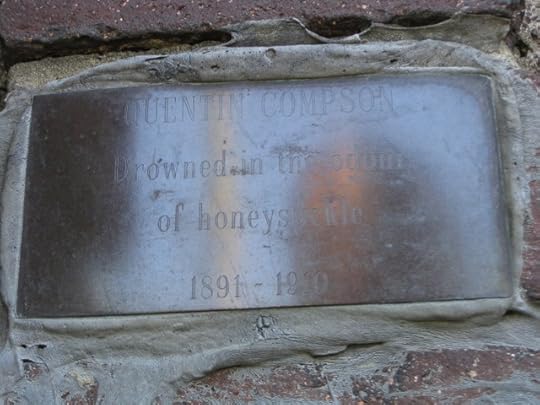
The last 30 pages were like watching a long fuse burn toward a powder keg, or seeing another neurotic, introspective Hahvahd freshman, Quentin Compson, browse around Cambridge before diving into the Charles River--with Wayne's nod to Faulkner's The Sound and the Fury, as near the novel's end the anti-hero David sees the plaque that is actually now on the Anderson Memorial Bridge above the Charles which reads
"QUENTIN COMPSON Drowned in the odour of honeysuckle. 1891-1910"
Anderson Memorial Bridge in Cambridge, MA and Plaque to Quentin Compson
This highly clever fireball of a relatively short novel has an explosive ending with a few unexpected surprises. Wayne also toys with our expectations based on gender and socio-economic status. I highly recommend this if you like psychological character studies.
Nope. This is not going to do it for me. I could put it back to to-read status but that would be a fib. I'm done. I have the attention span of a gnat lately!
3.5 stars. I’m having trouble rating Loner. I really enjoyed it until the end, which I first found clever but ultimately quite disappointing. Loner is a first person narrative about 18 year old David Federman who starts his first year as an undergraduate at Harvard. Loner is also David’s second person narrative addressed to Veronica Wells, who is also a first year student at Harvard. Most of the story is David’s sad pathetic attempt to get Veronica to pay attention to him. Which she does every now and then, which makes David’s efforts even more sad and pathetic. When I say I enjoyed Loner, I don’t really mean that it was an enjoyable reading experience. It was actually somewhat painful and full of cringe worthy toe curling moments. David is really book smart but he’s awful at reading people. But it’s hard to feel bad for him because he’s also really unlikeable -- quite awful really. Teddy Wayne does a really skilful job at conveying David’s inner voice. And he throws in some great tidbits about literature, literary theory and life on an elite American campus. So, he had me reading along with admiring – albeit cringing – interest, until the end. And the end has a very clever twist – a form of poetic justice -- and then for me the end’s cleverness was marred by an unnecessary final event that didn’t seem to fit with the rest of the book. But I won’t say more to avoid spoilers. Do read Loner if you like books about unlikeable characters, unreliable narrators and academic settings. And if you read it, let me know how you feel about the end.
Oddly, Loner hit a personal note. I just sent my 18 year old son off for his first year in university. Fortunately, he’s nothing like David. But Loner definitely fed my parental anxiety…
Thank you to Netgalley and the publisher for an opportunity to read an advance copy.
I was excited to read this book. I tend to like stories that take place in and around College. Teddy Wayne is an award-winning author, and Federman is such a Jewish name ... I was curious just how meschugena ( crazy, insane ), David Federman might be. The blurp says David Federman is academically gifted - yet never felt appreciated. He was a forgettable classmate in High School.
Early in the novel, we get a good idea that David doesn't want to be invisible as a Freshman at Harvard. I wasn't expecting him to be a mensch, ( a good guy), but I had no idea he was going to be a shmendrik, ( a person who is a jerk, only a MUCH bigger jerk than normal --basically, master of all jerks). He was so annoying while trying to impress his new friends that he could turn all their names around-backwards. His talent was to reflect the world in a linguistic mirror. "Why is an apple not an elppa".
Desperate - lacking chutzpah - he is obsessed over a girl named Veronica. Completely out of touch with being able to read her signals - and respect them- that she is not interested....David has tunnel vision- is somewhat delusional. The purpose of his Harvard Days...( the author throws the word, Harvard, around like its confetti), is to get the glamor girl to melt over him. She doesn't. He's still a loner!
*This story is easy to read - straight forward- no surprises- but what makes it good is our AWARD WINNING AUTHOR....and all that he didn't write. His prose and intelligence is top notch...qualified to write a tale on the HARVARD CAMPUS....but what I like is all that 'isn't' being said. All the things the author didn't write. Teddy Wayne leaves us with our emotions exposed....( irritated, angry, frustrated, a little frightened, sad, puzzled, and if you are my age, possibly reflecting back to your college and or High School days).
Reading "Loner" allows us to look inside both young men and women who clearly have not figured out who they are yet.
3.5
Thank You Simon & Schuster, Netgalley, and Teddy Wayne.
I love a great anti-hero. An unlikable, reproachable, repulsive main character. That's why I loved Eileen. That's why Joe Goldberg from Caroline Kepnes' books is so delightful to me. Yes, you heard right. DELIGHTFUL.
So, when I opened this book and began reading about David Federman, I was hooked. I was fascinated. He's very intelligent, he's super bookish, he's in his first year at Harvard. He's also a virgin, socially detached - a "loner". When he lays eyes on Veronica, the delicious and malicious obsession begins.
In addition to the creepy main character, there's so much that I enjoyed during this compulsive read:
1) The setting - cerebral, high achieving Harvard and the academic-fused-with-social/sexual-hierarchy that is student life. 2) The many references to literature, which included The Yellow Wallpaper, The Sound and the Fury, and others. 3) Point of view - 2nd person narrative, which immediately had me think of You, but which ramped up the stalker tension as David intimately addresses his story to Veronica. This boldly illustrates his scopophilic (pleasure from gazing at the object of your desire) tendencies. 4) The clever unraveling, which is truly unpredictable.
This is a psychological, literary character study that will make your skin crawl. David is someone who you might pass on the street, meet at a party, and you would never guess what lies under the surface.
What keeps this from being a 5 star read is the ending, which somehow fell flat for me. I haven't worked out exactly what I hoped for, but I think I needed more. The long slow burn should have led up to a stronger climax. That being said, what a fun ride!
My plan was to sit in a restaurant or coffee shop with a view of your building. At some point you'd pop out for a cigarette, and that's when our coincidental run-in would transpire.
But during my many jaunts down your block through Google Street View, I'd failed to notice the critical oversight in my strategy: Park was strictly residential. There wasn't a single commercial establishment that could serve as an inconspicuous hideout; it was as if the avenue were designed to discourage the casual lurker.
Humph - imagine anyone wanting to discourage lurkers!
Yes, this is a tale of a smart, nerdy loner who, in his first semester at Harvard, become bewitched, bothered, and besotted by and with a fellow student. David Alan Federman may not be the most likable guy, but his exploits make for an interesting and involving read, The author helps things along by ending many chapters with ominous hints at bad things to come, like How differently our lives would have unraveled if . . . and It's convenient, in hindsight, to blame Harvard. But it wasn't the guilty party.
But, the ominous thing, when it comes, isn't nearly as awful or horrifying as I had imagined. Granted, David does commit an act of stalkery that reminded me of the part in Scott Spencer's Endless Love, where the lovesick protagonist is found sleeping in a doghouse in the backyard of his obsession's parents' house. BUT, I was expecting I almost wished the book had ended with the "empty page" following the revelation that
Anyway . . . Wayne has created an unusual main character, though self-obsessed and single-minded, he's probably only slightly more extreme than you or me. The writing is quite excellent, and I enjoyed the look at college life in the age of Facebook. (There was no such thing when I attended a university in the dark ages of the eighties.) I'm grading this work a B-, the same grade that irked poor David so much. This is not, however, recommended to anyone who has to LIKE all the characters in order to LIKE a book.
There’s something oddly satisfying about campus novels. Although I had great fun during my university days, it’s not that I miss these crazy times so much, not that I’m aware of, but the gregarious settings, the shaky personalities, the emotional roller coaster, something just works in favor of character-driven stories when they’re set on a campus, it seems.
Is it that Loner demonizes a quiet geek, as plain as they come, that did it for me this time? Is it that the victim of his unwanted attention doesn’t come out of this entirely clean, herself? Is it that, as romance eludes them both, a semester in their company feels as messy and debauched as it should, holding up to some of the best campus tales out there? Hard to say. All of the above sounds right.
The manipulation at the heart of this novel grabbed me, that much I know. Teddy Wayne certainly knows how to weave a story.
A timely and engrossing character study, LONER was one of the most impressive psychological novels I've read in some time. Focusing on a lonesome young man entering Harvard for his freshman year, Teddy Wayne's brilliant novel is both bitingly funny and unrelentingly visceral, with the latter being responsible for the heap of my praise. A funny book is one thing, and a psychologically adept character study of a dark mind is another, but being able to combine the two into a novel of such immense resonance is something else entirely.
Wayne has an eye for detail, both for physical and nuanced mental aspects of space, that is entirely refreshing. Though LONER focuses on a rather uncomfortable subject, Wayne entraps his readers will a false sense of calm and humor, slowly allowing the more nefarious nature of his subject to unveil itself. By the end of the book, the reader cannot help but to be enthralled by the prose, following the story like that of a car wreck happening before our eyes. I read LONER in one sitting, though I had not intended to. I rarely read novels in one sitting but I simply could not put this book down, all cliches aside. From first page to last, Wayne has crafted a singular novel of incredible power. Eminently readable, ferociously entertaining, and ultimately shocking, LONER is a book that novel only does what it promises in "turning the campus novel on its head," but does so in all the most important ways.
Real quick like – this is the story of David Federline’s first year at Haaaaaavaaaaaaaad. David’s always been a real brainiac, so grades won’t be a problem. It’s the social aspect he might have trouble with. When he sees Veronica Morgan Wells at a freshman mixer he knows his luck is about to change. He just needs to figure out how to get close to her . . . .
Oh Loner, you really missed the mark for me. I know several people who have read/reviewed this and mentioned how it made them feel like they needed a shower due to being squicked out, but really . . . .
I looooooooooooove stories with unlovable leading characters. Until recently I thought there were two categories when it came to books that focus on the bad guys. Crazy mah fahs like that you hate to love . . . .
Or crazy mah fahs that you love to hate . . . .
Well, I meant more like the kind of guy Herman Koch is good at writing, but hey that works too.
A couple of years ago a character came into my life and turned things completely upside down. That character was Joe from You . . . .
Joe made nearly all of my friends question their sanity cross their fingers that the nutcase would get the girl. David, on the other hand????
He reminded me of Holden Caulfield and I straight up wanted to punch his stupid face. The narration didn’t help either. I already knew I was going to be reading about a creepy little stalker, but I do okay comparing apples to similar apples and figured both You as well as Loner could tickle my fancy. That is, until the narration went from first person to second person and it seemed like Loner was a pretty terrible copy of the original. 2.5 Stars because it was super short and had one unexpected twist which led to a moment of . . . .
Unfortunately, it turned out to be just what you’d expect out of someone like Brock Turner a sociopath.
Let me introduce you to David Federman. But the next time you meet him, I'll have to introduce you again, because you will have completely forgotten him. Boring, bland, vanilla David Federman (from New Jersey, to add insult to injury) has never fit in. He's highly intelligent, but socially awkward. He starts his freshman year at Harvard with great hope that he will finally feel a sense of belonging -- that people will recognize his genius, and that he'll be among his intellectual peers.
His first day on campus, he sees a gorgeous freshman woman. He learns she's from the Upper East Side of NYC and she's everything he's not -- attractive, wealthy, and cosmopolitan. Thus begins his descent into obsession with her.
This book exceeded my expectations. I was completely drawn in by the unique story line and surprised by an end I didn't see coming. I loved Teddy Wayne's use of language and will definitely seek out his other works.
4 stars
Thank you to NetGalley and Simon & Schuster for a galley of this book. Although I had a galley I listened to the audio version, which was excellent.
Academically gifted, socially awkward, uninitiated in the finer arts of verbal communication with the opposite sex, David Federman enters Harvard his freshman year with a determination not to forever remain part of the “forgettables.” You know, those overly shy, overly apologetic kids he hung out with in high school, heads perpetually down, avoiding eye contact. David approaches Harvard as if it alone will be the panacea, never doubting he will find “his tribe” here.
Enter Veronica Morgan Wells. VMW. Inaccessible. Sophisticated. Daughter of a socialite from Manhattan. Beautiful. The kind of young woman you would remember. The kind of girl who would have ignored him in his previous incarnation, but David is determined to slowly, imperceptibly weave his way into her life. Ingratiate himself. Slowly. Easily, almost naturally. At first.
Teddy Wayne's Loner is not a thriller, some moments are more tense than others. Like David Federman himself, Wayne’s cautionary tale slowly creeps forward to a point in time where you begin to see things unravel. Loner delves into the life and mind of David Federman, a loner. That fact that this is so timely a topic and such a believable read is the truly terrifying thought.
Many thanks to Simon & Schuster, NetGalley, to author Teddy Wayne for the opportunity to read this book.
"All I could think about, running in a loop, was Veronica Morgan Wells, Veronica Morgan Wells, Veronica Morgan Wells. The quadrisyllable that halves its beats at the middle name, dividing again at its pluralized terminus of subterranean depths. The percussively alert 'c' drowsily succumbing to the dozing 's.' Perfectly symmetrical initials, the 'V' found twice upside-down in the 'M,' inverted once more in the 'W,' and, if spoken, easily confused with a German luxury automaker."
David Federman is an academically gifted student, but he's never been able to make much of an impression socially. While he had a group of friends in high school, they all tended to be those on the social fringe. As an incoming freshman at Harvard, he hopes things will be different. He's ready to trade witty barbs with fellow classmates, become noted for his academic prowess, forge friendships that will last for a lifetime, and, of course, finally have some luc in the romance department as well.
But his chance to reinvent himself socially doesn't seem to be working, and he finds himself part of a very similar group of social misfits as he had in high school, although this time there are a few female members, and he seems to have a reasonably easy rapport (and a great deal in common) with Sara, one of the group's members. And then David sees Veronica Morgan Wells. Veronica is beautiful, intelligent, worldly, and seems to carry herself with immense poise and social grace, the antithesis of David's life to date.
David is convinced that Veronica is the one for him, and all he has to do is prove it. He does everything he can to set up situations where she'll get to know the "real" David, to see him for the smart, witty, generous, romantic guy he knows he is. But as David's obsession with Veronica grows, he starts to make questionable decisions that have ramifications for him academically, socially, and morally. Even as he realizes that Veronica isn't the person she seems to be, he still feels the need to finally be noticed by her as an equal.
Loner is an interesting look at how someone who has always been on the fringes of life—partially by choice and partially because of the social pecking order common to high school and college—finally wants to be noticed by the "in-crowd." It's a book about struggling to find yourself when you appear to be surrounded by a sea of people who already have found themselves, and how feeling you have never really made an impact on anyone starts to take its toll. It's also a book about how we fail to notice what we actually have as we strive for what we think will be better.
Above all, however, Loner is about obsession. David isn't quite the stalker that we've traditionally seen in books and movies, yet you can feel just how palpable his longing is. As you watch this mild-mannered, significantly intelligent young man transform into someone completely different, you wonder whether these characteristics have been latent in him all along, or whether he simply began cracking under the strain of desire and the need for acceptance.
I thought this was a good book, but my main problem was that I found David not particularly likable, which, I guess, is understandable given his actions. I understood his desire to be noticed, to transcend the social doldrums in which he always seemed to find himself, and his inability to recognize what he actually had right in front of him. But as his desire for Veronica intensified, I didn't find him sympathetic in the least, so while I was interested in seeing how the story unfolded, I didn't really care about his plight.
I've never read anything by Teddy Wayne before, and while I didn't find David to be a particularly compelling character the entire book, I thought Wayne did a great job with the "Harvard voice"—the types of things Harvard freshmen talk about when having social conversation. Even David's own thoughts, as evidenced in the quote that began this review, were well-voiced. This was an intriguing look at the downside of college pressure, and Wayne definitely kept me reading to see what happened.
NetGalley and Simon & Schuster provided me an advance copy of the book in exchange for an unbiased review. Thanks for making this available!
Update: Reconsidering my rating. This is better than a 3-star.
The Loner was a mixed bag for me. I'm not sure how to rate it. Teddy Wayne is a competent writer, there's no doubt about it. If he meant to create one of the most unlikable characters I've ever read, then kudos to him, he succeeded. Because, David Federman, eighteen-year-old Harvard freshman is a sociopath. He's sex-obsessed, like most young men. He wants to change his social status, from a loner to a more popular student. Nothing wrong with that.
He's very articulate and his grasp of the English language is far above everyone else's. I like when authors use big words, I like to learn new words, yet for the most of the book I wondered "who talks like this"? Do any eighteen-year-olds speak/think like that? Even the very smart ones? It felt like too much.
I also had many "yewww" moments. Let's just say that one is best kept in the dark when it comes to a young man's thoughts and observations on sex, intercourse etc. If Wayne tried to make David unlikeable through this, well, he was brilliant.
In saying all that, I'm glad I didn't abandon the novel and read it to the end. Because, around the 85%, it got really good. I can't tell you why, because I don't want to spoil it for you, should you decide to read it.
I forgot to mention, that, throughout the novel, Wayne switches from the first to the second person narrative. David is an unreliable narrator, who's obsessed with Veronica, a very beautiful, privileged freshman. The second person narration reminds me of You by Caroline Hepnes, where another sociopathic guy is obsessed with a young woman.
So in conclusion, I appreciated Teddy Wayne's writing skill. He managed to create a very unlikable character, who's beyond redemption. I was so irritated with him, not even his nerd status endeared him to me (I usually go for the underdog). Again, if that's what Wayne intended to do, he did it very well. Come to think of it, I'm so ... I don't know what I am with this novel - because David is so real, he could be or is like many others we've met or could meet, which is scary. None of the scenarios are far fetched, so that makes the whole thing even scarier.
There is more to this novel than a freshman's obsession with a beautiful girl. The Harvard setting is a good background to talk about social status, the obsession with succeeding, at all cost. Sexism, feminism, elitism, sexuality, relationships are addressed as well, some in more depth than the others.
I'm guessing this is going to be one of those novels you either love or hate. While I hated the character, as you should, there's no denying Teddy Wayne wrote a good novel.
I've received this novel via NetGalley, in exchange for an honest review. Thanks to the publishers, Simon & Schuster, for the opportunity to read and review this novel.
Step inside the mind of a stalker. That was the first term that came to mind, but don’t stalkers usually work from a distance? If so, then David would be different. Peripheral stalking is only a first step. He wants more. He wants to be a part of Veronica’s life.
As a character, David is pretty well unlikeable. Not a big surprise. I have to believe this was a wholly intentional move by the author. Shitheads aren’t supposed to be liked. Supposedly Ted Bundy was a charmer, easily to like, but then again no one had the chance to see just what was going on inside that head of his. It’s the outer shell we see, unless you pick up this book. How good is the actor, and how long can he play the part?
So when a main character is hard to like, what’s of interest? Well, the progression of David’s game gets a little intense. I kept waiting (hoping even) for the mistake that would bring down the house of cards he had so carefully constructed along the way. Call me a stalker’s stalker, but I wanted to know the outcome. A funny thing happened along the way. As much as I wanted to trip David up, a part of me felt sorry for his nutty self. He’s insanely smart, yet weirdly naive at the same time. Add to this the realization that Veronica would have benefited beautifully from a kick to the heiney – the pompous gluteus maximus that she is. Who to root for then? If there’s anyone to like, it is Veronica’s roommate Sara, the one David uses as a pawn to reach his goal. Collateral damage sucks.
Interested so far? Here’s another reason to read this book: the final quarter throws a wrench in the works. I had a feeling that something different might be coming. Pretty good ending.
Loner is a suspenseful and engrossing story about a disturbed first year student at Harvard named David Federman (or should say Divad Namredef.) Instead of focusing on his studies, as I am sure a freshman at Harvard would be doing, he begins obsessively stalking another student.
This is a fast paced book that is a real eye opener into the disillusioned mind of a young man. I thought it was interesting how Teddy Wayne slowly builds David’s character; from the reader somewhat liking him in the beginning of the book, to then becoming creeped out and by the end completely disliking him. It is written in such a way as to make you feel like you are inside a stalker’s mind. I read an interview with the author and he stated that he felt compelled to write about young men who are labeled the loners in society and researched teenage killers. You can definitely tell he did his homework on this one.
From the time I was in the second grade, I'd go upstairs for part of the day and have my reading and English classes with the sixth and seventh grade classes. In all, it was a wonderful arrangement, with the only unfortunate consequence that I sometimes read texts that were within the scope of my reading comprehension, yet well outside the scope of my maturity. For instance, after reading an article about what would transpire on earth once the sun burns out, I could not be convinced by any means whatsoever that this would not occur imminently. For weeks I soldiered on bearing a sense of impending doom, casting anxious glances skyward to assess time remaining until oblivion. And the other most notable example of my eyes being bigger than my brain was in my reading of the Daniel Keyes novella Flowers For Algernon, which reminded me of Teddy Wayne's Loner in its fluent portrayal of an unreliable narrator whose level of insight ebbs and flows - or in the case of Loner, perhaps simply ebbs! - throughout the course of the book.
So without spoiling either book, let me first try to explain what made Flowers For Algernon so traumatizing to little me. Basically, the narrator of FFA, Charlie, undergoes some radical brain-based changes that he's sometimes, but not always, able to anticipate and describe. However, even when his cognitive and behavioral changes lie beyond the scope of his awareness, the reader is fully able to tell what's going on, which creates a terrifying and helpless feeling of watching someone about to be hit by a train. In my case, reading at the very self-referential age of eight, my takeaway was that if Charlie could be undergoing such transformation unbeknownst to him, then the same could happen to me, and therefore, logically, MUST be happening to me at that very moment! As those who've read that novel will understand, this outcome would be equally as fearsome as the prospect of a burned-out sun, only even more so, because in this case, the sun would be my HEAD, which would surely result in my banishment from seventh-grade English.
Now, Loner works in somewhat the same hypnotic fashion, only a little differently. Instead of just merely witnessing a narrator's progressive suffering as we do in FFA - and also in Loner, where the narrator, David, pushes the cringeworthy boundaries of social awkwardness from the very beginning of Harvard freshman orientation week - we also become progressively, uncomfortably aware of the narrator's potential to create, or perhaps even inflict, suffering as well. As FFA's Charlie increasingly loses touch with reality, we become increasingly aware of the catastrophe that may befall him, whereas as Loner's David increasingly loses touch with reality, we become increasingly aware of his capacity to generate catastrophe or generally precipitate and participate in chaos. Basically, the reader is slowly, deftly, inexorably led to believe that something bad is going to happen to someone, and it's somehow going to involve David and most of the other main characters, but we don't exactly know the whos, whens, wheres, or whats - or, as a surprise plot twist reveals, even all of the whys and hows. As with Flowers For Algernon, we simultaneously know both more and less than the narrator, and this makes for a hell of a mouse maze to navigate. (Flowers For Algernon inside joke!)
As many have stated, Loner is a rapid page-turner that's hard to put down and easy to pick back up. I'd describe it as a character-driven literary thriller. Wayne deserves kudos for his unique and rather macabre twist on the Ivy League campus novel as well as the "Say Anything" or "Can't Buy Me Love"-type "geek boy pursues golden girl" story. Although the threads tie together quite neatly in the end, I must say the book sat a little lightly with me once it was over: it was an engrossing read while it lasted, with a resolution aided by a clever latebreaking surprise reveal, but I wasn't left weightily pondering it for days on end. I'd compare it to a perfectly executed egg sandwich, but that's not a knock. After all, sometimes nothing's more delicious than that perfect egg sandwich, especially after you've been subsisting on mysteries that all too often resemble the mush of campus cafeteria marinara, cereal, and soft-serve.
David Federman is not an anti-hero. He's not a loner.
He's just a loser.
A creepy, creepo waste of space, a sad sack wrapped up in white middle class privilege hiding dangerous sexual perversions.
He's one step away from the pervs who expose themselves on the subway and two steps away from holding an innocent woman captive in his basement.
To me, an anti-hero is not just a morally ambiguous character but someone who also retains some dark, villainous qualities I may also admire/desire/envy in some way.
David Federman possesses none of the above dark qualities.
He is a person of no redeeming value or traits.
He's not attractive, talented or exceptionally bright and witty.
A part of me had a difficult time accepting how he even managed to matriculate at Harvard.
I was bored when I began this book.
When I came to the end, I was still bored and now just annoyed.
The ending was anti-climatic and yet oddly appropriate, maybe because I could see it coming and should have known better.
How else could it have ended?
Maybe I was hoping someone would swing Lucille into David's head.
This one falls into the "hard to rate" category. On the one hand, I couldn't stop reading it. I was completely sucked into the story and invested in the outcome. On the other hand, I really didn't like the ending and I found the whole book to be lacking in substance. I guess I was looking for more depth.
David is a freshman at Harvard who is completely obsessed with Veronica who lives in his dorm. Obsessed to the point that he dates her roommate to get closer to her. Bad things happen and neither David nor Veronica are who they seem.
This was an engaging fast read but I doubt I'll remember much about it in a few weeks.
After being fully devastated by Wayne's fourth novel, Apartment, I waited a while to recover and then dove into his third novel. I found this one as wholly entertaining, absorbing, and emotionally astute as both Apartment and Wayne's second book, The Love Song of Jonny Valentine, but, while I genuinely liked the way the ending was executed, it felt a bit unoriginal to me (did it remind anyone else of ?). Anyway, this was still great, it's just that Teddy Wayne had already set the bar so damn high. Looking forward to his next novel, out later this year!
Oh my! This was a tense, page turning 5+ STAR read through page 200 and then, just three pages before the close … I don’t know … nothing! That’s it? I re-read the last several pages again and again … what did I miss? I didn’t miss anything. That’s it … that’s how it ends. I hated the ending!
Okay, the first 200 pages … absolutely, positively brilliant! At work I watched the clock in anticipation of lunchtime so I could jump back into the story, a story about the obsession of a loner. David Alan Federman is a loner. The loner’s obsession is Veronica Morgan Wells. Veronica Veritas …. she was the only one to follow his lead during the freshman orientation exercise. Her mischievous smile lassoed his imagination. The loner tells his story about his first three months at Harvard University.
David is one of three children and the only son of a pair of New Jersey lawyers who seemed to act a little unnatural around him. Extraordinarily smart, David can easily speak and write backwards, the language of the world inside his head he developed during his long periods of solitude. He spends a lot of time alone. At Garret Hobart High, named for New Jersey’s only vice president, he is a member of a coalition of very studious seniors, not quite geeks or nerds but on the margins nonetheless, who banded together like a herd of wilder beasts out of instinct to survive. Harvard, his longtime dream, was his ticket to a higher social stratum.
Mrs. Rice’s letter of recommendation helped secure his ticket to Harvard; his admission essay sealed the deal.
“...one of the most gifted students I’ve encountered in my twenty-four years teaching English at Garret Hobart High,” wrote Rice. “...already in possession of quite a fancy prose style (that sometimes goes over my head, I must admit!), although I can sense the immense strain human interactions put on him … I have the utmost confidence that, with the properly nurturing environment, this young man, somewhat of a loner, will come out of his shell and be as expansive and eloquent in person as he is on the page”.
Dissuaded from writing his entire admission essay backwards, he wrote the essay normally but entitled it BACKWARDS, written backwards. The Harvard admission committee was intrigued!
Veronica Morgan Wells is of Park Avenue pedigree, a graduate of the prestigious Chapin School. She runs with her posse of private school sophisticates on campus, barely acknowledges David’s existence, at first; until he insidiously inserts himself into her life. Months of meticulous strategizing … the innocent touch of elbows, the internet searches and incessant reading of the same material about Veronica, class shopping to land in the same lecture as Veronica, Facebook friendship, dating Veronica’s roommate to get inside her room, helping Veronica write class essays.
The sexual tension builds slowly but methodically, the obsessive escalation incremental but obvious. The infinitesimal expansion of the creep factor glued me to each page. From a slow rumbling freight train to a torrid page turner, David’s obsession, laced with sadomasochist desires, comes to a head when he discovers A QUID PRO QUO, A Market-Based Study of Fe(male) Sexual Transactions by Veronica Wells. The beta male … she knew! The first 200 pages were AWESOME!
The last three pages … horrible! So anticlimactic that I felt cheated. I suppose this was the author’s way of saying once a loner, always a loner. David was a highly intelligent eighteen year old man, locked up inside his head like a form of self-imposed solitary confinement, creating his own little world without external references or benchmarks. Stepping outside his head into the reality of life in Boston and Harvard University, he was a rookie, an easy mark! Five years later, David is back in his room. But still, why such a flat, unsatisfying conclusion? David wormed his way back into Sara’s life, to get to Veronica, by seeking closure. I am still seeking closure to this tale.
Almost DNF'd. Starts off as an annoying version of Caroline Kepnes's You. It got more engaging as it went along but I still would have just preferred to re-read You. Oh well.
What a disturbing, creepy, different sort of book this was, and I absolutely loved it! This book is told in the first person by David, a loner who's never fit in, during his freshman year at Harvard. Because the book is completely from David's perspective, you get an unfiltered look into his truly twisted mind, his motivations for everything and his actions. My only complaint is that I didn't want this book to end, I just wanted it to keep on going. I very highly recommend this book. Now, I'm looking forward to reading the author's other works.
Thank you to Netgalley and Simon & Schuster for an advance copy of this in exchange for an honest review.