Jump to ratings and reviews
Rate this book

The End of White Christian America

Rate this book
Winner of the 2019 Grawemeyer Award in Religion Robert P. Jones, CEO of the Public Religion Research Institute, spells out the profound political and cultural consequences of a new reality—that America is no longer a majority white Christian nation. “Quite possibly the most illuminating text for this election year” (The New York Times Book Review).For most of our nation’s history, White Christian America (WCA) set the tone for our national policy and shaped American ideals. But especially since the 1990s, WCA has steadily lost influence, following declines within both its mainline and evangelical branches. Today, America is no longer demographically or culturally a majority white, Christian nation. Drawing on more than four decades of polling data, The End of White Christian America explains and analyzes the waning vitality of WCA. Robert P. Jones argues that the visceral nature of today’s most heated issues—the vociferous arguments around same-sex marriage and religious and sexual liberty, the rise of the Tea Party following the election of our first black president, and stark disagreements between black and white Americans over the fairness of the criminal justice system—can only be understood against the backdrop of white Christians’ anxieties as America’s racial and religious topography shifts around them. Beyond 2016, the descendants of WCA will lack the political power they once had to set the terms of the nation’s debate over values and morals and to determine election outcomes. Looking ahead, Jones forecasts the ways that they might adjust to find their place in the new America—and the consequences for us all if they don’t. “Jones’s analysis is an insightful combination of history, sociology, religious studies, and political science….This book will be of interest to a wide range of readers across the political spectrum” (Library Journal).

320 pages, ebook

First published July 1, 2016

233 people are currently reading
2882 people want to read

About the author

Robert P. Jones

25 books217 followers
Robert P. Jones is the president and founder of Public Religion Research Institute (PRRI). He is the New York Times bestselling author of The Hidden Roots of White Supremacy and the Path to a Shared American Future (2023), as well as White Too Long: The Legacy of White Supremacy in American Christianity (2020), which won a 2021 American Book Award. He is also the author of The End of White Christian America (2016), which won the 2019 Grawemeyer Award in Religion.

Jones writes regularly on politics, culture, and religion for The Atlantic, TIME, Religion News Service, and other outlets. He is frequently featured in major national media, such as CNN, MSNBC, NPR, The New York Times, The Washington Post, and others. Jones writes a weekly newsletter for those dedicated to the work of truth-telling, repair, and healing from the legacy of white supremacy in American Christianity at www.whitetoolong.net.

He holds a Ph.D. in religion from Emory University, an M.Div. from Southwestern Baptist Theological Seminary, and a B.S. in computing science and mathematics from Mississippi College. Jones was selected by Emory University’s Graduate Division of Religion as Distinguished Alumnus of the Year in 2013, and by Mississippi College’s Mathematics Department as Alumnus of the Year in 2016. Jones serves on the national program committee for the American Academy of Religion and is a past member of the editorial boards for the Journal of the American Academy of Religion, and Politics and Religion, a journal of the American Political Science Association.

Jones served as CEO of PRRI from the organization’s inception in 2009 to 2022. Before founding PRRI, he worked as a consultant and senior research fellow at several think tanks in Washington, D.C., and was an assistant professor of religious studies at Missouri State University.

Ratings & Reviews

What do you think?
Rate this book

Friends & Following

Create a free account to discover what your friends think of this book!

Community Reviews

5 stars
378 (26%)
4 stars
655 (46%)
3 stars
309 (22%)
2 stars
50 (3%)
1 star
12 (<1%)
Displaying 1 - 30 of 266 reviews
Profile Image for David Pierce.
70 reviews7 followers
August 6, 2016
I was raised in a Caucasian Christian family in the Bible Belt. I have been a Baptist pastor for some 20+ years. I conclude White Christian America actually existed (past tense). And if it is not dead, it certainly is terminal and near death. You might be surprised to read that from me, as much as I hate to admit it. I purchased the book to give it a real critical treatment. The author succeeded in convincing me of much of his argument. Note, I don't doubt my faith nor the Bible I preach from daily. But the cultural Christianity of this country and particularly of the South that insisted on their right to dominate politics and social norms needs to be eulogized. It is misguided and hypocritical to insist that White Christian America has any ownership rights or right to control. The shifts in the culture, have not been the general population becoming more progressive. It has been almost solely a Protestant shift in values. I would suggest reading this book not to find agreement with the author, I read values I don't agree with whole heartedly. But read it to unpack some of the prejudicial and misinformed analysis of the religious right. We either haven't been honest or we have been self-deceived.
Profile Image for Clif Hostetler.
1,298 reviews1,061 followers
September 4, 2024
When this book was first published I planned to read it. But I procrastinated and the 2016 election happened in which Republicans won the Presidency and the majority in both the Senate and House of Representatives. At that point I lost interest in the book since it appeared that its forecast of the end of "White Christian America" was a bit premature.

But then I learned that an "Afterword" had been added to the recent editions of this book that discusses the results of the 2016 election. I've not read the book, but I did read the Afterword. I've included a copy of the Afterword below by use of OCR and Amazon preview feature.

Excerpt from "Afterword" of Latest Edition
“You have one day to make every dream you've ever dreamed for your country and your family come true. You have one magnificent chance to beat this corrupt system and to deliver justice for every forgotten man, every forgotten woman, and every forgotten child in this nation. It will never happen again-it will never happen again, folks. In four years, not going happen. Not going to happen. lt's never going to happen again. Do not let this opportunity slip away.”

-Donald I. Trump, speaking at a campaign stop in Pennsylvania, November 7, 20I6 (CNN )
Trump and the "Last Chance" Election of 2016

Down the home stretch of the 2016 presidential campaign, one of Donald Trump's most consistent talking points was a claim that America's changing demographics and culture had brought the country to a precipice. He repeatedly cast himself as the last chance for Republicans and conservative white Christians to step back from the cliff to preserve their power and way of life. In an interview on Pat Robertson's Christian Broadcasting Network (CBN) in early September, Trump put the choice starkly for the channel's conservative Christian viewers: “If we don’t win this election, you'll never see another Republican, and you'll have a whole different church structure." Asked to elaborate. Trump continued. ‘l think this will he the last election that the Republicans have a chance of winning because you’re going to have people flowing across the border, you’re going to have illegal immigrants coming in, and they’re going to be legalized, and they’re going to be able to vote, and once that all happens you can forget it."

Michelle Bachmann, a member of Trumps evangelical executive advisory board, echoed these same sentiments in a speech at the Values Voters Summit, an annual meeting attended largely by conservative white Christians That same week. she declared in an interview with CBN: “If you look at the numbers of people who vote and who lives [sic] in the country and who Barack Obama and Hillary Clinton want to bring in to the country; this is the last election when we even have a chance to vote for somebody who will stand up for godly moral principles. This is it. Post-election polling from PRRI and The Atlantic showed that this appeal found its mark among conservative voters. Nearly two-thirds (66 percent) of Trump voters, compared to only 22 percent of Clinton voters. agreed that “the 2016 election represented the last chance to stop Americas decline."

Not Dead Yet? Trump’s Victory in Context

What should we make of Trump’s unexpected victory? Does it represent a resurrection of White Christian America? The consequences of the 2016 elections are indeed sweeping. Republicans entered 2017 with control of both houses of Congress and the White House. And because the Republican controlled Senate refused to consider an Obama appointee to replace Justice Antonin Scalia, who died in early 2016, Trump was able to nominate a conservative Supreme Court justice right out of the gate. Trump's cabinet and advisors consist largely of defenders of either Wall Street or White Christian America.

The evidence, however. suggests that Trumps unlikely victory is better understood as the death rattle of White Christian America rather than its resuscitation. Despite the elections immediate and dramatic consequences, it's important not to over-interpret Trump's win which was extraordinarily close as a mandate. Out of more than 136 million votes Cast, Trump's victory in the Electoral College came down to a razor-thin edge of only 77,744 votes across three states Pennsylvania (44,292 votes), Wisconsin (22,748 votes), and Michigan (10,704 votes). These votes represent a Trump margin of 0.7 percentage points in Pennsylvania, 0.7 percentage points in Wisconsin, and 0.2 percentage points in Michigan. If Clinton had won these states. she would now be president. And of course Clinton actually won the popular vote by 2.9 million votes, receiving 48.2 percent of all votes compared to Trump’s 46.1 percent. The real story of 2016 is that there was just enough movement in just the right places, just enough increased turnout from just the right groups, to get Trump the electoral votes he needed to win.

Trump's intense appeal that 2016 was the “last chance” election seems to have spurred conservative white Christian voters to turn out at particularly high rates. Two election cycles ago in 2008, white evangelicals represented 21 percent of the general population but, thanks to their higher turnout relative to other voters, comprised 26 percent of actual voters. Two presidential election cycles later, in 2016, white evangelicals continued to represent 26 percent of voters-even as their proportion of the population fell to 17 percent. In other words, white evangelicals went from being overrepresented by 5 percentage points at the ballot box in 2008 to being overrepresented by 9 percentage points in 2016. This is an impressive feat to be sure, but one less and less likely to be replicated as their decline in the general population continues.

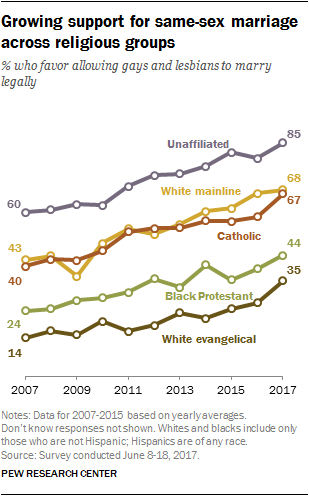
Updating two trends with 2015-2016 data also confirms that the overall patterns of demographic and cultural change are continuing. The chart below plots two trend lines that capture key measures of change: the percentage of white, non-Hispanic Christians in the country and the percentage of Americans who support same-sex marriage. In Chapter Two, I noted that the percentage of white Christians in the country had fallen from 54 percent in 2008 to 47 percent in 2014. That percentage has fallen again in each subsequent year, to 45 percent in 2015 and to 43 percent in 2016. Similarly, in Chapter Four, I noted that the percentage of Americans who supported same-sex marriage had risen from 40 percent in 2008 to 54 percent in 2014. That number stayed relatively stable (53 percent) in 2015-the year the Supreme Court legalized same-sex marriage in all 50 states-but jumped to 58 percent in 2016.

LINK TO CHART REFERENCED ABOVE

In summary. despite the outcome of the 2016 elections, the key long-term trends indicate White Christian America's decline is continuing unabated. Over the last eight years. the percentage of Americans who identify as white and Christian fell 11 percentage points, and support for same-sex marriage jumped 18 percentage points. In a New York Times op-ed shortly after the election, I summarized the results of the election this way: “The waning numbers of white Christians in the country today may not have time on their side. but as the sun is slowly setting on the cultural world of white Christian America, they‘ve managed, at least in this election, to rage against the dying
of the light?

The Transformation of white Evangelicals
from Values Voters to Nostalgia Voters


One of the most perplexing features of the 20l6 election was the high level of support Donald Trump received from white evangelical Protestants. Since Reagan's presidency, white evangelicals have overwhelmingly supported Republican presidential candidates. But Trump, of course, was no typical Republican candidate. So how did a group that once proudly identified itself as “values voters" come to support a candidate who had been married three times, cursed from the campaign stump. owned casinos, appeared on the cover of Playboy Magazine, and most remarkably, was caught on tape bragging in the most graphic terms about habitually grabbing women's genitals without their permission? White evangelical voters' attraction to Trump was even more mysterious because the early GOP presidential field offered candidates with strong evangelical credentials, such as Ted Cruz, a longtime Southern Baptist whose father was a Baptist minister, and Marco Rubio, a conservative Catholic who could tall: with ease and familiarity about his own personal relationship with Jesus.

The shotgun wedding between Trump and white evangelicals was not without conflict and objections. It set off some high drama between Trump suitors. such as Jerry Falwell Jr. of Liberty University and Robert Jeffress of First Baptist Church in Dallas. and #NeverTrump evangelical leaders such as Russell Moore of the Southern Baptist Convention. lust days ahead of the Iowa caucuses, Falwell invited Trump to speak at Liberty University. In his introduction, Falwell told the gathered students. "In my opinion, Donald Trump lives a life of loving and helping others as Jesus taught in the great commandment" And a week later. he oficially endorsed Trump for president. Robert Jeffress, the senior pastor of the influential First Baptist Church in Dallas and a frequent commentator on Fox News, also threw his support behind Trump early in the campaign but took a decidedly different approach. Jeffress explicitly argued that a president`s faith is “not the only consideration, and sometimes it's not the most important consideration.” Citing grave threats to America. particularly from "radical Islamic terrorism," Jeffress's support of Trump for president was straightforward realpolitik: “I want the meanest, toughest, son-of-a-you-know-what I can find in that role, and I think that's where many evangelicals are.” Moore, by contrast, remained a steadfast Trump opponent throughout the campaign. He was aghast at the high-level embrace of Trump by white evangelical leaders and strongly expressed his incredulity that they “have tossed aside everything that they previously said they believed in order to embrace and to support
the Trump candidacy.”

In the end, however, Falwell and Jeffress had a better feel for the people in the pews. Trump received unwavering support from white evangelicals from the beginning of the primaries through Election Day. As I noted in an article for The Atlantic at the beginning of the primary season, the first evidence that Trump was rewriting the Republican playbook was his victory in the South Carolina GOP primary, the first southern primary and one in which more than two-thirds of the voters were white evangelicals. The Cruz campaign had considered Super Tuesdays South-heavy lineup to be their firewall against early Trump momentum. But when the returns came in, Cruz had won only his home state of Texas and neighboring Oklahoma, while Trump had swept the southem states, taking Georgia, Alabama, Tennessee, Virginia, and Arkansas. Trump ultimately secured the GOP nomination, not over white evangelical voters’ objections, but because of their support. And on Election Day, white evangelicals set a new high-water mark in their support for a Republican presidential candidate. Trump at a slightly higher level than even President George W Bush in 2004 (81 percent vs. 78 percent).

Trump's campaign-with its sweeping promise to “make America great again”-triumphed by convening self-described “values voters" into what I've called "nostalgia voters." In the final chapter of The End of White Christian America, I predicted that “siren song of nostalgia” would be the strongest for the white evangelical branch of the WCA family tree because they had only recently been confronted with the evidence of their own decline. Trump's promise to restore a mythical past golden age—where factory jobs paid the bills and white Protestant churches were the dominant cultural hubs—powerfully tapped evangelical anxieties about an uncertain future.

The 2016 election, in fact, was peculiar because of just how little concrete policy issues mattered. The election, more than any in recent memory, came down to two vividly contrasting views of America. Donald Trump's campaign painted a bleak portrait of Americas present, set against a bright, if monochromatic, vision of 1950s America restored. Hillary Clinton's campaign, by contrast, sought to succeed the first African-American president with the first female president and embraced the multicultural future of 2050, the year the Census Bureau originally projected the United States would become a majority nonwhite nation. ‘* “Make America Great Again” and “Stronger Together? the two campaigns’ competing slogans, became proxies for an epic battle over the changing face of America.

The gravitational pull of nostalgia among white evangelicals was evident across a wide range of public opinion polling questions. Just a few weeks before the 2016 election, two-thirds (66 percent) of white evangelical Protestants said the growing number of newcomers from other countries threatens traditional American customs and values. Nearly as many favored building a wall along the U.S. border with Mexico (64 percent) and temporarily banning Muslims from other countries from entering the United States (62 percent). And 63 percent believed that today discrimination against whites has become as big a problem as discrimination against blacks and other minorities. White evangelicals also stood out on broad questions about cultural change. While Americans overall were nearly evenly divided on whether American culture and way of life have changed for worse (51 percent) or better (48 percent) since the 1950s, white evangelical Protestants were likelier than any
other demographic group to say things have changed for the worse since the 1950s (74 percent).

It is perhaps an open question whether Trump's candidacy represents a true change in evangelicals' DNA or whether it simply revealed previously hidden traits, but the shift from values to nostalgia voter has undoubtedly transformed their political ethics. The clearest example of evangelical ethics bending to fit the Trump presidency is white evangelicals’ abandonment of their conviction that personal character matters for elected oflicials. ln 2011 and again just ahead of the 2OI6 election, PRRI asked Americans whether a political leader who committed an immoral act in his or her private life could nonetheless behave ethically and fulfill their duties in their public life. ln 2011, consistent with the "values voter” brand and the traditional evangelical emphasis on the importance of personal characten only 30 percent of white evangelical Protestants agreed with this statement But with Trump at the top of the Republican ticket in 2016, 72 percent of white evangelicals said they believed a candidate could build a kind of moral dike between his private and public life. In a head spinning reversal, white evangelicals went from being the least likely to the most likely group to agree that a candidates personal immorality has no bearing on his performance in public oflice.

Fears about the present and a desire for a lost past, bound together with partisan attachments, ultimately overwhelmed values voters’ convictions. Rather than standing on principle and letting the chips fall where they may, white evangelicals fully embraced a consequentialist ethics that works backward from predetermined political ends, bending or even discarding core principles as needed to achieve a predetermined outcome. When it came to the 2016 election, the ends were deemed so necessary they justilied the means. As he saw the polls trending for Trump in the last days before the election, in no small part because of the support of white evangelicals, Russell Moore was blunt, lamenting that Trump-supporting evangelicals had simply adopted "a political agenda in search of a gospel useful enough to accommodate it."

The Road Ahead

lt’s clear that white evangelicals have entered a grand bargain with the self-described master dealmaker, with high hopes that this alliance will stem the tide and turn back the clock. And Donald Trump’s installation as the 45th president of the United States may in fact temporarily prop up, by pure exertions of political and legal power, what white Christian Americans perceive they have lost. But these short-term victories will come at an exorbitant price. Like the biblical story of Esau, who exchanged his inheritance for a pot of stew, white evangelicals have traded their distinctive values for fleeting political power. Twenty years from now, there is little chance that 20l6 will be celebrated as the revival of White Christian America, no matter how many Christian right leaders are installed in positions of power over the next four years. Rather, this election will mostly likely be remembered as the one in which white evangelicals traded away their integrity and influence in a gambit to resurrect their past.

Meanwhile. the major trends transforming the country continue. lf anything, the evangelicals’ deal with Trump may accelerate the very changes it is designed to arrest. as a growing number of nonwhite and non-Christian Americans are repulsed by the increasingly nativist, tribal tenor of both conservative white Christianity and conservative white politics At the end of the day, white evangelicals’ grand bargain with Trump will be unable to hold back the sheer weight of cultural change, and WCA's descendants will be left with the only real move possible: acceptance.

End of afterword ---


The following is a link to PEW polling report on public views on abortion. I'm putting it here for my own future reference:
http://www.pewforum.org/fact-sheet/pu...

Same Sex Marriage by Religion

description


American Religious Landscape:
https://www.prri.org/research/america...

2024 Update:
https://www.whitetoolong.net/p/11-fac...
Profile Image for Jess Dollar.
669 reviews23 followers
September 9, 2016
An excellent and intelligent look into the loss of majority status for what, until recently, was the dominant cultural norm in America. I learned so much in this book. In the last chapter I found this:
"...a chastened position is good for the church because Christianity can provide an alternative to the broader culture only when it becomes truly abnormal."

It made me think about how the prosperity gospel nonsense that has dominated evangelical Christianity for so long has ultimately led to it's decreasing popularity among young people. We don't need Christianity to reinforce the most dominate (and destructive) influences in our culture like consumerism and materialistic individuality.

Unfortunately, I live in a part of the country where church life still largely seems to be a substitute for country clubs. Where you go to church is a social symbol, nothing more. It isn't a place where you break your "self" down to live in true service to the "least of these" but a place where your "self" is built up along with your self esteem and sense of righteousness.

I would love to see a growing Christian community that rejects materialistic, consumerist, celebrity worship, potato-chip news watching, nationalistic, nostalgic culture. THAT would be truly abnormal and it's just the alternative that I think many people would flock to.
Profile Image for Michael Andersen-Andrade.
118 reviews4 followers
July 10, 2017
Hallelujah! As a white, gay, socialist atheist I rejoice in the dying days of White Christian America. It has been a force for so many of America's ills. Thankfully my family was a generation or two ahead of the curve, and this child of the 1950's never suffered a single day of Sunday school, or squirmed through a boring sermon on a hard pew. My parents abandoned their childhood religions in their late teens and I was spared any religious indoctrination and that, combined with an upbringing in New York City and California meant I was surrounded by cultural secularism from the start. Red State Christian America is as alien to me as Outer Mongolia, and I delight in doing everything I possibly can to bring it to its knees. Trump's America is a last gasp attempt by White Christian America to regain its footing, but demographics and seismic cultural shifts will soon mark this dark time in America's history as the end of White Christian's death grip on America.
Profile Image for Joseph Stieb.
Author 1 book248 followers
December 21, 2020
There's a certain advantage that books published in or before 2016 have: they don't have to explain Trump, and Trump doesn't loom over them as the sort of telos of all the bad aspects of American society/history. Books like Jones's here help you understand Trump without being about Trump, which means you learn about a broader range of things. This book taught me a ton about "White Christian America," which is composed of the Protestant mainline churches and the white evangelical churches. The data in this book are absolutely incredible; they drive home the argument almost without the need for Jones to make it. The argument is that WCA is undergoing a 50+ year decline and "de-normalization" (my term), from the height of its cultural and political power. This is especially true of mainline Protestantism, which was practically synonymous with the AMerican elite for more than a century (think about hte cultural/social milieu of a young Teddy Roosevelt, for instance). This decline has come about from a number of factors: demographic decline of white Americans, somewhat secularizing cultural changes, political/culture war type battles that have soured religion for many (especially under 40's), and the broader de-institutionalization of our social lives (think Bowling Alone).

Jones charts how and why this decline happened and how WCA has dealt with it. I think the concept of de-normalization is most helpful here for understanding reactions: people who grew up in WCA, in the more homogenous America that used to be, could assume that CHristianity, especially Protestantism, formed the cultural/moral glue and common language/reference point for the majority of society. It was, of course, highly exclusionary, but the memory of that power, prestige, and common ground remains incredibly resonant for WCA. Any scholar of international relations can tell you that great powers are at their most unstable and dangerous when they are going from a position of superiority to inferiority and trying to grasp desperately to retain dominance rather than adapt and retrench (Austria Hungary much, or America even?). For Jones, the challenge for white Christians is to resist the siren song of nostalgia, face up to the fact that demographic and cultural changes mean that they won't retain the centrality and unquestioned dominance they once had, and find ways to fulfill their missions/responsibilities as Christians. This requires a full reckoning with the role WCA has played in racial oppression, including its ignoring of those issues in the last few decades.

Jones doesn't come across as particularly optimistic about WCA having this kind of reckoning. He's positive about the reforms of mainline Christianity, who, following a sort of Social Gospel theology, have been in the forefront of movements like Civil Rights and racial reckoning today. He's less keen on evangelicals, whom he criticizes for grasping at culture war relevance rather than reaching out to heal wounds with the younger generation, minorities, LGBTs, etc.

This book helps you see exactly why Trump won the vast majority of white evangelical support without being about Trump. The appeal to nostalgia, insecurity, resentment at cultural changes, generational resentments, racial anger, etc was perfectly calibrated to play to this group's deepest and darkest demons. And boy did they dance to his fiddle, and they are still dancing.

I strongly recommend this book as a way to understand politics and religion today. I learned a ton about modern Christianity in the US, especially in relation to politics; there was a fascinating chapter on gay marriage that I haven't even mentioned. Jones is a fair-minded and effective narrator, but also clearly deeply cares about the future of Christianity in America. We need more Christians like him, please, and not the Franklin Graham who have sold our their decency and values for power. I particularly recommend this book to secularists like myself who might not have any idea what is going on inside Christian communities. This is still a majority-Christian nation (statement of fact, not normative judgment) and we have a responsibility to know the trends, ideas, and conflicts within those institutions.
Profile Image for Amber.
718 reviews4 followers
November 12, 2022
Like a Buzzfeed news article, this book has an intentionally inflammatory title that's designed to draw you in, but for most part it's not the partisan bitchfest you might be expecting. It's a sober historical analysis by the head of the Public Religion Research Institute, and as you might expect from that name, a lot of research went into it and is cited in it.

What does the term “White Christian America” (WCA) mean? It's a specifically defined term that essentially means white Protestantism, of both the mainline and the evangelical flavors. Why doesn't it include Catholics? Primarily because Catholicism in America has almost never been viewed as a “white” denomination, but as the strange alien religion of a bunch of unwanted immigrants – first Irish and Italians, and more recently Hispanics and Asians. The interval between the rise of Catholicism as a significant American power (arguably the election of the first Catholic president in 1960 marked the beginning of that era) and the browning of Catholicism through immigration from lower latitudes was quite short.

With this understanding of WCA, most of the book reads like a sober and relatively balanced historical account of the rise and fall of WCA's influence on American culture, and you could read it from any political slant and not feel you're being insulted. But if you're reading it from a white Christian perspective, there's no question the message is dire in some respects: In 21st-century America, any church that continues refusing to welcome non-whites and people of a variety of sexual identities and orientations is probably doomed because of simple demographics. There just aren't enough straight white Americans who would rather build walls than bridges left to fill their pews.

Jones paints Mitt Romney's defeat by Barack Obama in the 2012 presidential election as the watershed moment when it became clear that WCA was all but finished in demographic terms: Even though they had brought Mormons, viewed for a century as a wacky cult, into the fold by backing Romney, and even though Romney's campaign did everything right to secure the conservative white Christians who were the core Republican voting bloc, there simply weren't enough of them left in America in 2012 to propel Romney to the White House when the other groups united behind Obama.

But there's one area in which it can only be read as an overt and searing indictment of White Christian America, and that's race relations. The author has this to say on the matter: “No segment of White Christian America has been more complicit in the nation's fraught racial history than white Evangelical Protestants. And no group of white Evangelical Protestants bears more responsibility than Southern Baptists.” When you realize the Southern Baptist Convention began its life in the 1840s as a schism from mainline Baptists over the issue of slavery, it comes as no surprise that Southern Baptists are perhaps the single most racist religious denomination in America and have repeatedly led the charge in support of slavery, in support of segregation, in support of Jim Crow laws, and against the civil rights movement.

The heart of the book contains some good analysis (relying on other sources) of where we are now on race relations, why we're there and not somewhere else, the role that White Christian America played, and why WCA's efforts to put a Band-Aid on it with fatuous concepts like #AllLivesMatter are not helping to either move our nation toward reconciliation (first passing through the essential stages of repentance and reparation) or restore WCA's tattered reputation in the public arena.

But it also makes clear that while White Christian America will never again be the dominant monolithic cultural force that it has been for most of the nation's history, it's not too late for individual churches to do better and become more vibrant and connected to their communities than ever, with specific success stories. But all of those success stories are based on inclusivity... i.e. dumping the “White” from “White Christian America.”

The final section is an analysis of the classic “stages of grief” that explains a lot about certain things we're seeing in the USA today. In particular, it explains “Project Blitz,” an effort of the evangelicals to buy more time by creating a legacy of pro-Christian laws that will enforce their peculiar way of life in years to come even as they themselves become a tiny dissenting minority.

As someone who has always been part of a religious minority and who knows no other life, I personally think the death imagery used throughout the book is misleading and overblown. Yes, “White Christian America” as a hegemonic power is dead. But white Christian Americans are still very much alive, and while they are diminished in numbers and temporal power, this is no tragedy, and likening it to “death” is pure melodrama. And I find the whole “grieving” and “mourning” metaphor absurd and even offensive. The problem with hegemony is that no one ever gives up power willingly, and to those who are accustomed to having all the power, being asked to diminish themselves to the status of merely one among a group of diverse peers feels like persecution. So “death” and “doom” type language no doubt accurately encapsulates how white Protestant leaders, particularly evangelicals, feel about it. But in fact, no one is trying to eliminate white Christians or prevent them from having a seat at the table. They are merely being told they now have to make room for others at the table. They should be like Galadriel, who nobly released the One Ring and agreed to diminish herself.

The book was published mere months before the surprising election of Donald Trump in November 2016, and you may be wondering how Jones fits that event into his analysis. If you get the right edition of the book, you'll also get Jones' Afterword that discusses this very topic. According to Jones, Trump's election is not proof he is wrong about any of his analysis, but the proof he is right. It's not the resurrection of WCA, but its death rattle. It took a historically high turnout of a shrinking and embattled right-wing white Christian voting bloc, and a historically divisive opposing candidate on the left, and a Democratic runner-up who did everything he could to undermine the nominee's campaign, and the vagaries of the American electoral system, and interference by foreign powers to accomplish a win that was razor-thin. As part of the “stages of grief” analysis, it's clearly another effort at “bargaining.” WCA sold its soul to buy four more years of worldly power and a raft of federal judge appointments, including a couple of Supreme Court picks. And Jones believes it will ultimately prove to be no more than a desperate rearguard action, and may do them more harm than good in the long term, as white evangelicals' strong support of the not-so-Christian Trump further damaged WCA's public reputation and strengthened accusations of hypocrisy. It's clear from the numbers the faction that once proudly called itself the "Moral Majority" is no longer a majority. And in the eyes of an increasingly skeptical American public, it's no longer moral either.
Profile Image for Steven Peterson.
Author 19 books328 followers
August 10, 2016
This is a provocative book. Some will accept the thesis unhesitatingly; others will reject it a priori. But the volume should make any reader think about the subject--whatever their evaluation of the work.

Simply, Robert Jones argues that the formerly dominant (perhaps hegemonic, using Antonio Gramsci's term) white Christian values--which once structured American policy-making and politics--has declined. It is a world view that has lost its power. The end result? Anger from those who feel that their values are being devalued and disrespected.

Elements in the alleged change? New forces in the United States, whether immigration, growing percentage of minorities in the population, changing values among younger whites. . . Case studies stud the book--such as churches built many decades ago which no longer attract the support that once they did. Jones suggests that there has been a staged decline--mainstream Protestant faiths began to lose steam decades ago. Now? The fundamentalist/evangelical movement is sputtering. The future will no longer be dominated by the "white Christian American" narrative.

The statistics used are pretty straightforward. I would like to see more advanced multivariate analysis (readers' eyes are glazing over. . . ) to assess the various factors that might affect the picture.

Is this the case? That is at the heart of the book. This is a question that will produce sharp debate. And such a debate is probably a positive outcome. Only time will tell if the thesis is correct. But we should be discussing it now, because much is at stake.
Profile Image for Drick.
908 reviews24 followers
May 7, 2017
Published in early 2016 while the political primaries were in full swing, this book predicts the end of white Christian America after the election of Barack Obama. One wonders if Jones spoke too soon. Drawing on statistics of a decline in raw numbers of whites, of evangelicals, and mainline Christians and the passage of the marriage equality act and the emergence of the Black Lives Matter movement, Jones shares many of the same assumptions about the shifting demographics and the increase in secularization shared by many liberal pundits. And indeed Donald Trump's election may be White Christian America's last gasp. However I think that Jones may have confused the cultural and institutional power of whiteness as a force with the raw data showing the decrease in the number of White Christians in the U.S. Whiteness is not only impacting white people but others who may feel that change will not come and so have dropped out and do not participate in political action at any level. He did not account for the power of whiteness and civil religion ensconced in the judiciary, in the corporate sector and in the culture at large. While I think there are many valid points in Jones' analysis, I suspect that his prediction of the end of Whiteness and American civil religion is far over-rated and premature. Whites may be declining but Whiteness as a force has endured in the U.S. for over 350 years and will not go easily or quietly.
Profile Image for Adam Shields.
1,879 reviews122 followers
October 27, 2016
Short Review: This is a mix of demographics, polling and recent religious and cultural history. It is well written and engaging even when I don't completely agree with the line of argument or the retelling of a historical argument.

I think that this is a book that particularly White evangelicals need to read, especially political conservative and rural or suburban residents. The shift in culture and demographics has already occurred. It isn't going to change back. But how we react to it matters a lot.

My full review is on my blog at http://bookwi.se/end-of-white-christi...
Profile Image for Tucker.
Author 29 books226 followers
July 4, 2017
In The End of White Christian America, Robert P. Jones describes the changing influence and self-perception of a large demographic in American society. When he says “White Christian America” (WCA) he means "white Protestants in America." To be more specific, he means a “historically Protestant” demographic that includes the liberal “northern mainline Protestantism” and the conservative “southern evangelical Protestantism,” while acknowledging that these groups were “marked by differences in social class and by their perspectives on race relations” and have had “disagreements over fundamental tenets of theology, approaches to diversity, and accommodations to the modern world and science.“ (Let the Southern Baptists be the arm of WCA to bear the most responsibility for “the nation’s fraught racial history,” he says, since the Southern Baptist Convention was founded before the Civil War specifically for white Baptists who didn’t want their religion to tell them to give up their slaves.) Broad enough to encompass those differences, the term WCA is “a more inclusive and neutral term than WASP, describing the view as it appears from within." He notes: "It always operated parallel to the rich religious and cultural domain of African American Protestants.”

For much of American history, WCA was “a cultural touchstone” that “provided a shared aesthetic, a historical framework, and a moral vocabulary. WCA’s vibrancy was historically one of the most prominent features of American public life.” For example, the National Council of Churches (originally founded as an alliance of 32 denominations in 1908, known then as the Federal Council of Churches) was instrumental in the call for a United Nations declaration of human rights.

Now, this influence — and the perceptions that helped create the influence — is waning.

“For most of the nation’s life, White Christian America was big enough, cohesive enough, and influential enough to pull off the illusion that it was the cultural pivot around which the country turned — at least for those living safely within its expansive confines. But this artifice weakened as White Christian America shrank in size and the power of its institutions dwindled.” Today, it's not really possible to believe that this influence exists, at least, not the way it used to.

Mississippi’s recent successful initiative to add the words “In God We Trust” to the state seal, along with unsuccessful 2015 efforts by both Democrats and Republicans to reflect the Bible as the “official state book,” indicates WCA's weakness rather than strength in the author’s opinion. “When leaders feel it is necessary to state explicitly what has always been assumed, they betray their own cultural insecurity....These efforts amount to little more than bargaining beside the deathbed of White Christian America.”

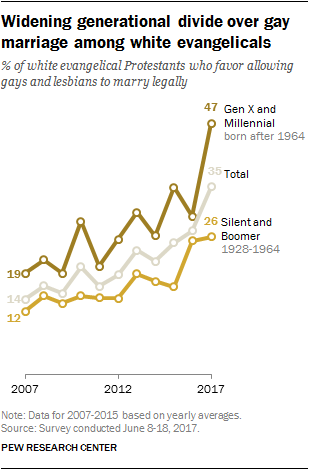
The nation's dramatic shift in favor of gay rights is an example of this. There is a generational shift. Of over 140 people who signed an Evangelicals and Catholics Together document called "The Two Shall Become One Flesh: Reclaiming Marriage" in 2015, there were "no notable evangelicals under 40," according to prominent evangelical Jonathan Merritt. Overall, a majority of Americans support same-sex marriage and this may be partially attributed to high numbers of people who say they are "religiously unaffiliated." Furthermore, most major banks and technology companies support gay rights, making it nearly impossible for anyone to consistently boycott gay-friendly companies and still live in the modern world.

Some leaders are ready to acknowledge the political defeat and move on to another topic. Today, they have begun to campaign for “religious liberty,” their preferred term for the idea that individuals should be allowed to exempt themselves from complying with nondiscrimination laws on the grounds that their religious beliefs place them in disagreement with the law and that they should be able to behave in their public life in accordance with their private beliefs. Catholic columnist Ross Douthat wrote “The Terms of Our Surrender” to describe this as “a way for religious conservatives to negotiate surrender” to the existence of same-sex marriage.

Jones pointed out that, as of 2010, “for the first time in its history, the U.S. Supreme Court has no Protestant justices.” [This is arguably still the case in 2017.] In response to the loss of cultural and political power that had always been assumed, some — like Russell Moore, author of Onward: Engaging the Culture Without Losing the Gospel — are ready to let go of that "near-Christianity" and instead pursue something more actively religious and only secondarily cultural. Moore thinks that "authentic" Christianity that sticks to its theology without trying to assimilate to the broader culture in a misguided attempt to stay “relevant” is what keeps pews full. To Jones, however, this “suggests at least a partial denial of WCA’s death.” Jones acknowledges contemporary spiritual movements that involve “young, primarily progressive evangelicals mov[ing] to blighted urban areas so they can live among the poor” or “a contemplative rural lifestyle,” but observes that “these movements are minority movements by design” and notes: “These models all accept the death of WCA and offer in response a retreat to sectarian enclaves that are disconnected from politics.” A better approach, he thinks, is for the church to broaden and deepen its political awareness and interest. He quotes professor and minister David Gushee, author of The Future of Faith in American Politics: The Public Witness of the Evangelical Center, who says that evangelicals must move beyond immature politics such as "single-issue voting" and a "reactive, episodic, boom-and-bust cycle of political engagement." Instead, he thinks that they need to integrate public engagement and "bearing witness" into their religious beliefs. Jones says approvingly: "This approach accepts the death of White Christian America and encourages evangelicals to participate fully in a pluralistic society, but avoids the temptations toward domination and sectarianism, each of which is driven by nostalgia for a lost Christian America."

To those who are relieved at the dying of the past order, Jones says, don’t gloat in your eagerness to welcome a new order. The next generation of would-have-been WCA “will ultimately bear the responsibility of choosing their own path, [and] its critics’ posture during this moment of grief may make one route more inviting than another.”
Profile Image for MyLan.
96 reviews41 followers
June 28, 2018
I have a lot of really smart things to say about this book and the arguments he makes but it's summer vacation so I'm not actually going to say any of them. However, I will say I really enjoyed his historical analysis, but disagreed with his conclusions and projections about the future. So does history as the 2016 election pretty much disproved a lot of his predictions. I would be interested to read his afterword on the election, but that wasn't in my copy from the library. I guess we'll never know.
39 reviews3 followers
May 29, 2022
The good (with a caveat) - The church has failed to understand systemic racism and it’s effects. However, this is a problem that extends to the culture at large and is not isolated to the church.

The bad - Jones is really arguing that white Christian America has failed because it hasn’t embraced the culture. He lauds the mainline church (which is neither a church or Christian for that matter) for affirming the LGBTQ movement, abortion, and women ordination. So his thesis is flawed. It’s not the end of white Christian America, it’s the end of biblical Christianity as a norming cultural influence. His solution is that the white Church needs to follow the mainline which really means he doesn’t want Christianity, he wants paganism clothed in Christian garb.
Profile Image for Casey.
939 reviews55 followers
April 6, 2021
The title might imply that this book is anti-Christian, but it is not. The author was raised as a devout Baptist in Mississippi. He switched denominations as an adult, but I believe he is a life-long Christian. I was not raised in a religion so it's always interesting to enter this other world as a visitor.

The author's research was very thorough. His comments on our changing culture and the demise of White Christian America were full of insights. Though he didn't shy away from disagreements, I was pleasantly surprised by the kindness he showed to all factions.

I expect to read more of his books.
Profile Image for Brahn.
50 reviews1 follower
April 26, 2020
A great reminder of the past two or three decades of watching as American Evangelicalism has rapidly gone insane. Filled with encouraging statistics that show this kind of piety is very much on its last legs. Highly recommended.
Profile Image for Barry Wynn.
35 reviews6 followers
October 16, 2022
Jones takes a clear eyes look at the effects of long predicted shifting demographics of American society.
I appreciate the way he provides historical context for white America's reaction.
Profile Image for Matthew.
176 reviews5 followers
March 7, 2022
Woah. Lots of information but if I could sum it up, Christianity was not always as involved in politics. Falwell was the main culprit in polarizing Americans. With the LGBT movement and most churches being highly segregated, teaching basically two different gospels, it was final straw that made white American Christianity collapse. We are in a post-Christian nation. I am a product of that fallout.

Lots of graphs, lots of research and polling. Lots of information but also a really captivating narrative.

This is one of the excerpts from the book I found interesting.

“One of the major contributors to this polarization has been the post-Reagan drift of white evangelical Protestants, who now overwhelmingly support Republican candidates. As the GOP’s own 2012 autopsy report noted, the party cannot survive as the party of white Christian Americans, or even white Americans. A plan that is mostly tailored to winning supermajorities among a shrinking pool of voters will only lead to obscurity. While Democrats are in a more strategically advantageous place because their core base groups are growing, it’s also not healthy for them to become almost exclusively the party of racial minorities and nonreligious whites. This kind of polarized status quo incentivizes each party to stake out ideological positions with little room for compromise. With a two-party system, it may be inevitable that the parties will align along a liberal-conservative spectrum, but the polarization we are currently witnessing is turbocharged by the racial and religious divisions.”

Excerpt From: Robert P. Jones. “The End of White Christian America.”

Profile Image for Jaz Boon.
94 reviews1 follower
October 29, 2024
Straightforward read on White Christian America’s loss of power and status in American society. Jones follows the trajectories of white mainline and white evangelical churches from how they rose to power and ultimately were passed by. Jones writing is not only accessible and extremely supported by anecdotes and data. He also strikes a hopeful tone of how we can move forward toward a brighter future if what is left of WCA can move past nostalgia and into acceptance of its change in status. Otherwise, we may be subject to the caprice and polarization of WCA’s politics for quite some time.
Profile Image for Vannessa Anderson.
Author 0 books220 followers
March 22, 2017
I found the table of contents amusing. Here are a few of the table of contents. An Obituary For White Christian America; Who Is White Christian America; Vital Signs: A divided and Dying White Christian America; Politics: The End of the White Christian Strategy; Family: Gay Marriage and White Christian America; Race: Desegregating White Christian America; and this one was my favorite: A Eulogy for White Christian America. The End of White Christian America, though informative was a slow read.
Profile Image for Hazel Bright.
1,364 reviews37 followers
March 28, 2021
Thank you to Joseph Steib for his excellent review that inspired me to read this book. Find it here: https://www.goodreads.com/review/show...

As one of the descendants of White Christian America, this was a troubling book to read. It documents the death of a culture that had a tremendous positive impact on its people and on the world. This is something I actually remember, being kind of a geezer, but have forgotten about as I watch the corruption of Christian values and the transformation of its church into a donkey that acts an authoritarian vehicle to sell Fox News snake oil for the superwealthy.

My attention for the last decade or so has focused on Bob Altemeyer and his discussion of how authoritarianism via religion teaches people how to fool themselves, to compartmentalize, to rationalize hypocrisy, and to do it so flawlessly that it becomes almost a superpower. Jones discusses these issues briefly in his book, rightly noting that we used our self-delusion superpower to convince ourselves to believe in the power of positive thinking and other such White Christian America fables; that we were a nation of brothers (except for non-white men, homosexuals, Catholics, Mormons, commies, and of course, and heaven forbid, women) who could accomplish just about anything we set our minds to. And it worked, sort of. We did some amazing stuff. We created the first modern democracy. We tamed the West. We invented the Industrial Revolution, more or less. We went to the moon. You know the drill. It's our national nursery rhyme. Jones's final say is that the death of that America, the hopeful and audacious America, the ant that moves the rubber tree plant America, the fix it with bailing wire and chewing gum America, the barn-raising help your neighbor America, the America invented by White Christian America, flawed as it was, is a death worth mourning.

I wonder how different this book might have been had it been published a year later. It would have been a lot harder to justify the life and regret the death of what White Christian America showed itself to be. It would be interesting to find out what Jones makes of the obvious feasting on the corpse of White Christian America by profiteers, and he does address this somewhat in his discussions about the Crystal Cathedral and other charismatic churches, but perversion to the degree we've seen? No. Tacit in the text is the looming figure of a sociopathic con artist willing to fleece the flock and their delight in his arrival. I could feel it, like ominous background music under that bright sunny window as I looked down the long dark hall and into the basement staircase. I wanted to yell, "Go back! Don't go down there!" at White Christian America, even though I knew it would go there. Although this book was written before the rise of the one-term Golden Calf, he quivers between every line like a pustule on the face of White Christian America, a pustule filled with contagion and mucus and blood, throbbing and just about ready to burst. As I read this book, I could see images of White Christian America laying their hands on their comb-over deity, and speaking in tongues about him, and praying to him for the return of a non-existent idealized past. It made me sad. Someone still loved White Christian America, this Robert P. Jones, a man who wrote its eulogy and tried to help it through the stages of grief. For his trouble, White Christian America betrayed even him, because White Christian America did not die. It turned into a flesh-eating zombie, dressing in fur and trashing the Capitol of the United States of America, and perfectly willing to destroy its own most precious legacy, the democracy it created, in the process.

Jones exhorts us not to dance on the grave of White Christian America, and I appreciate that, but he did not know about 2020-21 when he wrote this book. He did not know the self-deluded stinking reek that White Christian America allowed itself to become. I hope Jones would be as empathetic and kind to me as he was to White Christian America as I don my red dress. I have some grave dancing to do.
Profile Image for Jesse Morrow.
117 reviews1 follower
April 23, 2018
This thing is painful.

Somewhere between a schadenfreude and a prescription to White Protestants.

So, if you haven't read a newspaper in 40 years, you might want to read this book. Then you will learn that White Christians are generally angry about America becoming a pluralist society. It would be shocking to find out that the Bush Administration wasn't actually serious when they started "faith based initiates." Also, Old white Christians turned out to take a wrapper of Christianity and Libertarianism to hide their racist attacks on Barack Obama. Also you might be surprised to find out that most new evangelicals who push "Prosperity Gospel" really are trying to make consumerism "Christian." It also turns out that just like they were on Slavery, Women's Rights and Segregation, White Christians were on the wrong side of history about Gay Marriage.

But if you have read a newspaper in the past 40 years, you don't need to read this book.
Profile Image for Dan Connors.
369 reviews46 followers
July 29, 2018

This book's title is explosive and a bit misleading. By defining "White Christian America," the author deliberately excludes Roman Catholics, who make up a significant portion of that demographic. It's primary focus in on white Protestants- both mainline churches and evangelicals. And the book does not predict the end of white or Christians, but only their dominance over American culture, politics and decisions. As America shifts to a more diverse population, WCA and its stranglehold gets progressively weaker. As a white person who attends a Christian church, I was curious to see what the author was talking about.

This book was published in 2016, before the election, and it might have told its story a tad too early. The 2016 election, such as it was, was a triumphant victory for white evangelicals who doggedly supported Donald Trump's election and have reaped rewards with him in office.

The author examines demographic data from the past century to chronicle the rise to power of white Christianity and predict its fall. The data is actually pretty persuasive. In 1976, 81% of white Americans identified as Christian and 55% as Protestant. As of 2017, only 43% of Americans are white Christians, and only 30% Protestant. The trend is accelerating, especially in the age of Trump and in the age of evangelical Christianity's war against homosexuals, which was lost in 2015 with the Supreme Court decision.

Even more ominous, the current state of today's Christianity, much of Trump's base, is aging. The percentage of evangelicals over 50 is nearly 62%, and the portion of the church under the age of 30 has dropped by half in the past thirty years. The author points out that many Christians are still in denial about their decline, which explains their inability to face reality and rejuvenate their faith, choosing instead to cling to the past when they were dominant and life was simpler.

The author, CEO of the public religion institute, presents a thoughtful and compelling look at the history of the church in America, its racist tendencies that go back to the civil war, and its entry into politics with Jerry Falwell and the Moral Majority. He shows how the election of Barack Obama in 2008 caused a freak-out among white Christians who felt compelled to sabotage President Obama's credibility and fitness as an American at every instant. He wasn't one of "them." This freak out has continued to this day, and WCA has had to resort to tactics that would have been unthinkable just years ago. In their efforts to cling to power they are now willing to consort with godless Russians, embrace a crooked womanizer in Donald Trump, rig elections and suppress votes, and come up with the most dire invective to describe Democrats and those who don't "belong."

This book explained a lot to me about where we are, but I still don't understand how we got here. The spiritual dimension of Christianity has been stripped from the religion in support of the political dimension. The end of white Christian America won't come tomorrow and it won't come easily, but it will come, and hopefully something better will take it's place.
Profile Image for Mark Lawry.
290 reviews15 followers
April 10, 2020
I grew up in a very WASP family. By 20 I was about done (quietly) with religion and took off for the the U.S. Army. Three deployments confirmed for me I was done with religion, still quietly. Then I met a women who grew up in the Muslim world who had emigrated to the U.S. She was done with religion herself. Praise God. This allowed us to come together and have two kids. Neither religion would have ever approved of our terrible sinful lives. While the world debates if people of different faiths should even date we'll be exploring national parks with our 2 kids, not concerning ourselves with such drivel. Then 2016, as I listen to the racist crap around me I'll be less quiet going forward. If people don't want to hang out with us because my wife hands me all the pork....O'well.

The problem with this book is it says nothing new. We know the U.S. is becoming more diverse, more open, more free. Jones spends most of the book reviewing our racist ignorant past. Let's just skip over the slavery and Jim Crow and remind ourselves of the KKK freaking out because a Catholic was about to run for president. It was preached that Catholicism was incompatible with democracy. If a Catholic was to win the presidency it would be the end of the American experiment. Nothing has changed. It is 2020 as I write this and we still have people preaching that market economics and democracy only work for certain people. The same people who tend to want to build walls around themselves.

Jones argues that these problems can be fixed by the church and religion, and not an increasingly secular world. He just spent most of an entire book demonstrating with examples of why the church isn't going to do what he says it should. He enumerates several secular humanist writers and suggests they are wrong about a world becoming better as it becomes more secular. I would recommend reading all of those other authors (among my own favorites.)
Profile Image for Brenton.
144 reviews11 followers
March 7, 2024
I grew up as a member of White Christian America; was intimately familiar with its trappings, its ideals, its overtones and undercurrents, its aspirations. Eventually there came a point at which I could not square any of that with which I was intimately familiar with what I was actually experiencing in life and seeing in the real world, and over the course of the last half of my twenties, I gradually erased the Christian from my cultural nametag. I haven't looked back, and the more distance there is between me and the culture I grew up with, the weirder and scarier it looks in the rearview mirror. I am glad to be free of it. But you can't live in this country, in this society, without White Christian America reaching out and touching you in myriad ways on a daily basis, and so I do keep tabs on it, in a sense, as you would an off-kilter and possibly vengeful ex. I observe it often with amusement, frequently with disdain and with pity, but also, increasingly, with alarm.

This book is a thorough examination of the historical stature of WCA and of the recent unmistakable decline of that stature. It is interesting to place myself within that curve on the graph, to see how I was born at such a time as to straddle some of the glory days and, it would seem, some of the hospice days. The decades to come (assuming we have anything resembling a stable, living organism of society) may bring some fascinating watershed moments to our national culture as the juggernaut that held this society in its (nearly cold, dead) hands for so long is relinquishing its grasp. What will the transition look like? What exactly will we transition to?

Of note is that this was published in 2016, so the violent death-spasms of WCA that brought us the presidency of Trump only appear in brief, vague "what if?" musings, and I'm curious how those four years, and the continuation of MAGA since then, have altered the author's view of this End. Also, I commend the author for maintaining the tone of a sociological survey throughout; I gather that he himself is a Christian, but at no point does the text devolve into any personal handwringing. However, there is one bizarre bit in the closing chapter in which the author opines that a dying beast ought to be granted a gentle death by the victors, in this case the cultural forces aligned against WCA's historical racism, bigotry, and abuses of power, even going so far as to suggest that these victors refrain from gloating of their victory over the discrimination of LGBTQ+ people and give recognition to the religious liberty by which WCA holds to such discrimination within its own halls - essentially asking non-WC America to turn a blind eye to bigotry within the church, as if such bigotry isn't a horrific and deeply damaging form of abuse that has no place in the modern world, religious or not. Truly a tone deaf left turn in the very last chapter.
Profile Image for David.
1,184 reviews65 followers
January 18, 2021
Robert Jones (CEO of the Public Religion Research Institute) examines how American has changed now that its culture is no longer a reflection of white Evangelicals, and what this means for Christians moving forward.

Two excerpts:

p228: When a social world succeeds in being taken for granted—as white Protestant Christianity was at the height of its powers—cultural meanings merge with “what are considered to be the fundamental meanings inherent in the universe.” Religion, historically and globally, has been one of the most powerful tools for mapping specific cultural worldviews onto ultimate reality. Until its powers failed, WCA [White Christian America] served as a kind of ontological cartographer for both mainline and evangelical Protestants, and to some extent for the country as a whole.
Today, White Christian America’s faded cultural map is increasingly inaccurate. Like retirees setting out on a trip with their 1950s AAA road atlas, the graying descendants of WCA find themselves frequently pulling off the road in disbelief and frustration as they encounter new routes and cities that are not on their map. The slow death of WCA has left many with a haunting sense of dislocation.


p231: Evangelicals will feel the lure of safe retreat back into their old enclaves, even if this option is virtually impossible today. Their greatest temptation will be to wield what remaining political power they have as a desperate corrective for their waning cultural influence. If this happens, we may be in for another decade of closing skirmishes in the culture wars, but white evangelical Protestants will mortgage their future in a fight to resurrect the past.
As alluring as turning back the clock may seem to WCA’s loyalists, efforts to resurrect the dead are futile at best—and at worst, disrespectful to its memory. Like Mary Shelley’s Frankenstein, resurrection by human power rather than divine spirit always produces a monstrosity. If resurrection is not possible, both white evangelicals and white mainline Protestants—each still representing sizable constituencies in the country—will need to choose between sectarian retreat and a new kind of engagement. It seems highly unlikely that the descendants of WCA, having seen themselves at the American center for so long, will find a self-imposed social retreat comfortable. If this option proves ultimately to be unsatisfying, the only other course is a different social arrangement in which white evangelical and white mainline Protestants find their seats at the table alongside Catholics, Jews, Muslims, Hindus, Buddhists, and the religiously unaffiliated. This time, they will be guests rather than hosts.

Profile Image for Laura Kisthardt.
674 reviews13 followers
April 11, 2021
The book opens with an obituary for White Christian America and uses death as a lens to examine the state of Christianity in the United States. The book concludes with a eulogy to White Christian America and talks through Elizabeth Kubler Ross’s stages of death and dying.
I really liked the building analysis in the first chapter. The use of physical space and church buildings is an interest area of mine.
I think it was chapter two that examined the role in the 2008-2015 election cycles. I started listening to this book without realizing when it was published. It was strange listening on the other side of the 2016 election where it seems Evangelical White Christian America had a resurgence.
I listened to the audio version of this book. One of the challenges of audio is when the chapter titles are not easily identifiable within the app. I couldn’t always remember what topic the author was covering in that specific chapter. Each chapter almost stands on its own.
I would recommend this book to those who work in churches. But it wasn’t a must read for the general public from my perspective.

Profile Image for Dave.
820 reviews7 followers
March 6, 2021
This is a marvelous, easily accessible history of religion in the USA backed up with tons of statistics, graphs and charts. He examines the damage done to White Christian America [WCA] by things like Prohibition and the Scopes Monkey Trial all the way up to racial inequality, abortion and LGBTQ issues in our time. The primary factor working against WCA seems to be age. The younger generations are refusing to accept the old ways and are much more open minded and accepting. Jones treats WCA as dead and starts the book with an obituary and ends with a eulogy. It's clever, but it works. The second to the last chapter is about the stages of grief and how the WCA and various religious sects are, or are not, coping with the changes. A lot of the anger and angst we see in the WCA is that second step of grieving: they know they are losing and they are fighting mad and fighting back. Personally, I do not see WCA as dead, but it is certainly headed in that direction.
Profile Image for Aaron Reyes.
57 reviews
February 25, 2018
It might have a provocative title but it's conclusions are well researched. If you are like me and halfway through the book you begin to ask the question "Yeah, but what about Trump?". There is an "afterword" in some later additions of the book that aim to answer that question. Also worth noting, this book is more of a sociological study and less of a theological one. Well worth your time.
Profile Image for Meredith.
181 reviews5 followers
August 8, 2018
Like anything published before November 2016, this book is a little out of date. However, it does not take away from the central arguments of the book that demographics are changing and WCA as a majority is a relic of the past. I would have liked this book to come out a year later just to hear the authors take on what is going on with WCA’s last gasp in he form of Trumpism, but I guess I will have to wait for his next one!
Profile Image for Will.
219 reviews31 followers
November 15, 2018
An interesting deep dive into the power and influence of White Christian America (WCA) - or lack thereof these days.

It starts by covering the past, most notably the times of the "Moral Majority" and the likes of evangelical preachers such as Jerry Falwell & megachurches, and then works towards modern times by focusing on the diminishing membership rates and reduced control that these groups have over the larger population of the country.

There are lots of interesting facts and stats to comb through here. I did not know that most WASPs were indifferent - or at least not strongly invested - towards abortion rights until the evangelical/Protestant churches decided to join up with the Catholic Church, who WAS invested in this issue, in the 1970s. It has become a major fringe issue for their groups but has also deterred many millennials and younger people from organized religion.

The author does caution though that while their numbers are dwindling they do have disproportionate political power (thanks to so many citizens who can't be bothered to actually vote) and that they could flex their muscle in a last attempt to keep control. This was demonstrated with the 2016 election and the current maniac that is POTUS. The 'Religious Right' essentially declares him a messiah; completely delusional and misguided... even frightening. However, if the 2018 midterms are any indication, things appear to be on a more positive trajectory.

There are people who lament the demise of WCA and some who dance on their graves. How will society move forward without the strength of these religious institutions? I think people will finally start to think for themselves (hurts doesn't it?) and be forced into self reflection. Ultimately, I think we'll be just fine.
Profile Image for Heath.
379 reviews
October 11, 2020
Jones presents a compelling analysis of White Christian America (WCA): how it began, where it went wrong, why it is failing, and what is next. The real gem is the final chapter, it is truly worth the price of the book. In it, Jones offers a summary of positions forward for WCA that I believe are hopeful and realistic, if we can overcome our nostalgia for a past that never existed. To quote Jones, “White evangelical Christians may mortgage their future in order to resurrect their past.” Wow.
Displaying 1 - 30 of 266 reviews

Can't find what you're looking for?

Get help and learn more about the design.