Adhortacja apostolska Ojca Świętego Jana Pawła II do Episkopatu, duchowieństwa i wiernych po synodzie biskupów o pojednaniu i pokucie w dzisiejszym posłannictwie Kościoła.
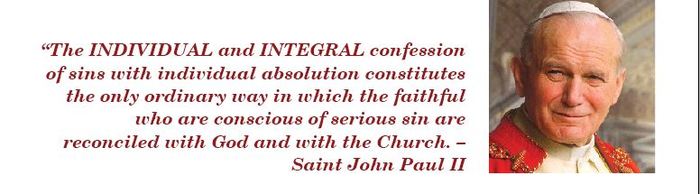
Saint Pope John Paul II (Latin: Ioannes Paulus II), born Karol Józef Wojtyła was elected Pope at the Conclave of 16 October 1978, and he took the name of John Paul II. On 22 October, the Lord's Day, he solemnly inaugurated his Petrine ministry as the 263rd successor to the Apostle. His pontificate, one of the longest in the history of the Church, lasted nearly 27 years.
Driven by his pastoral solicitude for all Churches and by a sense of openness and charity to the entire human race, John Paul II exercised the Petrine ministry with a tireless missionary spirit, dedicating it all his energy. He made 104 pastoral visits outside Italy and 146 within Italy. As bishop of Rome he visited 317 of the city's 333 parishes.
He had more meetings than any of his predecessors with the People of God and the leaders of Nations. More than 17,600,000 pilgrims participated in the General Audiences held on Wednesdays (more than 1160), not counting other special audiences and religious ceremonies [more than 8 million pilgrims during the Great Jubilee of the Year 2000 alone], and the millions of faithful he met during pastoral visits in Italy and throughout the world. We must also remember the numerous government personalities he encountered during 38 official visits, 738 audiences and meetings held with Heads of State, and 246 audiences and meetings with Prime Ministers.
His love for young people brought him to establish the World Youth Days. The 19 WYDs celebrated during his pontificate brought together millions of young people from all over the world. At the same time his care for the family was expressed in the World Meetings of Families, which he initiated in 1994. John Paul II successfully encouraged dialogue with the Jews and with the representatives of other religions, whom he several times invited to prayer meetings for peace, especially in Assisi.
Under his guidance the Church prepared herself for the third millennium and celebrated the Great Jubilee of the year 2000 in accordance with the instructions given in the Apostolic Letter Tertio Millennio adveniente. The Church then faced the new epoch, receiving his instructions in the Apostolic Letter Novo Millennio ineunte, in which he indicated to the faithful their future path.
With the Year of the Redemption, the Marian Year and the Year of the Eucharist, he promoted the spiritual renewal of the Church. He gave an extraordinary impetus to Canonizations and Beatifications, focusing on countless examples of holiness as an incentive for the people of our time. He celebrated 147 beatification ceremonies during which he proclaimed 1,338 Blesseds; and 51 canonizations for a total of 482 saints. He made Thérèse of the Child Jesus a Doctor of the Church.
He considerably expanded the College of Cardinals, creating 231 Cardinals (plus one in pectore) in 9 consistories. He also called six full meetings of the College of Cardinals. His most important Documents include 14 Encyclicals, 15 Apostolic Exhortations, 11 Apostolic Constitutions, 45 Apostolic Letters. He promulgated the Catechism of the Catholic Church in the light of Tradition as authoritatively interpreted by the Second Vatican Council. He also reformed the Eastern and Western Codes of Canon Law, created new Institutions and reorganized the Roman Curia.
In the light of Christ risen from the dead, on 2 April 2005 at 9.37 p.m., while Saturday was drawing to a close and the Lord's Day was already beginning, the Octave of Easter and Divine Mercy Sunday, the Church's beloved Pastor, John Paul II, departed this world for the Father. On April 1, 2011, he was raised to the glory of the altars and on April 27, 2014 canonized.
It is a wonderfully written Post-Synodal Apostolic Exhortation by Pope Saint John Paul II. This document is the result of the synod which held in 1983. In this document, Saint John Paul II deals mainly with the topic reconciliation. The reconciliation is needed not only on an individual level but also at the social level also. The parable of the prodigal son has interpreted in this document also by John Paul II. Again and again, when we revisit this parable more and more insights we are getting this parable. Here, Saint John Paul II analyzes the three characters of this parable and interpreted. We all need to reconcile with God, people and nature in one way or other. The importance of the sacrament of reconciliation also emphasized once again in this Exhortation. Though every sacrament helps us to reconcile with God the sacrament of reconciliation has a great role in this duty. It will help us to grow more in perfection. The other major part I saw in this document is that Saint John Paul II's view on the different duties entrusted to the Confessor. He narrates how a confessor should be. Again he gives the attitude of the penitent, this also an important aspect in the Sacrament of Penance.
No secret that again, the Church has been blessed with a wonderful mind. Namely of Pope St. John Paul II, a very influential leader of the Catholic Church and a person well-invested into philosophy and humanity. His personal experience from the second world war and the early stages of the iron curtain deeply affected him but it never drew him to absolute despair and in-fact, deepened and solidified his theology which was focused on the primacy of the mercy of God and how the most unfortunate situations only happen so that good may come through it. I believe his writings such as Redemptor Hominis and Salvifici Doloris reveal this much of his character because it is essentially the churches teaches applied to the mind, the formula, and the example of this man.
This writing, Reconciliatio et Paenitentia is something I found personally impactful. It makes sense of the current human condition. It draws parallels to the contemporary troubles and the solutions that Christ offer through parables. He teaches the necessary closeness humanity, as a species, has with each other and how that potentiality can only be fully achieved with Christian doctrine. This is after all something that has been constantly taught. There is a special emphasis however on human reconciliation and the reconciliation provided by God. Both of these are graces yet both of these achieve different ends. One is simply common fraternity and fellowship. This reflects an aspect of God and is even necessary for our survival and enjoyment but there is more to human solidarity. The other is personal and communal salvation through peace in God and with God. That is, as with ourselves personally and as a whole which is the race.
There is a natural kind of friendship that is only healed through brotherly forgiveness and the work to repair the damage for justice and kindness sake. The same kind exist supernaturally with God, hence the Sacrament of Reconciliation which also includes acts of Penance. Pope St. John Paul II explains the Catholic soteriology through these means, primarily with the parable of the prodigal son to show that even after being fully endowed with love and acceptance from his father, his life must go on and he will not be exempt from challenges unheard of.
He will greatly explain as I've emphasized the need for man to not just merely reconcile himself and his differences with others but that through these means, that God may be found and propagated all through out the world, seeking the conversion of hearts and work to heal all the damage that sin has done. This is the truth about reconciliation: it doesn't end with warm fuzzies and a clean conscience but it advances to exterior functions to proclaim goodness, discipline ones self, and reveal to the nations that the very same promise of forgiveness is extended to all peoples. That is the goal of this document. And I think he does it very well. It is a document that is meant to not just explain the Sacrament of Confession and make a distinction between mortal and venial sin, he also does this in other places like ''Veritatis Splendor'', but to make it known to man as a species that this Catholic doctrine is not a foreign entity but the reasons for repentance, forgiveness and penance in that order exists naturally so that it may be fulfilled amongst ourselves so that the Kingdom of God may be found in the simple act(s) of Charity.