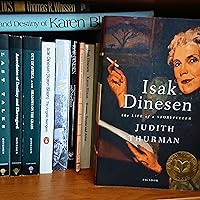
"Isak Dinesen . . . had an original approach to life that permeated all her work. She loved storytelling, with the result that most of her essays are quasi-narratives, which proceed not from major to minor premise but from one anecdote to another as the way of making concrete whatever idea she is considering. Her work is a delight and at times a marvel."— The New Yorker
"Through these daguerreotypes we begin to understand other periods, the renunciations of World War I, the purpose of houses and mansions, of ritual ceremonials, such as tatooing. We are given a fresh and vivid view of the women's movement . . . which urges that what our 'small society' needs beyond human beings who have demonstrated what they can do , is people who are . 'Indeed, our own time,' she wrote in 1953, 'can be said to need a revision from doing to being .' She demonstrated it in her own work and craft, with courage and with dignity. This collection is as real as a gallery of old daguerreotypes, moving and unfaded. The work, as Hannah Arendt says, of a wise woman."—Robert Kirsch, Los Angeles Times
"These essays . . . have the flavor of good humorous, easy, personal but not oppressive, the distillation of reading, thought, and experience. Their subjects are of surprisingly current interest. We need make no concessions to the past, need not set our watches back to 'historical.' Isak Dinesen was not a faddish thinker. . . . 'In history it is always the human element that has a chance for eternal life,' Dinesen remarks, and she gives these essays their chance."—Penelope Mesic, Chicago
Baroness Karen von Blixen-Finecke (Danish: [kʰɑːɑn ˈb̥leɡ̊sn̩]), born Karen Christentze Dinesen, was a Danish author, also known by the pen name Isak Dinesen, who wrote works in Danish, French and English. She also at times used the pen names Tania Blixen, Osceola, and Pierre Andrézel.
Blixen is best known for Out of Africa, an account of her life while living in Kenya, and for one of her stories, "Babette's Feast," both of which have been adapted into Academy Award-winning motion pictures. She is also noted for her Seven Gothic Tales, particularly in Denmark.
This is evidently a collection of miscellaneous pieces, some written in English and others in Danish, cobbled together some years after the author's death. To my mind, Isak Dinesen is a world class writer, but Daguerreotypes and Other Essays is not her best work. The longest piece in it is a lengthy book review of a work of whose existence I did not know; and several of the other essays were not her best work.
But every once in a while, Isak Dinesen shone through in all her glory, as in the title essay, "On Mottoes of My Life," "Rungstedlund: A Radio Address." This is one of those books one approaches who loves a famous author's best works and who wants more, even if it is surrounded by a lot of mediocre filler.
Isak Dinesen was a great practitioner of the story within the story and this collection of essays is also full of wonderful, embedded tales -- some based on chance encounters, some recounting fables that illustrate a point. Whatever the topic (feminism, Nazi Germany, orthography), Dinesen always has her eye on entertaining the listener and continually draws from unexpected sources (The Koran, her aunt's issues with a serving woman, an uncle's reaction to a woman on a bicycle) to do so. If she were alive and still doing her radio show, I for one would tune in.
Daguerreotypes is only a collection of essays in the loosest sense of the word -- it mostly consists of Blixen/Dinesen's speeches or radio talks that later on appeared in print in some form, plus a piece of literary criticism and some unpublished articles. If there's a throughline here, it's the attempt to write and preserve a sincere and humane snapshot of the past. 'Daguerreotypes' (which is about 19th century attitudes to gender relations and class) is probably the one that commits to it the hardest, which makes it a good choice for the titular essay even though it's not the best one in the collection.
The best one, for me, was 'On Mottoes of My Life', the first in the collection -- and honestly, this is maybe the only essay here that I would wholeheartedly recommend reading without any caveats. It's personal, but you don't need to know anything about Blixen to appreciate it, and it's beautifully written -- very conversational and storyteller-like, and sparkling with Blixen's usual eloquence.
There are some other good things in here too. Hannah Arendt's foreword is very insightful, especially if you're new to Blixen (which I wasn't, so I was already very familiar with the things Arendt discusses, but I honestly think her analysis of Blixen's work, life, and philosophy here is a really good balance of depth and accessibility!). And then there's also 'Rungstedlund', a radio address in which Blixen talks about her vision for her estate as a bird sanctuary after her death. There are some beautiful and touching passages here, and I enjoyed it a lot. To be fair, though, this one's probably more for big Blixen readers -- it's one of those things that you can only get so much out of without already being interested in the author.
Unfortunately, beyond these, most of the other essays were varying degrees of bland, forgettable, or inconsequential. Most of them retain Blixen's elegant conversational tone, but I just wasn't all that interested in the subject matter, which ranges from Blixen's views on feminism to Germany during WW2 to Danish spelling reform.
So all in all, Daguerreotypes is far from Blixen's best work, but I'm happy to be reading her again, and it makes me want to pick up something from her that's actually good.
Do due stelle a questo libro non avendolo finito. Ne ho letto metà (circa 200 pagine) ma ne ho apprezzate solamente una cinquantina, ossia le prime, quando racconta dell'Africa (con un tono che risulta a tratti razzista, a tratti colonialista), e il secondo saggio, in cui parla della Germania nazista (con un tono stranamente accondiscendente). Fra l'altro la seconda parte del secondo saggio non mi è interessata nemmeno un po', come pressoché ogni altro seguente saggio. Insomma, se volete leggere la Blixen va benissimo optare per "La mia Africa" così come per "Ombre sull'erba", sempre sull'Africa, ma questo dal mio punto di vista, a meno che non siate grandissimi appassionati dell'autrice, non merita granché di essere letto.
I liked some essays more than others, and skimmed some of them accordingly . But this must be some of the best writing I have ever read - though some is oration (?)
She is so clearly of not only her own era which is so distant from mine/ours, but also of those of her teachers and Influences, which she alludes to. Her mastery and love of language and expansive cultural knowledge feel classical but in a way I am jealous of and wish to steal from!!
I read this kind of in the spirit of "completism," since I've read the rest of her works. Some very interesting essays. the most moving is the final article, which is radio address to the nation of Denmark when she pleaded with her listeners to each contribute one Krone toward an endowment to keep her home, Rungstedlund, as a permanent public park and bird sanctuary. there is also a 38-page essay about a novel called "The Riding Master" by H. C. Branner that apparently took Denmark by storm in 1949. It sounds a very curious book and I am going to try to hold of an english translation. However, her essay doesn't really convey whatever it was about the book that made it so very popular. p.s. I just discovered that in English it was published as "The Mistress" in a paperback edition with a typically sleazy-looking 1950s cover.
I was disappointed in this collection of essays. After loving her memoir OUT OF AFRICA so intensely, I thought these essays would give me the same level of insight to her interesting life. Sadly, most of them are a random compilation, which makes her thoughts and ideas come across as rather random. The final essay about her family home on Denmark comes the closest to what I was hoping the entire collection would be.
قرأت الكتاب لأتعرف أكثر على فكر ايزاك دنسن حيث تعتبر من ضمن المع أسماء النسويات. الكتاب يعرض قصص مرت فيها ايزاك دنسن في الماضي وكل قصه ترويها فيها فكره معينه. لكن لم يفيدني الكتاب في هدفي منه حقيقة ولكنه ممتع لمحبي القصص والرواية... تقديم حنة ارنديت لايزاك كان جميل جداً ..