To save precious centuries-old Arabic texts from Al Qaeda, a band of librarians in Timbuktu pulls off a brazen heist worthy of Ocean’s Eleven.
In the 1980s, a young adventurer and collector for a government library, Abdel Kader Haidara, journeyed across the Sahara Desert and along the Niger River, tracking down and salvaging tens of thousands of ancient Islamic and secular manuscripts that had fallen into obscurity. The Bad-Ass Librarians of Timbuktu tells the incredible story of how Haidara, a mild-mannered archivist and historian from the legendary city of Timbuktu, later became one of the world’s greatest and most brazen smugglers.
In 2012, thousands of Al Qaeda militants from northwest Africa seized control of most of Mali, including Timbuktu. They imposed Sharia law, chopped off the hands of accused thieves, stoned to death unmarried couples, and threatened to destroy the great manuscripts. As the militants tightened their control over Timbuktu, Haidara organized a dangerous operation to sneak all 350,000 volumes out of the city to the safety of southern Mali.
Over the past twenty years, journalist Joshua Hammer visited Timbuktu numerous times and is uniquely qualified to tell the story of Haidara’s heroic and ultimately successful effort to outwit Al Qaeda and preserve Mali’s—and the world’s—literary patrimony. Hammer explores the city’s manuscript heritage and offers never-before-reported details about the militants’ march into northwest Africa. But above all, The Bad-Ass Librarians of Timbuktu is an inspiring account of the victory of art and literature over extremism.
Joshua Hammer was born in New York and educated at Horace Mann and Princeton University, graduating with a BA in English literature. In 1988 he joined Newsweek Magazine as a business and media writer, transitioning to the magazine's foreign correspondent corps in 1992. Hammer served, successively, as bureau chief in Nairobi, Buenos Aires, Los Angeles, Berlin, Jerusalem, and Cape Town, and also was the magazine's Correspondent at Large in 2005 and 2006. He was a Nieman Fellow at Harvard University in the 2004-2005 academic year.
Since leaving Newsweek in 2006 Hammer has been an independent foreign correspondent, a contributing editor at Smithsonian Magazine and Outside, and a frequent contributor to the New York Review of Books, GQ, the New York Times Magazine, and other US publications. He was a finalist for the National Magazine Award in reporting in 2003, and won the award, for his writing about the Ebola crisis in West Africa, in 2016. He is the author of 5 non-fiction books, including the New York Times bestseller, "The Bad-Ass Librarians of Timbuktu," which was published by Simon & Schuster in April 2016. Hammer is currently based in Berlin.
This book really isn't what the title or description led me to believe what it's about. It's ostensibly about Abdel Kader Haidara who collected thousands of centuries old Islamic and other texts in Mali and then attempted to keep them safe from Al Qaeda as they took control of much of Mali. It does obviously include that story, but it really moreso concentrates on the war and Al Qaeda. There are long chunks of the book that seem to never mention Haidara or the books at all. If you were interested in reading about Al Qaeda in Mali this would be a good book for you, but I'm not sure it is what it sets out to be.
This book was recently mentioned in the ALA Think Tank Facebook group, so I imagine every library and librarian in America will end up with this book. I wonder how many of us could have done what this librarian did!
The title of this book covers just about everything the book is about, in a nutshell. I learned a lot about the early (medieval) literary of north Africa, which makes sense considering Egypt is not far, but I did not know much about the manuscripts and academic culture covering centuries in the desert. That history lays the groundwork for Abdul Kader Haidara, the most significant gatherer of these manuscripts, gaining the trust of families who had held manuscripts for generations, building multiple libraries and archives in Timbuktu. He was very active in seeking outside funding for buildings and materials, up through the threats posed by Al Qaeda and the fundamentalist Islamic state being imposed on the residents of the city. He could see that cultural relics might be destroyed, and was able to arrange for the removal of almost 400 thousand items. Truly amazing.
I enjoyed this read, I think an entire book on one collection and one story was refreshing compared to books like A Universal History of the Destruction of Books: From Ancient Sumer to Modern-Day Iraq (don't get me wrong, that book is excellent but spans many times and places.) I got a bit bogged down in the terrorist roll-call, although I did end up spending some time on the United States Counter-Terrorism website looking up the faces of the leaders mentioned.
I received a copy of this book in exchange for an honest review, from the publisher through Edelweiss.
ETA: I read this book again, from the library this time, in preparation for my in-person book club. This time around I was more struck by the place of music in this story, and how much of it was lost because it hadn't been preserved in the same way as the manuscripts. I was particularly sorrowful about the radio station's 20 years of field recordings. The Festival in the Desert sounds amazing and sent me off on a listening spree. You can read the author's original article about the festival and its connection to Bono at the Pulitzer Center.
Review: I'm conflicted, because while the book was interesting, it is definitely not all that it's promised to be or promoted. The majority of the book is consumed with the actions and movements of a constantly shifting war. And while, yes, this is important information and necessary to understanding the pressure and danger to these precious manuscripts, in the end, the books became a lesser thread in the story, only being mentioned sporadically.
The first third of the book was strong, the history and heritage of Mali, Timbuktu, and the wealth of knowledge preserved and dying within the crumbling books. We meet Haidara and his quest to find and compile the scattered manuscripts. His journey and the people he meets and the preservation effort are exactly what I was hoping and expecting from this book.
The rest of the book gives way to a very dry and factual account of Al Qaeda, politics, militants, and various news reports. It all becomes very journalistic and less like a story being told. And while we are updated at times to the librarians and books, they essentially fall behind and become nearly forgotten. It reads more like a nighttime news special. And all of this would be fine and interesting, except that the book is called The Bad-Ass Librarians of Timbuktu: And Their Race to Save the World's Most Precious Manuscripts...and we lose sight of the librarians.
When we finally return to the saving and smuggling, it is over too soon. I in no way want to downplay what was and is a very real situation, especially for those involved in saving all these manuscripts, but the author didn't give us enough. I wanted more first hand accounts from Haidara's family and even anonymous librarians and those involved inside Timbuktu. I recognize that the author can only give us what he is able to attain but perhaps more time was needed in assembling this book. At the very least, more first hand accounts from Haidara's nephew and chief assistant was needed.
The story of these librarians, preservationists, and citizens is nothing short of amazing. For that alone I am glad that I read this book. But overall I felt that this wasn't a successful book. I think you can see my conflict in reviewing this book. I'll leave it for other readers to decide for themselves, though, because while it didn't work for me, I know that others will find better than I did.
I recommend this book with a caveat: it's not really all that much about the bad-ass librarians of Timbuktu.
Nope, maybe 20%, tops, is about the librarians' race to save the world's most precious manuscripts.
This is really about the jihadi occupation of Timbuktu [and other parts of Mali] that happened in 2012, and which you probably never heard about because a lot of Western media tends to ignore Africa. Or maybe I just missed it somehow? I know I am not the biggest follower of international affairs but I don't know how in the world I might have missed this one.
Anyway, Saharan Africa has long struggled with the effects of Islam extremism and Mali is no exception to that. In 2012, a group of jihadis rolled into Timbuktu and declared themselves in charge. They instituted Shariah law and started brutally punishing anyone that they decided was violating that law. Which is never a good thing, but these guys were so awful that Al Qaeda leaders in other parts of Africa were apparently like, "Woah, guys. Let's lighten it up a bit."
Seriously, some of the examples in here made me queasy. Amputating hands with kitchen knives and burying people in sand up to their necks before stoning them.
Abdel Kader Haidara is the titular bad-ass librarian. His father had instilled in him from a young age a love of the manuscripts he'd spent a lifetime gathering. These manuscripts, written by African and Islamic scholars, date as far back as the 1600s and Abdel Kader's father amassed one of the biggest collections in Africa. He then willed the manuscripts to his son upon his death, and Abdel Kader spent decades expanding the collection and building libraries to house them. He fought for funding from all over the world, including the likes of Henry Louis Gates, Jr., and even brought digitization to the libraries.
When the jihadis came to town, he very quickly realized that the manuscripts were at risk--Al Qaeda and its various extremist off-shoots are known for destroying anything that doesn't adhere strictly to their own warped version of Islam. So Abdel Kader recruited some folks to help sneak the manuscripts out of jihadi-controlled territory to other parts of the country where they might be safe. It was incredibly risky and these folks are, indeed, bad-ass.
But their story makes up a pretty small portion of this book, most of which focuses on the background that led to the occupation in the first place. Hammer examines the way in which the terrorist groups leaders became radicalized and traces a history of various levels of extremism in the region. It's somehow both incredibly dense and incredibly rushed-through. So many of the bad guys have names that can easily be mixed-up, and their affiliations to each other are all so loose and many-pronged. I think that Hammer kind of took for granted how easy it would be for his readers to follow along, but I struggled to keep track of everything.
The history of Timbuktu's role in the literary world and Haidara's efforts to save his manuscripts are incredibly interesting, but this book left me wanting more of that and a little less Who's Who in African Terrorism.
One thing that I think this book does very well and that I do think is incredibly important, though, is demonstrate just how bad Sharia law is for most people in the Muslim world. There's a lot of Islamaphobic chatter in the West that argues that all Muslim people possess extremist views or want everyone to live under Sharia law, and Hammer paints a portrait of a group of people who definitely do not feel this way. The people of Mali--and people throughout Northern Africa and the Middle East--largely do not support the extremist leaders taking control of their countries. Sharia law is imposed on them by force and often ends up destroying their own ways of life. A greater understanding of this would go a long way, I think, and I'm glad that Hammer was able to incorporate that message into his story.
This should get a prize for the best book title of the year. It tells the story about Timbuktu as a centre of learning from the 1300's. It was renowned for its universities, scholarship including religion, humanities, science and music. This scholarship lead to hundreds of thousand of manuscripts, including those on astronomy, mathematics, music, poetry and medicine. These manuscripts were often beautiful works of art wonderfully written and illustrated, illuminated with gold. Over the centuries this centre of scholarship had periods of strict repression and families hid their collections of manuscripts in cellars, behind walls and in trunks buried in the sandy earth.
Having spent a very short time in Timbuktu I was interested in the efforts of a young man, Abdel Kader Haidara, who started efforts to obtain grants to gather hidden books from families throughout the area, and build a library where experts could restore, preserve and digitize these manuscripts which had deteriorated over the centuries. I had read a book and an article with photographs in the National Geographic on the restoration in progress but was not aware of the subject of this book which was the heroic effort to smuggle close to 400,000 manuscripts out of Timbuktu when Al Qaeda and other jihadist groups threatened to destroy them.
There was little in the news of Al Qaeda entering Mali in 2010, and by 2012 had control of Timbuktu. Prior to this Timbuktu had been a tolerant, secular and liberal Moslem city. Each year there was an international music festival attracting top African musicians and singers, as well as Western performers such as Robert Plant and Bono. The fundamentalist terrorists punished anyone listening to music, participating in sports, unmarried couples seen together and they demanded women cover their face and body. Harsh punishments were giving out, including amputation of limbs, whippings and stoning to anyone thought straying from their strict rules.
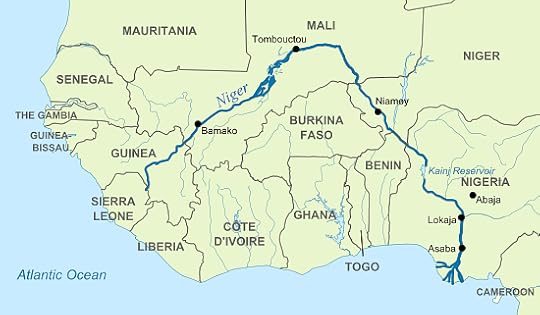
Haidara organized the smuggling of about 377,000 documents out of Timbuktu by boat on the Niger River and van to the Capitol, Bamako. Many of these smugglers were teenaged boys or young men, often relatives. They were in constant danger with bad roads, and road blocks set up by the terrorists.. Bribes had to be paid at these stops or to get them out of jail. The safety of the manuscripts was assured for now and awaiting the day when they can be returned to the place they belong.
Since the author includes so many historical, political and terrorist names it was sometimes a distraction to the story of the manuscripts, and made some parts of the book complicated to read. Still an important story on the value of books and the preserving of scholarship and history.
I blogged this review in 2017 and somehow or another the world found it this month. Anyone have any idea why it's suddenly getting over 700 views a day?
A journalistic telling of a summer-blockbuster level tale...not that that's a bad thing!
What's most exciting in the book is the interaction of Al Qaeda and the resistance. What's least exciting about the whole story is the fact that we need to be told about the awful and hideous actions of the hate-filled anti-intellectuals who are, even as we speak, eviscerating an entire world's millennium of progress so their imaginary friend won't be mad at them.
And then there are the angry anti-intellectual greedy motherfuckers running the US government as an ATM for the world's wealthiest people.
And that, my dears, is 2017 in a nutshell. Books threaten these scumbags. They have to eliminate them somehow, and here in the US they've chosen the modern path of making them irrelevant, while in the old-school climes of Africa they physically destroy them. Same result. The forces of rage are out to stupidify the globe and it looks depressingly like they're succeeding.
But there are people like the brilliant, beautiful-souled Mr. Haidara. There are nooks in cyberspace where learning and passion for words still matter. There will always be a way to prevent the final night from falling.
It's more urgent than ever to remember that #READINGisResistance!
This book gets its title from librarians who thwarted the wishes of Al Qaeda in the Islamic Maghreb (AQIM) by secretly moving 377,000 ancient manuscripts hundreds of miles through a war zone. The terrorists weren't the only threats they faced because the government soldiers at road blocks were also erratic and unpredictable.
This book is part history, part description of Maghreb regional politics, and part adventure story. The book makes clear to the western reader that Timbuktu has a proud history and is the keeper of substantial numbers of artifacts from its cultural heritage.
It has always been my understanding that when people referred to, "a thousand miles from nowhere," they were referring to Timbuktu. That sort of thinking is the result of western oriented education. I've learned from this book that when Europe was mired in the dark ages, Timbuktu from the 13th to the 17th century was a center of intellectual enlightenment of the Islamic world. Scienteists, engineers, poets and philosophers congregated there to debate and share ideas. These exchanges of ideas were committed to the thousands of manuscripts written in Arabic and various African languages.
The golden age of Timbuktu intellectual culture occurred during the 16th century when the population of Timbuktu was approximately 100,000, and about a quarter of that population consisted of students from various parts of the Islamic world. In additional to religious texts the manuscripts included works of poetry, algebra, physics, medicine, jurisprudence, magic, mathematics, history, botany, geography and astronomy. This eclectic mix of scholarship thrived under the tolerant form of Sufism that prevailed during the 16th century golden age.
However, there was also other Islamic ideologies. Radical conservative Islamists saw the manuscripts as heretical. Also, the French colonial forces that occupied that part of Africa during the 19th century considered the manuscripts as plunder. Consequently a third tradition emerged, that of concealment. The native residents of Timbuktu hid these documents inside their homes and desert caves. By the twentieth century the Timbuktu's intellectual inheritance had become invisible to the rest of the world.
During the 1980s there was a concerted effort to collect these scattered and concealed manuscripts into the protected environment of newly constructed libraries. Funding from Saudi Arabia and other oil-rich countries founded the Ahmed Baba Institute of Higher Learning and Islamic Research in Timbuktu. This book gives a thorough accounting of the adventures of one particular manuscript collector named Aabdel Kader Haidara.
Then in March 2012 came the invasion of Tmbuktu by combined forces of the AQIM and Tuareg rebels armed with weapons from the collapse of Libyan regime of Muammar el-Qaddafi. At first the Islamists were preoccupied with the process of religious cleansing of the dress, behavior and music of the Timbuktu residents, and thus they didn't notice the covert hiding and moving of the manuscripts. In the end only a small portion of the manuscripts ended up being destroyed by the time that the Islamists were driven out by the French and Malian military forces in January of 2013.
Ironically, the invasions by the Islamists drew worldwide attention to Timbuktu’s literary heritage and enabled the first full accounting of its magnificence.
In the 1980's, Abdel Kader Haidara worked for the Ahmed Baba Institute. He traveled by boat, camel or on foot, to collect ancient Arabic manuscripts from private owners, convincing them that these priceless volumes needed to be preserved in a climate controlled library where they could be appreciated by all. These tomes, written in Arabic and many African languages, were the record that told the historical significance of Timbuktu as a city of enlightenment. Some dating back to the 13th century, there were religious as well as secular texts. These writings on philosophy, science, medicine, history, and everyday life, gave voice to the tolerance, acceptance, and level of education and thought that had once been in the Malian city. With contributions from many different governments, grants, organizations, and private donors, "...the forty-five resulting libraries served as repositories for a total of 377,000 manuscripts, ranging from four-hundred page, leather-encased volumes to single folios, including some of the greatest works in medieval literature in the world."All this was threatened by the rise and radicalization of al Qaida militants.
Destroying libraries has always been a way to demoralize those in a conquered land. As al Qaida took control of Timbuktu this treasured collection of cultural heritage was in danger of being destroyed. These extremists had no use for secular archives. They wanted no reminders of a former open society. Working by candlelight, Haidara, his nephew, and many courageous and dedicated heroes, transported these documents to various secretive storage locations. They may not have been bad-ass, but they risked torture and certain death had their nocturnal movements been discovered.
Joshua Hammer does a good job of explaining and chronicling the manuscripts and the time period they were from. The arduous work of gathering them, funding and establishing the libraries, and then emptying them when Timbuktu was under al Qaida control was amazing. I did find it difficult to keep track of all the names of characters and locations, however. It is always good for the soul to read about those willing to risk their lives for what they believe is important. As an avid reader, when the fight is for the written word, that good feeling is magnified.
I was fascinated by this account of the libraries/archives of irreplaceable old manuscripts in Arabic and other languages of North Africa and the Middle East. The first chapters introduce us to the main players in the manuscript biz, as they try to find & trade for these delicate, rare documents and set up local archives to store them.
I think many people forget how sophisticated the Arab world was, back when Europe was languishing in the Dark Ages. They were responsible for maintaining scientific knowledge, mathematics, medicine, and philosophy, while Europeans were being held back by a repressive Church. The Renaissance began when Europeans re-discovered the books that had been preserved by the Arabs.
I don’t know about you, but I remember being taught the history of civilization in grade school. I think it must have been about Grade 5 or 6 that we learned about Mesopotamia being the Cradle of Civilization and being part of the Fertile Crescent. And still, Western governments & researchers seem to be surprised to discover that non-European people had complex civilizations complete with books & universities. I was glad to see the people of North Africa hanging on to their patrimony and keeping these manuscript collections in their own countries, as they have the expertise to read and interpret them. Too often this kind of collection gets whisked off to some Western repository where it attracts limited interest and travel costs prevent African scholars from accessing them.
Reading about the history & variety of extremists in the area certainly gives one pause. So many of the names of the major players were familiar to anyone who follows the news, especially the kidnap victims. I was interested to fill in the details on why these events happened and what else was going on behind the scenes. I still don’t really comprehend the level of hostility of groups like Al Qaeda and the Taliban to art, culture, and literature, but I understand that they have a potentially mistaken idea of what early Islam was like (just as many fundamentalist Christians seem to have a skewed view of what early Christians were like). It seems like most fundamentalists have the same view of the world, i.e. that it is just a temporary waiting room before the real deal, the hereafter. What a limiting way to look at the world!
As a library worker who has dabbled in archival and museum collection description, I have to say that I was sincerely jealous of the people who got to work with the marvelous collections described in this volume. I would give my eye teeth to be involved in the cataloguing & digitization of such a significant resource!
I really wish that I had liked this more. A great initial start of the book eventually flounders when Mr. Hammer starts going into the unrest in the Mali region and how that impacted Timbuktu. I think just a few pages here and there would have been enough to set the scene. Instead the entire book reads like a who's who of Al Qaeda and every military operation in the region. I just lost interest a good 1/3 through the book and never recovered.
I really did love reading about the history of Timbuktu, how it was prized in the 16th and 17th centuries as a place for learning. I also loved reading about how Abdel Kader Haidara (the man who through his own travels single handily bought and rescued thousands of ancient manuscripts in order to house them in a library in Timbuktu) initially balked at being tasked with finding manuscripts and becoming obsessed (in a good way) of finding everything out there and safe-keeping it for the generations. If the book had focused more on him than I would have easily given this 5 stars.
This is an interesting, if uneven, mashup of the history of African and Arabic culture and literature as collected over centuries in the manuscript libraries of Timbuktu, in what is now Mali, with the origins and recent history of Al Qaeda in the Islamic Maghreb and related groups in Saharan and Western Africa.
These stories intersect in the story of Abdel Kader Haidara, a Malian collector and conservator, who organized the smuggling of almost 400,000 manuscripts out of Timbuktu to safety, avoiding their almost certain destruction at the hands of a coalition of Al Qaeda forces and Tuareg separatists in 2012.
The book ends in 2015, with a sense of uncertainty about when the manuscripts might be able to be safely returned to Timbuktu. The French had driven Al Qaeda out of the cities of northern Mali, but they and other groups were still a threat to the region. Two days ago, I read a news story that a suspected Al Qaeda and Islamic State attack killed at least 31 people riding a bus in the Mopti Region south of Timbuktu. This story clearly hasn't ended.
Some readers might want to note that the later chapters of the book graphically detail Shariah punishments including amputation and execution.
In this narrative non-fiction, journalist Joshua Hammer relates the efforts to collect and preserve centuries-old manuscripts in Timbuktu, Mali. It covers the lives of Mamma Haidara and his son, Adbel Kader Haidara, the methods they used to gather the historic documents, and the establishment of a library. In the wake of a 2012 military coup and jihadist takeover, the librarians and archivists associated with Haidera worked in secret, at great risk to personal safety, to transport these precious manuscripts to a more secure location. It includes a history of Timbuktu and surrounding areas in northern Africa, as well as a recounting of the recent political turmoil.
It will appeal to those interested in African history, the preservation of historic manuscripts, or the heroic efforts to safeguard cultural artifacts from those who seek to destroy them. Be aware that it contains extremely graphic and disturbing accounts of executions and other terrorist activities. If you are unfamiliar with this region of the world, it will be useful to keep a map of Africa at hand. I found it both informative and engrossing.
I received this ARC from Simon & Schuster and Netgalley in exchange for an honest review.
Wow, do I feel completely ignorant about the world around me after finally putting this one down. I know where Mali is on a map but I had no idea that there was a major conflict from 2012 that lingers until present day. Further still, I had NO IDEA that dedicated and brave as all-get-out scholars, academics and ordinary citizens risked their lives to smuggle some of the world's most precious literary treasures to safety.
Joshua Hammer certainly taught me a little something. This book follows the conflict, loosely tied together with the story of Abdel Kader Haidara-the man who orchestrated the salvation of hundreds of thousands of manuscripts.
At a time when some of Mesopotamia's finest treasures are being crushed or carried off in the night, and when Syria's revered chief of antiquities has been executed by ISIS, here is a story with a good ending: In 2012, a librarian in Timbuktu pulled of a daring heist worthy of Ocean's Eleven by rescuing thousands of the world's most valuable manuscripts from Al Queda.-Priscilla Painton, VP and Executive Editor
She said it best. This is a painstakingly researched chronology of what happened during the Northern Mali conflict as told through the preservation of the manuscripts. Hammer not only gives a detailed piecemeal of witness accounts but actually traveled to the sites soon after many of these events.
Haidara is a hero and I was enthralled reading about him-which for someone that rarely reads non-fiction is a big deal.
What drove him most was a belief in the power of the written word--the rich variety of human experience and ideas contained between the covers of a book.
As Al-Queda and their allies close in, Haidara doesn't pick up the sword of his ancestors or the gun of his modern antagonists but instead wields art and culture as the most deadly weapon of all.
A jihadi, Haidara argued, in the original and best sense of the word: one who struggles against evil ideas, desire and anger in himself and subjugates them to reason and obedience to God's commands.
An excellent read. I am enriched for having read it.
This book is not only a telling of how precious manuscripts were protected from Al Qaeda (AQIM, its arm in northern Africa) in 2012, but a painting of the context in which that adventure happened. To understand the audacious act of these librarians struggling to preserve their heritage, we need to understand just how valuable and remarkable that heritage is. We also have to understand the librarians' bewilderment. To us, Mali may just be another desert full of crazy Islamic jihadists, but it was never that to Haidara and his fellow archivists. Timbuktu has a long, multifaceted history, one with tyrannical governments, but also will long stretches of scholarly, scientific, and artistic activities, recorded in their manuscripts. The brand of Islam the jihadists brought to Timbuktu was utterly foreign to the population there. They scoffed at the jihadists proclamation that they brought Islam to Timbuktu. Several of them dismissed the invaders, saying that they had had Islam for over 1000 years. AQIM invading Timbuktu was something that many in the city never thought possible.
This is just as much a story answering the question "how did this happen?" about the AQIM takeover of Timbuktu as it is a story of those manuscripts. Mr. Hammer had been to Mali multiple times before the invansion and then returned afterwards, so he was able to tell the full story, including involvement by not only Western governments, but Western individuals (Henry Louis Gates, Bono, other musical figures). He had me looking up historical and more recent phenomena in Mali and listening to music by Malian groups that played prominent roles in defining the culture there. It's far more wide-reaching than I thought it was going to be, based on the blurb and title. For me, that is a wonderful thing. I learned so much. I saw the AQIM in Mali activity put into context and reviewed in richer details things I had only seen headlines for previously.
If you just want to read about the manuscripts, you'll probably get annoyed at all the pages spent on telling the story of the jihadists. But if you're open to learning the whole context of this amazing story, this book will take you on an amazing ride.
For centuries Arabic manuscripts were collected by private households inn the West African country of Mali and particularly Timbuktu. These were gilded manuscripts painted with real gold, and showed vibrant colored illustrations of nature. Some were scholarly in nature and complex such as the creation of the leap year, medical, astronomy and most were written in stylized Arabic. These highly valued manuscripts were handed down from family member to family member to be their caretakers. Why caretakers? As more radicalized Muslin leaders came into power (first time in the late 1300s) the manuscripts were seen as corruptions of the true Islam. Families then began hiding their historic works in caves, buried in the ground and behind false walls, all so that they would not be destroyed. History and adventure at its best written by a veteran correspondent. Note: I received a free review copy of this book and was not compensated for it.
Hammer's style is so inclusive to tangent details that this is a truly difficult read. You are tracing centuries of history for this region of Mali, and the forces that have controlled it. For most of the book, the Timbuktu collection seems secondary to the larger Al Qaeda background field/ present dominance. And all of those progressions and former cycles of Islamic lessening or tightening "authority" are a large percentage of the read. This is a 1000 character tale of dozens of rulers and myriad language, culture, economic habits for the moving populations throughout all of that history.
The story of the incredible work of Haidara over the length of the period (since his father's death in the 1980's)for all his seeking, storing, grant getting, and ultimate transcript protections- that is awe-inspiring. But this book is rather poorly titled to that being the predominant feature of the book, IMHO.
Because of the geographic name changes and so many different authority or controlling influences, this was one of the hardest reads this year for me. Desert turning to canal, and vice versa. Moving populations and borders- both. Countries rising and falling as nation states. Inputs from other continents to compose the physical library at Timbuktu. The description of various manuscripts from nine or ten centuries ago, that was instructive. But the history is immense, not just the story of those manuscripts that survive.
This book is a page turner. It is fascinating and horrifying and inspiring and unfinished. It is so up-to-date including references to last November's terrorist attacks in Paris and yet there is no final resolution to the situation in Mali. I had heard about the Golden Age of Scholarship in Timbuktu in the 1500s and 1600s. That a tolerant, eclectic Islamic society enabled scholarship in theology, science and medicine to flourish and that illuminated manuscripts chronicled this history. It was often referred to as a mystery or legend as the manuscripts were lost over time. The existence of these manuscripts is revealed here. In this amazing book we learn about the Ahmed Baba Institute of Higher Learning and Islamic Research created by UNESCO to find, conserve and digitalize the manuscripts. Also we learn about the Haidara family who were inspired and driven to find the remaining manuscripts that, for safety, had been hidden throughout the country when repressive regimes or marauding invaders had overrun Timbuktu. This family had a collection of their own developed by Mohammed "Momma" Haidera throughout his adventurous life, who worked for the Institute the last years of his life. His son carries on his father's obsession and sees Timbuktu begin to arise from the backwater it had become. We learn the difficulty of finding these manuscripts and encouraging the owners to share with the libraries; of finding the money to purchase the manuscripts, build libraries and develop conservation laboratories. The heartbreak of finding masterpieces devoured by termites and humidity. The task was monumental and then... The terrorist organizations from Libya, Afghanistan and neighboring countries along with local thugs who have radicalized decide that Mali is a perfect target for establishing an Islamic State with Sharia law and the real horror story begins. Can Mali be saved? Will the 377,000 manuscripts fall into the hands of ignorant fanatics who will certainly destroy them? If you love history and are fascinated by Africa and want to know more about the movement of radical Islam that is terrorizing and changing our world, this is a must read! For me, a retired librarian, the Manuscript Librarians of Timbuktu really are bad-assed and this is a great story that happens to be true.
When it first surfaced in the news that a great deal of the ancient manuscripts had been saved against all odds I shed a few tears in relief. Timbuctoo has been on my “travel radar” for decades. I have so wanted to pay my respects to a city in which so much wisdom and thirst for knowledge flourished during a time when we in Western Europe only cared about our next meal. Timbuctoo has lived through ages of changing winds, many times falling prey to invaders carrying a strict version of Islam with them and imposing Sharia in extremis, it seems like history is repeating, coming in waves. The book is not only about “The Bad-ass Librarians”, the men and women who sought out centuries old manuscripts being kept hidden for ages, with the purpose of not letting the cultural inheritance of Timbuctoo being forgotten. They deserve the praise and they deserve, if only the slightest, guarantee that what they risked their lives for will be preserved for ever. The statements from old, that Islam can live side by side with secular knowledge and science and prosper by each other’s company is too easily overshadowed by men in black turbans setting other agendas. The book is about both aspects, the rise of militant Islamism in the Maghreb and how it spread to northern Mali and eventually reached Timbuctoo. It also carries the tones of a war correspondent and an analyst when going into the politics behind the all to sudden hostile take-over of Timbuctoo and how it was recaptured. But mostly it is about people, those who cease an opportunity to gain power, the misguided, the landless and the exploited people, the ones who resist against all odds and the ones who live on.
It's been three days since I finished this book, and I still don't quite know what to make of it. First of all, it's a fairly astonishing story. I - being the vague, gets-her-news-from-Twitter type that I am - had no idea that Al Qaeda had a presence in Mali five years ago. So from that perspective, this was incredibly educational.
The fact that librarians are badasses who will go to ridiculous extents to protect their collections comes as no surprise to me, being a librarian and all. The realisation that for some, those extents include smuggling priceless documents out of the country with death waiting around every corner made me appreciate the fact that all I have to do is sometimes put books in the freezer when they're returned having taken a little visit to a puddle on the way back to the library.
I think my main gripe with this was that I thought I had like 60 pages left of the Kindle edition and then it turned out that the last 60 pages was actually notes and references and the index, so the story felt like it ended quite abruptly.
Not my favourite non-fiction read of the year, but it certainly lived up to its title!
If you never thought of librarians as bad-ass, read this book and it might just change your mind! This is the true story of the librarians, who at risk to their lives, sneaked thousands of invaluable manuscripts out of Timbuktu in Mali. In 2012, an alliance of Tuareg separatists and Al Qaeda jihadis captured the city of Timbuktu and the jihadis imposed strict Sharia law on the city. It was feared that manuscripts on secular subjects such as mathematics, science, and literature, as well as promoting a tolerant Islam, would be destroyed. Abdel Kader Haidara had spent years collecting and saving old (and sometimes crumbling) manuscripts dating back to the Golden Age of Timbuktu, when the city was a great center of learning in the fifteenth and sixteenth centuries. He had also built a library to store, display, and preserve what he felt was his country's--and the world's-- patrimony...Now all his work faced destruction. It's a story of a great achievement by ordinary people--to save their culture from being destroyed by barbarism and intolerant religion. I knew some of this story before I read the book and I appreciated getting filled in with more details about what happened by Joshua Hammer. There is a lot of detail on the background of the occupation of Timbuktu and the war that finally drove the jihadis out. I found it all interesting and didn't think the book was too long, being only around 250 pages.
Timbuktu was a leading center of Islamic scholarship in the medieval era leaving a precious inheritance of hundreds of thousands of illuminated and gold plated manuscripts on subjects ranging from jurisprudence to musicology, from medicine to poetry. When Al Qaeda forces took control of Mali in 2012 enforcing a strict interpretation of Shariah law, these texts became endangered. This book chronicles the collection of these ancient texts in libraries in Timbuktu, the occupation by Al Qaeda, the daring efforts to hide these texts and the eventual over throw of these militant Islamic forces by international military power. The book ends in 2015 and it is clear that Mali and these precious artifacts are not safe. I found this a fascinating story clearly
Mali -- a country that was not even on my radar -- did I know it existed? It comes to life in this book, which I somehow managed to nab as "included" (free!) from Audible. Then I found a used copy online -- hardback, like new! -- for under $5, to go along with it (very helpful with names in unfamiliar languages, etc.).
The book is about books. The main "librarian" of the title is Abdel Kader Haidara, the most academically-minded son of Mohammed Haidara's large brood. Although only 17 when his father died in 1981, Abdel Kader was chosen to become proprietor and guardian of his father's library of thousands and thousands of ancient volumes -- precious works of art hand-written by scribes in the fifteenth and sixteenth centuries and before.
Timbuktu had been a center of ancient scholarship. But from the late fifteenth century and for about 80 years, Mali had been taken over by Morocco, and during that time, books had to be spread out among the various populace and hidden. Then the region was free once again and had a peaceful and productive eighteenth century -- only to become a French colonial territory, until 1964. During that time, French soldiers tended to purloin books as souvenirs, so once again they were hidden.
As a young man, Abdel Kader Haidara went to work for a Malian institute, the Ahmed Baba institute, seeking to find and restore this literary treasure. He spent his twenties traveling the country, learning to reassure families who'd hidden the books. That travel was no easy task. A large part of it was via the Niger River. Grant money allowed him to do this traveling and pay them for their treasures. The books desperately needed care to protect from further ravages of termites and difficult storage. He became an expert in negotiations and in evaluation of the books -- helped in his enterprise by knowing about five of the various ethnic languages and Arabic, as well as French. (Mali has 13 separate ethnic groups.)
Eventually Haidara became ready to marry and settle down, and then he wanted to build a library to protect his own family's books. Here, the American scholar Henry Louis Gates became his benefactor, arranging contributions from the National Geographic. Gates had seen a comic strip, Ripley's Believe It or Not, when he was ten, about medieval Africans in robes and turbans surrounded by books in university libraries. He'd been shocked and exhilarated, having been taught that black Africans were illiterates without history or learning. With his help, Abdel Kader Haidara eventually got his library built. Various Arab countries also contributed funds, both for the original institute for which Haidara had worked and for his own family library. And he finally did settle down after his decade of traveling to reclaim Mali's literary heritage.
But now instability in the area was rising once again. The Arab Spring and its contribution to the Libyan civil war and fall of Muammar Gaddafi, the return of Tuareg separatists, now battle-hardened after fighting for Gaddafi, the rise of Al-Qaeda in the African Maghreb, the overflow of militants from Algeria, the weakness of the Malian army (and poor oversight and management of U.S. financial funding)...all fed into threat from the north and moving toward Timbuktu.
The time came when Haidara had to act, which meant moving the thousands of volumes via road and river. He had trunks built for shipping and supposedly temporary storage. He once again solicited grant money. He hired teen-aged drivers by the hundreds for the harrowing effort of transporting the volumes 600+ miles to the capital, by land cruiser and canoe, eluding jihadists along the way.
Jihadists had eventually taken over Timbuktu by late 2012, imposing a draconian version of Shariah law. Haidara's bad-ass librarians of the title made it out and to the capital, Bamako, just in time.
But French intervention was required, or otherwise the whole country would have been overrun. Just before the French reached Timbuktu, the jihadists found and burned 4000 volumes still remaining at the Ahmed Baba institute. Thanks to Abdel Kader Haidara's initiative, the thousands of volumes he rescued did not meet the same fate.
2014 found Haidara wanting to return the volumes to Timbuktu and its drier climate, but p0litical instability has continued during the past decade, involving ineptitude of the civilian government, military takeover, anti-French sentiment and the end of French and UN involvement -- and increase in Russian influence, including influx of the Wagner group, all resulting in need for humanitarian aid for many.
That last paragraph falls beyond the scope of the book, which was published in 2016. I had to search, with the help of AI. So -- no stability of the sort that allows for an ordinary, stable life, much less the building of libraries and restoration of the ancient literary treasure.
That outcome made me think of the basic importance of order. Not so much law and order; just order. We take it for granted but historically it's hard to come by. It's hard to establish a liberal and democratic central government to which others will cede their power in return for its providing a modicum of order. It's hard to persuade or make everybody do so, and then to keep them all on board. We have it now, and we have habits of expecting it, but norms lending themselves to order seem to be eroding. Order is at the foundation. I'm worried now about whether we can keep it.
The book covered the finding and amassing of the manuscripts, how Al Qaeda overran the country in order to reform the people of Mali and destroy their literature and music, and how France and the United States played a part in vanquishing Al Qaeda and getting the manuscripts moved out of harm's way.
This book is about Islamic Manuscripts. The creation of these manuscripts range from the 13th to the 20th century, with most of them being made during the Mali Empire (1230–1672).
Abdel Kader Haidara was a small boy when he first learned about the hidden treasures of Timbuktu. His father, Mamma, collected manuscripts. Abdel became enthused about manuscripts early in life.
He was approached by the director of the Ahmed Baba Institute. The purpose of the Institute was to find and save these Islamic manuscripts. The director had built up the archive from nothing—starting with the fifteen manuscripts borrowed from Mamma Haidara’s collection. A team of eight prospectors scouted for more. They embarked on one hundred separate missions in search of manuscripts. In a decade of driving through the bush in a convoy of four-wheel-drive vehicles, they had accumulated just 2,500 works. There were many thousands more out there. After decades of thievery by the French colonial army, the owners of the manuscripts had become fiercely protective of them and deeply distrustful of government institutions. At first reluctant to get involved, Haidara was finally convinced that it was his DUTY to find these documents and he did get involved.
Abdel was able to procure many more. The latest count was over 300,000 manuscripts. Then Al Qaeda invaded Mali with the intent of "purifying" the resident Muslims, and ridding the culture of literature and music. They were enforcing Shariah Law to the utmost, removing body parts from the people who did not comply. They also burned manuscripts and destroyed musician's instruments.
The French came in to help. The country had originally been named French West Sudan. The French still felt a protective involvement. They came to defeat the jihadists.
It was vital to get the manuscripts out of Timbuktu. The United States Ambassador, Vicki Huddleston got involved.
My eyes were opened by this book. I did not realize where Timbuktu was located and had hardly processed the Islamic influence in Northern Africa including the Al Qaeda terrorism.
I encourage you to read the publisher's description of the book. It gives you player names and clarifies the timeline.
The book is not an easy read but I was able to procure the audible and the flow made the understanding easier. I like to listen to audible to hear the pronunciations of places and name with which I am not familiar. There were many incidences of clarified word pronunciation provided.
I liked the book but know it is not for everybody.
According to the title (and subtitle), this is meant to be about librarians in Timbuktu (a city in the African country of Mali) who saved over 300,000 manuscripts from Al Qaeda after they occupied Timbuktu. Really, there was some about the guy collecting all these manuscripts, and later on, about evacuating them all; but, the majority of the book was really about the history of Islam, and the history of the area.
I was disappointed. I guess I’m just not that interested in the history, at least the way it was written in this book, anyway. I listened to the audio, which may have had a bearing on what I thought, but in all honesty, I still don’t think I would have liked it.
I wish I liked this more. There's a great story here, but it feels really elongated over the book's (already-slim) 250 pages. Hammer mentions that this had its origins in a magazine piece, and you can feel that in the extended descriptions of the theatre of battle between the French army and the Al Qaeda forces, or the breathless transcription of Reddit or Kickstarter fundraising drives. There's just not a lot of insightful coverage here - it feels broad, but not deep. I'd love to know more about Haidara, his network, and more of his personal narrative, as well as some more about the best manuscripts that he has managed to save, but it feels like I'll have to go to Timbuktu to find out.
April 10-16 is National Library Week, so The Bad-Ass Librarians of Timbuktu was an absolutely irresistible title to review this week.
But the story in this book is a lot bigger than just the librarians, and goes a lot further back. Yes, we do have the story of the librarians who rescued the manuscripts, but also a whole lot more. Because the author has taken the story and set it into the history of the region, and provides the context for why the rescue was necessary.
So, this isn’t just the story of the librarians or the rescue. What we have is a history of Timbuktu and the region surrounding it. The author gives us an all too brief glimpse into the scholarly past of the town, and shows how this incredible treasure trove of manuscripts came to be in this city that is a byword for remote.
From the late 13th century through the early 20th, Timbuktu survived successive cycles of open and abundant scholarship, followed by waves of educational repression and suppression. When the scholarship flourished, manuscripts were collected and accumulated by the thousands. During the periods of repression, the manuscripts were hidden in private collections in the city and surrounding areas.
In the 20th century, a man named Abdul Kader Haidara inherited one of the largest of those private collections. He went from being skeptical about his legacy, to becoming a passionate preserver of not only his own archive, but of all of the manuscripts and scrolls that had been hidden, both in the town and in the large area surrounding it.
For decades, Abdul Kader sought grant funds, and eventually was able to create a world-renowned institute for the study and preservation of the manuscripts, said to number nearly 800,000 and nearly all irreplaceable.
But just as in history, his wave of open scholarship was succeeded by a wave of severe repression. In the 21st century, Al Queda and other intolerant forces began to scoop up territory around Timbuktu, as they inserted themselves into the power vacuum after the fall of Qaddafi. When an Al Queda offshoot took control of Timbuktu, Abdul Kader made plans for the manuscripts.
In a long and daring series of convoys, over desert trails and river voyages, and through military checkpoints that had to be bribed or evaded every step of the way, 95% of the precious manuscripts were evacuated to safety.
This is their story.
Reality Rating B: I’m not sure whether to call this one a “Reality” rating or an “Escape” rating. The story is real, but the manuscripts escaped.
This is really three stories rolled into one – first the history that made this collection possible. Second, the tragedy that made the rescue necessary. And finally, the rescue itself.
While the history of Timbuktu and its frequent scholarly golden ages was interesting, the recent history was sometimes hard to follow. While we know in general terms that many of the Islamic fundamentalist sects are extremely hostile towards any historical references that contradict their dogmatic view of history and religion, the attempt to provide the reader with context on which group controlled which part of Mali at which time, and why, often fell a little flat. There were too many names and dates, and not enough background to what made them different from each other.
History, or at least the parts of it that interest this reader, is about people. There were too many unfamiliar names and places infodumped on the reader in too few pages. At the same time, those expositions felt longer than the earlier history, or certainly dragged on longer than the story of Abdul Kader and the rescue of the manuscripts, itself.
It is in Abdul Kader’s story that the book really shines. We are with him as he shoulders the responsibility for his family’s collection, and we suffer along with all of his hardships on his dangerous and ultimately successful trips to acquire more manuscripts for the Institute that set him on his path. It’s his journey, his hopes, and his fears that bring the reader fully into this story and engage the mind, heart and imagination.
Speaking as a librarian, Abdul Kader’s story is one that makes me proud of my profession. He’s a librarian, a rescuer of history, and an inspiration to us all.
The Bad-Ass Librarians of Timbuktu is not really the story that it bills itself to be, but that's OK. The actual story is better. Really, though, it is three stories told in succession that culminate in the dramatic manuscript heist that was not quite as dramatic as it is portrayed in the blurbs. That is OK too. Nothing is ever as dramatic as it is portrayed in the blurbs.
The first story--and to me the most interesting one by far--is the story of how the nearly 400,000 manuscripts managed to find their way to the libraries (45 of them) of Timbuktu. This is a fascinating story of which I knew almost nothing. Timbuktu has been a center of Muslim scholarship for a thousand years, and, during the heyday of Islamic thought, it was the most important learning center in all of Africa. It was home to poetry, medicine, art, science, mathematics, astronomy, and all of the other fields that flourished in the Golden Age of Islamic Thought. It was also a center of Sufism, the mystical (and very moderate) form of worship that largely made the expansion of Islam into Africa possible.
But there have always been extremists in Islam (as in Christianity) that don't much care for poetry and scholarship. Each time this happened--in the fourteenth century under Sunni Ali, in the seventeenth century under Moroccan rule, and in the 19th century during the reformist efforts of the Sufi reformation--the city's librarians would take the manuscripts underground. They would be hidden in the houses of private citizens until it was safe to bring them out again. The entire city developed a into a collective devoted to preserving manuscripts. When Mali fell under French colonial rule in the early 2oth century, nearly all of the manuscripts were kept by individual citizens to prevent the French from looting Timbuktu's greatest treasures.
After giving this background, Hammer takes us to the 1980s, when a young manuscript collector--Abdel Haidera, the book's principal hero--begins going from house to house trying to convince people to sell or donate their manuscripts to a local library. Haidera is phenomenally successful and manages to retrieve thousands of manuscripts. Eventually, he and other librarians in the city compile nearly 400,000 manuscripts dating all the way back to the 10th century. These manuscripts document the rich intellectual history of Islamic North Africa. I found this long process of collecting rare manuscripts to be the most bad-ass thing that the librarians do.
The second story is the story of the Islamist takeover of Timbuktu during a civil war in Mali between the Malian government and Tuareg rebels in the north. For about nine months, Timbuktu was occupied by Al-Qaeda fighters who declared Sharia law and threatened to destroy the manuscripts. The occupation persisted until the French military intervened and ousted the Islamists.
The third story, then, takes place during the final weeks of the occupation, when Haidera, with the help of a large portion of the citizens of Timbuktu, saves the manuscripts from destruction by smuggling them first into homes and then, by way of the Niger River, into the South of Mali where they would be safe. In all, this smuggling operation preserved 377,000 manuscripts from senseless destruction. When the jihadists are finally forced by the French army to evacuate, they make a great show of burning all of the manuscripts that they can find, about 4,500 of them--the remainder having already been spirited to safety.
Hammer tells all of these compelling stories well, and throws light onto a genuinely heroic action by some seriously bad-ass librarians. But even more importantly, he alerts Western readers to the fact that the city of Timbuktu--which most of us know only as an ironic way to say "nowhere important"--is in fact somewhere very important. And they have a thousand years worth of books to prove it.
Clearly with a title like Bad-Ass Librarians I had to request this book right away right? Bad-Ass is definitely an apt descriptor for Abdel Kader Haidara and his band of merry men in Mali. I had no idea of the scholarly history of Timbuktu over the ages and it was fascinating. Hammer describes how manuscripts were once dispersed among families and Haidara crossed Mali back and forth as a young man buying them back to be placed into a library. That Haidara was able to rescue the manuscripts he found just once was phenomenal. Parchments thousands of years old originally buried in the sand for protection then saved to be restored and cataloged with international funds…
And then came the terrorists. Haidara realized that the manuscripts he had saved once were under a new threat of imminent destruction and they had to be removed from the ostensibly safe libraries they had been placed in. So he had to arrange for the movement of priceless artifacts under the noses of uneducated and armed militants! Hammer made me feel like I was right there a few times watching boxes of priceless papers going under the nose of the militants by donkey, then car and then boat. Miraculous really.
There was more detail than I expected about the terrorists but it was all important and flowed with the story of the manuscripts. The context was necessary to understand the threat Mali was under and the real victory Haidara and those working with him had in saving thousands of manuscripts. This ended up being a really interesting read not just for the librarians but the events in Mali and the importance with global terrorism.
Thank you Simon & Schuster and Edelweiss for this advance copy in exchange for an honest opinion!
Timbuktu is a city with a storied history, and one lesser-known piece of that history is that twice during the Middle Ages it was the center of a flowering of education and scholarship. In the 1980s, a young man named Abdel Kader Haidara, a collector for a government library, traveled the Sahara Desert and the Niger River, collecting ancient Arabic manuscripts, both religious and secular, rescuing them from decay and destruction, and bringing them back for preservation. This part of the story include some amazing adventures in itself. But there's more.
Haidara over the years matured into a mild-mannered archivist and historian, along with marrying and raising a family. Then in 2012, Al Qaeda militants seized control of Mali, including Timbuktu, and the marvelous collection and the scholarship around it was in danger of being destroyed.
At first Al Qaeda leaders were outwardly respectful of the collection and its value, but as their grip tightened, that didn't last. Priceless manuscripts representing an important part of Mali and the world's literary heritage, was in danger of being destroyed.
Haidara, thirty years after his original adventures, organized a massive smuggling operation, to get that amazing collection of priceless manuscripts out of the country, right under the noses of the Al Qaeda occupiers. No short review can capture how thrilling this story is, or how well Hammer recounts it. Haidara and his crew of scholarly librarians risked their lives and smuggled crates of manuscripts downriver to safety at risk of horrible punishments Al Qaeda imposed on those who violated their version of Sharia law. It's an exciting, amazing, thrilling story, and an exceptional example of the devotion of dedicated librarians to preservation of and access to knowledge.