

What do you think?

The Great Stone of Sardis
Frank R. Stockton's 1898 Science Fiction classic tells the tale of a submarine trip to the North Pole taken fifty years into the future. Eccentric scientist Roland Clewe designs and constructs a revolutionary machine of exploration and sets out to examine the center of the Earth by boring a deep shaft. What he and his team find at the core of the planet surprises the enterprising explorers. A whimsical, chimerical and thoroughly fun mechanical tour de force.
238 pages, Paperback
First published January 1, 1898
About the author
Frank R. Stockton
512 books69 followersFrank Richard Stockton was an American writer and humorist, best known today for a series of innovative children's fairy tales that were widely popular during the last decades of the 19th century. Stockton avoided the didactic moralizing common to children's stories of the time, instead using clever humor to poke at greed, violence, abuse of power and other human foibles, describing his fantastic characters' adventures in a charming, matter-of-fact way.
Ratings & Reviews
Friends & Following
Create a free account to discover what your friends think of this book!
Community Reviews
Displaying 1 - 11 of 11 reviews

October 8, 2023
I so want to give this 1-star. I really hated it but 1-star is what i usually reserve for books with no interest in them and this one has these little tid-bits sprinkled about, like stars in the black night of dullness.
Such as the fact
But everyone still dresses and acts victorian because retro is in. Some men even prefer to ride horses, not women of course because a woman riding a horse would be weird (apparently).
We also have this little gem which i include because i cannot for the life of me work out how this would work even in a pseudo-science kind of way. So a woman is seasick at one point and we get this line.
“A few electric capsules of half an alterative volt each soon relieved her...” .
This is an Edisonian tale, which are usually short stories, with a young inventor and plenty of daring-do for there mostly adolescent audience. This actually hits none of those marks, being stretched to full book length with an adult protagonist and zero action of note.
However it does have about the level of writing normally reserved for dime-novels or british story papers. Which is not a compliment.
The story is split in two since the inventor wants to run a side job while working on his main invention he sends a servant and crew to the northpole, but doesn’t go himself because it would be very boring given how awesome his invention is which will take the crew there.
And he’s right.. the inventor was indeed right not to go as virtually nothing of interest happens in that entire half of the tale, i only wish i hadn’t gone either. I'm being a little hyperbolic (slightly), here too there are tid-bits of interest, denying me even the satisfaction of pure anger.
The other half of the story with, you know the actually main character.. is a bit better but not by much.
Anyway check out the cover of this 1970s edition . The artist really earned his pay with this one, its not even a complete lie, it IS utterly misleading but in a certain abstract way it does represent things which happen in the book, credit where credits due that is a hell of a bit of salesmanship :lol .
Made available by the Merril Collection or the Roy Glashan's Library.
Such as the fact
But everyone still dresses and acts victorian because retro is in. Some men even prefer to ride horses, not women of course because a woman riding a horse would be weird (apparently).
We also have this little gem which i include because i cannot for the life of me work out how this would work even in a pseudo-science kind of way. So a woman is seasick at one point and we get this line.
“A few electric capsules of half an alterative volt each soon relieved her...” .
This is an Edisonian tale, which are usually short stories, with a young inventor and plenty of daring-do for there mostly adolescent audience. This actually hits none of those marks, being stretched to full book length with an adult protagonist and zero action of note.
However it does have about the level of writing normally reserved for dime-novels or british story papers. Which is not a compliment.
The story is split in two since the inventor wants to run a side job while working on his main invention he sends a servant and crew to the northpole, but doesn’t go himself because it would be very boring given how awesome his invention is which will take the crew there.
And he’s right.. the inventor was indeed right not to go as virtually nothing of interest happens in that entire half of the tale, i only wish i hadn’t gone either. I'm being a little hyperbolic (slightly), here too there are tid-bits of interest, denying me even the satisfaction of pure anger.
The other half of the story with, you know the actually main character.. is a bit better but not by much.
Anyway check out the cover of this 1970s edition
. The artist really earned his pay with this one, its not even a complete lie, it IS utterly misleading but in a certain abstract way it does represent things which happen in the book, credit where credits due that is a hell of a bit of salesmanship :lol .Made available by the Merril Collection or the Roy Glashan's Library.

October 29, 2024
Weird little science fiction classic with questionable science. It's a fun silly little book. Turn your brain off and enjoy some old-timey sci-fi!
July 3, 2021
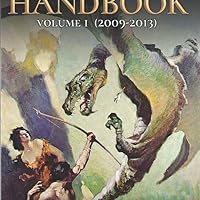
I happened upon this 1976 paperback at random and picked it up based on the fun cover art. I had no idea this was actually written in the mid 19th century, imagining the far flung future of 1947.
Mr. Stockton somehow managed to predict exploration of the Arctic by submarine and something not unlike ground penetrating radar but hangs a lot on a wildly incorrect concept of how the Earth was formed, terminal velocity, and a few other clunkers, but the story is more fun when he gets it wrong.
And FUN is the operative word. I gobbled this compact and weirdly unpredictable book right up. It is an absolute hoot.
Mr. Stockton somehow managed to predict exploration of the Arctic by submarine and something not unlike ground penetrating radar but hangs a lot on a wildly incorrect concept of how the Earth was formed, terminal velocity, and a few other clunkers, but the story is more fun when he gets it wrong.
And FUN is the operative word. I gobbled this compact and weirdly unpredictable book right up. It is an absolute hoot.

July 16, 2025
Throughout the 19th century, numerous expeditions made the valiant attempt to be the first to reach the North Pole, and records were set as one team after another vied for the title of "Farthest North." The ball got rolling in 1827, when the team of the English explorer Sir William Edward Parry reached the northern latitude of 82 degrees. By 1898, expeditions from the U.K., U.S., Norway and Italy had nudged their way ever higher, and the record stood at 86 degrees north latitude, with nobody yet having achieved the ultimate objective. This fascination with reaching the northernmost point on Earth evidently proved irresistible to the American author Frank R. Stockton as well, resulting in his lost-world adventure "The Great Stone of Sardis," which was released 12 years before the American Robert Peary claimed to reach the pole in 1909...a claim that has been disputed in modern times.
"The Great Stone of Sardis" was originally released as a six-part serial in the June - November 1897 issues of Harper's "New Monthly Magazine," which had been first published by the Harper brothers in the 1850s. Stockton's novel would receive the hardcover treatment in 1898, via the Harper Brothers publishing house, which dated back to 1817. Scribner's would reissue the book in 1900, accompanied by Stockton's novelette "The Water-Devil" (1874), after which the novel would go OOPs (out of prints) for no fewer than 76 years. In 1976, however, the book was reissued twice: first as part of Gregg Press' big hardcover "The Science Fiction of Frank R. Stockton," and then as a Belmont Tower paperback. Flash forward another 33 years, to 2009, and the novel is again reissued twice in one year...as a Book Jungle trade-size edition and as a paperback from Tark. And finally, there is the incarnation that I was fortunate enough to acquire...the 2020 edition from Armchair Fiction--the 26th installment of their ongoing Lost World-Lost Race Classics series (which, as of this writing, extends to 66 volumes) and which replicates the unfaithful piece of cover art from the Belmont Tower edition, by an unknown artist.
Before going on, a quick word about author Frank R. Stockton himself, for those of you who might be unfamiliar with him, as I admittedly was, for the most part. Stockton was born in Philadelphia in 1834 and is today probably best known for his tales of adventure, as well as for the dozens of short stories and fairy tales that he wrote for children. He also seems to have dabbled in the field of science fiction, as revealed in the book in question and, reportedly, in his 1889 novel "The Great War Syndicate." But he is surely most famous for his classic short story 'The Lady, or the Tiger?" (1882), which used to be a staple of required high-school reading (at least, it was when I went to high school!). Stockton ultimately passed away in 1902, at the age of 68.
Now, as to "The Great Stone of Sardis" itself: The book is set in the futuristic year of, uh, 1947, and introduces the reader to the great scientist and inventor Roland Clewe. When we first encounter him, Clewe is returning from Germany after a year's worth of study, and is now ready to get back to work at his laboratory and manufacturing installation in (the fictitious town of) Sardis, New Jersey. Preoccupying his mind foremost are three pet projects. The first of these is a new type of submarine that he has developed, christened the Dipsey. This sub has been specially built to travel beneath the Arctic pack ice, and Clewe now hopes to send a handpicked crew of around a dozen individuals to the frozen wilderness, and so become the first to reach the North Pole. And while the Dipsey is thus engaged, Clewe will remain in Sardis to pursue his other projects.
Thus, Stockton gives the reader a novel with a highly captivating parallel set of story lines, given to us alternately. In one, the Dipsey's crew encounters any number of hazards while making their polar attempt. The crew includes Samuel Block, Clewe's elderly manager and right-hand man, who has been compelled to bring along his chatterbox wife Sarah; an old-fashioned sailor, Capt. James Hubbell; the first and second chief electricians, Gibbs and Marcy; and Ivan Rovinski, Clewe's Polish enemy and rival, who has somehow made his way on board, will do anything to steal and take credit for Roland's discoveries, and who causes the crew no end of trouble during their voyage. Meanwhile, back in New Jersey, Clewe prosecutes his investigation of the so-called Artesian ray, aka the photic borer. With this device, Clewe can peer far underground...miles deep, as a matter of fact! With the aid of the ray and a telescope, Clewe looks down to a depth of 14 1/8 miles, being ultimately stymied by a zone of light! Putting this project on hold, Clewe next concentrates on his automatic shell, which can burrow its way through mountains and defenses and shows potential as both a tool of construction and a weapon of war. But then, disaster strikes! The automatic shell accidentally falls from its scaffolding and digs a hole straight down...14 1/8 miles down, as a matter of fact, where it is somehow stopped by that same mysterious zone of light. And so, what else can a conscientious scientist possibly be expected to do? Despite the objections of Margaret Raleigh, a wealthy widow who had been Clewe's partner and is now his fiancée, Roland determines to descend into the depths of the great pit, and learn its secrets. And in so doing, he ultimately comes to discover some fascinating facts about this old Earth's origin and structure....
Brian Aldiss, I recall, used to have a term for describing the sci-fi work of his fellow Englishman John Wyndam. He called Wyndham's novels "cosy catastrophes," referring to the fact that things usually turned out just fine for the lead characters in those books, despite the desperate circumstances that surrounded them. Well, it seems to me that Stockton's book here could very easily be thought of as a "cozy lost-world affair." All of the characters in it, with the exception of that weaselly villain Rovinski, are hugely likeable, plain-folk, down-to-earth sorts, and the reader can identify with and root for them all, knowing full well that no harm will possibly befall them. Indeed, there is but a single fatality in Stockton's story to be had, and I probably don't have to tell you which character, right? The author's style here is a highly readable one with expertly rendered dialogue, perfect for YA readers yet with a strong appeal for adults; it did not surprise me one bit when I learned later on that Stockton wrote many pieces for children. The use of alternating, parallel story lines really helps move things along, and the incorporation of dry humor only adds to the fun. Thus, we have Mr. Gibbs remarking "...if we are drowned outside in the open water we shall be food for fishes, whereas if we suffocate inside the vessel we shall only be food for reflection, if anybody ever finds us." And then there is the seasick Mrs. Block, telling her husband "I feel...as if I had had a Christmas dinner yesterday and somebody else had made the pies"!
Not surprisingly, any number of memorable scenes and set pieces are given to the reader. Among them: Roland and Margaret, after years of being in a professional relationship, finally admitting their feelings for one another; the first test of the Artesian ray, with unexpected results; the Dipsey's discovery of "Lake Shiver," a body of water surrounded by icebergs and ice floes; the anchoring of a buoy at the North Pole, and Sammy Block's speech claiming that pole for the U.S.A.; the discovery of the last whale in existence...a species thought to have gone extinct; the accident with the automatic shell; our Arctic explorers blasting a canal through the dense pack ice; Rovinski's escape from the Dipsey, and Marcy's pursuit of him; and, of course, Clewe's descent into the depths of that 14-mile pit, and the discoveries that he makes therein. Given its futuristic setting (well, let's just say a setting 50 years following the time of the book's creation; an era that has seemingly not gone through a world war or two), any number of quaint and curious touches are to be had. And so, we see transatlantic ships with top and bottom hulls that can be separated upon docking; a bridge extending from Brooklyn to New Jersey across New York Harbor, with its central pier resting in the Battery; an early type of monorail; a United North America, made up of the U.S., Canada, Greenland (our current president would surely approve of this!), British America, British Columbia, Alaska, Mexico, Central America and the West Indies; Clewe's three great inventions; the extinction of whales; a "fly-foot sledge," capable of climbing up vertical surfaces; and the 40-mile-long tunnels that are part of the Great Straightcut Pacific Railroad. It is a neat, economical bit of world building, to be sure, if hardly a prescient one. "The Great Stone of Sardis," I suppose we might say, is a double lost-world novel, showcasing not just the unknown world north of 86 degrees north latitude, but also the unexplored world that lies 14 1/8 miles beneath us. It is perfect fare for fans of sci-fi, lost-world stories, and perhaps for those with a liking for Victor Appleton II's Tom Swift, Jr. books. I promise that you will be left wishing that Frank R. Stockton had penned a bunch of other books dealing with Roland Clewe and his remarkable inventions!
All of which, naturally, is not to say that Stockton's book is flawless. Hardly so. For one thing, Clewe's discovery of what lies 14 miles down, and his subsequent theory regarding our planet's formation, initially struck this reader as being a tad on the silly side. Even Margaret is forced to exclaim to Roland "...it is absurd...why, people will think you are crazy...it is simply impossible...." And yet, the day after I finished reading Stockton's admittedly hugely entertaining work, I saw a report online claiming that scientists have just discovered a body of water 700 kilometers beneath the Earth's surface! 'Trapped inside a type of blue rock called ringwoodite," this ocean "might be holding three times more water than all the oceans on the surface combined"! My point is, who can say what lies far beneath our feet, or how far off Clewe's theory might be? So I'm willing to concede that point. More unusual is the fact that the attainment of the pole in this book is shown to be...well, not that big of a deal, really. The journey getting there was all; the pole itself, just another spot on the ocean. Even Clewe readily admits that the reaching of the North Pole must pale into insignificance when stacked against all his other achievements...a surprising admission in a book that is at least half centered on that polar goal!
Some other minor problems present themselves here and there. There are a few instances of faulty grammar to be had (such as "if it was possible" rather than "were possible"), and a few times when the author refers to the last whale as a "great fish." And while I'm nitpicking, if a vessel is headed south, wouldn't a wind coming from the east strike its port side, not its starboard? But again, these are merely quibbles. Between Stockton's easily readable writing style and his compelling use of multiple story lines, I found myself zipping through his book as smoothly and quickly as the Dipsey in open water. It is most assuredly recommended, for readers age 12 and up. Now, if only I could lay my hands on a copy of that "Great War Syndicate"....
(By the way, this review originally appeared on the FanLit website at https://fantasyliterature.com/ ... a most ideal destination for all fans of lost-world/lost-race fare such as this....)
"The Great Stone of Sardis" was originally released as a six-part serial in the June - November 1897 issues of Harper's "New Monthly Magazine," which had been first published by the Harper brothers in the 1850s. Stockton's novel would receive the hardcover treatment in 1898, via the Harper Brothers publishing house, which dated back to 1817. Scribner's would reissue the book in 1900, accompanied by Stockton's novelette "The Water-Devil" (1874), after which the novel would go OOPs (out of prints) for no fewer than 76 years. In 1976, however, the book was reissued twice: first as part of Gregg Press' big hardcover "The Science Fiction of Frank R. Stockton," and then as a Belmont Tower paperback. Flash forward another 33 years, to 2009, and the novel is again reissued twice in one year...as a Book Jungle trade-size edition and as a paperback from Tark. And finally, there is the incarnation that I was fortunate enough to acquire...the 2020 edition from Armchair Fiction--the 26th installment of their ongoing Lost World-Lost Race Classics series (which, as of this writing, extends to 66 volumes) and which replicates the unfaithful piece of cover art from the Belmont Tower edition, by an unknown artist.
Before going on, a quick word about author Frank R. Stockton himself, for those of you who might be unfamiliar with him, as I admittedly was, for the most part. Stockton was born in Philadelphia in 1834 and is today probably best known for his tales of adventure, as well as for the dozens of short stories and fairy tales that he wrote for children. He also seems to have dabbled in the field of science fiction, as revealed in the book in question and, reportedly, in his 1889 novel "The Great War Syndicate." But he is surely most famous for his classic short story 'The Lady, or the Tiger?" (1882), which used to be a staple of required high-school reading (at least, it was when I went to high school!). Stockton ultimately passed away in 1902, at the age of 68.
Now, as to "The Great Stone of Sardis" itself: The book is set in the futuristic year of, uh, 1947, and introduces the reader to the great scientist and inventor Roland Clewe. When we first encounter him, Clewe is returning from Germany after a year's worth of study, and is now ready to get back to work at his laboratory and manufacturing installation in (the fictitious town of) Sardis, New Jersey. Preoccupying his mind foremost are three pet projects. The first of these is a new type of submarine that he has developed, christened the Dipsey. This sub has been specially built to travel beneath the Arctic pack ice, and Clewe now hopes to send a handpicked crew of around a dozen individuals to the frozen wilderness, and so become the first to reach the North Pole. And while the Dipsey is thus engaged, Clewe will remain in Sardis to pursue his other projects.
Thus, Stockton gives the reader a novel with a highly captivating parallel set of story lines, given to us alternately. In one, the Dipsey's crew encounters any number of hazards while making their polar attempt. The crew includes Samuel Block, Clewe's elderly manager and right-hand man, who has been compelled to bring along his chatterbox wife Sarah; an old-fashioned sailor, Capt. James Hubbell; the first and second chief electricians, Gibbs and Marcy; and Ivan Rovinski, Clewe's Polish enemy and rival, who has somehow made his way on board, will do anything to steal and take credit for Roland's discoveries, and who causes the crew no end of trouble during their voyage. Meanwhile, back in New Jersey, Clewe prosecutes his investigation of the so-called Artesian ray, aka the photic borer. With this device, Clewe can peer far underground...miles deep, as a matter of fact! With the aid of the ray and a telescope, Clewe looks down to a depth of 14 1/8 miles, being ultimately stymied by a zone of light! Putting this project on hold, Clewe next concentrates on his automatic shell, which can burrow its way through mountains and defenses and shows potential as both a tool of construction and a weapon of war. But then, disaster strikes! The automatic shell accidentally falls from its scaffolding and digs a hole straight down...14 1/8 miles down, as a matter of fact, where it is somehow stopped by that same mysterious zone of light. And so, what else can a conscientious scientist possibly be expected to do? Despite the objections of Margaret Raleigh, a wealthy widow who had been Clewe's partner and is now his fiancée, Roland determines to descend into the depths of the great pit, and learn its secrets. And in so doing, he ultimately comes to discover some fascinating facts about this old Earth's origin and structure....
Brian Aldiss, I recall, used to have a term for describing the sci-fi work of his fellow Englishman John Wyndam. He called Wyndham's novels "cosy catastrophes," referring to the fact that things usually turned out just fine for the lead characters in those books, despite the desperate circumstances that surrounded them. Well, it seems to me that Stockton's book here could very easily be thought of as a "cozy lost-world affair." All of the characters in it, with the exception of that weaselly villain Rovinski, are hugely likeable, plain-folk, down-to-earth sorts, and the reader can identify with and root for them all, knowing full well that no harm will possibly befall them. Indeed, there is but a single fatality in Stockton's story to be had, and I probably don't have to tell you which character, right? The author's style here is a highly readable one with expertly rendered dialogue, perfect for YA readers yet with a strong appeal for adults; it did not surprise me one bit when I learned later on that Stockton wrote many pieces for children. The use of alternating, parallel story lines really helps move things along, and the incorporation of dry humor only adds to the fun. Thus, we have Mr. Gibbs remarking "...if we are drowned outside in the open water we shall be food for fishes, whereas if we suffocate inside the vessel we shall only be food for reflection, if anybody ever finds us." And then there is the seasick Mrs. Block, telling her husband "I feel...as if I had had a Christmas dinner yesterday and somebody else had made the pies"!
Not surprisingly, any number of memorable scenes and set pieces are given to the reader. Among them: Roland and Margaret, after years of being in a professional relationship, finally admitting their feelings for one another; the first test of the Artesian ray, with unexpected results; the Dipsey's discovery of "Lake Shiver," a body of water surrounded by icebergs and ice floes; the anchoring of a buoy at the North Pole, and Sammy Block's speech claiming that pole for the U.S.A.; the discovery of the last whale in existence...a species thought to have gone extinct; the accident with the automatic shell; our Arctic explorers blasting a canal through the dense pack ice; Rovinski's escape from the Dipsey, and Marcy's pursuit of him; and, of course, Clewe's descent into the depths of that 14-mile pit, and the discoveries that he makes therein. Given its futuristic setting (well, let's just say a setting 50 years following the time of the book's creation; an era that has seemingly not gone through a world war or two), any number of quaint and curious touches are to be had. And so, we see transatlantic ships with top and bottom hulls that can be separated upon docking; a bridge extending from Brooklyn to New Jersey across New York Harbor, with its central pier resting in the Battery; an early type of monorail; a United North America, made up of the U.S., Canada, Greenland (our current president would surely approve of this!), British America, British Columbia, Alaska, Mexico, Central America and the West Indies; Clewe's three great inventions; the extinction of whales; a "fly-foot sledge," capable of climbing up vertical surfaces; and the 40-mile-long tunnels that are part of the Great Straightcut Pacific Railroad. It is a neat, economical bit of world building, to be sure, if hardly a prescient one. "The Great Stone of Sardis," I suppose we might say, is a double lost-world novel, showcasing not just the unknown world north of 86 degrees north latitude, but also the unexplored world that lies 14 1/8 miles beneath us. It is perfect fare for fans of sci-fi, lost-world stories, and perhaps for those with a liking for Victor Appleton II's Tom Swift, Jr. books. I promise that you will be left wishing that Frank R. Stockton had penned a bunch of other books dealing with Roland Clewe and his remarkable inventions!
All of which, naturally, is not to say that Stockton's book is flawless. Hardly so. For one thing, Clewe's discovery of what lies 14 miles down, and his subsequent theory regarding our planet's formation, initially struck this reader as being a tad on the silly side. Even Margaret is forced to exclaim to Roland "...it is absurd...why, people will think you are crazy...it is simply impossible...." And yet, the day after I finished reading Stockton's admittedly hugely entertaining work, I saw a report online claiming that scientists have just discovered a body of water 700 kilometers beneath the Earth's surface! 'Trapped inside a type of blue rock called ringwoodite," this ocean "might be holding three times more water than all the oceans on the surface combined"! My point is, who can say what lies far beneath our feet, or how far off Clewe's theory might be? So I'm willing to concede that point. More unusual is the fact that the attainment of the pole in this book is shown to be...well, not that big of a deal, really. The journey getting there was all; the pole itself, just another spot on the ocean. Even Clewe readily admits that the reaching of the North Pole must pale into insignificance when stacked against all his other achievements...a surprising admission in a book that is at least half centered on that polar goal!
Some other minor problems present themselves here and there. There are a few instances of faulty grammar to be had (such as "if it was possible" rather than "were possible"), and a few times when the author refers to the last whale as a "great fish." And while I'm nitpicking, if a vessel is headed south, wouldn't a wind coming from the east strike its port side, not its starboard? But again, these are merely quibbles. Between Stockton's easily readable writing style and his compelling use of multiple story lines, I found myself zipping through his book as smoothly and quickly as the Dipsey in open water. It is most assuredly recommended, for readers age 12 and up. Now, if only I could lay my hands on a copy of that "Great War Syndicate"....
(By the way, this review originally appeared on the FanLit website at https://fantasyliterature.com/ ... a most ideal destination for all fans of lost-world/lost-race fare such as this....)

Read
March 23, 2017While I didn't particularly looked forward to this book ( was for a task), I really enjoyed it a lot. It's kind of a sreampunk novel in the style of Jules Verne and it was a very enjoyable read.
December 28, 2019
Story of an inventor.
Two plot lines at the same time.
1) Finding the North Pole.
2) Tunneling through the Earth
Written in 1898. The story takes place in the 1940s. Kind of fun to see what the author thought could happen in the '40s when he lived 50 years earlier.
Two plot lines at the same time.
1) Finding the North Pole.
2) Tunneling through the Earth
Written in 1898. The story takes place in the 1940s. Kind of fun to see what the author thought could happen in the '40s when he lived 50 years earlier.

September 1, 2018
Not my favorite of Stockton's work.
February 5, 2026
Roland Clewe is perhaps the greatest genius that the world has ever known. He’s conceived and built a revolutionary new submersible called the ‘Dipsey’, which he sends to the Arctic regions on an expedition to discover the North Pole. At the same time, he’s invented a ray that can peer into the bowels of the Earth and a burrowing machine, which generates more power the harder the substance it encounters. As it has no external power source, I guess that means he’s discovered perpetual motion as well? The burrowing machine falls off its scaffolding (which presumably Roland didn't invent!), and starts digging into the Earth, creating a shaft 14 and a half miles deep before it comes to a sudden and mysterious halt. Of course, Roland comes up with a quick form of subterranean transportation so he can pop down the shaft and have a look at what’s at the bottom.
This is a novel that reads very much like two novellas slapped together, not one followed by another, but literally smashed together. The two stories of discovery run side by side throughout, during which time they are connected only by the occasional telegraph message. The events arising from each has no direct effect on the other. Yes, they are linked by the early chapters which set up the story, but only come together again right at the end, thanks to the fairly clumsy plot device of a traitor in Roland’s camp. The effect of these separate narratives is that neither feels sufficiently expanded and the entire work fairly slight.
One interesting aspect is that Stockton wrote this in 1898 during the technological upheaval at the turn of the 20th century, but the book is set in 1947. Stockton’s unusual premise is that after this technological upheaval, humanity chose to reject some of this progress and go backwards instead for a couple of decades before advancing again. This is a unusual idea and one that might seem incredibly unlikely unless you live in the UK, where nostalgia is like a national disease.
This is a decently written tale, but it does desperately need some plot development to transform it into a truly satisfying experience.
This is a novel that reads very much like two novellas slapped together, not one followed by another, but literally smashed together. The two stories of discovery run side by side throughout, during which time they are connected only by the occasional telegraph message. The events arising from each has no direct effect on the other. Yes, they are linked by the early chapters which set up the story, but only come together again right at the end, thanks to the fairly clumsy plot device of a traitor in Roland’s camp. The effect of these separate narratives is that neither feels sufficiently expanded and the entire work fairly slight.
One interesting aspect is that Stockton wrote this in 1898 during the technological upheaval at the turn of the 20th century, but the book is set in 1947. Stockton’s unusual premise is that after this technological upheaval, humanity chose to reject some of this progress and go backwards instead for a couple of decades before advancing again. This is a unusual idea and one that might seem incredibly unlikely unless you live in the UK, where nostalgia is like a national disease.
This is a decently written tale, but it does desperately need some plot development to transform it into a truly satisfying experience.

Read
May 17, 2021I like the old stuff
I really enjoy older books from the 1850s to the 1960s and 70s. This one falls in there and is a pleasure to read. I love the old sci-fi showing what people use to think what their future (now our past) would be like and seeing how close or far away the authors got it. This book didn't get close at all, but sometimes that is a large part of the appeal for me.
I really enjoy older books from the 1850s to the 1960s and 70s. This one falls in there and is a pleasure to read. I love the old sci-fi showing what people use to think what their future (now our past) would be like and seeing how close or far away the authors got it. This book didn't get close at all, but sometimes that is a large part of the appeal for me.

January 22, 2024
Interesting that this novel has whales as extinct.

June 27, 2015
Early futuristic "Adventure" tale written in 1897, depicting the —then— far-flung world of the year of 1947.
Both Steam and Diesel Punk aficionados will love this! Like the cover says; it's "thoroughly MECHANICAL fun."
The protagonist would make Edison jealous with his many gadgets and gizmos.
Both Steam and Diesel Punk aficionados will love this! Like the cover says; it's "thoroughly MECHANICAL fun."
The protagonist would make Edison jealous with his many gadgets and gizmos.
Displaying 1 - 11 of 11 reviews