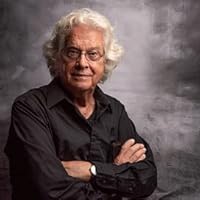
Paul Bestor Woodruff was an American classicist, professor of philosophy, and was dean at The University of Texas at Austin, where he once chaired the department of philosophy and has more recently held the Hayden Head Regents Chair as director of Plan II Honors program, which he resigned in 2006 after 15 years of service. On September 21, 2006, University President William C. Powers, Jr. named Dr. Woodruff the inaugural dean of undergraduate studies. He is best known for his work on Socrates, Plato, and philosophy of theater. A beloved professor, he taught courses outside his Ancient Greek Philosophy specialty, including literature courses and specialty seminars, often for the Plan II program.
I really wanted to love this book because it addresses a topic that really need more attention. But, the book is 8x longer than it should be. Get a good editor man. He repeats ideas and circles around things without ever making clear points most of the time. It’s frustrating and at times contradictory. My other issue with it is the tendency of the author to resolve intellectual conflict by rushing to the resolution and stating there is no inherent conflict of you understand it right. It’s like saying a husband and wife would never really fight if they understood marriage in the perfect way. It’s absurd and you have to go through the mess of working out contradictions and compromises. Other than that though, good book.
Woodruff does a good job in the early chapters explaining the concept of reverence and breaking down his definition of the virtue. However, his explanation of reverence lacks any connection with religion. He does a decent job of trying to persuade the reader that one must pursue virtue for virtue's sake, but his arguments still lack the transcendent qualities that can be found in religious accounts, which he specifically tries to avoid. Thus, the assumptions he makes about certain topics do not seem to be grounded in metaphysical realities professed by Christians (or even other sects), making it miss the mark for them in some areas.
What could have been a marvelous philosophical work if he had not pandered to a more secular audience is instead merely a decent work, most notable for its definition of reverence.
A life-changing book. One cannot read it without improving in mind and morals.
Months after reading this book I cannot shake its message from my head. And I don't want to. It's looking to be the best book I read in 2009.
Woodruff talks about a trait that can tie all believers and non-believers together, a trait that the contemporary West is losing quickly, one we cannot afford to lose. It is reverence that draws us to Cathedrals though we might not be Catholic, Stonehenge though we might not be Pagans. It is reverence that leads us to have awe for the Other even when our faith disagrees with theirs. It is reverence that resonates with us as we watch Shakespeare's characters wrestle with Jove, though we may believe in Christ. It is the most important trait for any good writer of fiction to comprehend, for it is a nod towards reverence and not towards dogma that makes great literature.
It is important to have a trigger to remind us of reverence. Paul Woodruff’s book is just that trigger—a reminder to base our ethics on virtues rather than rules. He invites us to examine the qualities of being morally good that are dependent on virtues such as honesty, compassion, courage and prudence... Where Mr. Woodruff gets off the track is when he begins mixing his metaphors among the Greek classics and Chinese philosophers. Both Plato and Confucius have similar ideals for rulers and the common folk—competition and the drive to win has no place among human beings whose primary virtue is virtue itself. His expertise in philosophy is diluted when he applies ancient wisdom to commonplace situations. His anecdotes about students he has known (Chris, Sam and Lila) reek of pettiness, and certainly do not aspire to the reverence he is helping us to understand and master. It might be because his definition of reverence is flawed. He says: reverence comprises awe, respect and shame. But there is no shame in reverence. There is, however, humility in reverence. Being humbled is an emotion of great purity and not the same as feeling shame. Still, I am grateful to Mr. Woodruff for bringing reverence to my attention, so I can examine what it means in my life and every life I touch.
Some of the discussion was interesting enough but a lot of it was tautological and a bit muddled. I’m still not sure what reverence is to him. He tries to distinguish religious from nonreligious or religion-neutral reverence, but it doesn’t work well. In some religious traditions, following a command to be violent to others on religious grounds is reverent. He wants a reverence built on first principles in which a reverential duty could not conflict with another, within or between individuals, but then he gives the example of Antigone where reverence clearly does conflict. As food for thought sure, it was worth the read. But it’s not a cohesive, much less a comprehensive, argument.
Wow! What a book. The concepts of virtue, of community, and of reverence itself have changed the way I look at the regular ceremonies I participate in with Church, school, family, and country. I value them now more than ever. I started marking the passages I liked in my copy, and found I'd marked nearly half the book. Woodruff's style does get a bit repetitive, so reading it all in one or two days (as I did) may not be ideal; you'd be better off picking it up in small segments, and being reminded of things you'd already learned.
Interesting, made me think. Would've helped if I'd had more of a classical education so I could understand all the references to Greek literature. Was pleased to read his opinion of reverence as a virtue, a virtue that I think is sadly lacking in so many people these days. Disappointed that the final chapter didn't tie everything together or summarize his thesis. The book simply ended.
Some time ago I tried to work out a list of core virtues to help me, as a teacher, in thinking about moral formation. One, I discovered to my surprise, and perhaps the most important, was reverence. Civic virtues spring from reverence toward land, kin, and heritage; religious piety springs from reverence for God; and liberality springs from reverence for others. Odd, then, that nobody talks about it.
So I found this book, which has two purposes. First, to explain and defend the forgotten virtue of reverence. In this, Woodruff succeeds remarkably well. Second, to expound a way to integrate reverence into the cultural framework of a liberal, pluralistic society. In this, I think he is less successful, for several reasons.
One is that the negative space into which Woodruff tries to press this virtue has already shifted. Woodruff wrote at a time when the American intelligentsia above all feared the threats to secular liberalism posed at home by conservative Evangelicalism and abroad by militant Islamism. Neither, of course, has faded into irrelevance, but in 2025, the frequent tut-tutting about irreverent religion in the early chapters feels obligatory and almost quaint. Perhaps we are simply more attentive today to the economic and political factors that trigger religiously-coded turns to violence.
But I am also skeptical, despite his arguments to the contrary, that secular liberalism has the resources to maintain common reverence. For Woodruff, we need not have gods in common, or even any gods at all, for reverence; only a shared feeling that there is something bigger than us. The object of reverence may even be an “evil god,” not particularly worthy of admiration, yet the effect is the same. Reverence forbids rather than fosters emulation, because it reminds us of our place as mere human beings.
That pagans and atheists are capable of reverence is unquestionable. Likewise, awe per se carries no moral judgment. But I suspect Woodruff overstates the dichotomy between reverence and imitation. After all, for Christians, as for Platonists and classical theists and not a few Vedantists, goodness is a intrinsic property of transcendence, and an entity is only deserving of reverence insofar as it participates in transcendence. Reverence is possible across differences of faith, not because the virtue is absolutely belief-neutral, but because the capacity to address or experience transcendence is not confined within specific doctrinal formulations. And even though reverence does mark out the distance between worshiper and worshipped, Christian sacrament and its analogues in other traditions exist to transcend (without denying) that difference, to acquire unity or at least congruency with the object of one’s wonder. This perhaps explains why Woodruff is so wary of religious liturgy—it does not fit with how he understands reverence as “keeping our feet on the ground.” But if reverence does not merely begin in feelings of awe, but moves us toward the transcendence apparent in the object of our reverence, the rituals of a secular liberal regime, and the ersatz gods around which they are constructed, will fail to cultivate the feelings and habits of reverence he finds so regrettably absent in our present context.
Despite these reservations, this is a commendable book, bound to get one thinking about the right questions.
In Reverence: Renewing a Forgotten Virtue, classics translator and expert Paul Woodruff makes a case for reverence as a much needed virtue for our times. And a reverence that should permeate all facets of society: politics, religion, education and family life. Often drawing heavily from the classics, he presents examples of reverent leaders, teachers, philosophers and parents and yet also points out the places where reverence is lacking or misunderstood. He is particularly critical of political and spiritual leaders who lack true reverence in their treatment of those they serve. Even though this book was written a bit before current world events, so many passages seem like warnings for us today. Well worth reading.
I'll keep this one. It is filled with applicable ideas for both philosophy class and for sermons. Woodruff explores the concept of reverence particularly in ancient Greek and Chinese societies, successfully pulling it away from the assumed connection to religion. It is a practice inspired by awe, but not awe itself. Observation of ceremony and ritual is a part of it, but insufficient to meet the idea fully. He makes the case that it is a virtue itself, and thus applicable to how we lead our lives. I particularly enjoyed his application of this idea to teaching and to leadership. Read it with a pencil in hand!
The notion behind this book is noble and at times wonderfully expressed. I was reading it at the time of the Christchurch shootings and was able to observe what Woodruff was getting at as i watched Jacinta Adern leading the people of New Zealand (and all of us) through the trauma. I found the book a little repetitive but still worth reading. I will endeavour to be more reverent in my attitude to people and events around me
This book looks at the virtue of reverence which comes from awe, shame, and, respect. It is an interesting review of Greek and Chinese examples. Paul comes across with an irreverent air much of the time which turned me off to buying that this deserves absolute following. Great overall message, but tries to sell it too hard.
Pleasant read. Brings up many examples from classical literature and philosophy. Gives the reader much to consider about something not discussed in popular media. Personally I found the inclusion of Oliver North as an example of "respect" to be a bizarre choice out of left field; but the rest of it is worth reading.
Read this book of You truly want to be a better perdón. We get confused by ideas of honor, being right, justice, and the lack of respecto destroys it all, if we do not have agreement on what we revere. Reverence is for humans, not systems. The systems driven world makes US forget the importante of reverence. This book is shorts and east to read.
I read this because my university program asked me to over the summer. It was definitely interesting and made me think differently about our virtues, but I don't think I would choose to read this book again.
The author has touched many themes in the context of reverence providing scope for further reading. At times chapters needed to be read again to gain clarity. Not with standing this it was worth the time reading and chapter by chapter worthy of it being read again.
This book dragged. A decent one time read, but could have been said succinctly in a blog post. Didn’t DNF, but read it for the well thought out definition of reverence. Other reviews I’ve liked here have summed up what I thought of it, by Eli & Stephen. Reference those.
Paul Woodruff opens an important dialogue. Drawing on Greek and Confucian traditions, he explores the many aspects of reverence. The lesson in the end is that reverence saves lives. What he shares throughout his book brings the reader to understand just that.
The writing in this book is incredibly dense. That being said, as you dig through the text, keep your eyes open for the gems hidden within. Not riveting but insightful.
An impactful read, I believe that Woodruff's views on transcendence would be beneficial for anyone to consider regardless on if they adopt his worldview or not. To be truly reverent, and to acknowledge human limitations, is always a concept worth considering.
A book of wisdom makes me want to be a better person and some way shows me how. This is a very wise book in both senses. By drawing on sources mostly from ancient Greece and China, and illustrating with examples from the contemporary western world (sports, politics, family, religion, education), Woodruff makes a compelling case that reverence as he defines it is a cardinal, i.e. trans-cultural virtue. Also, and not incidentally, I take Woodruff to be an exemplar of philosophical writing: he is equally erudite and accessible. I will share his chapter on teaching with my philosophy of education students, and his chapter on leadership with my administrators. Here are a few of my favorite passages:
"Reverence is the capacity for a range of feelings and emotions that are linked; it is a sense that there is something larger than a human being, accompanied by capacities for awe, respect, and shame; it is often expressed in, and reinforced by, ceremony." (63)
"Reverence calls for respect only when respect is really the right attitude. To pay respect to a tyrant would not be reverent; it would be weak and cowardly. The most reverent response to a tyrant is to mock him." (5)
"If you wish to be reverent, never claim the awful majesty of God in support of your political views. You cannot speak on such matters with the authority of God. It is an especially vicious and harmful falsehood to say that you do--vicious because it is irreverent, harmful because it is like pouring fuel on smoldering disagreements.... Your followers will never listen to the other side, never enter into discussion, never consider a compromise. In fact, by claiming that God votes with you, you have effectively opted out of political process altogether."(18-19)
"Home above all is the place where small rituals bring a family together into a family, where the respect they share is so common and familiar that they hardly recognize it as flowing from reverence." (35)
"A virtue is a capacity, cultivated by experience and training, to have emotions that make you feel like doing good things.... Virtue talk has been revived in recent years, but it runs against the grain of modern ethics, which is mostly about doing what is right whether you feel like it or not. By contrast, virtue is about cultivating feelings that will lead you in the right way whether you know the rule in a given case or not." (61-2)
"Without reverence, we may feel shame as the pain of being exposed to other people for having violated community standards--and this is not a virtuous response, because it may have nothing to do with right and wrong. But when reverence is in play, we feel shame when exposed in our own minds to shortcomings vis-à-vis the ideals toward which we stand in awe, and this reaction does belong to virtue …." (63)
"What religious people today admire in other religions cannot be faith (since they reject most of the content of other faiths), but reverence." (11)
"Reverence is not faith, because the faithful may hold their faith with arrogance and self-satisfaction, and because the reverent may not know what to believe." (46-7)
"Socrates hides his meaning in inaccessible places. If he knows anything, he rarely admits it. He twists and turns away from the role of a teacher .... Irony is silence twisted into words that provoke and do not satisfy. Like pure silence, irony shows awe at subject matter that cannot easily be tamed. Irony treats students with more respect than they are likely to recognize. It is Socrates’ peculiar way of being reverent toward the goals of philosophy, toward wisdom ...." (188-9)
"Every honest scholar knows that he too will die, that future generations will know more than he, and that someone will sooner or later refute him on some point or other. Knowing this--really knowing it in a way that enables you to feel respect for the faltering efforts of beginners in the field--is reverence." (195)
This essay, which is based on reflections of Woodruff's book, appeared in my blog:
My life is lived out in tension.
I want the world to be a better place. I also desire for people to treat one another with respect. Often, these two desires come into conflict.
How can we encourage people to be better without being perceived as attacking them? Is there a way to accept people without judgment? I hope so, but sometimes find it difficult. I try not to be judgmental. But I find I am judgmental, especially when I find judgments by others that I perceive to be made unfairly or for unjust reasons. Then I become judgmental toward those who are judgmental. Instead of building relationships,, they become fractured. Is there a way to stop the vicious circle of accelerating tension?
I also want to encourage people to live up to their potential. It is from this desire I often resort to parody and satire to challenge those whose actions seem self-righteous or who seem to take for granted their positions of power. The satirist critiques are based upon a strong moral ethic and the sharpness of his or her pen lies in the hypocrisy being practiced by those who are in control. “If mild reproof and counsel could succeed, the satirist would have nothing to do,†according to Ernest Tuveson in an article in “The Satirist’s Art. But when I critique, I run the risk of treating others with less respect that I would like. [for more on satire, see “Edward and Lillian Bloom, Satire’s Persuasive Voice, (Ithaca: Cornell, 1979). A warning however, the Bloom’s never met a compound or complex sentence they didn’t like—me being judgmental again.]
One of the most influential books I’ve read in the past 2 years is Paul Woodruff, Reverence: Renewing a Forgotten Virtue (Oxford, 2001). Woodruff draws from early Greek and Chinese philosophy to make the case that reverence is a classic virtue which helps us to do right. “Reverence arises out of an understanding of human limitations; from this grows the capacity to be in awe of whatever we believe lies outside our control—God, truth, justice, nature, even death…†“Simply put, reverence is the virtue that keeps human beings from trying to act like gods…†“tyranny is the height of irreverence.†“reverence separates leaders from tyrants…†“the reverent leader need not pretend to be godlike; the ideals are godlike enough.â€
Woodruff does not deny the importance of humor and mockery in reverence. “Mockery serves reverence in two ways: by reminding stuffed shirts about their imperfections, and by awakening a sense of shame in people who have allowed theirs to lie dormant.†This is good news for me—I can still use humor.
Since reverence makes few demands on belief (it can be practiced across religious lines), then a truly good desire would be that all people of all faiths practice reverence. I think there are deep wells within the Christian tradition from which we can draw. Jesus’ command not to judge, not to hate, and to pray for our enemies (anyone said a prayer for Bin Laden lately? And I don’t think Jesus saying to pray for our enemies’ means for us to pray that he meets his maker sooner.) Instead, we love others and pray even for our persecutors, for when we act in such a way, we will have a hard time demonizing them. We should pray that our enemies have reverence! I like that.
Okay, this is heavy stuff—reminds me of the Ethics classes I took as an undergrad in the philosophy department. Let me end it with one quote from another of my favorite reverent/irreverent philosophers, Edward Abbey (who died in 1989, but lives on in Ed Abbey’s blog): “I hate intellectual discussion. When I hear the words phenomenology or structuralism, I reach for my buck knife.†-from, A Voice Crying in the Wilderness