Kath Walker (Oodgeroo Nunukul) spent her childhood with her family on Stradbroke Island, off the Queensland coast. The first half of this book, 'Stories from Stradbroke', describes episodes from her childhood days - some happy, some sad - and gives a memorable impression of Aboriginal life on the island and of a family proud of its Aboriginal heritage. The second part of the book, 'Stories from the Old and New Dreamtime', is made up of Aboriginal folklore which the author recalls hearing as a child, and of new stories written in traditional Aboriginal forms.
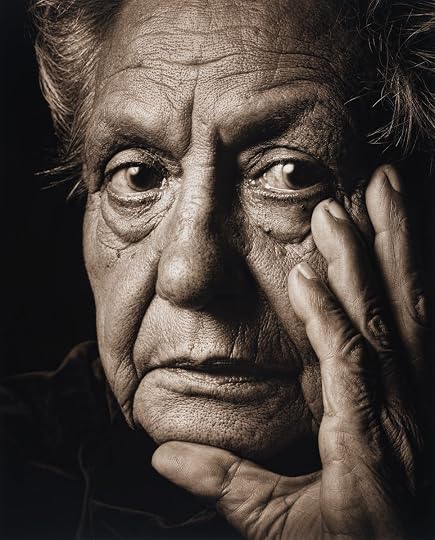
Oodgeroo Noonuccal (/ˈʊdʒəruː/ /ˈnuːnəkəl/ uud-gə-roo noo-nə-kəl; born Kathleen Jean Mary Ruska, formerly Kath Walker) (3 November 1920 – 16 September 1993) was an Australian poet, political activist, artist and educator. She was also a campaigner for Aboriginal rights. Oodgeroo was best known for her poetry, and was the first Aboriginal Australian to publish a book of verse.
Oodgeroo won several literary awards, including the Mary Gilmore Medal (1970), the Jessie Litchfield Award (1975), and the Fellowship of Australian Writers' Award.
In 1979, she was awarded the Sixth Annual Oscar at the Micheaux Awards Ceremony, hosted by the US Black Filmmakers Hall of Fame and in the same year received the International Acting Award for the film Shadow Sisters.
She was appointed a Member of the Order of the British Empire in 1970, returning it in 1987 to protest the Australian Bicentenary celebrations, and to make a political statement at the condition of her people.
Oodgeroo was born on Stradbroke Island, off the coast of Queensland.
She grew up to be a voice for conservation, a poet, political activist, and Australia's most famous Aboriginal author. Here she relates tales of growing up surrounded by her large family.
The seven children had great freedom to roam the island, and were taught by their father to hunt and fish, though they were strictly cautioned that all weapons were to be used only in the gathering of food. In one of my favorite stories, Oodgeroo's older brother kills a kookaburra - strictly forbidden by the Aborigine culture. As punishment, their father confiscates their weapons for three months, during which time the children can only eat the awful rations donated by white men. The family dog, used to delicious leftovers from the local sea, decides to go fishing for himself, and manages to snag, AND, drag home a young shark. The mother cooks and serves it to the dog, but the children get none: they're still being punished.
Not all the tales are funny, however. The author tells sad stories about being beaten for using her left hand, and of the time when her little sister broke her arm, and the family had to take a boat to the mainland, as the island doctor refused to treat Aborigines.
The second part of the book is a collection of Aboriginal folklore, and stories from the author written in traditional style.
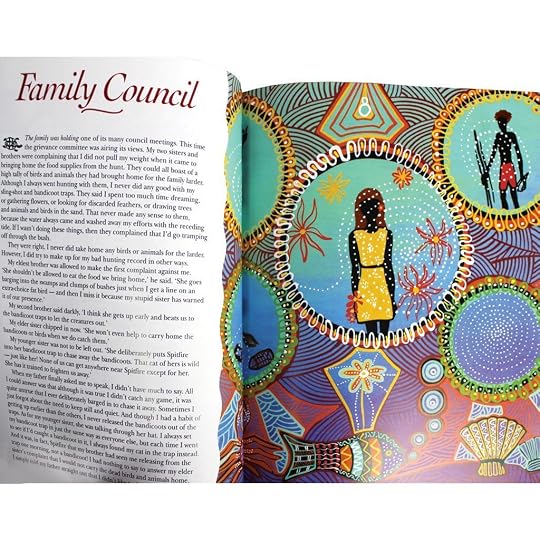
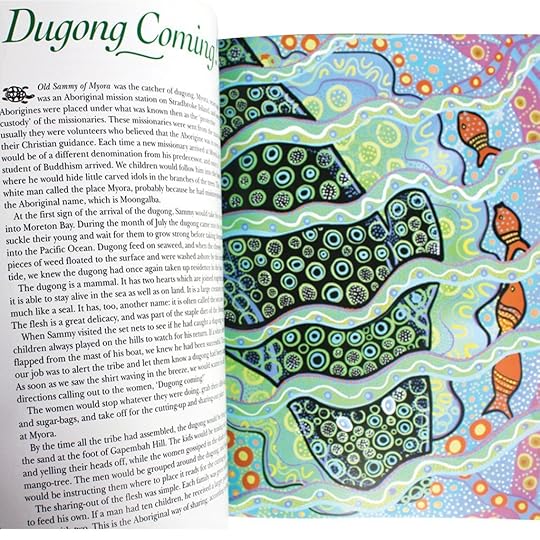
Each story is highlighted by stunning artwork by Bronwyn Bancroft, an Aboriginal artist.
Much like the recently aired and renewed TV show Cleverman, my interest in this derives more from a far too late awareness of indigenous Australia than anything else. This may have also been a factor in the incentive of the 500 GBBW including this, as this work and maybe one or two others are the only representatives of the original inhabitants of an entire continent. As is often the case with a demographic rendered intensely niche by malignant forces, there is a lack of wide variety, and while I've made a concerted effort to broaden and/or avoid weeding my tastes over the years, young adult styled coming of age/mythos short stories are not my strong point. However, even the most simplistic story was extremely informative about either Aboriginal folklore or twentieth century Aboriginal life, which the Goodreads readership at large is in desperate need of acquiring.
I may characterize these stories as young adult, but this is coming from someone for whom the term 'apolitical' is both an impossible entity and a dangerous trap. The first half of the stories dealing with Nunukul's autobiographical fiction don't dance around the realities of settler state life on the side that has been settled, an white parents/teachers/academics will probably shy away from the lack of food, medical care, and environmental justice accorded to the Aboriginal populations of what is popularly known as a continent colonized by criminals. One could try and cut out the first half in favor of the less explicitly political folklore, but even that has a story where Nunukul goes around literally disinterring and reviving her heritage. Take that out in addition, and you're left with a conveniently sized souvenir whose amputations have rendered it all the more easily described as 'quaint', 'surprisingly like our own thinking', and other adjectives that are being applied to the upcoming Moana and all its misbegotten filth of a merchandise. You'd think Disney would know better than to sell someone's skin as a costume. Then again, Pocahontas was a thing that happened.
During one of my job interviews, the employer made a point of saying she encouraged her young students to read foreign fairy tale picture books. My edition of this doesn't have any pictures beyond its illustrated front cover, and the autobiographical shorts with their overtones of marginalization combined with the folklore with its Greek mythology level of adultness will probably pass over the kiddies' heads if they're allowed anywhere near them. However, I'd be more than happy to recommend to an intrepid ninth grader and any of their generation-gap-older cohorts. If schools assign them Oedipus, this is a walk in the age appropriate park.
Stradbroke Dreamtime is a beautifully illustrated collection of stories from author Oodgeroo Noonuccal's childhood as well as stories of Oodgeroo Noonuccal's people in Australia.
I have nothing but praise for the art, which is amazing, and I enjoyed the prose as well. I enjoyed reading of growing up in an Aboriginal family during a time of transition, but felt it would have been better if it had been in its own book separate from the traditional myths. The traditional myths are nicely told but there aren't very many of them. I know there must be more, so why are they not included? And I thought that the author's myth about herself would have made a nice transition from one section to the other, but it wasn't used that way for some reason. I guess this is definitely a good book for getting one interested in Aboriginal culture and myth, but it doesn't really go much further than that.
These are marvellous tales...unique and to the point.
The Myths are revealing how the Aboriginal World came into being and was and is sustained through time. They are not sweet tales. They are rather battles or schemes to outwit one or others who have become traitors to what the Rainbow Serpent has revealed and established.
There is a first set however describing a typical Aboriginal family's daily Life on Stradbroke Island. It is that of the Author, Kath Walker whose Aboriginal name shows a Variety mostly unaccustomed to European ears....Oodgeroo Noonuccal. She has many an amusing story to tell of her parents and her brothers and sisters.
Read at school. This is an absolutely gorgeous book that is as enthralling for the teacher as it is for the kids. The art is exquisite! Highly recommend this for school libraries or for anyone wanting to explore Aboriginal stories written and illustrated by Aborigines.
The author recounts her childhood on Stradbroke Island, off the Australian coast. It's fine, I guess, and the stories are somewhat interesting, but it can get a bit preachy, and historically I don't respond well to that sort of thing. *shudders*
Let's just go with "stunning", shall we? The illustrations by Bronwyn Bancroft are something out of this world, and threaten to overwhelm the text (which is impressive in itself. Bancroft uses traditional desert methods, but non-traditional colours, plus some non-traditional methods, and the result is spectacular. I want to go out and buy this woman's work now. (If, you know, I could afford to invest in artwork.) It is spectacularly fabulous on so *many* levels. (I wish I could try what Bancroft is doing in my own art, but that would be inappropriate. Doesn't stop me wishing.)
The text, too, is something special. The first section of the book contains stories from Oodgeroo Noonuccal's early life on Stradbroke Island. I've been to Stradbroke (only once, and only for a day - I'm one of the white trippers she doesn't like very much) but having been there gave me a sense of connection with what she was saying that I really appreciated.
It wasn't an easy life for her family. That much is abundantly clear. And yet there's love and respect in those stories, too (a link to Secrets of the Red Lantern, which I'm also reading at the moment.
The second section is "Stories from the Old and New Dreamtime". Her story "Oodgeroo" is like to break my heart. To have not only the ability to tell these stories, but the culture in which to form the story... and have it accepted. That's amazing to me. It (once again) reminds me that I really need to go watch Ten Canoes.
This is a beautiful book, and one I am exceedingly glad that I found in the shelves and read. For the pictures alone, for the stories alone: either would have made this magnificent. Together, they are way, way beyond the ordinary.
The first ~half of this book is short stories from Oodgeroo's life growing up on Stradboke Island off the Queensland coast. While the stories are of her childhood, I'm not sure how much children are the target demographic for this book. Maybe older kids?
The second ~half is traditional Aboriginal stories -- many are stories "explaining" the origins of various plants and other natural phenomena.
This book isn't necessarily one you read straight through, though some of the stories reference earlier ones so I would recommend reading in order at least the first time.
While I wasn't particularly engaged by Bronwyn Bancroft's illustrations in her word/counting books, here where she's illustrating scenes rather than simple objects, I was much more engaged.
The contemporary artwork helps hold the book together in a rhythmic and lyrical style. I found the personal stories and Dreamtime stories more engaging than I thought they might. In fact, I couldn't put the book down!
في بداية القرن الحادي والعشرين ظهرت في أستراليا مُؤلفات رائعة للكُتَّاب من أصولٍ( أبروجينيَّة)؛ لقد كتبوا في كل المجالات: الخيال، الواقع، الدراما، التاريخ الفلسفة وغيرها. وكان أوَّل كتاب تم ترجمته إلى البولنديَّة: (زمن الأحلام في جزيرة سترادبروك- "Stradbroke Dreamtime") للكاتبة. Kath Walker - 1977]. ----- (سترادبروك، جزيرة كانت ذات يومٍ مليئة بالجمال الطبيعي، والبحر ينشر رغوته المُتدفِّقة فوق الصُخور الفاتنة، ومياه المُحيط تغسل الرمال المُمتدَّة إلى ما لا نهاية. منذ سنوات قديمة عاشت عائلتي الأصليَّة في هذه الجزيرة، كان ذلك قبل مجيء الباحثين عن المعادن، الذين يدفعهم الجميع لتشويه جمالها وجمال كُلَّ منظرٍ طبيعي. كان أبي يُجهِّز الحصان صباحاً ونشق طريقنا على طول الشاطئ، نتسلَّق التِلال التي تُغطيها أشجار الصنوبر والسنديان وأشجار الصمغ العجيبة. كانت الخيول البريَّة تُراقبنا من مسافاتٍ آمنه؛ لم تثق في الإنسان أبداً، في بعض الأيام كُنا نُشاهد زوارق صيد صغيرة، ويُخبرنا أبي أنَّهم بعض جيراننا يأتون من شمال أستراليا ليمنحهم البحر من خيراته، وكان البحر يهدأ حينما تصل زوارقهم. كان هناك مشهداً واحداً أحببناه. عندما نصل إلى منطقة مُرتفعة عن الشاطئ، نربط حصاننا بعيداً .. وننتتشر خلف الكُثبان الرمليَّة الصغيرة؛ نستلقي على بُطوننا لنتأمَّل حيوانات "النَّواتِيّ" الجميلة نتأمَّل صَرخاتها ونعتقد أنَّها مراكب صغيرة ذات أشرعة كاملة، تُبهرنا ألوانها الأرجوانيَّة، وكُنا نُدرك أن مثل هذه الكائنات الجميلة ستختفي فجأةً وتسقط مثل الحِجارة في قاع البحر. الجزيرة مُختلفة الآن، حضارة الإنسان الجشع طردت هذه الكائنات الجميلة، السيارات تنفث دُخانها فوق الأرض وضجيج الصناعة يدوي في كل مكان. إن جزيرتنا تموت تدريجياً؛ والطيور والحيوانات تُهاجر كل يوم، والأشجار تُهمل حتى تموت. السيَّاح يأتون للاستمتاع بأشعة الشمس والاستحمام في مياه المحيط الزرقاء؛ ينثرون علب السجائر والزُجاجات المُهملة وحتى هياكل السيارات. ما يزال الرجل الجشع - الجاهل - الطائش - الغبي يُواصل اعتداءه على الطبيعة لكنه سيعاني قريباً من هذا التصرُّف. جرافاته القاسية تحفر قبره بهدوء{…. (Kath walker )
I came to read Dreamtime: Aboriginal Stories thanks to my professor, who showed it in class and lent it to me. To be honest, I did not know a lot about the Aboriginal culture, and this book helped a lot with that.
The first section of this book consists of little stories about Oodgeroo's childhood. In these, she relates the aboriginal lifestyle and the prejudices she lived with as a child. I thought this section was very interesting because I could picture better how her growing-up experience was and which things had an impact on that. The second section of this book consists of myths that are part of the Aboriginal culture. These myths tell us about the beginning of life; the emergence of good and evil; and the creation of rivers, mountains, different tree species and much more. I am a big mythology fanatic, so I loved reading, discovering, comparing, and appreciating those myths. Last but not least, Bronwyn Bancroft's art throughout the book is majestic. Her drawings were outstanding and illustrated the tales in a way that somehow enriched them. Basically, they felt as necessary as the text to complete the experience.
To sum it up, Dreamtime: Aboriginal Stories is a beautiful recollection of the art, culture, and experiences of Aboriginal people. If you want to know a bit more about the Aborigines, I think this is a good place to start. I recommend it!
Oodgeroo was an Aboriginal rights activist, poet, veteran, environmentalist and educator. Her father was a Quandamooka man and her mother was of the Peewee clan. In 1964 she became the first published Aboriginal poet in Australia. I highly recommend My People is a compilation of her poetry. Bronwyn Bancroft is a Bundjalung woman and artist. This book was first published in 1972 and its first illustrated edition was in 1993. "Stradbroke Dreaming" contains stories of growing up on Minjerribah (North Stradbroke Island) going crabbing and hunting and being left-handed in a school system that didn't allow it. There is a story about a carpet snake they had as a pet. Her mother didn't like the snake as it took eggs from the hens but it was her dad's totem, and her totem also, so they couldn't do anything to it. As well as stories of growing up there are 14 stories of the "Old and New Dreamtime". What is powerful in this is that we hear the stories of Oodgeroo as a girl, stories that are easy to relate to and that could be happening now. I find her stories more compelling than the "dreamtime" stories but having them in the same book gives us insight into Oodgeroo's storytelling in a couple of genres. The illustrations are vibrant and engaging. The edition I have has glossy pages all the way through and it's a delight to browse through.
A fascinating illustrated text, presented in portrait format with aboriginal-stylised paintings and patterns, Stradbroke Dreamtime is a book of two halves. Penned by Oodgeroo, a name given to her by the Nukukul tribe, the first half is autobiographical and sees the author (then known as Kath Walker) reflect on her time on the island under the guidance and tutelage of her aboriginal father who shows her the cultures and customs of their heritage. The second is a retelling of the myths that Oodgeroo has inherited.
I enjoyed both halves equally. Her childhood stories did much to highlight the oppression and devastation that colonialism brought with it but there are moments of humour and warmth here too. Stradbroke island itself is alive, in memory, with the flora and fauna of the land. The myths themselves were written well - you could hear them being told rather than read aloud which I felt was far more in the spirit of what all traditional tales should set out to achieve.
I'm not sure why it's considered a children's book save for the fact that these are memories of her childhood and although there is much here that a young reader will enjoy (all of it, in fact) it felt like its audience was rather nebulous.
This little book is divided into two halves. The first half is a collection of anecdotes from Oodgeroo Noonuccal's childhood on Stradbroke Island. The second half is a collection of Aboriginal myths. I found the childhood anecdotes far more interesting than the myths which, though quite complex and varied, lacked the warmth and spontaneity of the childhood stories. Taken all together, it is an interesting and rather charming book.
Lovely anecdotes from Oodgeroo Noonuccal’s childhood with her family on Stradbroke Island. And some little folk tales about plants and animals in Queensland. The illustrations are beautiful. I wish there were more stories in this book. A good book to read to children.