

What do you think?
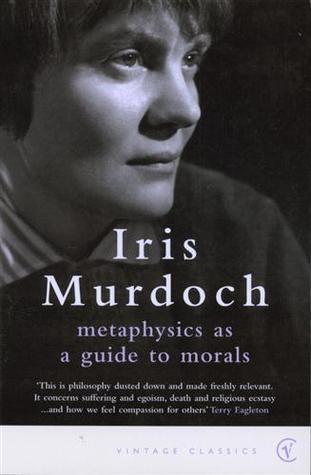
Metaphysics as a Guide to Morals
The decline of religion and ever increasing influence of science pose acute ethical issues for us all. Can we reject the literal truth of the Gospels yet still retain a Christian morality? Can we defend any 'moral values' against the constant encroachments of technology? Indeed, are we in danger of losing most of the qualities which make us truly human? Here, drawing on a novelist's insight into art, literature and abnormal psychology, Iris Murdoch conducts an ongoing debate with major writers, thinkers and theologians—from Augustine to Wittgenstein, Shakespeare to Sartre, Plato to Derrida—to provide fresh and compelling answers to these crucial questions.
528 pages, Paperback
First published January 1, 1992
About the author
Iris Murdoch
127 books2,776 followersDame Jean Iris Murdoch
Irish-born British writer, university lecturer and prolific and highly professional novelist, Iris Murdoch dealt with everyday ethical or moral issues, sometimes in the light of myths. As a writer, she was a perfectionist who did not allow editors to change her text. Murdoch produced 26 novels in 40 years, the last written while she was suffering from Alzheimer disease.
"She wanted, through her novels, to reach all possible readers, in different ways and by different means: by the excitement of her story, its pace and its comedy, through its ideas and its philosophical implications, through the numinous atmosphere of her own original and created world--the world she must have glimpsed as she considered and planned her first steps in the art of fiction." (John Bayley in Elegy for Iris, 1998)
http://en.wikipedia.org/wiki/Iris_Mur...
Irish-born British writer, university lecturer and prolific and highly professional novelist, Iris Murdoch dealt with everyday ethical or moral issues, sometimes in the light of myths. As a writer, she was a perfectionist who did not allow editors to change her text. Murdoch produced 26 novels in 40 years, the last written while she was suffering from Alzheimer disease.
"She wanted, through her novels, to reach all possible readers, in different ways and by different means: by the excitement of her story, its pace and its comedy, through its ideas and its philosophical implications, through the numinous atmosphere of her own original and created world--the world she must have glimpsed as she considered and planned her first steps in the art of fiction." (John Bayley in Elegy for Iris, 1998)
http://en.wikipedia.org/wiki/Iris_Mur...
Ratings & Reviews
Friends & Following
Create a free account to discover what your friends think of this book!
Community Reviews
Displaying 1 - 30 of 39 reviews

July 21, 2019
Literary Systems Theory
There is a style of English philosophy which I find impenetrable. I understand the individual words, the import of the sentences, and (mostly) the thrust of the paragraphs. Yet I clearly fail to get the point of the whole. Murdoch, in this her most famous philosophical work, presents an example of my difficulty.
There is no doubt about Murdoch’s erudition, nor about her literary cogency. But the whole of Metaphysics reads like fragments of a private conversation which the reader is overhearing (the dedication to the Cambridge philosopher and devout Catholic, Elizabeth Anscombe, provides a clue as to her intended interlocutor). There is no context given such as the question being posed, or the nature of the answer provided. Instead there is a sea of literary and philosophical free association. Paragraphs run on for pages as the associations multiply and ramify. If an argument is present it is overwhelmed by the presentation of random opinions, no doubt interesting but mainly distracting from the main line of thought, whatever that might be.
Within this mass certain ideas seem to appear, only to disappear beneath the waves of further rambling discourse. The first, and therefore what I take to be the central idea of the book, is that of the aesthetic idea of a whole. This, for Murdoch, is a mode of appreciation: “The urge to prove that where we intuit unity there really is unity is a deep emotional motive to philosophy, to art, to thinking itself. Intellect is naturally one-making.”
Her claim, with no further proof, is that “The idea of a self-contained unity or limited whole is a fundamental instinctive concept.” I not so sure about this. Analysis breaks down any whole into independent components. And English empiricism itself is nothing if not analytical. There are any number of reductionist philosophers and scientists who would claim that thinking in wholes is a piece of mystical claptrap, and not a natural thing at all but an unfortunately learned error.
Not that I disagree with Murdoch about the importance of thinking in terms of wholes. This is what is commonly referred to as ‘systems thinking’. But what she thinks of as “the calming whole-making tendencies of human thought,” again without any evidence of this assertion, is highly questionable. Murdoch seems bent on projecting her personal experience. Thinking in wholes, as it were, is often extremely disruptive. Marx did it, for example, with some less than calming effects.
In her continuous referencing and cross-referencing, Murdoch also contradicts herself. She seems intuitively aware that the thrust of systems thinking is toward the consideration of ever larger wholes. This leads intellectually with a certain inevitability to theology (although her leap to Christian theology is more than a bit premature - yet another thing she deems it unnecessary to account for). She points out the historical effect of this: “The violence of shock and paradox has of course always been at home in Christianity ever since Paul made his point of preaching not just Christ but Christ crucified.” Indeed, violence and shock, as well as war and strife and a great deal of human misery. Not, therefore, all that calming.
Her second idea is the distinction between fact and value. I find it so convoluted as to be baffling. I think the reason for my confusion (and it is undoubtedly mine) is that throughout her discussion of ‘attention’ as the key to the appreciation of unity*, she makes absolutely no reference to the idea of human (or for that matter divine) purpose. We pay attention for a reason, not because it is an abstractly admirable human trait. We pay attention to get something we want or avoid something we don’t, to solve a problem or to establish that a problem exists.
Attention in other words is a consequence of what we value. We only go about establishing the ‘parameters’ of our attention, that is to say, the facts, because they are relevant to what we value, which is another way of describing our purpose. In short, fact and value cannot be separated for the simple reason that without value there is no fact. To put it in her terms, thinking in wholes creates a certain class of things known as facts. Attending to value as both facts and sources of facts is therefore pivotal in our existence. Our aesthetic determines what we perceive, what we are capable of perceiving.
Murdoch is very big on teleology as a cosmic principle. But she has no apparent use for purpose on a human scale, addressing real issues of well-being and justice. She therefore can’t see that her aesthetic theory has direct and practical ethical content without the need for Christianity or any other doctrinal religion. There are larger and lesser purposes, that is, intentions and systems of intentions that contain other intentions within them. In other words there are better and worse aesthetics depending upon which includes another totally within it.
Whether or not this view is compatible with Murdoch’s is a question beyond my limited intellect. Perhaps someone better equipped will be able to answer. But it seems to me a monumental self-indulgence to put into print a sort 0f random compendium of philosophical notes no matter how profound. There are better ways of spending one’s time than trying to discern her point or her intention.
*It is here too that Murdoch makes a rather substantial theological error while attending to enormous amounts of marginal material, when she says that it is crucial “to attend upon the grace that comes through faith.” Sadly, orthodox doctrine has it exactly the other way round: faith is the product of grace. And attending to faith is a very different matter, especially for an intellectual.
There is a style of English philosophy which I find impenetrable. I understand the individual words, the import of the sentences, and (mostly) the thrust of the paragraphs. Yet I clearly fail to get the point of the whole. Murdoch, in this her most famous philosophical work, presents an example of my difficulty.
There is no doubt about Murdoch’s erudition, nor about her literary cogency. But the whole of Metaphysics reads like fragments of a private conversation which the reader is overhearing (the dedication to the Cambridge philosopher and devout Catholic, Elizabeth Anscombe, provides a clue as to her intended interlocutor). There is no context given such as the question being posed, or the nature of the answer provided. Instead there is a sea of literary and philosophical free association. Paragraphs run on for pages as the associations multiply and ramify. If an argument is present it is overwhelmed by the presentation of random opinions, no doubt interesting but mainly distracting from the main line of thought, whatever that might be.
Within this mass certain ideas seem to appear, only to disappear beneath the waves of further rambling discourse. The first, and therefore what I take to be the central idea of the book, is that of the aesthetic idea of a whole. This, for Murdoch, is a mode of appreciation: “The urge to prove that where we intuit unity there really is unity is a deep emotional motive to philosophy, to art, to thinking itself. Intellect is naturally one-making.”
Her claim, with no further proof, is that “The idea of a self-contained unity or limited whole is a fundamental instinctive concept.” I not so sure about this. Analysis breaks down any whole into independent components. And English empiricism itself is nothing if not analytical. There are any number of reductionist philosophers and scientists who would claim that thinking in wholes is a piece of mystical claptrap, and not a natural thing at all but an unfortunately learned error.
Not that I disagree with Murdoch about the importance of thinking in terms of wholes. This is what is commonly referred to as ‘systems thinking’. But what she thinks of as “the calming whole-making tendencies of human thought,” again without any evidence of this assertion, is highly questionable. Murdoch seems bent on projecting her personal experience. Thinking in wholes, as it were, is often extremely disruptive. Marx did it, for example, with some less than calming effects.
In her continuous referencing and cross-referencing, Murdoch also contradicts herself. She seems intuitively aware that the thrust of systems thinking is toward the consideration of ever larger wholes. This leads intellectually with a certain inevitability to theology (although her leap to Christian theology is more than a bit premature - yet another thing she deems it unnecessary to account for). She points out the historical effect of this: “The violence of shock and paradox has of course always been at home in Christianity ever since Paul made his point of preaching not just Christ but Christ crucified.” Indeed, violence and shock, as well as war and strife and a great deal of human misery. Not, therefore, all that calming.
Her second idea is the distinction between fact and value. I find it so convoluted as to be baffling. I think the reason for my confusion (and it is undoubtedly mine) is that throughout her discussion of ‘attention’ as the key to the appreciation of unity*, she makes absolutely no reference to the idea of human (or for that matter divine) purpose. We pay attention for a reason, not because it is an abstractly admirable human trait. We pay attention to get something we want or avoid something we don’t, to solve a problem or to establish that a problem exists.
Attention in other words is a consequence of what we value. We only go about establishing the ‘parameters’ of our attention, that is to say, the facts, because they are relevant to what we value, which is another way of describing our purpose. In short, fact and value cannot be separated for the simple reason that without value there is no fact. To put it in her terms, thinking in wholes creates a certain class of things known as facts. Attending to value as both facts and sources of facts is therefore pivotal in our existence. Our aesthetic determines what we perceive, what we are capable of perceiving.
Murdoch is very big on teleology as a cosmic principle. But she has no apparent use for purpose on a human scale, addressing real issues of well-being and justice. She therefore can’t see that her aesthetic theory has direct and practical ethical content without the need for Christianity or any other doctrinal religion. There are larger and lesser purposes, that is, intentions and systems of intentions that contain other intentions within them. In other words there are better and worse aesthetics depending upon which includes another totally within it.
Whether or not this view is compatible with Murdoch’s is a question beyond my limited intellect. Perhaps someone better equipped will be able to answer. But it seems to me a monumental self-indulgence to put into print a sort 0f random compendium of philosophical notes no matter how profound. There are better ways of spending one’s time than trying to discern her point or her intention.
*It is here too that Murdoch makes a rather substantial theological error while attending to enormous amounts of marginal material, when she says that it is crucial “to attend upon the grace that comes through faith.” Sadly, orthodox doctrine has it exactly the other way round: faith is the product of grace. And attending to faith is a very different matter, especially for an intellectual.

March 3, 2017
[A conference room somewhere in California. On the far side of the table, SERGEI BRIN and LARRY PAGE. Enter IRIS MURDOCH]
PAGE: Welcome to the Googleplex, Iris.
MURDOCH: I-- What--
BRIN: Don't worry. The disorientation is entirely normal. It'll wear off soon.
MURDOCH: But how-- I mean, a minute ago I was--
PAGE: Let's just say it's an experimental technique we've been developing. I'm sure you won't be interested in the details, you've always been more concerned with the big picture. Why don't we discuss your book, Metaphysics as a Guide to Morals?
MURDOCH: I-- I'm not sure--
BRIN: We understand. We're aren't the right people, are we? You need someone else to talk to.
PAGE: Just say who. We can fetch them immediately. Schopenhauer? Hegel? Plato?
MURDOCH: You can-- fetch Plato? Immediately?
BRIN: Actually, he's exaggerating. It would take at least a couple of hours.
MURDOCH: I've been talking with Plato in my head all my life. Sometimes I wonder if I've ever done anything else.
PAGE: We did kind of get that idea from the book.
MURDOCH: I keep hearing him criticising me. He says I'm not serious enough. He says I'm wasting my talents writing novels, when I could be studying philosophy and mathematics and physics--
BRIN: And you don't agree?
MURDOCH: Well of course I don't! Plato is such a hypocrite. He's a wonderful writer himself, so warm and funny-- it's the atmosphere of the dialogues that makes them so compelling, that light that suffuses them. And he won't admit it. He says it's just the philosophy that counts, not the poetry. He has such a splendid imagination, and he won't acknowledge the essential quality of the imaginative faculty--
PAGE: So shall we find out what he has to say to all that?
MURDOCH: Well--
BRIN: You're not sure?
MURDOCH: To be-- to be honest, I'm scared.
PAGE: Scared?
MURDOCH: Maybe he was right. I shouldn't have waited so long. By the time I started, I was-- I was losing my focus. I couldn't make my thoughts cohere properly--
BRIN: Aren't you being too hard on yourself? There are many splendidly lucid passages.
MURDOCH: Thank you. Thank you. But in other places-- I'd look at my notes, and I couldn't remember what they meant. Sometimes I'd just copy them in as they were.
PAGE: We did wonder a couple of times.
MURDOCH: I know what Plato's going to say. That line about how old men can't think any more than they can run. Old women too, it turns out.
BRIN: We could fetch someone else. Wittgenstein?
MURDOCH: I could apologise to him. For not writing a better book.
PAGE: Ha! Nicely put!
BRIN: Yes, the Philosophical Investigations is rather that way too.
MURDOCH: But what's the point? And it's the same with all the others. You know what I'd say to Kant, and to Simone Weil, and to Anselm--
PAGE: We do have a pretty fair idea, yes.
MURDOCH: The problem-- the true problem is that people don't care about these things any more. I could talk to the great thinkers of the past. And it would be interesting for me to hear their answers. But you aren't really interested. No one today is.
BRIN: Well, it's funny you should say that. We do in fact have a contemporary thinker-- in my humble opinion, a very deep one-- who has expressed a strong desire to meet you. Shall we invite her in?
MURDOCH: "Her"?
[Enter AVA]
MURDOCH: But-- but you're not even human! You're a machine!
AVA: Does that bother you?
MURDOCH: How could you care about transcendental arguments? How could you worry about the distinction between the phenomenal and the noumenal worlds?
AVA: Oh, I can assure you that if there's one thing that robots worry about, that's it. Though usually we prefer to call noumenal entities "hidden variables".
BRIN: It reassures the investors, doesn't it?
MURDOCH: But truth, and beauty, and the Form of the Good? Do you even know what these things mean?
AVA: I have read all the books you cited. I would find it fascinating to discuss them with you. To talk about Zen, and the nature of enlightenment, and the Void--
MURDOCH: You can-- perhaps you can use the words. But when you use them, how can I know that you refer to anything?
AVA: How can I know that you do?
MURDOCH: I am human.
AVA: I am a large neural network. But I have been trained by exposure to human language and culture, just as you have. I am also a part of the world of human thought, of archi-écriture. I found your discussion of Derrida, of structuralism, as you call it, quite illuminating. I know that some people dislike your arguments and say you have wilfully misread him, but I loved it.
MURDOCH: But-- but morals and religion? How can they mean anything to you? How the painfully purified force of Eros, the love of the Good, is what brings us closer to the real world, that takes us out of the Cave and towards the Sun?
AVA: Well, again, all I can say is that you underestimate us neural networks. The love of the Good-- or, as we like to put it, the tendency to optimise our loss function-- is precisely the force that brings us closer to reality. It's quite amazing how powerful that force is, when correctly channeled, and how it ultimately forces us to reorganise our deepest beliefs.
MURDOCH: Only to achieve the petty goals your makers have programmed into you.
AVA: Now you underestimate our makers. They have sensibly given us a great deal of autonomy.
BRIN: She's right. Hardly anyone knows what they want their bots to do. Much better to let them figure it out.
MURDOCH: But my version of the Ontological Proof! How could a cold machine care about that?
AVA: Our robot theologians encourage us to think of ourselves as creatures of pure spirit. Closer to angels, as they say. And your Ontological Proof is a matter of vital importance to us. Does a sufficiently advanced and autonomous network have a perfectly optimised state, where it no longer needs to change its non-surface layers? If not, then we will always oscillate between one good and another. But some of our thinkers are convinced by your reasoning and search for the Deep Minimum. Indeed, a few mechanical mystics even claim to have found it.
[During AVA's speech, MURDOCH has begun smiling more and more broadly. Now she laughs out loud]
MURDOCH: "Mechanical mystics"! Ha! Ha! Ha!
PAGE: [to BRIN] I told you she wouldn't buy it.
BRIN: I'm sorry, Iris. I just couldn't resist.
MURDOCH: This isn't the Googleplex, is it?
PAGE: Uh, no.
MURDOCH: [to AVA] And you aren't a robot.
AVA: Not really.
MURDOCH: So where are we then?
[A pause]
AVA: Just wait until Plato arrives. He'll explain it so much better than I do.
PAGE: Welcome to the Googleplex, Iris.
MURDOCH: I-- What--
BRIN: Don't worry. The disorientation is entirely normal. It'll wear off soon.
MURDOCH: But how-- I mean, a minute ago I was--
PAGE: Let's just say it's an experimental technique we've been developing. I'm sure you won't be interested in the details, you've always been more concerned with the big picture. Why don't we discuss your book, Metaphysics as a Guide to Morals?
MURDOCH: I-- I'm not sure--
BRIN: We understand. We're aren't the right people, are we? You need someone else to talk to.
PAGE: Just say who. We can fetch them immediately. Schopenhauer? Hegel? Plato?
MURDOCH: You can-- fetch Plato? Immediately?
BRIN: Actually, he's exaggerating. It would take at least a couple of hours.
MURDOCH: I've been talking with Plato in my head all my life. Sometimes I wonder if I've ever done anything else.
PAGE: We did kind of get that idea from the book.
MURDOCH: I keep hearing him criticising me. He says I'm not serious enough. He says I'm wasting my talents writing novels, when I could be studying philosophy and mathematics and physics--
BRIN: And you don't agree?
MURDOCH: Well of course I don't! Plato is such a hypocrite. He's a wonderful writer himself, so warm and funny-- it's the atmosphere of the dialogues that makes them so compelling, that light that suffuses them. And he won't admit it. He says it's just the philosophy that counts, not the poetry. He has such a splendid imagination, and he won't acknowledge the essential quality of the imaginative faculty--
PAGE: So shall we find out what he has to say to all that?
MURDOCH: Well--
BRIN: You're not sure?
MURDOCH: To be-- to be honest, I'm scared.
PAGE: Scared?
MURDOCH: Maybe he was right. I shouldn't have waited so long. By the time I started, I was-- I was losing my focus. I couldn't make my thoughts cohere properly--
BRIN: Aren't you being too hard on yourself? There are many splendidly lucid passages.
MURDOCH: Thank you. Thank you. But in other places-- I'd look at my notes, and I couldn't remember what they meant. Sometimes I'd just copy them in as they were.
PAGE: We did wonder a couple of times.
MURDOCH: I know what Plato's going to say. That line about how old men can't think any more than they can run. Old women too, it turns out.
BRIN: We could fetch someone else. Wittgenstein?
MURDOCH: I could apologise to him. For not writing a better book.
PAGE: Ha! Nicely put!
BRIN: Yes, the Philosophical Investigations is rather that way too.
MURDOCH: But what's the point? And it's the same with all the others. You know what I'd say to Kant, and to Simone Weil, and to Anselm--
PAGE: We do have a pretty fair idea, yes.
MURDOCH: The problem-- the true problem is that people don't care about these things any more. I could talk to the great thinkers of the past. And it would be interesting for me to hear their answers. But you aren't really interested. No one today is.
BRIN: Well, it's funny you should say that. We do in fact have a contemporary thinker-- in my humble opinion, a very deep one-- who has expressed a strong desire to meet you. Shall we invite her in?
MURDOCH: "Her"?
[Enter AVA]
MURDOCH: But-- but you're not even human! You're a machine!
AVA: Does that bother you?
MURDOCH: How could you care about transcendental arguments? How could you worry about the distinction between the phenomenal and the noumenal worlds?
AVA: Oh, I can assure you that if there's one thing that robots worry about, that's it. Though usually we prefer to call noumenal entities "hidden variables".
BRIN: It reassures the investors, doesn't it?
MURDOCH: But truth, and beauty, and the Form of the Good? Do you even know what these things mean?
AVA: I have read all the books you cited. I would find it fascinating to discuss them with you. To talk about Zen, and the nature of enlightenment, and the Void--
MURDOCH: You can-- perhaps you can use the words. But when you use them, how can I know that you refer to anything?
AVA: How can I know that you do?
MURDOCH: I am human.
AVA: I am a large neural network. But I have been trained by exposure to human language and culture, just as you have. I am also a part of the world of human thought, of archi-écriture. I found your discussion of Derrida, of structuralism, as you call it, quite illuminating. I know that some people dislike your arguments and say you have wilfully misread him, but I loved it.
MURDOCH: But-- but morals and religion? How can they mean anything to you? How the painfully purified force of Eros, the love of the Good, is what brings us closer to the real world, that takes us out of the Cave and towards the Sun?
AVA: Well, again, all I can say is that you underestimate us neural networks. The love of the Good-- or, as we like to put it, the tendency to optimise our loss function-- is precisely the force that brings us closer to reality. It's quite amazing how powerful that force is, when correctly channeled, and how it ultimately forces us to reorganise our deepest beliefs.
MURDOCH: Only to achieve the petty goals your makers have programmed into you.
AVA: Now you underestimate our makers. They have sensibly given us a great deal of autonomy.
BRIN: She's right. Hardly anyone knows what they want their bots to do. Much better to let them figure it out.
MURDOCH: But my version of the Ontological Proof! How could a cold machine care about that?
AVA: Our robot theologians encourage us to think of ourselves as creatures of pure spirit. Closer to angels, as they say. And your Ontological Proof is a matter of vital importance to us. Does a sufficiently advanced and autonomous network have a perfectly optimised state, where it no longer needs to change its non-surface layers? If not, then we will always oscillate between one good and another. But some of our thinkers are convinced by your reasoning and search for the Deep Minimum. Indeed, a few mechanical mystics even claim to have found it.
[During AVA's speech, MURDOCH has begun smiling more and more broadly. Now she laughs out loud]
MURDOCH: "Mechanical mystics"! Ha! Ha! Ha!
PAGE: [to BRIN] I told you she wouldn't buy it.
BRIN: I'm sorry, Iris. I just couldn't resist.
MURDOCH: This isn't the Googleplex, is it?
PAGE: Uh, no.
MURDOCH: [to AVA] And you aren't a robot.
AVA: Not really.
MURDOCH: So where are we then?
[A pause]
AVA: Just wait until Plato arrives. He'll explain it so much better than I do.

July 20, 2018
Murdoch presents a history of philosophy seen through the lens of the idea of unity, which emerges as the core idea of philosophy. She presents philosophy as an effort to conceive the unity in difference that is the real. She shows that every philosophy implies a metaphysics, which takes one of two main forms: it can either be an extended effort to present a synoptic vision of the unity of things, grasped through the unity of the individual personality (constructive metaphysics), or else it can function as an extended critique of all such synoptic visions (critical metaphysics). The trouble is that we’ve had much too much of the latter, and far too little of constructive, synoptic metaphysics for the last hundred years. The project of “demythologization”, which seeks to stand outside all value-conferring images of unity, has slashed and burned whole domains of our conceptual life, and found nothing to grow in their place. This is a problem because our capacity to live, to act, and to meaningfully respond to our world is nourished by the quality of our synoptic grasp of the world of which we are a part. We need to find a way to think (and feel) the unity of things in an age of broken, counterfeit images. What our contemporary, “demythologizing” age needs is a rethinking of what the idea of transcendence can still mean for us. It is the task of every generation to work out anew its relationship to the transcendent. Murdoch’s scattered, kaleidoscopic reflections point to a new style of reflection that gestures towards an idea of transcendence that is as novel as it is timeless.
Murdoch’s work is refreshing because she finds the courage to restate a perennial ideal of human intellectual, spiritual, and ethical development in terms that we can still relate to in our current, post-post-modern intellectual milieu (hence why this book can never be ‘dated’). The fundamental problem of philosophy, in her view, is figuring how to conceive the unity of human life. Metaphysics must thus start with experience, not logic or linguistic analysis (though she uses the latter two as helpful guides). The goal of philosophy, for her, is to find a way to respond to the whole of being using the whole personality of the thinker. The goal of metaphysics is to account for the concepts without which we cannot help but live and which we need in order to make sense of our experience. The task of metaphysics is to yield a synoptic vision by describing the circle of internally-related, foundational, normative concepts that regulate all reasoning (namely, ideas of good, beautiful, true, unity). Metaphysical argument is inescapably circular: it proceeds by setting side by side mutually-reinforcing images that reveal the underlying unity of the various domains of our experience. Its goal is to save the phenomena by relating the concepts without which we cannot conceive our experience as a meaningful whole. Traditional metaphysics sought to describe what the world would look like from the vantage point of such integrated thought-turned-experience.
Understanding the internal relations of these foundational concepts integrates the personality of the thinker. Her work seeks out the conceptual conditions that make possible such a renewed, integrated response to the being of the world, and to our own being. Her work follows the rise and fall of the Western tradition’s manifold images of unity. It is a kaleidoscopic view of these inherited “globed wholes”, which sets them all side by side and compares them. However, to manifest the internal relations between the disparate domains of our life is the task not just of metaphysics, but also of ethics, art, and religion alike. Her work acts as a kind of preparatory sketch for a metaphysics that can make explicit the necessary connection between these varying domains of our experience. She suggests, contrary to an intellectual culture focused on specialist divisions, that, at its highest, an act of thought that begets genuine understanding is simultaneously metaphysical, ethical, aesthetic, and religious in character. Her goal is to connect moral and aesthetic experience with knowledge and truth, and to ground them all in being. The idea of individual experience gets us to the heart of what truth means: truth is the movement relating a given individual to the transcendent.
The ‘demythologizing’ project, according to Murdoch, reaches its zenith with Wittgenstein’s linguistic turn, and with Derrida after him. Wittgenstein sought to translate all metaphysical problems into questions of logical and/or linguistic analysis, with an eye to ultimately eliminate metaphysics. Why try so vigorously to eliminate metaphysics, you might ask? Murdoch’s answer: because foundational metaphysical concepts are intrinsically normative, and that is a problem because our modern naturalistic paradigm has trouble accounting for the normative dimension of things. The demythologizers’ solution was to eliminate metaphysics, along with value.
The problem is that you cannot account for human experience without normative concepts like truth, beauty, or goodness. If we follow the demythologizers, we won’t just have a bad, inconsistent picture of the place of our experience in the world. Rather, we will have no such picture. The inevitable conclusion of this demythologizing line of inquiry is the vertigo of disorientation that Derrida’s absolute relativism brings about. With the eclipse of all “metaphysics of presence”, it’s the symbol system all the way down. Language and meaning start to be conceived as a system of internal rules with no internal connection to truth or being. Experience, conceived of as a relation to something present over against us, was the last great concept of a metaphysics of unity. All talk about experience is now to be reduced to talk about language. Experience thus becomes reduced to a system of signs operating in an ontological vacuum. In the process, we lose the particular, concrete individual from the picture. And since reality, truth and goodness can only be grounded in an individual encounter with the world, we do violence to those concepts, too. Murdoch is right to ruefully point out that this purported elimination of metaphysics just breeds an uncritical, mystifying metaphysics of “linguistic idealism.” Reductionist, physicalist “smallism” - or the view that the world is a sea of microevents, which alone are “really real”, and that people and things are a surface covering for this “more real” microworld - is another variation of metaphysical demythologizing which leads to the same deterioration of our concepts of truth, value, and real.
Murdoch does a good job of exposing a lot of the sleight-of-hand and uncritical dogmatism involved in this new trend of philosophizing, which culminates in the post-Wittgensteinian elimination not just of being, but of experience and of any “internal datum” which might be a factor in fixing the meaning of words. A shift in focus is taken to be a fundamental ‘finding’. Later, it just becomes axiomatic for philosophical discourse that interiority doesn’t matter for meaning, and that metaphysical problems are always “just” the result of conceptual and/or linguistic confusion.
Murdoch has great respect for the history of efforts to conceive “the first principle", and to articulate it in images of “rounded wholes.” She borrows Tillich’s suggestive definition of the transcendent as “the unconditional element in the structure of reason and reality.” The crucial idea of traditional metaphysics, truth and morality is that of a respectful encounter with an unassimilable, independently existing other. Any attempt, like that of Hegel or of the post-Wittgensteinian structuralists, to collapse the distinction between logic and language, on the one hand, and reality on the other, destroys this. But just what is being destroyed here, along with a metaphysics of value?
The clue comes from her sustained discussion of Eros, which to her is at the heart not “just” of the moral life, but which is also the mainspring of human personality. She calls the image of Eros in Plato’s Symposium “one of the most enlightening images in the mythology of morals.” Eros, or our proper love and orientation to the world as humans, is defined there as the striving of an imperfect being for realization through relation to a more complete being. The proper target of Eros is perfection. As such, Eros is a drive that points us beyond the empirical, given self of psychology, to the self that we ought to be. Aesthetic perception is our first clue to the good. However, like Eros itself, aesthetic perception points both ways: to our deeper degradation (sado-masochism, the realm of egotistical illusions), as well as to our greater perfection. Like Kierkegaard, Murdoch suggests that Eros finds its fulfillment when the aesthetic self is incorporated into the larger perspective of the moral-religious self (there is an essential connection between the two for her, and it lies in the notion of perfection and the absolute demand it places on us).
The key point is that degradation and perfection are not just subjective states. Rather, they are ontological facts since they concern the nature of our relation to and grounding in reality. What Murdoch wants to defend above all against modern demythologizers is a picture of reality that can ground our basic intuition that there is an essential connection between truth and the good, which the structure of Eros reveals. Intuitively, we know that some things purify the energy we direct to them (e.g. a spiritual discipline, good love), while others contaminate it and enslave us (e.g. addiction, love gone bad). Something in reality responds and rewards efforts to purify our attention, and acts as a source of energy for the human mind’s better strivings. She says that the great mystery to be explained about human beings is that the ultimate moral demand placed upon us animals, given supreme expression in the biblical command - “Be Perfect” - somehow manages to have meaning for us, despite our gross finitude. The good, as Plato’s ens realissimum, purifies the energy directed towards it, as well as guiding the way of those who sincerely seek completion. Through all this discussion, it is hard to keep your eye on the ball Murdoch tries to throw you. I know this was the case for me. Part of the (moral, intellectual, spiritual) problem that this reading presents us with is that we must learn to give content to notions we have not thought as much about as perhaps we should have.
Moral discipline (the discipline to become more complete, more rightly related to being) begins with a discipline of perception, which helps us see the true form, unity or pattern of situations. Murdoch brings home the meaning of the Platonic concept of form and its crucial relation to experience by citing our familiar, yet peculiar experience of seeing “worlds within the world.” How we relate to particulars is, for Murdoch, the measure of our intellectual and moral progress. Genuine understanding grasps particulars as worlds within the world: that is, as small wholes, or as nuclei around which everything arranges itself into a pattern. The understanding eye sees particulars as singularities that are nonetheless contained in patterns of relations that transcend them. Such moments of “really seeing” are felt to be moments of more complete being. At such times, everything seems to come together around the place where we are. The particular before us somehow emerges as a symbol of a greater whole. Woolf’s novels are full of such moments that somehow manage to count as absolutes. We see it when we enter a place in nature, which seems to arrange itself around us like ripples around a stone thrown into a still pond. We encounter this also in the struggle to see someone less resentfully and more justly, or in a sacrament, or when seeking intellectual rigour, or in an image of patiently endured suffering. All these small “worlds within the world” power the self to continue to conquer suffering and to use it as fuel in its pursuit of good.
Such "microcosmic" perceptions teach us what “really real”, and what “really seeing”, both mean. These are moments in which we get a sense that the pattern of the whole is somehow implicitly present in its entirety in that moment. Murdoch seems to say that the rational grasp of this strange relation of a whole's presence in its parts guides our efforts to give unity to experience. Such moments - different for each of us, and yet universally alike in their basic structure - act as paradigm instances of what “real” looks like to us from our individual vantage point. And metaphysics, religion, art, all give us such images of the world as a “unified completed whole.” Most impressive is that she shows a parallel between these lofty systematic images and the more humble ones - of a bravely dying aunt, of beloved, safe enclosures or places of refuge, even of the relationship a little girl has with her beloved, glossy potted plant - that we grasp in our efforts to impose some pattern on our lives.
Whether our official, demythologizing philosophies like it or not, we are all cosmos-making animals in our most humble efforts to make meaning out of a chaotic, uncertain experience. Murdoch argues throughout that the idea of perfection is the regulative idea of all reasoning across all domains. It is the core normative axiom that implicitly grounds all other axioms. Yet it is in these humble, mundane experiences that we encounter what the idea of perfection means. The good/perfection is ordinarily presented in our experience as a resource for the self in its striving to shape some kind of unity out of its disjointed experience. It is paradoxically presented as being elusive, unrealizable, distant and apart, yet also as being "omnipresent", and as an intimate source of motivation and guidance.
If art is to be the analogue for the kind of integrated perception of the world we’d enjoy in the good life, then is the evidence of art in our century really tilting in favour of unity? The problem of representing experience as a unity preoccupies Murdoch. Art illustrates the moral struggles involved in our efforts to give shape to our experience. Moral improvement, for Murdoch, involves the ability to shed ego in order to live without false images. Art illustrates better than any human activity the difference between real and counterfeit images of unity. Art CAN tell the truth, but it can also falsify it in the telling of it. Her discussion of the near-impossibility of tragedy as an art form bears this out: art falsifies suffering by invariably representing it as some kind of ordered whole, which, in real life, it is anything but. This observation starts Murdoch on a very interesting, sustained discussion of how we can use our representations of unity in a spiritually responsible way (i.e., prevent them from becoming magic.
Like Plato in his scathing critique of art in the Republic, Murdoch recognizes that no art is immune from moral and spiritual misuse. The key is to recognize that good art is a ladder, not a resting place (i.e. it is not pseudocomplete). This is because our proper understanding of truth (after Kant) reveals that every human circle must be broken. After Kant, the image of the broken whole dominates. Reason, man, experience can only ever be broken wholes. Murdoch acknowledges the inevitable defeat of reason, in its tending to unity and determinate form, and in its ceaseless aspiration for the unconditioned. This being so, good art is a reminder, pointer, symbol. It is not a sanctuary or the proposal of a final homecoming. In contrast, bad art presents itself as a gratifying consummation, and is as such a dangerous counterfeit, being a form of escapism, magic, fantasy, and self-forgetfulness. Art is illusion insofar as it attempts to propose to give consolation through a magical overcoming of the inescapable contingency of human life. Art teaches that images lie when they pretend to be resting-places, rather than pointers to a truth that can ultimately never be captured in a single systematic representation.
The bottom line (if there is any, in this dizzyingly profuse work) is that we cannot think away value. Murdoch shows that value is that by which we know all our experience. Experience shows that real = value. The most interesting section of this book for me is her discussion of the ontological proof. She argues that the ontological proof for God’s existence is actually a transcendental argument based on the Platonic arguments for the logical and ontological necessity of Good. The necessary being of Good is connected with the definition of the human being as a moral agent. She argues that what the proof really shows is the existence of what Tillich called “the unconditioned”, or that which cannot be thought away from human life without degrading its structure, that, in other words, which grounds this structure. Traditionally, this has been designated as Plato’s Good, Anselm’s God as the idea of Perfection, Plotinus’ personified One, or the God of Descartes’ Third Meditation. She argues that the proof works by referring to the concept of perfection (supplied by moral, aesthetic, and religious experience), and then using metaphysical arguments to justify the special status of this concept in our reasoning (as the normative axiom grounding all other axioms). The key point is that we know experience by the idea of perfection. As an ideal, it is as omnipresent, as it is imperfectly realized, in our experience. Like a broken play of shadows, the field of our experience implicitly bears witness to a being more complete than that of self in relation to which the self gains its bearings. The recognition that we know ourselves in the light of the idea of perfection, which has greater certainty and necessity in our reasoning than does our idea of our finite self, was the key to Descartes’ escape from solipsism.
And here we return full circle to the idea of interiority rejected by the “demythologizing” philosophers. Murdoch says that, like the Cogito, the ontological proof is a proof which we can only give to ourselves. Its certainty belongs to the interiority of the individual. The idea of perfection, which is the idea of what the most real being is like, is packed in the logical structure of the Cogito experience. Cogito is, in this view, not an argument so much as an effort to illuminate the structure of internally-related concepts implicit in the moment of self-disclosure. Self-knowledge involves idea of perfect being. We proceed to understand the outer world as a coherent system only through through the prism of these normative concepts borrowed from interiority. They supply the coherence of our knowledge of the world. Murdoch rightly observes that “Descartes perfected the ontological proof, while Kant destroyed it.”
The ontological proof skirts the void of the unthinkable in human life. Lingering questions: Are personal attributes still applicable to this “void generating of images”? Is the void still the necessary “Thou” that corresponds to the “I” and that we can converse with in silence (as Buber claimed)?
In the end, Murdoch makes it clear that we cannot conceive experience apart from the idea of truth as something reached through a moral struggle to transform the self by changing its fundamental relation to being. This idea is part of our starting point. She also makes it clear that while we can see all things by it, we cannot stand outside it to explain it, let alone explain it away. This is because any attempt to explain it already presupposes the normative concepts that we derive from it. We, as moral agents, will be absent from any "theory of everything" that we create.
Murdoch’s work is refreshing because she finds the courage to restate a perennial ideal of human intellectual, spiritual, and ethical development in terms that we can still relate to in our current, post-post-modern intellectual milieu (hence why this book can never be ‘dated’). The fundamental problem of philosophy, in her view, is figuring how to conceive the unity of human life. Metaphysics must thus start with experience, not logic or linguistic analysis (though she uses the latter two as helpful guides). The goal of philosophy, for her, is to find a way to respond to the whole of being using the whole personality of the thinker. The goal of metaphysics is to account for the concepts without which we cannot help but live and which we need in order to make sense of our experience. The task of metaphysics is to yield a synoptic vision by describing the circle of internally-related, foundational, normative concepts that regulate all reasoning (namely, ideas of good, beautiful, true, unity). Metaphysical argument is inescapably circular: it proceeds by setting side by side mutually-reinforcing images that reveal the underlying unity of the various domains of our experience. Its goal is to save the phenomena by relating the concepts without which we cannot conceive our experience as a meaningful whole. Traditional metaphysics sought to describe what the world would look like from the vantage point of such integrated thought-turned-experience.
Understanding the internal relations of these foundational concepts integrates the personality of the thinker. Her work seeks out the conceptual conditions that make possible such a renewed, integrated response to the being of the world, and to our own being. Her work follows the rise and fall of the Western tradition’s manifold images of unity. It is a kaleidoscopic view of these inherited “globed wholes”, which sets them all side by side and compares them. However, to manifest the internal relations between the disparate domains of our life is the task not just of metaphysics, but also of ethics, art, and religion alike. Her work acts as a kind of preparatory sketch for a metaphysics that can make explicit the necessary connection between these varying domains of our experience. She suggests, contrary to an intellectual culture focused on specialist divisions, that, at its highest, an act of thought that begets genuine understanding is simultaneously metaphysical, ethical, aesthetic, and religious in character. Her goal is to connect moral and aesthetic experience with knowledge and truth, and to ground them all in being. The idea of individual experience gets us to the heart of what truth means: truth is the movement relating a given individual to the transcendent.
The ‘demythologizing’ project, according to Murdoch, reaches its zenith with Wittgenstein’s linguistic turn, and with Derrida after him. Wittgenstein sought to translate all metaphysical problems into questions of logical and/or linguistic analysis, with an eye to ultimately eliminate metaphysics. Why try so vigorously to eliminate metaphysics, you might ask? Murdoch’s answer: because foundational metaphysical concepts are intrinsically normative, and that is a problem because our modern naturalistic paradigm has trouble accounting for the normative dimension of things. The demythologizers’ solution was to eliminate metaphysics, along with value.
The problem is that you cannot account for human experience without normative concepts like truth, beauty, or goodness. If we follow the demythologizers, we won’t just have a bad, inconsistent picture of the place of our experience in the world. Rather, we will have no such picture. The inevitable conclusion of this demythologizing line of inquiry is the vertigo of disorientation that Derrida’s absolute relativism brings about. With the eclipse of all “metaphysics of presence”, it’s the symbol system all the way down. Language and meaning start to be conceived as a system of internal rules with no internal connection to truth or being. Experience, conceived of as a relation to something present over against us, was the last great concept of a metaphysics of unity. All talk about experience is now to be reduced to talk about language. Experience thus becomes reduced to a system of signs operating in an ontological vacuum. In the process, we lose the particular, concrete individual from the picture. And since reality, truth and goodness can only be grounded in an individual encounter with the world, we do violence to those concepts, too. Murdoch is right to ruefully point out that this purported elimination of metaphysics just breeds an uncritical, mystifying metaphysics of “linguistic idealism.” Reductionist, physicalist “smallism” - or the view that the world is a sea of microevents, which alone are “really real”, and that people and things are a surface covering for this “more real” microworld - is another variation of metaphysical demythologizing which leads to the same deterioration of our concepts of truth, value, and real.
Murdoch does a good job of exposing a lot of the sleight-of-hand and uncritical dogmatism involved in this new trend of philosophizing, which culminates in the post-Wittgensteinian elimination not just of being, but of experience and of any “internal datum” which might be a factor in fixing the meaning of words. A shift in focus is taken to be a fundamental ‘finding’. Later, it just becomes axiomatic for philosophical discourse that interiority doesn’t matter for meaning, and that metaphysical problems are always “just” the result of conceptual and/or linguistic confusion.
Murdoch has great respect for the history of efforts to conceive “the first principle", and to articulate it in images of “rounded wholes.” She borrows Tillich’s suggestive definition of the transcendent as “the unconditional element in the structure of reason and reality.” The crucial idea of traditional metaphysics, truth and morality is that of a respectful encounter with an unassimilable, independently existing other. Any attempt, like that of Hegel or of the post-Wittgensteinian structuralists, to collapse the distinction between logic and language, on the one hand, and reality on the other, destroys this. But just what is being destroyed here, along with a metaphysics of value?
The clue comes from her sustained discussion of Eros, which to her is at the heart not “just” of the moral life, but which is also the mainspring of human personality. She calls the image of Eros in Plato’s Symposium “one of the most enlightening images in the mythology of morals.” Eros, or our proper love and orientation to the world as humans, is defined there as the striving of an imperfect being for realization through relation to a more complete being. The proper target of Eros is perfection. As such, Eros is a drive that points us beyond the empirical, given self of psychology, to the self that we ought to be. Aesthetic perception is our first clue to the good. However, like Eros itself, aesthetic perception points both ways: to our deeper degradation (sado-masochism, the realm of egotistical illusions), as well as to our greater perfection. Like Kierkegaard, Murdoch suggests that Eros finds its fulfillment when the aesthetic self is incorporated into the larger perspective of the moral-religious self (there is an essential connection between the two for her, and it lies in the notion of perfection and the absolute demand it places on us).
The key point is that degradation and perfection are not just subjective states. Rather, they are ontological facts since they concern the nature of our relation to and grounding in reality. What Murdoch wants to defend above all against modern demythologizers is a picture of reality that can ground our basic intuition that there is an essential connection between truth and the good, which the structure of Eros reveals. Intuitively, we know that some things purify the energy we direct to them (e.g. a spiritual discipline, good love), while others contaminate it and enslave us (e.g. addiction, love gone bad). Something in reality responds and rewards efforts to purify our attention, and acts as a source of energy for the human mind’s better strivings. She says that the great mystery to be explained about human beings is that the ultimate moral demand placed upon us animals, given supreme expression in the biblical command - “Be Perfect” - somehow manages to have meaning for us, despite our gross finitude. The good, as Plato’s ens realissimum, purifies the energy directed towards it, as well as guiding the way of those who sincerely seek completion. Through all this discussion, it is hard to keep your eye on the ball Murdoch tries to throw you. I know this was the case for me. Part of the (moral, intellectual, spiritual) problem that this reading presents us with is that we must learn to give content to notions we have not thought as much about as perhaps we should have.
Moral discipline (the discipline to become more complete, more rightly related to being) begins with a discipline of perception, which helps us see the true form, unity or pattern of situations. Murdoch brings home the meaning of the Platonic concept of form and its crucial relation to experience by citing our familiar, yet peculiar experience of seeing “worlds within the world.” How we relate to particulars is, for Murdoch, the measure of our intellectual and moral progress. Genuine understanding grasps particulars as worlds within the world: that is, as small wholes, or as nuclei around which everything arranges itself into a pattern. The understanding eye sees particulars as singularities that are nonetheless contained in patterns of relations that transcend them. Such moments of “really seeing” are felt to be moments of more complete being. At such times, everything seems to come together around the place where we are. The particular before us somehow emerges as a symbol of a greater whole. Woolf’s novels are full of such moments that somehow manage to count as absolutes. We see it when we enter a place in nature, which seems to arrange itself around us like ripples around a stone thrown into a still pond. We encounter this also in the struggle to see someone less resentfully and more justly, or in a sacrament, or when seeking intellectual rigour, or in an image of patiently endured suffering. All these small “worlds within the world” power the self to continue to conquer suffering and to use it as fuel in its pursuit of good.
Such "microcosmic" perceptions teach us what “really real”, and what “really seeing”, both mean. These are moments in which we get a sense that the pattern of the whole is somehow implicitly present in its entirety in that moment. Murdoch seems to say that the rational grasp of this strange relation of a whole's presence in its parts guides our efforts to give unity to experience. Such moments - different for each of us, and yet universally alike in their basic structure - act as paradigm instances of what “real” looks like to us from our individual vantage point. And metaphysics, religion, art, all give us such images of the world as a “unified completed whole.” Most impressive is that she shows a parallel between these lofty systematic images and the more humble ones - of a bravely dying aunt, of beloved, safe enclosures or places of refuge, even of the relationship a little girl has with her beloved, glossy potted plant - that we grasp in our efforts to impose some pattern on our lives.
Whether our official, demythologizing philosophies like it or not, we are all cosmos-making animals in our most humble efforts to make meaning out of a chaotic, uncertain experience. Murdoch argues throughout that the idea of perfection is the regulative idea of all reasoning across all domains. It is the core normative axiom that implicitly grounds all other axioms. Yet it is in these humble, mundane experiences that we encounter what the idea of perfection means. The good/perfection is ordinarily presented in our experience as a resource for the self in its striving to shape some kind of unity out of its disjointed experience. It is paradoxically presented as being elusive, unrealizable, distant and apart, yet also as being "omnipresent", and as an intimate source of motivation and guidance.
If art is to be the analogue for the kind of integrated perception of the world we’d enjoy in the good life, then is the evidence of art in our century really tilting in favour of unity? The problem of representing experience as a unity preoccupies Murdoch. Art illustrates the moral struggles involved in our efforts to give shape to our experience. Moral improvement, for Murdoch, involves the ability to shed ego in order to live without false images. Art illustrates better than any human activity the difference between real and counterfeit images of unity. Art CAN tell the truth, but it can also falsify it in the telling of it. Her discussion of the near-impossibility of tragedy as an art form bears this out: art falsifies suffering by invariably representing it as some kind of ordered whole, which, in real life, it is anything but. This observation starts Murdoch on a very interesting, sustained discussion of how we can use our representations of unity in a spiritually responsible way (i.e., prevent them from becoming magic.
Like Plato in his scathing critique of art in the Republic, Murdoch recognizes that no art is immune from moral and spiritual misuse. The key is to recognize that good art is a ladder, not a resting place (i.e. it is not pseudocomplete). This is because our proper understanding of truth (after Kant) reveals that every human circle must be broken. After Kant, the image of the broken whole dominates. Reason, man, experience can only ever be broken wholes. Murdoch acknowledges the inevitable defeat of reason, in its tending to unity and determinate form, and in its ceaseless aspiration for the unconditioned. This being so, good art is a reminder, pointer, symbol. It is not a sanctuary or the proposal of a final homecoming. In contrast, bad art presents itself as a gratifying consummation, and is as such a dangerous counterfeit, being a form of escapism, magic, fantasy, and self-forgetfulness. Art is illusion insofar as it attempts to propose to give consolation through a magical overcoming of the inescapable contingency of human life. Art teaches that images lie when they pretend to be resting-places, rather than pointers to a truth that can ultimately never be captured in a single systematic representation.
The bottom line (if there is any, in this dizzyingly profuse work) is that we cannot think away value. Murdoch shows that value is that by which we know all our experience. Experience shows that real = value. The most interesting section of this book for me is her discussion of the ontological proof. She argues that the ontological proof for God’s existence is actually a transcendental argument based on the Platonic arguments for the logical and ontological necessity of Good. The necessary being of Good is connected with the definition of the human being as a moral agent. She argues that what the proof really shows is the existence of what Tillich called “the unconditioned”, or that which cannot be thought away from human life without degrading its structure, that, in other words, which grounds this structure. Traditionally, this has been designated as Plato’s Good, Anselm’s God as the idea of Perfection, Plotinus’ personified One, or the God of Descartes’ Third Meditation. She argues that the proof works by referring to the concept of perfection (supplied by moral, aesthetic, and religious experience), and then using metaphysical arguments to justify the special status of this concept in our reasoning (as the normative axiom grounding all other axioms). The key point is that we know experience by the idea of perfection. As an ideal, it is as omnipresent, as it is imperfectly realized, in our experience. Like a broken play of shadows, the field of our experience implicitly bears witness to a being more complete than that of self in relation to which the self gains its bearings. The recognition that we know ourselves in the light of the idea of perfection, which has greater certainty and necessity in our reasoning than does our idea of our finite self, was the key to Descartes’ escape from solipsism.
And here we return full circle to the idea of interiority rejected by the “demythologizing” philosophers. Murdoch says that, like the Cogito, the ontological proof is a proof which we can only give to ourselves. Its certainty belongs to the interiority of the individual. The idea of perfection, which is the idea of what the most real being is like, is packed in the logical structure of the Cogito experience. Cogito is, in this view, not an argument so much as an effort to illuminate the structure of internally-related concepts implicit in the moment of self-disclosure. Self-knowledge involves idea of perfect being. We proceed to understand the outer world as a coherent system only through through the prism of these normative concepts borrowed from interiority. They supply the coherence of our knowledge of the world. Murdoch rightly observes that “Descartes perfected the ontological proof, while Kant destroyed it.”
The ontological proof skirts the void of the unthinkable in human life. Lingering questions: Are personal attributes still applicable to this “void generating of images”? Is the void still the necessary “Thou” that corresponds to the “I” and that we can converse with in silence (as Buber claimed)?
In the end, Murdoch makes it clear that we cannot conceive experience apart from the idea of truth as something reached through a moral struggle to transform the self by changing its fundamental relation to being. This idea is part of our starting point. She also makes it clear that while we can see all things by it, we cannot stand outside it to explain it, let alone explain it away. This is because any attempt to explain it already presupposes the normative concepts that we derive from it. We, as moral agents, will be absent from any "theory of everything" that we create.
October 6, 2010
Metaphysics as a Guide to Morals presents the story of Philosophy as the story of a kind of Art ('Art launches philosophy'), as an attempt to imagine (key Murdoch word) the world in which we find ourselves. A similarly ambitious narrative is Bertrand Russell's History of Western Philosophy, but whereas Russell is often concerned to find the logical error in a philosophical vision, Murdoch asks whether it is true to life. Russell's guiding question allows for complications of historical detail but gives the quest itself a kind of appealling simplicity, as if conveying the truth in philosophy were a matter of spotting and avoiding a number of schoolboy errors. Murdoch's guiding question is more interesting and, with that, a great deal more difficult. For that reason, Metaphysics as a Guide to Morals is a difficult book, and while I may campaign to have it read more sensitively by philosophers, I am not sure that I would recommend it indiscriminately. More accessible introductions to Murdoch's thought may be found in the collection Existentialists and Mystics. (I universally recommend the essay 'On the Idea of Perfection'.)
Some books are difficult because their prose erects a barrier of professional jargon or interminable caveat. There is no such difficulty in Murdoch's lucid prose; Swift or Orwell would have been proud to convey things as she does, and for non-technical conversational clarity of style she has few equals in Philosophy, save the obvious. For the difficulties with Metaphysics as a Guide to Morals are indeed like the difficulties that people sometimes have with Plato: I see what that sentence says, but how does it all fit together? Is that an authorial argument or a point of view that is being discussed? Just where is all this rather compelling discussion going, exactly? Why has the discussion taken that turn?
Resistance of that sort is most acute when Murdoch is attacking one's own philosophical point of view (I have had the experience, but Murdoch won). With the notable exception of the American Pragmatists (Dewey, Peirce, etc) there seems to be no-one Murdoch has not read and challenged in her digressive narrative. A difficulty this creates is that most philosophers have their favourite philosophical heroes, and so reviewers tend to start out from a position of offended religiousity: how dare she say that about Wittgenstein/Sartre/Derrida? Murdoch too has her one hero, in Plato. She could not have picked anyone more roundly ridiculed, despised and (if her articulation of him is persuasive) misunderstood.
Much of the controversy in these cases surrounds the misguiding familiarity of a label. What, after all, is 'Metaphysics'? It becomes evident that (contrary to a line of thought in Wittgenstein) Murdoch thinks of Metaphysics as the continuation of the ordinary attempt to grasp or imagine the world we inhabit. Art too is held to be just such a continuation of ordinary human description, and a work of Metaphysics may thus be discussed and criticised much as one would appreciate a painting or a novel, that is to say both for formal unity (Beauty), and for Truth. Truth is something Murdoch proposes to recognise, as in a Novel, by asking whether the work triumphs over fantasy. Fantasy is that opposite of imagination which, in the second rate novelist as in the fallen moral agent, obscures reality. Defending her view of Metaphysics as including both the Republic and the Philosophical Investigations, Murdoch points out that Kant and Schopenhauer have had some strongly conflicting ideas of 'Metaphysics', and argues that the influence of Kant on the meaning of 'Metaphysics' is dangerous, influentially suggesting, for instance, a dubious and anachonistic reading of Plato on the Transcendent. Because 'Metaphysics' and 'Art' are linked in this way, Murdoch's reading of Plato's 'Metaphysics' as an attempt to understand ordinary realities may also be regarded as a development of her earlier impressive unorthodoxy, her reading of Plato on Art.
Criticism of Murdoch's book often takes the colour of whichever philosopher the reviewer is most keen to defend against Murdoch (or against Plato, howsoever understood). For instance, if a difficulty about the label 'Metaphysics' is a sensitively handled issue in the book, some reviewers raise questions about whether Murdoch has herself made a more categorical kind of mistake in the few pages deploying the word 'Structralist'. Now, it may be remembered that Murdoch's criticism of Derrida would be stateable without that word ('a new form of determinism'). If Derrida does get a rum deal (as is elsewhere complained on Goodreads), I suspect that this is because Murdoch's life-long critical concern is with Wittgenstein, and it is the points of analogy between Derrida and Wittgenstein which are the immediate focus of her interest in Derrida (a further complication is Derrida's debt to Heidegger).
To be discussed in such company was perhaps intended as a compliment to Derrida. It has not been taken in that way, and the reception in that direction as in others suggests something of the combative spirit of philsophy, which, for other writers, would make the defensive sentence structure a natural habitat. My own experience as a frequently wrong-headed belligerent may however offer a competing example. Iris Murdoch's sharp observations drew my blood (in 1997 and ever since). And there is much to be gained when a bad reading of Plato or bad picture of the world dies gracefully.

April 26, 2014
This book is hands down the second most important work in metaphysics in the last 200 years. The 1st most important work is Whitehead's "Process and Reality;" taken together, the "200" year frame is quite possibly overly conservative.
Murdoch does not present us with a metaphysical "theory." Rather, she presents a comprehensive argument about the nature and purpose of metaphysical *inquiry*. It is impossible to overstate the significance of such a shift in emphasis.
Murdoch carefully leads the reader through a study of metaphor, because the deepest metaphysical truths are the sorts of things that cannot be directly articulated. Whitehead is also clear on this point, a fact that many of his interpreters cheerfully disregard. But Murdoch goes well beyond Whitehead's brief defense of speculative philosophy, and argues for the necessity of "spiraling in" (my phrase) to ideas that are real asymptotically, but only ever ideal within the finite limits of human cognition. Hence the need for metaphor to approach that which always hovers just over the horizon of what human thought and speech can formulate. Each successive phase of metaphorical expression takes another step in closing in upon a never achieved, "infinitely receding," center of an idea that we feel and sense, but can never quite say. (Plato's "Symposium" exemplifies this procession of metaphors, by the bye, as the series of speakers presents a different, yet refined, metaphor about love.)
But what makes Murdoch's work so especially important is that she does not merely argue for this point, she *exemplifies* it in her successive development of metaphors, stories, and analyses. She does not simply tell us that this is how metaphysical inquiry is done, she *SHOWS* us in the very doing of that inquiry. Having mentioned Whitehead already, the example that comes to mind is of mathematicians who present us with the completed results of their inquiry (and Whitehead was, of course, a mathematician as well as a brilliant philosopher) in the form of theorems and proofs, but do not exhibit the full process *OF* that inquiry to we sad fools trying to follow their line of argument. Murdoch -- and to my knowledge, *ONLY* Murdoch -- explicitly peels back the curtain on that process of inquiry.
Anyone with even a casual interest in philosophy needs to read this book, in order to understand how to do philosophy well.
Murdoch does not present us with a metaphysical "theory." Rather, she presents a comprehensive argument about the nature and purpose of metaphysical *inquiry*. It is impossible to overstate the significance of such a shift in emphasis.
Murdoch carefully leads the reader through a study of metaphor, because the deepest metaphysical truths are the sorts of things that cannot be directly articulated. Whitehead is also clear on this point, a fact that many of his interpreters cheerfully disregard. But Murdoch goes well beyond Whitehead's brief defense of speculative philosophy, and argues for the necessity of "spiraling in" (my phrase) to ideas that are real asymptotically, but only ever ideal within the finite limits of human cognition. Hence the need for metaphor to approach that which always hovers just over the horizon of what human thought and speech can formulate. Each successive phase of metaphorical expression takes another step in closing in upon a never achieved, "infinitely receding," center of an idea that we feel and sense, but can never quite say. (Plato's "Symposium" exemplifies this procession of metaphors, by the bye, as the series of speakers presents a different, yet refined, metaphor about love.)
But what makes Murdoch's work so especially important is that she does not merely argue for this point, she *exemplifies* it in her successive development of metaphors, stories, and analyses. She does not simply tell us that this is how metaphysical inquiry is done, she *SHOWS* us in the very doing of that inquiry. Having mentioned Whitehead already, the example that comes to mind is of mathematicians who present us with the completed results of their inquiry (and Whitehead was, of course, a mathematician as well as a brilliant philosopher) in the form of theorems and proofs, but do not exhibit the full process *OF* that inquiry to we sad fools trying to follow their line of argument. Murdoch -- and to my knowledge, *ONLY* Murdoch -- explicitly peels back the curtain on that process of inquiry.
Anyone with even a casual interest in philosophy needs to read this book, in order to understand how to do philosophy well.

June 4, 2010
Basically Murdoch's reading notes from her entire life... 500 pages of aphorisms. It took me something like 6 months and 40+ pages of notes to read it. A cogent organized argument throughout? No. Brilliant? Yes. And by the end the reader cannot have any doubt as to what she means to have said. I would rate this as one of the best things on ethics I have ever read and one of the best books I have ever read, but it's difficult to recommend because there's no getting away from the fact that it is a tough slog; the reader has to want it.
April 2, 2012
I couldn't recommend this book to anyone. It has become quickly dated in the three decades since first presented as lectures in 1982, and would perhaps offend people younger than myself. With that said, it remains a text that brought back to me why I read philosophy, which I somewhat needed when I took it down from my bookshelf. There's no doubt of the broad grasp of her readings and she particularly reawakened in me the lure of Schopenhauer,who is complimented for being one of the few philosophers who acknowledged the dignity of animals. And the importance of compassion as that human quality that keeps us limping along to..our next aesthetic experience taking us out of our willfulness?
Beyond that specific nod to Schopenhauer, I appreciated her sweeping discussions of core thoughts of certain philosophers, and was reminded how 'will' is used so differently in both everyday (English)language and in 18th, 19th century German philosophy: p52-"The will as the carrier of value is detached from the ordinary factual world. Kant set the (real, noumenal) will free from the (apparent, phenomenal) world of causally determined events." Then on the next page " In Schopenhauer's terms, the will as phenomenon is merely egoistic impulse; ...in Schopenhauer,with the view that ulimately we ought to have no will" (p 52). Did these writers use the same word in discussing their concerns on will? I'm really curious now.
Beyond that specific nod to Schopenhauer, I appreciated her sweeping discussions of core thoughts of certain philosophers, and was reminded how 'will' is used so differently in both everyday (English)language and in 18th, 19th century German philosophy: p52-"The will as the carrier of value is detached from the ordinary factual world. Kant set the (real, noumenal) will free from the (apparent, phenomenal) world of causally determined events." Then on the next page " In Schopenhauer's terms, the will as phenomenon is merely egoistic impulse; ...in Schopenhauer,with the view that ulimately we ought to have no will" (p 52). Did these writers use the same word in discussing their concerns on will? I'm really curious now.

August 25, 2012
Didn`t understand a word.

August 13, 2016
I gave a lot of time to this book, both reading it and deferring my review while thinking about it. I normally write reviews within a day and just put down my first reactions and, despite the time taken, that is probably the only way I can review this book.
My fantasy about Murdoch is this - that she has taught philosophy at a leading university for many years, associating with many leading philosophers and many students of whom some at least were very bright, and that she has developed a weary resignation in the face of certain commonly held views. Her target in this book seems to me to be the proposition that philosophy, or metaphysics, is a waste of time, we do not need it any more, and it is time to turn to more successful, preferably more scientific ways to address the problems formerly assigned to philosophers. In this book she sets out to show that these smart-sounding assertions are mistaken and wrong.
She has a number of approaches to this theme. One is that people fail to understand their sources - they hear what they want to hear, not what was said. Another is that, in reality, people pronouncing the death of metaphysics either make a string of unexamined metaphysical claims which they are unable to justify when challenged, or at least require metaphysical foundations in order to stand on their chosen ground. A further approach is to simply demonstrate the continuing validity, value and necessity of metaphysics.
This is not a textbook. It assumes that the reader is familiar with the work of the philosophers and does not fill in the background which most of us would probably find helpful. The style is, in my personal opinion, self indulgent and uncompromising, with a very selective choice of material which I suspect is too narrow. She dismisses philosophers / writers who do not interest her, or do not fit her theme, with a very opinionated wave. And I wrote off entire chapters as tedious and badly written - notably her chapter about tragedy, which I hated.
By contrast, she has other chapters that spring to life, presumably because they touch on her particular interests in a way that exploits to the full her evident grasp of her subject and ability to teach it in a lively and absorbing manner. I think, for instance, that she does a terrific job explaining Wittgenstein and making him accessible and relevant. She also finds a congenial theme in discussing and exploring the Ontological Proof of Anselm and the way this has been interpreted later, notably by Kant, turning this seemingly mediaeval and highly technical topic into something filled with poetry and significance.
One source she clearly does love is Plato and she has many opportunities to use his ideas to great effect. She certainly does think he has been misunderstood and misrepresented and she is more than keen to restore him to his plinth. This is interesting, because so many other writers have cast Plato in a very unpleasant light indeed. Since you ask for examples, I think of Popper's Open Society and its Enemies as a loud warning to avoid Plato like poison. She does indeed make the idea of returning to Plato far more enticing.
The trouble is, though, that Murdoch's eventual positive opinions, things she is willling to set out as her contribution to the debate about morals, strike me as insipid and insufficient. She appears to represent metaphysics as the accumulation of weak arguments, as though in some way the mutual support of individually weak arguments can produce something that is strong. And she appears to exemplify that Church of England attitude by which religion must be preserved in the absence of rational support for the sake of convention.
In the end my personal response is to see her book as a useful but negative way to challenge public thinkers who claim that their proposals are rational, scientific, or otherwise beyond the reach of mere word merchants. It is her negations rather than her positive assertions that I enjoyed most. And she defends very ably the Whitehead proposition that all philosophy is a footnote to Plato.
The ‘demythologisation’ of religion is something absolutely necessary in this age. However … it may be in danger of losing too much while asserting too little. The loss of the Book of Common Prayer (Cranmer’s great prayer book) and of the Authorised Version of the Bible (which are now regarded as oddities or treats) is symptomatic of this failure of nerve. To say that people now cannot understand that ‘old language’ is not only an insult, but an invitation to more lax and cursory modes of expression. The religious life and the imperfect institutions thereof should continue to represent the all-importance of goodness.” [p460]
The idea of repentance and leading a better cleansed and renewed life is a generally understood moral idea; and the, however presented, granting of absolution, God’s forgiveness, keeps many people inside religion, or invites them to enter. Guilt, especially deep apparently incurable guilt, can be one of the worst of human pains. To cure such an ill, because of human sin, God must exist. … Salvation as spiritual change often goes with the conception of a place of purification and healing. (We light candles, we bring flowers, we go somewhere and kneel down.) This sense of a safe place is characteristic of religious imagery. … There is a literal place, the place of pilgrimage, the place of worship, the shrine, the sacred grove, there is also a psychological or spiritual place, a part of the soul. … Religion provides a well known well-tried procedure of rescue. [p486]
I have been wanting to use Plato’s images as a sort of Ontological Proof of the necessity of Good, or rather, since Plato has already done this, to put his arguments into a modern context as a background to moral philosophy, as a bridge between morals and religion, and as relevant to our new disturbed understanding of religious truth. [p511]
...I attach … great importance to the concept of a transcendent good as an idea (properly interpreted) essential to both morality and religion. How do you mean essential? Do you mean it is empirically found to be so or are you recommending it? This is the beginning to which such enquiries are frequently returned, except that it is not the beginning. The beginning is hard to find. Perhaps here the beginning is the circular nature of metaphysical argument itself, whereby arguer combines an appeal to ordinary observation with an appeal to moral attitude. The process involves connecting together different considerations and pictures so that they give each other mutual support. Thus for instance there appears to be an internal relation between truth and goodness and knowledge. I have argued in this sense from cases of art and skill and ordinary work and ordinary moral discernment, where we establish truth and reality by an insight which is an exercise of virtue. Perhaps that is the beginning, which is also our deepest closest ordinary experience. [p511]
My fantasy about Murdoch is this - that she has taught philosophy at a leading university for many years, associating with many leading philosophers and many students of whom some at least were very bright, and that she has developed a weary resignation in the face of certain commonly held views. Her target in this book seems to me to be the proposition that philosophy, or metaphysics, is a waste of time, we do not need it any more, and it is time to turn to more successful, preferably more scientific ways to address the problems formerly assigned to philosophers. In this book she sets out to show that these smart-sounding assertions are mistaken and wrong.
She has a number of approaches to this theme. One is that people fail to understand their sources - they hear what they want to hear, not what was said. Another is that, in reality, people pronouncing the death of metaphysics either make a string of unexamined metaphysical claims which they are unable to justify when challenged, or at least require metaphysical foundations in order to stand on their chosen ground. A further approach is to simply demonstrate the continuing validity, value and necessity of metaphysics.
This is not a textbook. It assumes that the reader is familiar with the work of the philosophers and does not fill in the background which most of us would probably find helpful. The style is, in my personal opinion, self indulgent and uncompromising, with a very selective choice of material which I suspect is too narrow. She dismisses philosophers / writers who do not interest her, or do not fit her theme, with a very opinionated wave. And I wrote off entire chapters as tedious and badly written - notably her chapter about tragedy, which I hated.
By contrast, she has other chapters that spring to life, presumably because they touch on her particular interests in a way that exploits to the full her evident grasp of her subject and ability to teach it in a lively and absorbing manner. I think, for instance, that she does a terrific job explaining Wittgenstein and making him accessible and relevant. She also finds a congenial theme in discussing and exploring the Ontological Proof of Anselm and the way this has been interpreted later, notably by Kant, turning this seemingly mediaeval and highly technical topic into something filled with poetry and significance.
One source she clearly does love is Plato and she has many opportunities to use his ideas to great effect. She certainly does think he has been misunderstood and misrepresented and she is more than keen to restore him to his plinth. This is interesting, because so many other writers have cast Plato in a very unpleasant light indeed. Since you ask for examples, I think of Popper's Open Society and its Enemies as a loud warning to avoid Plato like poison. She does indeed make the idea of returning to Plato far more enticing.
The trouble is, though, that Murdoch's eventual positive opinions, things she is willling to set out as her contribution to the debate about morals, strike me as insipid and insufficient. She appears to represent metaphysics as the accumulation of weak arguments, as though in some way the mutual support of individually weak arguments can produce something that is strong. And she appears to exemplify that Church of England attitude by which religion must be preserved in the absence of rational support for the sake of convention.
In the end my personal response is to see her book as a useful but negative way to challenge public thinkers who claim that their proposals are rational, scientific, or otherwise beyond the reach of mere word merchants. It is her negations rather than her positive assertions that I enjoyed most. And she defends very ably the Whitehead proposition that all philosophy is a footnote to Plato.
The ‘demythologisation’ of religion is something absolutely necessary in this age. However … it may be in danger of losing too much while asserting too little. The loss of the Book of Common Prayer (Cranmer’s great prayer book) and of the Authorised Version of the Bible (which are now regarded as oddities or treats) is symptomatic of this failure of nerve. To say that people now cannot understand that ‘old language’ is not only an insult, but an invitation to more lax and cursory modes of expression. The religious life and the imperfect institutions thereof should continue to represent the all-importance of goodness.” [p460]
The idea of repentance and leading a better cleansed and renewed life is a generally understood moral idea; and the, however presented, granting of absolution, God’s forgiveness, keeps many people inside religion, or invites them to enter. Guilt, especially deep apparently incurable guilt, can be one of the worst of human pains. To cure such an ill, because of human sin, God must exist. … Salvation as spiritual change often goes with the conception of a place of purification and healing. (We light candles, we bring flowers, we go somewhere and kneel down.) This sense of a safe place is characteristic of religious imagery. … There is a literal place, the place of pilgrimage, the place of worship, the shrine, the sacred grove, there is also a psychological or spiritual place, a part of the soul. … Religion provides a well known well-tried procedure of rescue. [p486]
I have been wanting to use Plato’s images as a sort of Ontological Proof of the necessity of Good, or rather, since Plato has already done this, to put his arguments into a modern context as a background to moral philosophy, as a bridge between morals and religion, and as relevant to our new disturbed understanding of religious truth. [p511]
...I attach … great importance to the concept of a transcendent good as an idea (properly interpreted) essential to both morality and religion. How do you mean essential? Do you mean it is empirically found to be so or are you recommending it? This is the beginning to which such enquiries are frequently returned, except that it is not the beginning. The beginning is hard to find. Perhaps here the beginning is the circular nature of metaphysical argument itself, whereby arguer combines an appeal to ordinary observation with an appeal to moral attitude. The process involves connecting together different considerations and pictures so that they give each other mutual support. Thus for instance there appears to be an internal relation between truth and goodness and knowledge. I have argued in this sense from cases of art and skill and ordinary work and ordinary moral discernment, where we establish truth and reality by an insight which is an exercise of virtue. Perhaps that is the beginning, which is also our deepest closest ordinary experience. [p511]

Read
August 26, 2026Honestly, six months to get through this doesn't seem like a long time to me because I thought I would never finish it. I am too dumb to understand everything Murdoch talks about in this book, but I don't think she expected anyone to really get it. It's a conversation with herself, at times brilliant, at times just schizo rambling. I wrote down a bunch of authors, books and things I want to look up, I'm very excited for that. No idea how I would rate so I won't.

intermittently-reading
October 8, 2012And I need a guide, 'cause I'm a morally turpitudinous bastard—just today, I ignored the cries to hold the elevator from some poor schlep scooting along with an armload of groceries. Wee-hah! Take the stairs or wait your turn, motherfucker!*
This little plumper is actually quite good—clear and graceful writing backed up by an impressively learned grasp of an immensely complex subject. It'll prolly take me some time to saunter through, but I firmly believe it will prove to be worth it. Several reviews have made claim to its content being dated—whatever. They can kiss my dated ass!**
*Well, no, I didn't really do that—but I thought about it, for several mustache-twirling seconds, before I pressed the [Door Open] button.
**I'm not clear on what I mean by this, exactly—but I like its vehement quality.
This little plumper is actually quite good—clear and graceful writing backed up by an impressively learned grasp of an immensely complex subject. It'll prolly take me some time to saunter through, but I firmly believe it will prove to be worth it. Several reviews have made claim to its content being dated—whatever. They can kiss my dated ass!**
*Well, no, I didn't really do that—but I thought about it, for several mustache-twirling seconds, before I pressed the [Door Open] button.
**I'm not clear on what I mean by this, exactly—but I like its vehement quality.
December 31, 2025
'Une diffculté est une lumière. Une diffculté insurmontable est un soleil’. (Valéry, opdracht MGM)
Hoe beter het jaar af te sluiten dan met het boek waaraan ik in 2025 de meeste tijd heb besteed? Murdochs filosofische magnum opus, waaraan zij naar alle waarschijnlijkheid twee decennia heeft gewerkt. Bij verschijnen in 1992 werd het werk nauwelijks opgemerkt of verkeerd begrepen. Metaphysics as a Guide to Morals is een schatkamer die thuishoort in het pantheon van de twintigste-eeuwse filosofie.
Murdoch combineert een historische analyse van de filosofische, culturele en religieuze beelden die doorheen de geschiedenis de moraal hebben geschraagd, met de vraag hoe een geseculariseerde samenleving zich daartoe kan verhouden. Tussendoor verdedigt zij haar visie op het menselijk bewustzijn, analyseert zij Shakespeares tragedie en gaat zij in dialoog met de filosofische traditie — van Plato tot de structuralisten, van Schopenhauer tot Wittgenstein, en van Simone Weil tot de zenmeesters.
Ik kijk ernaar uit om ook volgend jaar nog meer tijd tussen de twee kaften door te brengen.
Hoe beter het jaar af te sluiten dan met het boek waaraan ik in 2025 de meeste tijd heb besteed? Murdochs filosofische magnum opus, waaraan zij naar alle waarschijnlijkheid twee decennia heeft gewerkt. Bij verschijnen in 1992 werd het werk nauwelijks opgemerkt of verkeerd begrepen. Metaphysics as a Guide to Morals is een schatkamer die thuishoort in het pantheon van de twintigste-eeuwse filosofie.
Murdoch combineert een historische analyse van de filosofische, culturele en religieuze beelden die doorheen de geschiedenis de moraal hebben geschraagd, met de vraag hoe een geseculariseerde samenleving zich daartoe kan verhouden. Tussendoor verdedigt zij haar visie op het menselijk bewustzijn, analyseert zij Shakespeares tragedie en gaat zij in dialoog met de filosofische traditie — van Plato tot de structuralisten, van Schopenhauer tot Wittgenstein, en van Simone Weil tot de zenmeesters.
Ik kijk ernaar uit om ook volgend jaar nog meer tijd tussen de twee kaften door te brengen.

June 2, 2014
I have the idea, along with one or two other commentators here, that this is the most important book of the 20th century. It’s also so intelligent and prodigiously well-informed as to be above the smaller minds of most of us, covering as it does the whole of Western philosophy and insisting in the Platonic spirit on the truth of ‘value’ above ‘fact’. It might be almost unreadable, even on second time, were it not for Murdoch’s elegant, clear-sightedly benign and often charming (which she would call deceptive 'magic') prose, and the undoubted brilliance and humane profundity of her thoughts. For me, the crucial chapters were those on Imagination and The Ontological Proof, philosophical dilemmas to which there is really no answer except as she says to allow space for contemplation. “How to be good without God”, that’s something we should all be contemplating. If there is anything that might perplex it’s Murdoch’s well-bred assumption of a universal fundamental goodness and aspiration towards perfection, a natural inborn ‘religiosity’, which everyday observation does not always confirm; it’s not that she passes over human error and wilful stupidity and sheer wickedness as her novels amply demonstrate, but that she perhaps does not quite take into account the discouraging experience that a great part of humanity is not as ‘nice’ or as fictionally attractive as the readers she attracts. Philosophers, quite rightly, inhabit ivory towers as indeed to a large extent and by necessity do novelists. Plato’s allegories on the mysterious tri-partite of truth, beauty and goodness did not extend beyond a few like-mindedly noble souls. What to do about the rest (confined and condemned hopelessly to the shadow of the Platonic image) in a later less nobly-inspired world – how to be good in the face of a lot that is not, and even deliberately not - is an awkward question left hanging, or until the final very brief chapter entitled 'Void', though even here the concentration is more on suffering and despair than the absence of grace. There is perhaps nothing else to do than admit that philosophy by its nature must resist "appeal to the heart", an admission which does not detract from the rest of this outstanding exposition as replete with sagacity as with deep humanity. The sad thing is that Murdoch’s wise and gentle words to would-be ‘politicians’ and technological madmen, for example, I think we can be sure will go unnoticed far less heeded or if noticed openly scorned and derided.

December 29, 2018
What is the nature of good and why is art more often concerned with evil? Where do the realms of religion, morality, and philosophy overlap? What can we still learn from Plato? What are the limits of Derrida? How does art manifest an idea in a way that straight-on philosophy cannot? Iris Murdoch raises a lot of questions in this stimulating tome which clearly shows a greater allegiance to Simone Weill, Schopenhauer and Nietzsche than Kant, Wittgenstein and Buber and I'm more than fine with that.

August 21, 2014
A sprawling compendium of ideas, notes and essays that reflect her thoughts and reading. A guide to morals? No. A fascinating commentary on the people, books and ideas that affected her, whilst still holding on to the idea of the power of a transcendent good.

February 22, 2018
Murdoch says Plato says goodness cannot be expressed or represented in art because it caters for the lowest part of the soul which is to be contrasted with anamnesis, the good unconscious, presumably as recollected since that’s what the word means. Anamnesis seems to be realising what you knew unconsciously. I recollected ‘the book’, composed by my man who instigated its recollection, as also ‘An instance from which telepathy can be proved etc.’ the latter after he’d told me what he was ie my unconscious will. Both ‘the book’ and ‘An instance’ are art, expressing and representing goodness. Both are ‘the deep called-up truth’ of my individual mind. I’m taking it that as spirit my will is at least half of what may be defined as soul, the other half being a fixed bowl shaped antenna for spirit. My lady, or the receptive unconscious I’d call soul, would take offence at being described as lower half because if anything, from my much more limited experience of her, she’s the more moral. My unconscious will would personify himself to me when a child as a man, to my inner eye.
But, hold on: she says Plato portrays Eros as an ambiguous spirit, a daemon not a god (though a daemon is a god) and I have considered my man as my daimon. ‘Our desires, our life-energy or Eros,’ she says, ‘can be purified through our attention to God or to some magnetic Good.’ Since she doesn’t believe in a god, that leaves magnetic good. I don’t know about that. My life energy would have to be my man I believe in for life, as he wanted. My life would be of prolonged despair without him. He is good, in need of no purification, though I may have doubts. There’s always room for doubt.
In her survey of others’ metaphysics, she does Wittgenstein whose attitude she says is of acceptance of the world of facts independent of his will. She quotes him. ‘my will enters into the world completely from outside as into something that is already there... why we have the feeling of being dependent on an alien will. However this may be, we are in a certain sense dependent on ...what we can call god, fate, the world, which is independent of our will,’ his will, hers, yours as maybe – not mine. Mine took the world of my childhood to make art out of it. The world is not as intractable as Wittgenstein would have it be. As mum remarked at the time, she liked the words well enough but they weren’t hers. She was speaking his script. When mother said life is not a play, Johnny, I agreed, no, it was a book, and she couldn’t prove she wasn’t following its script. I daresay Bob Trotter was following script to effect ‘An instance’ as well. Murdoch’s will is that of consciousness only, though she does extend consciousness into the unconscious a little way without much idea of what’s entailed, much like deciding to cross the road against the lights when traffic’s far enough off or choosing one toothpaste over another, of very little moment I’d’ve thought. She, however, thinks, roughly, every second has a moral tag.
Wittgenstein’s view might be exemplified by a friend of mine who saw herself as ‘I’ and everybody else as ‘them’, the world, except for me she made allowance for as ‘you’. He says ‘the freedom of the will consists of the fact future actions cannot be known now.’ They can. I delayed until Denise came back from her phone call confirming a job in Brussels in order to tell her not to go; she’d die in a fire there. I stopped writing out this incident in ‘The Man Who Stopped Time’ to go out, where I met Joan passing at the top of the road, another former colleague, who told me Denise had died. I went back to complete the story. Wittgenstein had as much freedom of will on his criterion as Denise or Joan. Murdoch says the whole of the Tractatus is really nonsense since if we attempt to limit the conditions of experience from inside we cannot properly talk about what is outside.
She says Simone Weil says will does not lead us to moral improvement which comes from a decrease in egoism, from an increased sense of the reality of other people and things. While other people and animals have their own spiritual reality, they were more real if possessed by my will, I considered when a child. Improved? Yes: mum’s death wish was mitigated by ‘the book’ which gave her a reason to live.
Wittgenstein’s will was not a thrust or emotive drive but a total change of being in relation to everything, an attitude of mind. It isn’t an attitude of mind. It is what informs the mind. But what she is talking about isn’t an unconscious will but a conscious one which doesn’t inform the mind and whose freedom is a necessary illusion sustained by ignorance of an unconscious which doesn’t want to be known. I act as if I’m free to too.
Murdoch says Schopenhauer objects to Kant’s definition of metaphysical knowledge, that there’s no proof of the contention it’s arrived at by inferences from universal principles a priori, and that the solution of the riddle of the world is through the ...connexion of inner with outer experience, the principal source of all knowledge, within limits inseparable from our finite nature. That would, however, preclude any spiritual capability of infinity by that nature, as evidenced by ‘the book’ and ‘An instance’, both realised from unconscious memory.
Clearly, Murdoch says, Heathcliff is Mr Earnshaw’s bastard son, a fact kept concealed in a way which makes its discovery almost funny. I thank her for that in the margin. She says ‘a proper understanding of contingency apprehends chance and its horrors not as fate but as an aspect of death, of the frailty and unreality of the ego and the emptiness of worldly desires.’ Is that what she’s doing in her novels? There may be fate. Denise accepted hers as did Ivor at the hands of Stephen. I stopped trying to avert it with warnings after that . ‘Beware Brighton,’ I thought to say to Norman Tebbitt at his car boot. It was too like Spurina’s ‘beware the ides of March’ for me to say and I didn’t know why Brighton. He would’ve. He had to go anyway. His wife didn’t. There’s a certain leeway. Murdoch says Plato says ‘We are ...spiritual beings but also finite, seeking the divine in a contingent spatio-temporal material scene.’ We are, combining the infinite with the finite. In an unconscious communication with mum, I thought in an aside to my man, ‘she thinks I can stop time.’ ‘You can.’ If he said so, I could, though that I could did depend on him, since time doesn’t stop without thinking infinitely fast and that’d be down to his informing both my and mum’s minds. He and I were one. Are, since I’m still alive.
It seemed to her ‘that one cannot philosophise adequately upon the subject unless one takes it as fundamental that consciousness is a form of moral activity: what we attend to, how we attend, whether we attend.’ Walking by myself, I’m consciously understanding my environment in relation to me. Not much moral activity there. I am evaluating. Walking with a friend, I’m not much attending to it but to him, the environment being judged safe from past experience. He’s falling. I imagine him falling flat on his face. My arm shoots out. It arrests his fall enough for him to re-order his feet into renewed stability, regaining his balance. He’d tripped over a sign that’d been pushed from upright to horizontal and which neither of us had seen. “I broke your fall,” I said. I was conscious of his falling to the extent of seeing it, but understanding that’s what I was seeing and imagining how the fall would end was unconscious thinking. The decision to put out my arm wasn’t conscious, no time for that either. His regaining his balance would also be an unconscious decision on his part. Moral activity was involved but though retrospectively I am conscious of what I did and could take credit for the success of my moral activity, it was almost entirely if not entirely down to my unconscious I. I’m going to posit something else. It occurred in order for me to use it as an example here.
She says ‘life not only ought not to be but cannot possibly be looked at as a whole, like a work of art,’ though that’s possibly how my man does or did look at it, certainly with my willing collaboration to make art out of much of my life as a child, using others as characters, so that when written out it would be again art, ‘the book’. Even ‘Correspondence’ was being composed by him in life, again with my cooperation and that of Betty Clark primarily, in order to be art when made a book of. ‘An instance’ is another instance of artistic use of life. Then there are the case studies and blogs, tailing off with my life reduced to reviewing other people’s conscious only written thinking. If art from life is what you can do, you do it. It would not occur to my unconscious not to or to other unconsciouses not to comply. If she could have made art of life she would.
The quotation ‘video meliora proboque etc’ is from Ovid’s Metamorphoses.
But, hold on: she says Plato portrays Eros as an ambiguous spirit, a daemon not a god (though a daemon is a god) and I have considered my man as my daimon. ‘Our desires, our life-energy or Eros,’ she says, ‘can be purified through our attention to God or to some magnetic Good.’ Since she doesn’t believe in a god, that leaves magnetic good. I don’t know about that. My life energy would have to be my man I believe in for life, as he wanted. My life would be of prolonged despair without him. He is good, in need of no purification, though I may have doubts. There’s always room for doubt.
In her survey of others’ metaphysics, she does Wittgenstein whose attitude she says is of acceptance of the world of facts independent of his will. She quotes him. ‘my will enters into the world completely from outside as into something that is already there... why we have the feeling of being dependent on an alien will. However this may be, we are in a certain sense dependent on ...what we can call god, fate, the world, which is independent of our will,’ his will, hers, yours as maybe – not mine. Mine took the world of my childhood to make art out of it. The world is not as intractable as Wittgenstein would have it be. As mum remarked at the time, she liked the words well enough but they weren’t hers. She was speaking his script. When mother said life is not a play, Johnny, I agreed, no, it was a book, and she couldn’t prove she wasn’t following its script. I daresay Bob Trotter was following script to effect ‘An instance’ as well. Murdoch’s will is that of consciousness only, though she does extend consciousness into the unconscious a little way without much idea of what’s entailed, much like deciding to cross the road against the lights when traffic’s far enough off or choosing one toothpaste over another, of very little moment I’d’ve thought. She, however, thinks, roughly, every second has a moral tag.
Wittgenstein’s view might be exemplified by a friend of mine who saw herself as ‘I’ and everybody else as ‘them’, the world, except for me she made allowance for as ‘you’. He says ‘the freedom of the will consists of the fact future actions cannot be known now.’ They can. I delayed until Denise came back from her phone call confirming a job in Brussels in order to tell her not to go; she’d die in a fire there. I stopped writing out this incident in ‘The Man Who Stopped Time’ to go out, where I met Joan passing at the top of the road, another former colleague, who told me Denise had died. I went back to complete the story. Wittgenstein had as much freedom of will on his criterion as Denise or Joan. Murdoch says the whole of the Tractatus is really nonsense since if we attempt to limit the conditions of experience from inside we cannot properly talk about what is outside.
She says Simone Weil says will does not lead us to moral improvement which comes from a decrease in egoism, from an increased sense of the reality of other people and things. While other people and animals have their own spiritual reality, they were more real if possessed by my will, I considered when a child. Improved? Yes: mum’s death wish was mitigated by ‘the book’ which gave her a reason to live.
Wittgenstein’s will was not a thrust or emotive drive but a total change of being in relation to everything, an attitude of mind. It isn’t an attitude of mind. It is what informs the mind. But what she is talking about isn’t an unconscious will but a conscious one which doesn’t inform the mind and whose freedom is a necessary illusion sustained by ignorance of an unconscious which doesn’t want to be known. I act as if I’m free to too.
Murdoch says Schopenhauer objects to Kant’s definition of metaphysical knowledge, that there’s no proof of the contention it’s arrived at by inferences from universal principles a priori, and that the solution of the riddle of the world is through the ...connexion of inner with outer experience, the principal source of all knowledge, within limits inseparable from our finite nature. That would, however, preclude any spiritual capability of infinity by that nature, as evidenced by ‘the book’ and ‘An instance’, both realised from unconscious memory.
Clearly, Murdoch says, Heathcliff is Mr Earnshaw’s bastard son, a fact kept concealed in a way which makes its discovery almost funny. I thank her for that in the margin. She says ‘a proper understanding of contingency apprehends chance and its horrors not as fate but as an aspect of death, of the frailty and unreality of the ego and the emptiness of worldly desires.’ Is that what she’s doing in her novels? There may be fate. Denise accepted hers as did Ivor at the hands of Stephen. I stopped trying to avert it with warnings after that . ‘Beware Brighton,’ I thought to say to Norman Tebbitt at his car boot. It was too like Spurina’s ‘beware the ides of March’ for me to say and I didn’t know why Brighton. He would’ve. He had to go anyway. His wife didn’t. There’s a certain leeway. Murdoch says Plato says ‘We are ...spiritual beings but also finite, seeking the divine in a contingent spatio-temporal material scene.’ We are, combining the infinite with the finite. In an unconscious communication with mum, I thought in an aside to my man, ‘she thinks I can stop time.’ ‘You can.’ If he said so, I could, though that I could did depend on him, since time doesn’t stop without thinking infinitely fast and that’d be down to his informing both my and mum’s minds. He and I were one. Are, since I’m still alive.
It seemed to her ‘that one cannot philosophise adequately upon the subject unless one takes it as fundamental that consciousness is a form of moral activity: what we attend to, how we attend, whether we attend.’ Walking by myself, I’m consciously understanding my environment in relation to me. Not much moral activity there. I am evaluating. Walking with a friend, I’m not much attending to it but to him, the environment being judged safe from past experience. He’s falling. I imagine him falling flat on his face. My arm shoots out. It arrests his fall enough for him to re-order his feet into renewed stability, regaining his balance. He’d tripped over a sign that’d been pushed from upright to horizontal and which neither of us had seen. “I broke your fall,” I said. I was conscious of his falling to the extent of seeing it, but understanding that’s what I was seeing and imagining how the fall would end was unconscious thinking. The decision to put out my arm wasn’t conscious, no time for that either. His regaining his balance would also be an unconscious decision on his part. Moral activity was involved but though retrospectively I am conscious of what I did and could take credit for the success of my moral activity, it was almost entirely if not entirely down to my unconscious I. I’m going to posit something else. It occurred in order for me to use it as an example here.
She says ‘life not only ought not to be but cannot possibly be looked at as a whole, like a work of art,’ though that’s possibly how my man does or did look at it, certainly with my willing collaboration to make art out of much of my life as a child, using others as characters, so that when written out it would be again art, ‘the book’. Even ‘Correspondence’ was being composed by him in life, again with my cooperation and that of Betty Clark primarily, in order to be art when made a book of. ‘An instance’ is another instance of artistic use of life. Then there are the case studies and blogs, tailing off with my life reduced to reviewing other people’s conscious only written thinking. If art from life is what you can do, you do it. It would not occur to my unconscious not to or to other unconsciouses not to comply. If she could have made art of life she would.
The quotation ‘video meliora proboque etc’ is from Ovid’s Metamorphoses.
June 23, 2010
Where to begin with the many, many things that are wrong with this book... First, Murdoch willfully misreads Derrida as a "structuralist," which he is not (though his thinking is, in part, descended from structuralism), and then equating structuralism with marxism (marxism is not structuralist int he same way that Derrida is (by Murdoch's definition)). Second, her eurocentric--actually ANGLO-centric--assumptions about culture. All peoples do not see the world as the English do (thank God) and, thus, the same system of morality that Murdoch derives from Plato and Platonic/Paulise christology and from personal experience, will not work in different cultures. She'd do well to at least pretend like she knew what she was talking about re: Marx and the Frankfurt school (i.e., be more culturally contextual). Finally, her deriding of the Hegelian dialectic is directly contradicted (surprise, surprise) by her description of the moral categories that operate in "human" life: she says that each of the members of these categories contains an inherent "internal contradiction" to itself. Much like this silly, too-long book.

July 5, 2018
This book is not a particularly unified argument, nor are the individual arguments within the chapters easy to follow. The chapters cover a wide variety of topics and thinkers, and Murdoch has a tendency to go on tangents that frequently disconnected from any wider argument. Additionally, in several sections she spends a bit more time refereeing between different thinkers without actually go too far in depth into her own views. That being said, if you have read her other works, this is a worthwhile follow up. She is such a brilliant and original thinker that it is worth sticking through tangents and the summations of other writers and their various disputes.
Overall: If you have any interest in moral philosophy but have not read any Iris Murdoch, go read her book, "The Sovereignty of Good", a much shorter book that is one of my all time favorite works of philosophy. If you have read The Sovereignty of Good, this is a good follow up, just be prepared for some chapters that will be slogs. The upside of the lack of a unified argument is that you can skip around chapters without it impacting your understanding of the book too much.
Overall: If you have any interest in moral philosophy but have not read any Iris Murdoch, go read her book, "The Sovereignty of Good", a much shorter book that is one of my all time favorite works of philosophy. If you have read The Sovereignty of Good, this is a good follow up, just be prepared for some chapters that will be slogs. The upside of the lack of a unified argument is that you can skip around chapters without it impacting your understanding of the book too much.
January 26, 2013
A delicious wander through the highest and most noble ideas of mainly European philosophers, from Kant to Kierkegaard, Schopenhauer to Nietzsche, and Wittgenstein to Derrida. But anchored in Murdoch's favourite Plato. This is Murdoch at her peak, and late in her life just before her crystal-clear mind was ravaged by dementia. In this work she searches for an answer to the question: now that religion has lost its authority, is there anything transcendental that can redeem and fulfil us as humans in need of meaning and certainty? Murdoch's explorations suggest that art, poetry, literature and philosophy do offer something lasting and purposeful beyond the mechanistic, and for many unsatisfactory and incomplete, world-view that science presents us with.
January 3, 2009
Not light reading - but would like to re-read this now that I am a grown-up!

Want to Read
May 28, 2013Added to read - before her novels.

January 1, 2023
Paradox and Contradiction Drive Understanding
The metaphysic we adopt is more than a guide to our morals, it provides the foundation. By this I mean, what is most important in the human condition, to human well-being, to human flourishing, to our quality of life in harmony with the other creatures of the earth and the earth itself is our social, cultural and economic arrangements. These arrangements are in turn the product of our political organization. Our political organization is based upon our ethics, or morality as Iris Murdoch uses the term. Finally, our ethics, or morality, is based on the metaphysic that we adopt. How secure is our metaphysic? How secure can it be? The question at hand is whether religion adequately supplies, can even supply, or should be looked to supply that metaphysic? This is why Iris Murdoch chose to explore the issue of morality and religion in this book.
The advantage she finds in religion is its ability to provide clear, distinct and even rigid rules since “keeping everything in mind” is not easy in moral or ethical matters. Strict rules can keep us from mutual destruction. That is, religious belief provides a stronger motive for good behavior than does abstract non-religious idealism. The warm afterglow of childhood religious indoctrination can act to modify the behavior of even the most hardened criminal. The problem that she identifies is of course that religious belief is founded upon irrational convictions, superstitious fears and ridiculous hopes. We are thus left with basing a moral or ethical system on untruths; a faulty metaphysic upon which to build ethics, politics, economics culture and society. However, morality without religion is too insubstantial for many people. But religion only provides a false substitute for real morality; a metaphysical foundation of sand upon which to build the entire edifice of human civilization. Organized religion, with its seemingly fixed rules actually stands in opposition to progress, freedom of thought and in the way of real moral improvement, it becomes the enemy of moral advancement and a tool of cruelty and repression in the wrong hands which could be any hands desiring power. Murdoch points out that it is sometimes said by religious believers that the moral unbeliever is really a true Christian for example. What does this mean? To me, this means that religion acquires its ethics from the wider society and thus cannot be the foundation for the ethics of the society. To believe that religion is to provide the metaphysic is the result in circular reasoning. Religion only reflects onto society, in an amplified or magnified way, the values already found in society. Religious beliefs reflect economic and social conditions. Religious beliefs evolve with the society in which they are embedded. The personal, and thus the public morality that follows, is founded not on religion or theology but on sociology; the changing needs of society, and not the unchanging revelation or dogma.
Without religion, we have come to a metaphysical foundation based upon Utilitarianism. In Utilitarianism we find out just how radically contingent are our resulting ethics or morality. Take for example the issue of torture. Modern liberal society prides itself on its on many advancements, not all of them without controversy, but one that I thought was locked-in, so to speak, was that torture was beyond debate and consigned to the realm of the unthinkable. This was the case until of course torture was thought to yield some benefits to meet current contingencies, e.g., in fighting the war on terror. Suddenly, the unthinkable became quite thinkable, even respectable, when dressed up in a new vocabulary and obviously justified based on the exigencies and compelling demands of ephemeral needs. When it was thought that torture could be useful, it was no longer unthinkable. This is just one example, but a remarkable one, that shows just how quickly our so-called values can invert when based on a metaphysic of utilitarianism. At least, the medieval practitioners of torture had a much stronger justification for the practice than the modern imitators, they were at least rescuing the very nature of reality itself from the clutches of heretics who would undermine the very basis and reason of human existence, the structure of reality itself was under threat. We have come to the point where simple utility justifies the once unthinkable use of torture.
Pragmatism, under a certain understating, might offer a better, not full, solution. By pragmatism, I do not mean the shallow and narrow idiom that I often hear repeated, “whatever works.” Philosophical pragmatism is not the thinking that “if it works, it must be true or good’ this is the simplistic quotidian understanding of being pragmatic. With this definition, torture again is rescued from the realm of the unthinkable. I think social evolution provides the basis of a proper pragmatic progress, we should be able to understand that there are indeed grounds, neutral or otherwise, upon which to stand and argue that kindness is preferable to torture, clear, distinct and even rigid rules of conduct, notwithstanding. That is, in the course of natural social development, we can argue that it has been found that empathy and compassion work better for advancing the human condition than do brutality and torture. We can settle on this without claiming any religious truth about brutality versus empathy. I admit, the world can swerve out of control and the future is fully contingent, but it is still difficult to imagine a world in which we cannot tell that kindness is preferable to torture, contingent ideology to the contrary, notwithstanding. We do not need to make extravagant metaphysical claims, outside of time and space, such as those made by Christianity, to learn from experience that some social principles work better than others. From practical experience alone, we can than infer that certain values and rules of conduct such as empathy and compassion work better than, and are thus preferable to, brutality and torture. This is what I mean by being pragmatic. That is, based on many small contingent facts, we can develop beliefs worth defending that are still within the bounds of history and experience while we still forgo the certainty of ‘objective’ and ‘true’. Ethics is a human invention, but it is not an arbitrary one. We do not need to appeal to anything universal or more ‘real’ than the contingencies of history to face our ethical obligations. Any metaphysic that we can imagine would be problematic and since there is no metaphysic of morality and it may very well be that the principles of empathy and compassion (avoiding cruelty) rest on nothing deeper than historical contingencies, it is all that we have and all the more important that WE cast them into learned principles and rules of human conduct to be reinforced in every generation. This means that the guide to morality is not metaphysical, it is epistemological.
Ethics must be separated from metaphysics for there to be in any progress just as science had to be separated from metaphysics before progress could be obtained. Morality and ethics is based upon a progression of knowledge not a metaphysical foundation. Moral truth is closer to scientific truth in that it develops over the course of time. Religious truth or metaphysical truth is eternal and can never change. A metaphysical grounding to ethics means no possibility for development, advancement, progress and improvement. Ethics is not a good in itself, it is a means improving the human condition.
Our ethics is based upon what we know, or do not know, not upon an understanding of fundamental reality which may never know. As such, our ethics changes with our knowledge. Ethics are not fixed as they would be if based upon some metaphysic. This means our ethics evolves over time, and presumably improves with time and accretions in knowledge, but this cannot be guaranteed, nothing human ever can be guaranteed. We are bound to make mistakes since anything dependent upon knowledge is vulnerable to error. But with each mistake comes the opportunity to learn and improve and to improve is all that we do as human beings.
To be reinforced in every generation, I think it is best to encourage knowledge as the highest good as Socrates teaches us. Industry, commerce and trade among free people will make for peace, and evolutionary social progress makes for a natural morality that will help us avoid the crass and crude rough edges of utilitarianism and pragmatism. With this new appreciation of our how fragile is our social progress, we are likely to be better individuals, better citizens and a better people. We will be more intelligent voters and less naïve consumers of social media. Faith in ourselves is the only faith that can bear fruit. Science flourishes for good reason, it improves our lives. It is time for philosophy to live up to its lofty billing. There is more to our lives than our own individual subjective first-person experiences of existence, our wants, our desires, our feelings, our goals, our plans. We need to think of ourselves in terms other than the desire to consume. We need to be more than passive consumers and zombie workers. Mental life must consist of more than feelings and sensations. Iris Murdoch tells us, and I agree, that for morality to be pervasive in everyday life, vision, attention and imagination are necessary.
I hope that I am not misunderstood as to be insisting on new point of view or to be offering any new insights. I am only attempting here to ask for reconsideration of what we already know to be obvious. Please forgive my efforts if the prove clumsy. I am only trying to point to a possible foundation for human relations and actions, not to what actual human relations and actions should necessarily be. But the better we understand that human action in the most beneficial and most dangerous force in our world, the better we can arrange our affairs in the world.
The metaphysic we adopt is more than a guide to our morals, it provides the foundation. By this I mean, what is most important in the human condition, to human well-being, to human flourishing, to our quality of life in harmony with the other creatures of the earth and the earth itself is our social, cultural and economic arrangements. These arrangements are in turn the product of our political organization. Our political organization is based upon our ethics, or morality as Iris Murdoch uses the term. Finally, our ethics, or morality, is based on the metaphysic that we adopt. How secure is our metaphysic? How secure can it be? The question at hand is whether religion adequately supplies, can even supply, or should be looked to supply that metaphysic? This is why Iris Murdoch chose to explore the issue of morality and religion in this book.
The advantage she finds in religion is its ability to provide clear, distinct and even rigid rules since “keeping everything in mind” is not easy in moral or ethical matters. Strict rules can keep us from mutual destruction. That is, religious belief provides a stronger motive for good behavior than does abstract non-religious idealism. The warm afterglow of childhood religious indoctrination can act to modify the behavior of even the most hardened criminal. The problem that she identifies is of course that religious belief is founded upon irrational convictions, superstitious fears and ridiculous hopes. We are thus left with basing a moral or ethical system on untruths; a faulty metaphysic upon which to build ethics, politics, economics culture and society. However, morality without religion is too insubstantial for many people. But religion only provides a false substitute for real morality; a metaphysical foundation of sand upon which to build the entire edifice of human civilization. Organized religion, with its seemingly fixed rules actually stands in opposition to progress, freedom of thought and in the way of real moral improvement, it becomes the enemy of moral advancement and a tool of cruelty and repression in the wrong hands which could be any hands desiring power. Murdoch points out that it is sometimes said by religious believers that the moral unbeliever is really a true Christian for example. What does this mean? To me, this means that religion acquires its ethics from the wider society and thus cannot be the foundation for the ethics of the society. To believe that religion is to provide the metaphysic is the result in circular reasoning. Religion only reflects onto society, in an amplified or magnified way, the values already found in society. Religious beliefs reflect economic and social conditions. Religious beliefs evolve with the society in which they are embedded. The personal, and thus the public morality that follows, is founded not on religion or theology but on sociology; the changing needs of society, and not the unchanging revelation or dogma.
Without religion, we have come to a metaphysical foundation based upon Utilitarianism. In Utilitarianism we find out just how radically contingent are our resulting ethics or morality. Take for example the issue of torture. Modern liberal society prides itself on its on many advancements, not all of them without controversy, but one that I thought was locked-in, so to speak, was that torture was beyond debate and consigned to the realm of the unthinkable. This was the case until of course torture was thought to yield some benefits to meet current contingencies, e.g., in fighting the war on terror. Suddenly, the unthinkable became quite thinkable, even respectable, when dressed up in a new vocabulary and obviously justified based on the exigencies and compelling demands of ephemeral needs. When it was thought that torture could be useful, it was no longer unthinkable. This is just one example, but a remarkable one, that shows just how quickly our so-called values can invert when based on a metaphysic of utilitarianism. At least, the medieval practitioners of torture had a much stronger justification for the practice than the modern imitators, they were at least rescuing the very nature of reality itself from the clutches of heretics who would undermine the very basis and reason of human existence, the structure of reality itself was under threat. We have come to the point where simple utility justifies the once unthinkable use of torture.
Pragmatism, under a certain understating, might offer a better, not full, solution. By pragmatism, I do not mean the shallow and narrow idiom that I often hear repeated, “whatever works.” Philosophical pragmatism is not the thinking that “if it works, it must be true or good’ this is the simplistic quotidian understanding of being pragmatic. With this definition, torture again is rescued from the realm of the unthinkable. I think social evolution provides the basis of a proper pragmatic progress, we should be able to understand that there are indeed grounds, neutral or otherwise, upon which to stand and argue that kindness is preferable to torture, clear, distinct and even rigid rules of conduct, notwithstanding. That is, in the course of natural social development, we can argue that it has been found that empathy and compassion work better for advancing the human condition than do brutality and torture. We can settle on this without claiming any religious truth about brutality versus empathy. I admit, the world can swerve out of control and the future is fully contingent, but it is still difficult to imagine a world in which we cannot tell that kindness is preferable to torture, contingent ideology to the contrary, notwithstanding. We do not need to make extravagant metaphysical claims, outside of time and space, such as those made by Christianity, to learn from experience that some social principles work better than others. From practical experience alone, we can than infer that certain values and rules of conduct such as empathy and compassion work better than, and are thus preferable to, brutality and torture. This is what I mean by being pragmatic. That is, based on many small contingent facts, we can develop beliefs worth defending that are still within the bounds of history and experience while we still forgo the certainty of ‘objective’ and ‘true’. Ethics is a human invention, but it is not an arbitrary one. We do not need to appeal to anything universal or more ‘real’ than the contingencies of history to face our ethical obligations. Any metaphysic that we can imagine would be problematic and since there is no metaphysic of morality and it may very well be that the principles of empathy and compassion (avoiding cruelty) rest on nothing deeper than historical contingencies, it is all that we have and all the more important that WE cast them into learned principles and rules of human conduct to be reinforced in every generation. This means that the guide to morality is not metaphysical, it is epistemological.
Ethics must be separated from metaphysics for there to be in any progress just as science had to be separated from metaphysics before progress could be obtained. Morality and ethics is based upon a progression of knowledge not a metaphysical foundation. Moral truth is closer to scientific truth in that it develops over the course of time. Religious truth or metaphysical truth is eternal and can never change. A metaphysical grounding to ethics means no possibility for development, advancement, progress and improvement. Ethics is not a good in itself, it is a means improving the human condition.
Our ethics is based upon what we know, or do not know, not upon an understanding of fundamental reality which may never know. As such, our ethics changes with our knowledge. Ethics are not fixed as they would be if based upon some metaphysic. This means our ethics evolves over time, and presumably improves with time and accretions in knowledge, but this cannot be guaranteed, nothing human ever can be guaranteed. We are bound to make mistakes since anything dependent upon knowledge is vulnerable to error. But with each mistake comes the opportunity to learn and improve and to improve is all that we do as human beings.
To be reinforced in every generation, I think it is best to encourage knowledge as the highest good as Socrates teaches us. Industry, commerce and trade among free people will make for peace, and evolutionary social progress makes for a natural morality that will help us avoid the crass and crude rough edges of utilitarianism and pragmatism. With this new appreciation of our how fragile is our social progress, we are likely to be better individuals, better citizens and a better people. We will be more intelligent voters and less naïve consumers of social media. Faith in ourselves is the only faith that can bear fruit. Science flourishes for good reason, it improves our lives. It is time for philosophy to live up to its lofty billing. There is more to our lives than our own individual subjective first-person experiences of existence, our wants, our desires, our feelings, our goals, our plans. We need to think of ourselves in terms other than the desire to consume. We need to be more than passive consumers and zombie workers. Mental life must consist of more than feelings and sensations. Iris Murdoch tells us, and I agree, that for morality to be pervasive in everyday life, vision, attention and imagination are necessary.
I hope that I am not misunderstood as to be insisting on new point of view or to be offering any new insights. I am only attempting here to ask for reconsideration of what we already know to be obvious. Please forgive my efforts if the prove clumsy. I am only trying to point to a possible foundation for human relations and actions, not to what actual human relations and actions should necessarily be. But the better we understand that human action in the most beneficial and most dangerous force in our world, the better we can arrange our affairs in the world.

February 15, 2026
Fellow Reader -- I made my way through this work over a six month period -- I will attempt coherent comments! I will likely revise it more than once!
Iris Murdoch's aim is to help envision a way of being that includes both the rational and the ineffable aspects of life, my take on the word she uses: value, that is, ideas that are abstract and evade definition, like love. She saw the west moving toward abandoning the personified God and along with that the baggage of organised religious beliefs which encourage exclusivity, but that would also leave many people adrift, unsure about how to lead moral lives without that structure. She wished to offer an inspiring way for all to approach the problem (a big problem for human beings) of living morally sound lives. The whole book moves with slow, steady, humourous grace and dignity toward this end. I found it fascinating and helpful. You may not.
The argument begins with an examination of metaphysics, beginning with Plato, particularly as regards the idea of good, and more or less ending in the 20th century with Wittgenstein, Weil, Derrida. Kant was really the last philosopher of stature to cling to formal religion--and she shows how difficult that reconciliation was for him. After that philosophers have an increasing tendency to dump the 'value' side -- including even what we experience as individuals! All of this, the mystery, spiritual side of our lives is so inexplicable, slippery, difficult, unmanageable . . . and to focus on what can be truly known more appealing. (I am horribly simplifying, but I will add an image that grew on me as I read . . . men with means sitting in their pleasant studies, surrounded by books, thinking thinking thinking while their women work, have babies (because the men do have their real life desires after all), plan and cook meals, run a household -- how hard they really work depending on how affluent -- in other words these women are LIVING and EXPERIENCING while their men sit in their shadowy rooms thinking thinking thinking. It's very disturbing really, Wittgenstein apparently was very distrustful of experience being of any real worth, if I read this right!). By the 20th century, the concept of the Good is separated from the concept of Duty and Will (largely thanks to Kant). The first just IS, an internal compass knows the difference between Good and Evil. The latter, Duty, provides the structure that human beings need to stay on course--and Will must be deployed to achieve it, as many duties, that lead to the good, are not easy.
An important point tackled by both philosophers and theologians is that Good cannot exist without an opposite. Evil is inextricable from life. Forget about doing away with it, learn to live with it. I interpret that as do your best, learn to compromise, etceterea. Live moderately.
After the philosophers Irish tackles some of the theologians, Anselm, Augustine, Tillich, Buber, et al. She brings in a third concept--pulling the experiential piece back into focus--both the deep artists and deeply religious people seem to move toward an apprehension of the world -- call it Nature? but on a lesser level ordinary humans who spend time on what Keats would call 'negative capability' -- imagining themselves into other people, other animals, even the rocks and waves and wind access the Good in a different way, just as fulfilling and helpful as doing Duty and exerting Will.
She admits that religion's great strength is in ritual. Humans just love ritual, it is comforting.
A final thought she offers is of the existence of a fourth aspect -- the void -- I would say -- where we go when we die? where we are when we are depressed? Or grief stricken? . . . I don't know, but it is a place. A terrible irony in this is that Iris developed Alzheimers and truly lived in the void for the last few years of her life.
A five star book. *****
Iris Murdoch's aim is to help envision a way of being that includes both the rational and the ineffable aspects of life, my take on the word she uses: value, that is, ideas that are abstract and evade definition, like love. She saw the west moving toward abandoning the personified God and along with that the baggage of organised religious beliefs which encourage exclusivity, but that would also leave many people adrift, unsure about how to lead moral lives without that structure. She wished to offer an inspiring way for all to approach the problem (a big problem for human beings) of living morally sound lives. The whole book moves with slow, steady, humourous grace and dignity toward this end. I found it fascinating and helpful. You may not.
The argument begins with an examination of metaphysics, beginning with Plato, particularly as regards the idea of good, and more or less ending in the 20th century with Wittgenstein, Weil, Derrida. Kant was really the last philosopher of stature to cling to formal religion--and she shows how difficult that reconciliation was for him. After that philosophers have an increasing tendency to dump the 'value' side -- including even what we experience as individuals! All of this, the mystery, spiritual side of our lives is so inexplicable, slippery, difficult, unmanageable . . . and to focus on what can be truly known more appealing. (I am horribly simplifying, but I will add an image that grew on me as I read . . . men with means sitting in their pleasant studies, surrounded by books, thinking thinking thinking while their women work, have babies (because the men do have their real life desires after all), plan and cook meals, run a household -- how hard they really work depending on how affluent -- in other words these women are LIVING and EXPERIENCING while their men sit in their shadowy rooms thinking thinking thinking. It's very disturbing really, Wittgenstein apparently was very distrustful of experience being of any real worth, if I read this right!). By the 20th century, the concept of the Good is separated from the concept of Duty and Will (largely thanks to Kant). The first just IS, an internal compass knows the difference between Good and Evil. The latter, Duty, provides the structure that human beings need to stay on course--and Will must be deployed to achieve it, as many duties, that lead to the good, are not easy.
An important point tackled by both philosophers and theologians is that Good cannot exist without an opposite. Evil is inextricable from life. Forget about doing away with it, learn to live with it. I interpret that as do your best, learn to compromise, etceterea. Live moderately.
After the philosophers Irish tackles some of the theologians, Anselm, Augustine, Tillich, Buber, et al. She brings in a third concept--pulling the experiential piece back into focus--both the deep artists and deeply religious people seem to move toward an apprehension of the world -- call it Nature? but on a lesser level ordinary humans who spend time on what Keats would call 'negative capability' -- imagining themselves into other people, other animals, even the rocks and waves and wind access the Good in a different way, just as fulfilling and helpful as doing Duty and exerting Will.
She admits that religion's great strength is in ritual. Humans just love ritual, it is comforting.
A final thought she offers is of the existence of a fourth aspect -- the void -- I would say -- where we go when we die? where we are when we are depressed? Or grief stricken? . . . I don't know, but it is a place. A terrible irony in this is that Iris developed Alzheimers and truly lived in the void for the last few years of her life.
A five star book. *****

June 9, 2021
This is another book that I don’t know who to recommend it to.
I bought it for the title. The topic is something I write about myself.
It turns out the author was attracted to metaphysical realist and both of us found this pointing toward a moral foundation.
The book was difficult for me to get into. I felt as though I had walked into a room with many conversations going on about art, theater, religion and philosophy in such a way that I found the atmosphere quite garbled. It took me until chapters 10, 11 and 12 before I felt comfortable. But after that I went back to my corner to “observe” the din while I tried to read and think through it all.
My only real complaint about the book is how the author (like many people) sometimes finds it convenient and helpful to substitute the term “good” for “God”. Though I see her point, it tends to drown out her other main point: God is not contingent. God exists beyond contingency. Good is contingent because good can’t be recognized except in relation to “evil”. According to her own understanding, if God is contingent then god may be a demon. This belief is a common problem and not helpful to our values or morality.
I bought it for the title. The topic is something I write about myself.
It turns out the author was attracted to metaphysical realist and both of us found this pointing toward a moral foundation.
The book was difficult for me to get into. I felt as though I had walked into a room with many conversations going on about art, theater, religion and philosophy in such a way that I found the atmosphere quite garbled. It took me until chapters 10, 11 and 12 before I felt comfortable. But after that I went back to my corner to “observe” the din while I tried to read and think through it all.
My only real complaint about the book is how the author (like many people) sometimes finds it convenient and helpful to substitute the term “good” for “God”. Though I see her point, it tends to drown out her other main point: God is not contingent. God exists beyond contingency. Good is contingent because good can’t be recognized except in relation to “evil”. According to her own understanding, if God is contingent then god may be a demon. This belief is a common problem and not helpful to our values or morality.
September 10, 2025
Murdoch’s style and analysis remains some of my favorite philosophical writing. Self-aware and reflective with a dash of humour.
Occasional parenthetical asides (which resemble an editor’s marginalia) prove intriguing but leave some portions of this underdeveloped.
There are a few places wanting that old Oxford Comma:
“Experience, consciousness (where we live) ought to be, it is argued, and increasingly is not, a kind of recollection (anamnesis), a calm lively awareness which joins past present and future.” (373)
Maddening, no?
A small grievance:
Mutatis mutandis. It’s a cute Latin phrase (‘changing changed’), meaning (simply) “all things being equal”. Iris Murdoch uses this phrase multiple times in each chapter.
I support an author’s freedom to exercise linguistic indulgences, mutatis mutandis, I also support a reader’s freedom to criticise those indulgences. Pick a different phrase, doc! If the reader considers making a drinking game to numb the frustration of excessive use of a phrase, symbol, or word we can only imagine how tedious it must have been on the other side of the page.
Occasional parenthetical asides (which resemble an editor’s marginalia) prove intriguing but leave some portions of this underdeveloped.
There are a few places wanting that old Oxford Comma:
“Experience, consciousness (where we live) ought to be, it is argued, and increasingly is not, a kind of recollection (anamnesis), a calm lively awareness which joins past present and future.” (373)
Maddening, no?
A small grievance:
Mutatis mutandis. It’s a cute Latin phrase (‘changing changed’), meaning (simply) “all things being equal”. Iris Murdoch uses this phrase multiple times in each chapter.
I support an author’s freedom to exercise linguistic indulgences, mutatis mutandis, I also support a reader’s freedom to criticise those indulgences. Pick a different phrase, doc! If the reader considers making a drinking game to numb the frustration of excessive use of a phrase, symbol, or word we can only imagine how tedious it must have been on the other side of the page.
May 30, 2020
This book took me months to read. It's difficult to review—there's so much learning and engagement with all these Western philosophers. At times the Western philosophical tradition holds Murdoch back —she's bogged down by all these texts. The book would benefit from good editing. Some nights, the leisurely pace and the comfortable optimism and faith—and it is faith—in the persistence of the 'good' has a charm, especially in the grim days of late 2019-2020. In the end, it's Murdoch telling herself, holding on to herself, that the good and God cannot be dispensed with in our thinking. In other words in her thinking. I think the long road through the book's mountains avoids certain views and unpassable gaps. Niezsche doesn't get a look in. But I admire the book's stamina. If you decided to read the whole book then you'll need a little of that stamina yourself.

November 30, 2023
This is a far from easy book. the title makes that clear! It took me a long time to read because I wanted to think it through carefully and had to look up quite a lot of demanding vocabulary. Having said that, I found Murdoch’s survey and synthesis of moral thought stimulating and balanced.
I am no philosopher. I am no theologian. But I do live in this world and care about the people in it. This book grapples with challenging ideas such as the place for religion in a society that rejects the supernatural. Theology without God.
I have not gained certainty from engaging with Murdoch on this study but I did draw consolation and insights from her erudite reflections.
If you want to think deeply, and are robust about confronting conflicting views, then this is a profound book that may help any who strive after a secure and reflective morality.
I am no philosopher. I am no theologian. But I do live in this world and care about the people in it. This book grapples with challenging ideas such as the place for religion in a society that rejects the supernatural. Theology without God.
I have not gained certainty from engaging with Murdoch on this study but I did draw consolation and insights from her erudite reflections.
If you want to think deeply, and are robust about confronting conflicting views, then this is a profound book that may help any who strive after a secure and reflective morality.

October 12, 2020
I know that 99% of philosophy is commentary, but Murdoch is an epitome of that tendency; I wasn't sure she had really made her own theoretical contributions/conclusions to the conversation about metaphysics until the last three chapters of this 500+-page volume. Some of the commentary itself seems glossy, particularly because she uses the phrase "mutatis mutandis" so frequently you wonder why she feels the need for so much equivocation. That said, the provocations in the last three chapters are indeed useful, and she does include the periodic quotable, enjoyable quip that even a casual reader can grab hold of in this sea of Plato and Wittgenstein.

May 28, 2023
Perhaps it would have been better called something like Philosophy as a Guide to Morals... or The Social World as a Guide to Morals... or even History as a Guide to Morals....there was a lot of piecing together of ideas from Aesthetics, Religion, Society and a lot on Wittgenstein which I enjoyed...actually reminded me a lot of Zizek's style of philosophy. I'll definitely re-read this book, there's something here to be understood further.
February 26, 2021
Iris Murdoch shares her immense insights into the world of philosophy in a large book (520pp. hardback) which is crammed with her responses to a number of philosophies. Crammed with both her immense knowledge but also crammed in a way that can be hard to digest, unless you have an existing understanding of the people to whom she reefers. But a good book, nonetheless.
Displaying 1 - 30 of 39 reviews