
What do you think?
Rate this book


An absorbing novel of dissident life in the Soviet Union, by one of Russia's most popular writers
The Big Green Tent is the kind of book the term "Russian novel" was invented for. A sweeping saga, it tells the story of three school friends who meet in Moscow in the 1950s and go on to embody the heroism, folly, compromise, and hope of the Soviet dissident experience. These three boys--an orphaned poet; a gifted, fragile pianist; and a budding photographer with a talent for collecting secrets--struggle to reach adulthood in a society where their heroes have been censored and exiled. Rich with love stories, intrigue, and a cast of dissenters and spies, The Big Green Tent offers a panoramic survey of life after Stalin and a dramatic investigation into the prospects for integrity in a society defined by the KGB. Each of the central characters seeks to transcend an oppressive regime through art, a love of Russian literature, and activism. And each of them ends up face-to-face with a secret police that is highly skilled at fomenting paranoia, division, and self-betrayal. An artist is chased into the woods, where he remains in hiding for four years; a researcher is forced to deem a patient insane, damning him to torture in a psychiatric ward; a man and his wife each become collaborators, without the other knowing. Ludmila Ulitskaya's big yet intimate novel belongs to the tradition of Dostoyevsky, Tolstoy, and Pasternak: a work of politics, love, and belief that is a revelation of life in dark times.
594 pages, Kindle Edition
First published January 1, 2010



"Precisely. Because all through the ages there have been people who want to 'revolve primarily around literature.' Like all of us here!" The teacher laughed. "And then there are the Colonel Bibikovs, who are charged with keeping a close eye on them. Yes, such are the times."This book was recommended to me by a reader from Eastern Europe, Anna, who regards it as one of the great Russian novels of the last half-century. And I can see why she might feel a personal stake in it. In a culture where one's choice of reading—or even the pursuit of literature itself—can be cause for suspicion (Bibikov was the government spy keeping an eye on Pushkin), a tribute to the dissidents who defy it would be cause for celebration. Especially if you are a reader and critic yourself. So I started, hoping to join her in her praise. But a nearly 600-page tome is a lot, and although I was enjoying most of what I read, after about 250 pages, I simply saw no point in continuing.
The Guilt of the Innocent
“It’s a strange, inexplicable law that the most innocent people among us are the ones predisposed to the greatest sense of guilt.”
Weep, people, living here and yon,
Weep, doctors, typists, workers galore.
Our Stalin is dead, and never will one
Such as he return. Nay, nevermore.
Contrary to most of these other heirs of Gutenberg, his intellectual contemporaries, he felt no moral qualms about material compensation. He expected to be well paid for his time and effort, and he invested his earnings in his photography and his expanding archive.
From her parents she inherited a hatred for the rich (where were they, anyway?), as well as respect for the working man (or woman)—Faina Ivanovna, their housekeeper, for example, or Nikolai Ignatievich, who chauffeured her father’s official Volga automobile, not to mention Evgeny Borisovich, the chauffeur of her mother’s gray one. (…) She was guilty of nothing, before no one, and she loved Lenin-Stalin-Khrushchev-Brezhnev, the Motherland, and the Party, with a love both joyous and serene. She was morally stable and highly politically aware, as was noted in her letter of recommendation upon entering the Komsomol in seventh grade.
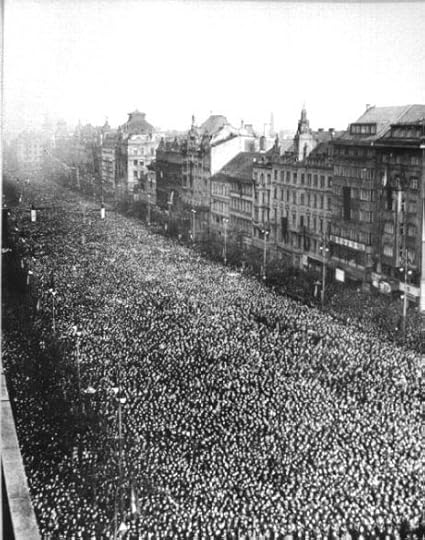
I look around and see that all the people in the line are people I know—girls from Pioneer camp that I haven’t seen since we were kids, teachers from school, friends from college, our professor… it was like a demonstration!
Their long, loose gray hair streamed down over their bumpy spines. Their hands and feet seemed enormous and even more misshapen. Broken by working the earth, twisted like the roots of old trees, their fingers had taken on the colour of the soil in which they had been digging for so many decades. The skin of their bodies, however, was so white it looked bluish pale, like skimmed milk.
And there was the great truth of literature—Solzhenitsyn wrote book after book. They came out in samizdat, passed from hand to hand in the time-honoured pre-Gutenberg manner, on loosely bound, soft, hardly legible pages of onionskin paper. It was impossible to argue with these pages: their truth was so stark and shattering, so naked and terrible—truth about oneself, about one’s own country, about its crimes and sins.


