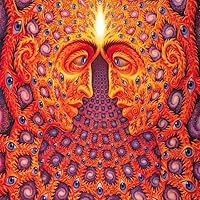
In this absorbing book Henri Michaux investigates the operation of the human mind under drugs. The analysis of the author's own experiences links the disturbance induced by drugs with parallel states of mind afflicting the mentally alienated. His observations illuminate and dissect the machanics of human thought and feeling in the normal and abnormal states. Michaux has an extraordinary capacity to remain outside himself, to record, to annotate, to recall and to analyse, and his sustained awareness brings control and discipline to the experience of chaos. Reports from this territory of the mind have tended to be couched in exstatic meanderings verging on the inarticulate. Monsieur Michaux brings to bear in this mericulous survey the subtlety, the power and the vision of a poet. [Taken from the inside cover]
Henri Michaux was a highly idiosyncratic Belgian poet, writer and painter who wrote in the French language. Michaux is best known for his esoteric books written in a highly accessible style, and his body of work includes poetry, travelogues, and art criticism. Michaux travelled widely, tried his hand at several careers, and experimented with drugs, the latter resulting in two of his most intriguing works, Miserable Miracle and The Major Ordeals of the Mind and the Countless Minor Ones.
There is a revealing moment in “Major Ordeals of the Mind” when a hallucinating Henri Michaux confesses to avoiding a female friend who would be concerned and disappointed about his continued drug experiments. At another moment, two of his friends walk into the middle of his trip, linger briefly failing at their interactions before deciding to leave him in perplexing solitude. These events take up less than half a page of Michaux’s book and he does not offer any other context on his life.
Accordingly, the remainder of his narrated experiences are accessible to anyone with an interest in drug experiences and their effects on consciousness. Michaux’s careful and honest observations seem universal—freed of personal baggage and purged of cryptic references—and they are often hilarious, “it was a biscuit wrapping, nothing more. I know that perfectly well. It was also a disturbing, annoying, deceptive being, capable of anything.”
His descriptions of dissociation, anxiety, nerviness and disrupted thought (chapters 1-4) moved quickly and resonated best with me. The second half of the book is at once more focused on those with permanent mental problems (primarily schizophrenics) and more absorbed with powerful, transcendent and appalling hallucinations. These were perhaps less universal experiences—though I am in no position to judge. But, for example, his cosmic launch into outer space and his explanation of losing touch with his body parts, were—for me—less accessible and because of that, less interesting (in the way that a stranger’s dreams are). Chapter 7 however, should not be missed; its discussion of a “table” made by a schizophrenic sheds more light on people with that misfortune than anything else I have read.
I was only skimmingly interested in his bizarre mystic system (“The Four Worlds”) that glorifies the movement from eroticism through fear, towards love and into contemplation. On the whole, the book reads with unusual speed and the first half of it is memorable, revealing, accurate and entertaining. It is fun to see someone so motivated and earnest struggling with all of the world’s small obstacles turned into major ordeals.
This rare little jem is yet another masterpiece amongst the psychedelic classic literature, however this is one of three staggeringly poetical and documented experimental masterpieces within what just so happens to be my favourite genre,the author was first and foremost a published poet until he made the courgeus and obviously wise decision to turn on and document every single time he did so and fortunately with an array of psychedelic drugs in about three books of which this title here is one of them,and all three of the books are hard to find, expensive and moreover Genius.