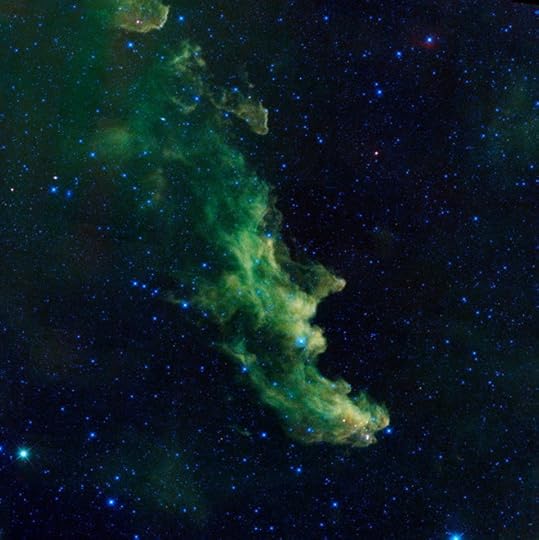
Take a tour of the universe with this awe-inspiring collection of photographs from the archives of NASA, featuring spectacular views of Earth from above, our solar system, and deep space.
Featuring a preface by everyone's favorite "Science Guy" Bill Nye, Earth and Space is an unparalleled journey through the cosmos, offering up-close views of our remarkable cosmos.
More than 100 astonishing images of Earth from above (first captured by the Apollo program), the phenomena of our solar system, and the celestial bodies of deep space will captivate readers and photography lovers with an interest in science, astronomy, and the great beyond. Each extraordinary photograph gleaned from the archives of the legendary space agency is paired with explanatory text that contextualizes its place in the cosmic ballet of planets, stars, dust, and matter—from Earth's limb to solar flares, the Jellyfish Nebula to Pandora's Cluster.
Anyone with an interest in stars, planets, space exploration, and the overall beauty and mystery of our universe will find much to marvel at within these pages.
DAZZLING HIGH-QUALITY Readers rave about the quality of the images in this collection as well as the gorgeous page layouts that offer a feast for the eyes. Equal parts photography book and astronomy book, it is ideal for casual browsers and science learners alike.
AMONG THE GREAT SPACE Alongside books like Carl Sagan's Cosmos and Stephen Hawking's A Brief History of Time , this volume offers us a chance to step deeply into our universe without ever leaving Earth. Page after page reveal incredible views of constellations, stars, star clusters, a hypernova, supernova remnants, nebulae, Milky Way dust, cloud galaxies, galaxy clusters, and much more.
A GIFT FOR ALL Much more than a coffee table book, Earth and Space holds appeal for kids, teens, adults, and seniors with its mesmerizing visual catalog and fascinating facts.
3.5* Be forewarned: This has been one of those days when nothing has gone according to plan and, because of that, I am a mite grumpy. Yes, that cross stitch hanging above me says: "Don't write anything while grumpy." But here I go anyway.
There is some overlap between the two, by that I mean that some of this book is devoted to photos of our solar system. This book does more to showcase planet Earth and to give us the incredible photos of galaxies, nebulae, and other phenomena outside our solar system. The text is again helpful. I did not find myself as agog with as many photos as in The Planets. That could be for one of three reasons: 1. The photography was not as good or the printing was substandard (not likely) 2. I found our solar system inherently more interesting than this book's subject matter 3. The afore mentioned mood
I hope that, if you look through this fine collection, you find it more enthralling.
I'm always a bit suspicious when books like this are titled to imply they only contain photos, because many of the more science oriented ones also have extensive captions for every picture. This is one of those books, but the captions were quick reads and relevant to the pictures being shown, and even teach a bit of science about both space and how the images are collected—turns out space doesn't really look like what we see in the photos because the photos are composites designed to show different light wavelengths or chemical elements in certain colors. Basically the sky would just look empty to us if we looked at it directly. That said, the photos included are really interesting, and several are genuinely gorgeous. It still fascinates me that space can be filled with shapes and substances that look like they'd be perfectly at home in the first Doctor Strange movie.
Lots of Nasa photos with short descriptions to explain where, when and how the photo was taken. Also explains as simply as possible what is occurring in each photograph.
I love Nasa photos, I look them online often. This book didn't seem to have a very clear direction. It's made more like a coffee table book to be flipped open and glanced through. The descriptions are rather dry, for all the beauty in the universe, why simplify it so much that it's just a composite photo and that red stuff is gas. I would have loved to see a flow of photos telling the story of the universe, instead I see random photographs chosen because they look cool. That being said, they chose many of the really good photos to show, especially in the space category.
Absolutely stunning. Images are fantastic and it's incredible to take a moment and realize that these are fairly "recent" photos. Imagine what is to come with more time, better imagining, and improved hardware to go the distance. This book will blow your mind of what is out there that we are just beginning to see.
You can open any page and there is a stunning view. Next to it you can read when it was captured, using what equipment and, most importantly, what actually is depicted in that image. It gives a small glimpse on data processing in order to get the image: it might not be something what we would see with naked eye, it is not even what we can "see" in other types of light as some parts show temperature or elemental composition. Surprisingly, the book does not have an image of the oldest light in the universe. Also, I wish it had more images of the Solar System. If this book was published today, it would contain an image of the black hole and something from the James Webb Space Telescope.
----- 2022-ųjų skaitymo iššūkis Viršeliai/pavadinimai 5. Pavadinime arba viršelyje yra planeta Viršelyje pavaizduota Žemė.
This collection of photos is fascinating and largely well-organized. The photos themselves are beautiful. The idea of starting with the (relative) micro of the Earth and Moon and progressing to the macro of galaxies billions of light years away is a solid one, though I did wonder why they ended the book at objects less than ten billion light years away.
The author focuses on explaining what astronomical objects and concepts are involved in these photos. By acknowledging right off the bat that these photos are often composites of many photos and include elements such as false color, the author is able to immediately jump into explaining the scientific reasons why NASA does that. Some of the explanations are a bit confusing (mentioning an object in a photo without saying where or what it is, for example, or saying it's in the upper-left corner when it's obviously in the upper-right). That said, the cumulative effect is educational about Hubble's influence on the field of astronomy over the past three decades.
In this collection of breathtaking images from space, some are familiar, some are new, all are spectacular. Here are Earth, the Moon, Sunset, Earthrise over the Moon, Mercury, Venus, Europa, Jupiter and Io, ringed Saturn, blue Neptune and Neptune’s moon Triton, and the Sun . . . our solar system seen in a whole new way.
Constellations, stars, star clusters, nebulae, supernova remnants, Milky Way dust, cloud galaxies, galaxies, galaxy clusters, a hypernova . . . and so much more.
A description and some information about the image accompany each photograph. Also included in each description is information about how NASA obtained the image.
Each photograph is exquisite; readers with an interest in stars and space will find much to appreciate here.
This book is similar to the Planets book by the same author, but it’s not quite as well presented. The Kindle Unlimited formatting is awkward with pictures generally separated from their commentary onto the next page. The commentaries tend to be repetitive rather than one complementing another. It’s a good read, full of wonders but not one I’d return to as readily as the Planets book.
Like other people have said, this feels more like a book you grab when you're bored in the waiting room, to read a few neat facts and watch some pretty photos. It isn't a real reading book to read all the way through.
Beautiful images and clear captions explaining each. I learned a little about space and the way NASA documents the heavens. Worth it for just looking through the pictures.
Great book with really fascinating and beautiful pictures of nebulae, stars and planets. Anyone who's into space or astronomy will really enjoy this book
Actual color photographs, many of them of objects in deep space taken with the best available technology and they remind us go how beautiful, massive, and mysterious this creation is.
Nothing else really puts everything to scale like the skies above us. Every problem you have seems so minuscule after dwelling on the cosmos. You were late on a bill? Yeah that's pretty big, at least until you realize that a star tens of thousands of light years away, a.k.a. trillions and trillions and trillions, (this could go on for a while) of miles that's millions and millions of kilometers across is going to explode, creating a beautiful remnant similar to a Picasso painting that will give birth to a bunch of new stars over millennia. Space is beautiful. This collection of images reminded me why I was so into astronomy when I was younger. I'm most definitely going to frown when I have to put this back into the book depository at my library.