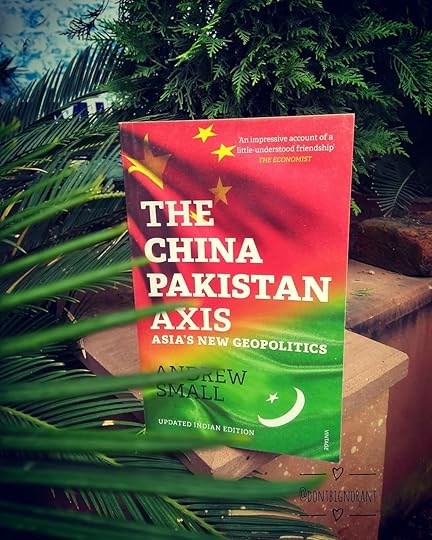
The China-Pakistan axis plays a central role in Asia's geopolitics, from India's rise to the prospects for a post-American Afghanistan, from the threat of nuclear terrorism to the continent's new map of mines, ports and pipelines. China is Pakistan's great economic hope and its most trusted military partner. Pakistan lies at the heart of China's geostrategic ambitions, from its take-off as a global naval power to its grand plans for a new silk road connecting the energy fields of the Middle East and the markets of Europe to the mega-cities of East Asia. Yet Pakistan is also the battleground for China's encounters with Islamic militancy, the country more than any other where China's rise has turned it into a target. For decades, each side has been the other's only "all-weather friend", but the relationship is still little understood. The wildest claims about it are widely believed, while many of its most dramatic developments remain closely-guarded secrets. This book explains the ramifications of Sino-Pakistani ties for the West, for India, for Afghanistan, and for Asia as a whole. It tells the stories behind some of the relationship's most sensitive aspects, including Beijing's support for Pakistan's nuclear program, China's dealings with the Taliban, and the Chinese military's planning for crises in Pakistan. From China's involvement in South Asia's wars to the Obama administration's efforts to secure Chinese cooperation in stabilizing the region, it traces the dilemmas Beijing increasingly faces between pursuing its strategic rivalry with India and the United States, and the imperative to address a terrorist threat that has become one of the gravest dangers to China's internal stability.
Over the years the China-Pakistan relationship has become a virtual constant in foreign policy matters pertaining to South Asia. Yet it is a relationship about which little is known. That is partly by design – the two nations like to keep the exact nature of the relationship out of the spotlight – but also because few experts have taken the time to dissect it.
The China – Pakistan Axis by Andrew Small is a worthy attempt to shine light on the longstanding linkages between the two nations.
The book chronicles the development of the relationship over the decades since the 1960s in a changing geopolitical environment. Indeed, the author brackets the relationship into easy to understand ‘bite size’ segments based on underlying themes during particular periods.
By the end of Small’s work, the reader has a good understanding of the main tenets of the Pak – China relationship. Nonetheless, the book is at best an introduction and not an in depth analysis. To be sure, it is an entertaining and worthy introduction.
However, the subject warrants more detailed analyses including in individual aspects of the China – Pakistan relationship, e.g. foreign policy coordination; counter terror cooperation especially with regard to Uygur separatism; economic cooperation; and even military industrial production.
One hopes Small’s book will be the first in a series – by different authors - on what is until now an enigmatic relationship between two very different nations. __________________ I am available on Instagram (@imranahmedsg); twitter (@grandmoofti) and can be contacted at imran.ahmed.sg@gmail.com.
This is an extremely biased book. The main agenda of this book is to explain to the western people how Pakistan built it's nuclear weapons, mainly using Chinese resources and capabilities.It's true that Pakistan was involved in "technology theft" for building its nuclear weapons, but almost every country including America(from Germany), Rusia (FromAmerica) did the same thing. For years, America and West used Pakistan's shoulders to fire guns at Russians, destabilizing Pakistan and cultivating terrorists there, while India was sharing bed with Russians, and at the end Pakistan is (as always) a victim. One Chinese reviewer gave a very good description of this book: " The use of word Axis in the title is biased. But it's common in the West to bash China. It's cool and it sells books. But it's incorrect, unless the author's next book is US-Saudi Axis"...........
A unique book of it’s own kind, shedding light on Sino-Pakistan relations with regards to US, Afghanistan, India, and other Central Asian states in the region. Based on 6 years of great and deep research, the author has touched a great topic of explaining how China has controlled the Geo-politics over the span of years. It kept me on track because of the great insight it provides. It explained China’s stance during the three Indo-Pak wars, China’s handling of Xinjiang Province and the Uighur militancy, helping Pakistan with nuclear materials, investing in high-end projects in Pakistan, USSR’s invasion in Afghanistan, Taliban peace process, and basically everything which has happened in this region since 1960s. This strange friendship can be described in these words:
“The Pakistani love China for what It can do for them, while the Chinese love Pakistanis despite what they can do to themselves.”
The China-Pakistan relationship would likely be a footnote in political history were it not for the remarkable ascendance of Asian economic and political power over the past several decades. For both countries, their shared relationship has been arguably the most enduring and stable political alignment they have in the world. On military and political issues Pakistan and China have been closely aligned throughout their modern histories, and signs point to growing economic convergence as well. This book offers a rare look at the history and future of this relationship, with great access to high level officials throughout the region.
Little known facts about China's history in helping develop Pakistan's asymmetrical warfare strategy (China was among the top countries arming the 80s mujahideen) and ongoing cooperation on issues related to Taliban and AQ are all thoroughly explored. Chinese and Pakistani joint efforts on civil nuclear and military technology are also well documented. The book also has lots of great anecdotes about the history of the leaders relationships, including Pakistani general's bafflement and Zhou and Mao's advice to fight total war from the interior of their country - their own histories coming from the British colonial tradition of warfare.
The "China-Pakistan Axis" will increase in importance in coming years as China seeks to assert itself more prominently around the globe. Both countries are largely isolated and have longstanding fears of encirclement, and their shared interests and deep history of strategic alignment have made the relationship a vital interest for both their respective leaderships. This book is a well-written and engaging look at the subject that does not suffer for being academically focused. An enjoyable read that is full of historical gems, and that offers a useful guide to present and future events in Asia.
Very well researched and well written book on the china Pakistan informal alliance that started as a common cause against a common enemy(India), but now grew into something more substantial in Asia's geopolitics with china's growing ambitions.
A really excellent synopsis of the China-Pakistan bilateral relationship — I’ve followed most of the general contours, but having this in a single volume is very valuable and I learned quite a bit even for events that I’ve already read histories of elsewhere. Concise and readable, the book touches on the historical roots on the relationship but focuses primarily on the more contemporary key relationship dynamics. The author identifies an intensified Chinese interest in solidifying its alliance with Pakistan in the wake of the U.S.-India civilian nuclear agreement and as part of a more externally-oriented Chinese foreign policy broadly, which stands in increasing tension with Pakistani reliance on militant proxies, concerns over which have been exacerbated by the rise in Uighur militancy over the past half-decade or so and the signals of a U.S. withdrawal from Afghanistan. As the author suggests, the two countries’ bilateral ties tend to be defined by hyperbolic superlatives and boosterism on the Pakistani side and an refusal to voice any disagreements publicly on the Chinese side, which makes analysis of the reality of the relationship very challenging. This book is a great contribution towards making a realistic and informed assessment. The timing of publication means that the China-Pakistan economic corridor currently being touted by the Nawaz Sharif administration is only covered in brief in the book’s epilogue, meaning there should be plenty of material for future studies expanding on this one. Looking forward to digging more into the bibliography.
China - Pakistan : The so-called " All-weather friends '' --------------------------------------------------------------------
'' Pakistan is China's Israel ''.
- General Xiong Guangkai
The China - Pakistan axis, Asia's new geopolitics, is brilliantly researched book, and here the author revealed some of the dark - secrets of the two very strange lovers, who are busy in making intense love to each other, without caring what the world will say about their clandestine relationship.
Infact Pakistan was the first muslim nation who recognized the ' People Republic of China ' in the 1950s, since then, both have become the so-called "All-weather Friends", and the foundation of this friendship was based on the mutual hatred towards India.
The author has rightly mentioned that during the three Indo-Pak wars of 1947-48, 1965 and 1971, china supported pakistan through thick and thin and also supplied them arms and ammunition and the moral support without any preconditions. But when Pakistan was defeated by the Indian security forces in the 1971 liberation of bangladesh war, china decided to give pakistan which no other sensible country would do, they gave Pakistan the technology to develop 'Nuclear weapon'. Though Uncle Sam was also responsible for turning a blind-eye on the Pakistan's clandestine nuclear programme.
With the acquisition of the Nuclear weapons by pakistan with the help of China, the strategic balance in the Indian subcontinent is changed dramatically, and the best example of this was the 1999-Kargil war, 2001- Indian Parliament attack & The 2008 Mumbai Attacks, in all of these terrorist activities, pakistan and its ''Deep-State'' was heavily involved, but because of the dangers of the all-out ''Nuclear-war'', the successive Indian governments avoided the war with the most fragile nuclear power nation i.e. Pakistan.
The author also discussed that how China is coming out of its shell and started playing a very assertive role in the international diplomacy, and the current example is Afghanistan, where China is the only country who has maintained good relations with all the stakeholders- the Afghan government, the Afghan Taliban, USA, Russian, the former northern alliance, and most importantly with Pakistan.
Though the relationship of China and Pakistan had seen many ups and downs but still it survived throughout, unlike the relationship of pakistan with the Americans, and with the recent announcements of the grand projects like, 'One belt and One Road' (OBOR) and China-Pakistan Economic corridor (CPEC), this relationship between the two countries are converted into a kind of marriage, where both the bride and groom are happy with each other.
The author has really done a good amount of research before writing this book, and he also travelled to, Pakistan, China, India, United States and Afghanistan for his research. I recommend this book only to those readers who loves reading about pakistan, and also to students of international studies , Because this book requires lots of patience to be read.
My Ratings : ⭐⭐ ⭐⭐ (4/5)
I hope you like the Review, thanks for reading, Jai Hind.
The Pakistani Chinese friendship is not easy to understand, which makes this wonderful book a goldmine of information. The relationship is fairly recent, started after the 1962 China-India war by the brilliant Zulfiqar Ali Bhutto in his capacity as the Foreign Minister who made the first overtures towards China at a time when few were willing to standing with an emerging but unsure superpower. Since then China has used its economy, military aid and political muscle to back Pakistan through most of its crises. And what does Pakistan with provide China in return? It keeps its number one economic competitor India in check on both borders. Pakistan is China's Israel and like Israel, China uses Pakistan like a hired private security guard and a bouncer. Pakistani jihadi issues, its nuclear arsenal is also used by China as a talking point with USA which helps China curry favours in return. But every relationship has boundaries, and Pakistan should realise the importance of China especially after losing the American support after its 1999 Kargil misadventure. And after CPEC, the Chinese have clearly laid down new ground rules which are based on the security of its citizens in Pakistan. It does not want a repeat of Lal Masjid under any circumstances. Pakistan also has to be very careful in not using its Jihadi army too much as China has already signed MOU with the likes of JI, JUI and the Taliban cutting off the fixer Pakistani government, making it irrelevant. Therefore Pakistan has to now completely change its strategic depth policy of relying on Afghanistan and its Jihadi brigade and to instead focus on an economic jihad instead.
This book came to me out of nowhere at a time when I was having tough time reading books. I started and was totally absorbed by this book. The narrative is just amazing. Too much juice in this book. Categorized into chapters for easy reading and understanding. Ups and downs of relationship discussed thoroughly from the very beginning including ignition for the relationship when it started back in 1960s. Before 1960 the things were going in opposite direction. I do feel that author was a bit focused on one topic: Nuclear technology collaboration among the both countries. Maybe for the sake of his personal curiosity. Many new things learned from this book which will stay with me. Looking forward to read more from the author.
Facts taked from the Indian propaganda perspective and one sided.... And extremly ignored Pakistani struggle into many levels..... My first review on English books..... 🙂
This entire review has been hidden because of spoilers.
Andrew Small, a western author and we all know what the west thinks of Pakistan and China, as well as how their media portrays these two countries. First and foremost, we must acknowledge that the author conducted extensive study on each and every incident in the China-Pakistan relationship. To write this book, he researched every facet of the narrative.
The author attempted to create the impression that Pakistan has stolen technology from the West, particularly the United States (For Reference: Pakistan's Babar Cruise Missile is a result of reverse engineering being done on a United States Tomahawk Cruise Missile that Pakistani agencies stole from Africa and brought to Pakistan via Balochistan, and then it was taken to China for further research).
Almost every country on the earth is engaged in “Technology Theft.” The US stole nuclear technology from the Germans, the Russians took it from the Americans, and, strangely, it was the US that somehow gave nuclear technology to China in order to maintain the balance of power in the area and to prevent the Soviet Union from dominating Asia.
When discussing Indo-Pak relations, the author appears to be heavily prejudiced in favor of India. He has stated several times that the Pakistan Army and ISI were playing both sides of the court, that they had friends and ties in the Taliban while also attempting to neutralize them with the support of the US and China. However, the author did not shed any light on how Pakistan was used and discarded like tissue paper by the West in fighting against the Soviet Union, and how we were dragged into a war that was not ours. At the same time, India was receiving benefits and assistance from the United States, the United Kingdom, France, and other countries.
He also attempted to convey the argument that the Pakistan Army is inefficient, deploying old defective weaponry with no strategic studies, so on and so forth. That is simply opposite to the reality. He neglected to note that the Pakistan Army is the only army in the world which has won the “War on Terror” in less than a decade, and that wars aren't only about weapons; if modern equipment was the guarantee of winning a war, the United States would not have wasted two decades and trillions of dollars in Afghanistan, Iraq, and the Middle East.
Author attempted to emphasize that China was unsure about investing billions of dollars in CPEC, China's largest investment outside of its own country. The author stated that China had serious concerns and disagreements with Pakistan, such as Pakistan's internal security, political instability, and an increasing number of Uighurs fleeing their country and seeking refuge in Pakistan, mostly on the outskirts of Rawalpindi, the home of the Pakistan Army.
Concerns he wrote about were somehow genuine, but he failed to explain why China would take such an uncalculated risk and put all of its eggs in the same basket by investing in Pakistan. In the book's epilogue, the author sounded more hopeful about Pakistan-China ties, highlighting the need of Pakistan's civil and military leadership in removing any obstacles that may jeopardize this All Weather Friendship. Mr. Andrew Small, interestingly, referred to Pakistan as "China's Israel." In the same manner that the United States gives preferential attention to Israel, China gives special attention to Pakistan.
I will rate this book 4/5 stars .The book excellently summarizes the history and contemporary geopolitical dynamics ,also gives a little insight of future of China and Pakistan as a close ally. The book was published in 2015 ,and no updated editions of it have yet been released. The book offers its readers to know and understand the main tenents of the relations .However,it is not an in depth analysis.It is a well researched book and primarily focuses on giving the reader an awful account of the history of sino-pak relations.In the book Small tries to make the readers understand the imperatives of this geostrategic partnership and enlighten the future projection of the alliance.Alongside mentioning bilateral military and economic cooperations the book also covers some regional cooperation and policy matters ,such as that of : Afghanistan,and Uighur sepratist issues.But the book also comes along with, the more or less expected, western baisness and skepticism towards the relations,as west considers China as an adversary of constantly growing rank.Moreover,the book also portrays the relations as an asymmetric one,subjected with the China’s aid and assistance towards Pakistan and by and large,disregarding what incentives does Pakistan has to offer in this partnership,may be this would have been accomplished if the book included more of recent developments such as the belt and road initiative , which not only promises Pakistan a bright economic future but gives China manyfold the incentives than of that to Pakistan.Thus, its mention may would have helped to understand the cooperation ,better.Small does mentions it shortly, in the epilogue, as the China-Pakistan economic corridor was first publicly announced in 2015.So the book’s updated editions or hopefully some other book by Small on the topic might come up with it.Overall,the book is a good read and reveals some lesser known facts of the sino-pak ties , and Small has managed to tell them in such an interesting way,he has made this book a page turner.The book is a really good one for an international relations student, to start the study of China-pakistan relations ,the book provides a short narrative of depth and breadth of the relations , and then one may go on further to read more detailed and analytical accounts on the topic.
An excellent and thoroughly researched introduction to China-Pakistan relations. Covers a lot of terrain and touches on many closely related issues such as China's concerns with Xinjiang, its Central-Asian strategy, and China-Indian relations, which is partly why it remains highly relevant despite the fact its writing is already 7 years old. (Having said so, now might be the time for Small to add a final chapter reviewing the developments that have taken place since).
Some of the Pakistani reviewers here mistakenly attribute bias to Small, in particular with regard to his account of Pakistan's acquisition of the bomb. I couldn't find anything of the sort. Small sticks to the facts and outlines various narratives whenever those facts are more muddy than usual. He consistently refrains from taking sides or condemning actions and actors.
The only fault I could find with the book, although somewhat understandable given the level of anonymity he had to award many of his primary sources who likely work at those places, was the fact China's institutional landscape in its relationships with Pakistan wasn't clearly discussed and analyzed. It makes it harder to understand who and what is behind the ramping up of involvement by Chinese SOEs or what developments have taken place within for example the Pakistan department of the PLA in the past decade. Such insight is key in understanding past changes and key events in China's approach, such as the refusal of a financial bailout shortly after the GFC, and predicting where relations will go to in the near future.
Well written and deeply researched book - almost one third of the book is references - that explains in good detail why a rising nation like China, mostly focused on economy and development, be such a close partner and protector of Pakistan which fortunately or unfortunately has become synonymous with global terrorism. Geopolitics aside, it almost appears from the book as though it is an yearning to a have a 'friend' in the neighbourhood whom you can trust (and not just by lure of investments). What the implications of this in the long term will be are to be seen. I wonder if the adage 'be careful of the company you keep' are applicable to states as well as to individuals.
The terrorism aspect and the challenges that China faces internally due to Islamic terrorism is explained in some detail and thus the desire to use the influence that Pakistan has directly or indirectly over these groups makes some sense. I don't fully agree whether that strategy ultimately works, but at least it explains why China seems to differentiate between "Good terrorists" and "Bad terrorists" as evidenced from their reluctance to sanction some well known global terrorists.
When I bought this book, I thought I would get something novel, but it is worst. Never imagined nor I did have ever read such a narrow point of view of an author beyond India and Pakistan who has written on this topic. I am 100 pages in, yet nothing was worthy I could praise for. However, I am still reading and hope to find a sentence that could worth the book. If any of you have read this? What was your experience?
P.S. Finally I have completed this book and my views about the book aren't good yet. I would also like to add that the facts and other provided in this book are till 2015. The major portion of the book is limited to the events happened in the 1960s and 1970s. Now the geopolitical condition is entirely changed. Economic connectivity and strategic relations between the two countries are different now from the past. This book is good to a little extent for understanding the history of relationships between China and Pakistan. However, it can't provide enough material for the present scenario, and the writer's analysis for the future also failed as he was expecting coldness between the two countries but, in reality, they have reinvigorated their mutual bonds.
An absolute must read for anyone interested in the rich relationship between the two nations! Mr. Small, with his profound understanding and lucid clarity of expression, shows a bigger picture. He walks us through a rich history of changing geopolitical dynamics and the breaking and forging of alliances. The connection of small events scattered throughout the timeline into a holistic zeitgeist was truly remarkable and insightful.
If there's one Foreign Policy lesson that I truly learnt from this book, it was: "Committment to a friend's security doesn't mean fighting ill-judged wars of their choosing." And I think that is such an accurate analysis of Chinese foreign policy for Pakistan. I also loved how at the very end, the author comments on how Pakistan has also taken this lesson from China in its dealing of the Saudi-Houthi conflict.
The book depicts the relationship between Pakistan and China from the early 1950s through Pakistan's wars with India and the emergence and (possible) decline of the Taliban in the Af-Pak border regions.
While China is Pakistan's great economic hope and its most trusted military partner; China doesn't treat Pakistan the same way - it is a relationship of unequals. Pakistan is the battleground for China's encounters with Islamic militancy and the heart of its efforts to counterbalance the emerging US-India partnership.
Book disentangles the relationship between one of the oddest couples in geopolitics: an unpredictable Islamic republic and a communist state that has turned to a mixture of consumerism and authoritarianism.
Interesting read - wish it was not written in 2015 because the real action is now!!
2.5 stars at best. There isn’t much of a thesis to this book. The idea is that CPEC will deliver the earth, economically. Actually at best there is some level of security cooperation.
(This thesis is not fully explored in any sort of robust economic way. Is it worth it for Pakistan to take on so much debt? So who knows).
The other annoying thing is that the author assumes that China in the 1960s and 70s was pretty much the same as post-reform China today.
Really don’t know
Will figure out the rest of the afterword soon.
In writing this review I was tempted to knock it down to two stars, but it’s Afghanistan chapter, especially today with Kabul maybe about to fall, is useful.
The book shreds light on the evolving nature of the relations between the two countries, Pakistan and China, and discusses Afghanistan, India, and the US in the context of relations. There are not many books on China and Pakistan relations in the context of evolving world order and emerging aspirations of China. This book is a good read in that direction. It gives in insight into the depths of relations among these nations and how they are dependent upon each other for different reasons. It also hinted at the role of China in the post NATO withdrawn Afghanistan, the role of Xinjiang in Chinese attitude towards Afghanistan.
This book revealed a great deal of how Pak - China relationship grew over time.
It was revealing, how China just not influencing Pakistan's foreign policy but also, how china putting pressure on Pakistan in driving internal policies, from initial jihad policy to abandonment of militants at later stage. Pakistanis do perceive china from a different perspective and that is because of well calculated posture by both China & Pakistan over the course of history.
I foresee a greater alliance between Pakistan & China in near future, which will reshape the geopolitics of South Asia.
This book helps understand the depth of China-Pakistan relations. The author believes that Pakistan is China's Israel and that is how he built the whole narrative of the book and explained how deep-rooted the relations between two neighbouring countries are. I do not agree with everything mentioned in the book. However, the author's analysis of China's role in Afghanistan (after USSR Invasion, during the war on terror and Afghan peace process) has expanded the horizons of my understanding of China's policies towards the regional politics.
I haven’t read much in geopolitical aspects of nation and this book has been my foray into it and I was delighted. Andrew Small has done a great job discussing geopolitical dance between China, Pakistan, India, Russia, USA, Afghanistan and many other countries. As they say, those who play with fire will eventually burn their hands by fire and that is exactly what has happened to US and China. It remains to be seen whether the dance stops or boomerangs in the coming years.
I like to think of the Sino-Pakistan relationship as a mysterious and surprisingly robust partnership between 2 nations that have zero linguistic or cultural links! They are poles apart but they have miraculously stuck together over several decades. This book does a great job of unravelling this mystery and making us understand the essence of this mainly geostrategic relationship without transforming into a boring academic thesis. It's a relatively short and enjoyable read.
A fine account that manages to really summarise the gist of the Pakistan-China relationship. A historical narrative infused with very well researched incidents and interesting internal diplomatic conversations. This culminates into the reader being actively engaged throughout the book. A must read for all those interested in understanding the complex geo-politics of the subcontinent.
This book demonstrates that the Pakistan is China's Israel.But Pakistan must take a stern stand against ETIM presence in Pakistan, and stop keeping them for good . The relation amid two neighboring also depicts that China count on Pakistan in all times ,irrespective of world's opposition . overall, I loved the Chinese diplomacy with US, Afghanistan ,and especially with Taliban .
an awesome amout of efforts involved to sift all the writings cum interviews involved in giving birth to one of the core aspect of two countries.marvelous...... a brilliant start with the brilliant ending.
A well deserved read for anyone interested in the work of China, and how it deals with a special like Pakistan whose land is situated in a tricky location, boiled with conflict with almost all its neighbours except China.
It is a good book which shed light on a relationship that I even as a Pakistani misunderstood. Yet as the author himself points out, a lot of work needs to be done to deem this as a "complete" piece of work.