In Acorn Lake, Minnesota, Lillian Anderson has reached the end of childhood still believing her much-adored mother’s worldview that life is a floating-wedding-cake fantasy fueled by love—that’s it, just love. She believes it even while naming every new pet right away, because anything without a name is likely to get eaten. She believes it in spite of knowing she needs to head home when hunters are hiding behind duck blinds with their shotguns loaded and the safeties off.
But clearly, not everybody is playing by the same rules as her mother, Marion, a resolutely optimistic roller coaster of a woman, equal parts mom, little girl and sexual goddess. Especially not her father, Jack, an easily ignited alcoholic with a talent for making the entire family feel as if they’re living beneath a clenched fist. When Lillian isn’t tiptoeing around her parents, she’s learning about life—and sex—from her two brothers and Mitzy (“My sister is the kind of girl who thinks letting Buddy Franklin fuck her in the Hoffmans’ hayloft is the same thing as a date”), and from her father’s mistress, Betty Boop, who tells her, “Once you learn how to cook and sew, hordes of hungry men will show up on your doorstep dragging gunnysacks full of mending.”
In a family scratching its way down a small-town social ladder, Lillian barrels from childhood into her early twenties with no illusions about her future, biding her time and honing her shorthand. But as she’s struggling to get on her feet and get out, her family’s house—built long ago on landfill hauled in to cover the marsh—is literally going under.
This is the irresistible debut of a writer with a hypnotizing gift for place and voice, and a singular talent for capturing the best and worst of rural life; in eleven linked stories she delivers up a character with the grit and sheer exuberance needed to appreciate the best and overcome the worst. Rich in emotion and brimming with wit, A Brief History of the Flood speaks to the question of whether it is possible, or even desirable, to leave the most troubled of family histories behind, and offers clear-eyed evidence that familial love, in even the most inclement circumstances, finds purchase in us, and persists.
I feel lost in someone else's childhood. Just blinking and staring, occasionally saying "wow" to myself as the end of this book settles on me... Wow...
Every character is just a real family member somehow flattened into ink on a page. In particular, Lillian's mom is a fascinating portrayal of a manic-depressive mother who is initially loved by her children for her zest and wonder, but as Lillian grows up, her opinion of her mother grows more cynical. Lillian's dad is the alcoholic father from hell who ruins everything, survives it all, and remains entirely unmalleable. Lillian's friend Irene is also written to be so intriguing, charismatic, and tragic; her demeanor when interacting with men is particularly heartbreaking.
A Brief History of the Flood has a similar plot to The Glass Castle, but the writing style of the former feels far more personal and emotional. While I loved The Glass Castle, I constantly felt like I was held at a distance from the narrator's emotions. In A Brief History of the Flood, the narrator's emotions are inescapable, a flood in their own right.
The chapter "The Gift" is one of the strongest pieces of fiction I've ever read. If you want to read just a few pages from this book, please let it be from "The Gift." The tension you experience as a reader while Lillian and her family rush to liquidate their father's belongings as he hunts is astounding. It made me feel the way I felt as a kid, waiting to get caught in my own inescapable lie.
And the ending... I don't think anyone really escapes their childhood fully, so Lillian seeing her childhood home caught in the rearview as she races forward is nothing short of stunning.
I feel like someone told me my own life story using a different language.
From page 79:
The kitchen windows are propped open to cut the gamy smell, and the freezing wind off the lake is hitting my neck. I lean forward, sink my arms into the hot water, and shiver like a girl who's being electrocuted.
I found this one in the library of the cruise ship I was on, and enjoyed it. It's a quick read, but the characters were interesting. Ultimately I would have liked more plot development -- the people didn't seem to do much.
This book had moments where I thought, "Ok, now we're going somewhere", but then there was no go. When really the only memorable thing about a book is the title, it's a letdown.
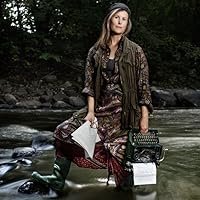
Harfenist grew up in Prior Lake, Minnesota in the sixties and seventies, and her first novel closely follows her own experience. The eleven inter-connected stories follow Lillian Anderson from age 8 to 18 as she grows up in rural Minnesota, living in a rundown house on a lake, dealing with her alcoholic father and manic-depressive mother, and escaping to “the Cities” an hour away. Even though I didn’t have a rural childhood, something about this coming-of-age novel resonated strongly with me and I couldn’t put it down. I highly recommend it.
Well now I've finished it. The ending was almost disturbing in it's lack of ending. It kind of taints my opinion of the book. But up until I realized the last page was really the last page, I liked it. ----- So far I like this book, although it has all those depressing traits modern literature is known for. It's set in 1950s-60s Minnesota, a ways out from Brainerd, I think, which gives it a nice nostalgic feel for me, despite some of the horrible happenings of the story.
This was one of those books that you tear through...wanting to see what happens next. At times, because of how well the main characters are drawn (specifically Lillian, the Mom and Irene)the stories read more like a memoir than a novel. The writer's descriptions fully evoke the time, the place and the social class in which the characters dwell. I'll look for more books by this author...I would love to read another book full of Lillian's stories. This book could make a great movie too.
i read this book more than a year ago. a lot of the images have stuck with me, and as someone who gets very emotionally involved in books, this is a book i got more attached to than anything else i can remember. and can i just say that i'd never appreciated the stories-as-novel approach before i read this book, which is honestly just very beautiful.
a scary, slightly comical look at a Minnesota lake home family during the Viet Nam war. Dad is a drunk, mom is sexually repressed, the house is a mess and the kids are in the water most of the time. Mom probably has the most creative and hilarious ideas for an annual garage sale that I've ever heard of.
2.5 stars. The family was a little too dysfunctional for my taste and the writing didn't seduce me enough to make up for it. I didn't really like the main character, but I guess this falls back on the writing, since that's how I usually judge a book. I got this hard cover with the ugly picture from the library. The cover art of the paperback is much better.
Not only is this novel set in my home state of Minnesota but the writing is tightly paced and hilarious. Jean Harfenist certainly doesn't take the fun out of dysfunctional. The narrator grows from 8 to 14 and then 18 right before your eyes. The dialog is very believable. My only criticism is that it's too short.
This short novel composed of short-story chapters may be my favorite book of all time. It follows protagonist Lillian Anderson from childhood, on a lake in central Minnesota, to adulthood as a young woman in the Twin Cities, and focuses on her relationship with her mother. Set in the 1960s, it captures the upheaval of the times from the point of view of upper midwesterners.
I liked the Minnesota roots of the book, especially the lake scenes and pontoon reminiscing. But there was something lacking in the character development. Very little forward progression and each montage/chapter seemed to repeat the same themes: isolation, boredom, withdrawal. I was searching for something more and didn't find it here. 3.5 stars.
You will know these characters. Anyone from the Midwest that survived puberty, crappy jobs, messed up family, and can laugh about it - or should - would love this collection of coming-of-age in Minnesota.
Wow, cheery! Not.. it's Minnesota, but that really hasn't been enough in the past, I don't know if it will become enough now. Perhaps here will be a waystation on the ongoing physical journey of this book. We'll see... All depends on the voice, and opportunity.
A compelling main character and intimate look inside a barely functional dysfunctional family. The book left me wanting more. The only problem I had was the each chapter seemed in short story format.
BEAUTIFULLY written short stories + about growing up in (northern) Minnesota + about growing up in a dysfunctional family = what's not to like? Also, my brother's friends with the author's brother -- support yer Minnesota writers!!
Really liked it and would recommend it for anyone who reads fiction. Yes, it's about a dysfunctional family but the characters are believable and the narrator is feisty, likeable and smart.