Caustic wit and a strong sense of horror mark works, including In the Midst of Life (1891-1892) and The Devil's Dictionary (1906), of American writer Ambrose Gwinett Bierce.
People today best know this editorialist, journalist, and fabulist for his short story, An Occurrence at Owl Creek Bridge and his lexicon.
The informative sardonic view of human nature alongside his vehemence as a critic with his motto, "nothing matters," earned him the nickname "Bitter Bierce."
People knew Bierce despite his reputation as a searing critic, however, to encourage younger poet George Sterling and fiction author W.C. Morrow.
Bierce employed a distinctive style especially in his stories. This style often embraces an abrupt beginning, dark imagery, vague references to time, limited descriptions, the theme of war, and impossible events.
Bierce disappeared in December 1913 at the age of 71 years. People think that he traveled to Mexico to gain a firsthand perspective on ongoing revolution of that country.
Theories abound on a mystery, ultimate fate of Bierce. He in one of his final letters stated: "Good-bye. If you hear of my being stood up against a Mexican stone wall and shot to rags, please know that I think it is a pretty good way to depart this life. It beats old age, disease, or falling down the cellar stairs. To be a Gringo in Mexico--ah, that is euthanasia!"
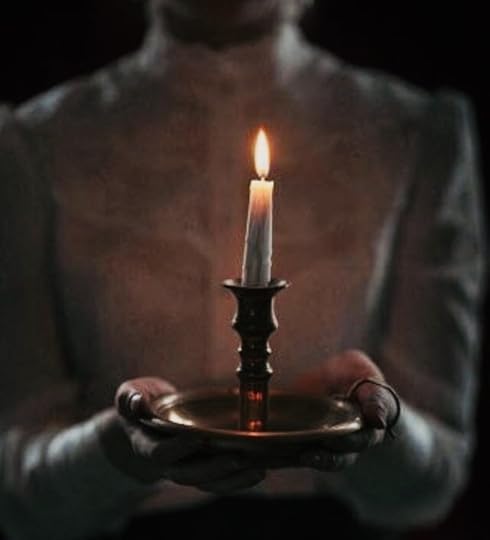
What is so special about Breathitt House (a hotel in Atlanta) and its lodgers? It was not unusual back then to have one room with several other lodgers. But lodgers like that? The night-clerk also is a fantastic haunting character with his tallow candle you'll never forget. Great Bierce, highly recommended!
this story is being retold to a traveler. it's the story of Colonel Levering and his stay in Breathhit House, a very old and run down hotel in Atlanta. He spent the night in a room with some other lodgers. Nothing is as it seems in this dark and great tale from one of my favorites.
This is a horror short story that you can read or listen for free and I read it for the Hallowween Fever ReadAThon. It was okay, but it didn't scared me. It just made me a little uncomfortable.
This is an intriguing short story that goes beyond the boundaries of horror fiction, and reaches far into the socio-historical circumstances of the era. The plot features a certain Colonel Levering, who had sought shelter for the night in an old hotel in Atlanta. During the night, he awoke to find himself surrounded by other lodgers, stretched on the bare floor of his room. The next moment, he realized they were dead, and finally bolted out of the room.
The last sentence on which Bierce had ended his tale, namely the mention of the siege, of armed conflicts, and, therefore, of war clicks with the title of the work, and emphasizes the purpose of its author. These lodgers are anonymous, faceless, and in possession of not a single vestige of individual identity. For a room taken by one colonel, a dozen such men had to die, which is a thinly veiled metaphor of the war, its injustice, and its doom.
An evocative story set in a hospital after the siege of Atlanta in 1864.
At a later date, a man who is traveling through Atlanta to catch a train, mistakenly stays in an untenanted building, that was once a hospital, during the siege of Atlanta, and which had formerly been a hotel.
While in New York , a Colonel Levering, an acquaitance at the Waldorf-Astoria, and the gentleman who is looking after the untenanted property, both tell the traveller not to stay at the Breathitt House after an unsettling night at the supposed hotel.
................................................................... Wikipedia ......The Battle of Atlanta was a battle of the Atlanta Campaign fought during the American Civil War on July 22, 1864, just southeast of Atlanta, Georgia.
Continuing their summer campaign to seize the important rail and supply hub of Atlanta, Union forces commanded by William Tecumseh Sherman overwhelmed and defeated Confederate forces defending the city under John Bell Hood. - - - WILLIAM TECUMSEH SHERMAN - - - JOHN BELL HOOD - -
Union Major General James B. McPherson was killed during the battle, the second-highest-ranking Union officer killed in action during the war. - - - MAJOR GENERAL JAMES B. MCPHERSON - - -
Despite the implication of finality in its name, the battle occurred midway through the campaign, and the city did not fall until September 2, 1864, after a Union siege and various attempts to seize railroads and supply lines leading to Atlanta.
After taking the city, Sherman's troops headed south-southeastward toward Milledgeville, the state capital, and on to Savannah with the March to the Sea. - - - WILLIAM TECUMSEH SHERMAN - - -
The fall of Atlanta was especially noteworthy for its political ramifications. In the 1864 election, former Union general George B. McClellan, a Democrat, ran against President Lincoln, on a peace platform calling for an armistice with the Confederacy. - - - GEORGE B. MCLELLAN (Democrat) - - -
The capture of Atlanta and Hood's burning of military facilities as he evacuated were extensively covered by Northern newspapers, significantly boosting Northern morale, and Lincoln was re-elected by a significant margin. - - - PRESIDENT ABRAHAM LINCOLN - - -
The other lodgers – “There are breaches in the walls that you could throw a cat through.” Beside the quirkiness of sentences such as this one, the story makes me thin of the fascination that occurred several decades ago with photographs revealing a happy family at home with the contrast of a seemingly overlaid ghostly apportion.