Rebecca Brown's The Last Time I Saw You is a Finalist for the 2007 Ferro-Grumley Awards for LGBT Fiction! In The Last Time I Saw You , author Rebecca Brown returns to the obsessive, darkly humorous voice that has earned her comparisons to Samuel Beckett and Djuna Barnes. Some of the tales in this collection are told in the scrappy, breathless voice of a naif on the verge of a terrible revelation. Others are noir-baroque monologues that collapse in on themselves as a speaker at last abandons a much-needed delusion. Intense, artfully crafted and oddly comic, the stories in this collection are bound to stay with you like an insistent, disturbing dream. “A strange and wonderful first-person voice emerges from the stories of Rebecca Brown"— The New York Times "Rebecca Brown's newest collection of short fiction pulses with desires that cannot be attained—knowledge, understanding, quiescence, and love . . . The straightforward prose style belies Brown's penchant for brilliant narrative, which at any moment can turn from the gentle and intimate to the violent and bizarre."— Utne Reader "Brown’s imaginative, fierce collection of 12 stories (her 10th book, after The End of Youth) evokes the painful detritus of lesbian love affairs long over and the trickiness of memory.”— Publishers Weekly "She is one of the few truly original modern lesbian writers, one who constantly pushes both her own boundaries and those of her readers. The Last Time I Saw You is an exhilarating reminder of just how thrilling difference can be . . . she reaches back into a time-honored tradition of mania that borders on the frightening, one that calls up Sappho's laments to lost lovers, Stephen Gordon's self-sacrificing delusions and the chilling compulsions of the women of Djuna Barnes' Nightwood.”—Joy Parks, San Francisco Chronicle "Every story is a stylistic and imaginative standout, but the most intriguing is 'Aspect of the Novel,' a truly original exercise in essayistic fiction that contrasts the closeted career of British novelist E.M. Forster—who wrote his queerest novel 'Maurice,' in 1914, but wouldn't permit its publication until after his death in 1970—with the secrets that the lovers populating Brown’s unsentimental prose keep from one another."—Richard Labonte, BookMarks Rebecca Brown is the winner of the 2003 Washington State Book Award. Her books include The Gifts of the Body , Excerpts From a Family Medical Dictionary , The Terrible Girls and The End of Youth .
Rebecca Brown’s diverse oeuvre contains collections of essays and short stories, a fictionalized autobiography, a modern bestiary, a memoir in the guise of a medical dictionary, a libretto for a dance opera, a play, and various kinds of fantasy.
Bought this book for a dollar at the Provincetown thrift store, and read it here and there at the beach, in between the other books I really wanted to read. Kind of the opposite of a palate cleanser, most of these short stories are very, very internal and left me sad, or enveloped and wanting to go elsewhere. “Someone Else” is an ode to being captive to your worst critic” and “Bread” was a monastical short story with a wheat roll as a main character that reminded me how much I miss carbs.
Sharp and searing, Brown's prose is gorgeous. The stories themselves can feel somewhat repetitive when read back-to-back, but it's a pleasure to be coated with words all the same.
For such a short book of very short stories this was incredibly affecting. I don't remember another book that made me feel this terrible.
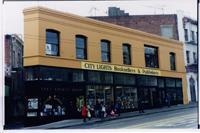
I picked it up (at the store that published it, City Lights in SF) because the blurb on the back used words like "obsessive" and "dark" and "like an insistent, disturbing dream". So I'm not sure why I was so shocked when it really truly was dark and intense and emotional and harrowing.
"Trying to Say" was the most painful. It discusses an intense long-term obsession that is voluntarily sustained after a relationship dies. It's visceral and potent and horrible. Most of the other stories are along a similar mood if not a similar topic - bleak and excruciating. I read the book as quickly as possible to get it done with because it was so emotionally difficult.
I hated reading it, but I reckon I was meant to. The author wants it to hurt and it absolutely does. She captures obsession perfectly. But it was very, very unpleasant.
I'm not a huge fan of art!Prose in general, so the fact that I willingly made it through this book is a good general indicator of its quality. That said, I could read no more than two of the stories pieces before my attention wandered. There's not so much with the plot, but yes, the writing is beautiful. The book jacket blurb may use the phrase "noir-baroque monologues" but don't let that bit of genre pretension fool you. Rebecca Brown is no Jack Kerouac and hence does not go on for years and years about how fucked up her life is--they are short stories, you see... No, I jest, in truth it is because she has much more variety in her own innovative style. So it's okay; treat it like poetry and it's a nice book to fall asleep to (and I do mean that as a positive. It's restful, and all poetical).
Rebecca Brown's The Last Time I Saw You is a Finalist for the 2007 Ferro-Grumley Awards for LGBT Fiction!
In The Last Time I Saw You, author Rebecca Brown returns to the obsessive, darkly humorous voice that has earned her comparisons to Samuel Beckett and Djuna Barnes. Some of the tales in this collection are told in the scrappy, breathless voice of a naif on the verge of a terrible revelation. Others are noir-baroque monologues that collapse in on themselves as a speaker at last abandons a much-needed delusion. Intense, artfully crafted, and oddly comic, the stories in this collection are bound to stay with you like an insistent, disturbing dream.
this book really freaked me out! it was terrible to read on the subway because it sometimes made me feel like i was going to throw up. i think that means it was good? i mean, it made me feel some things, that's for sure.