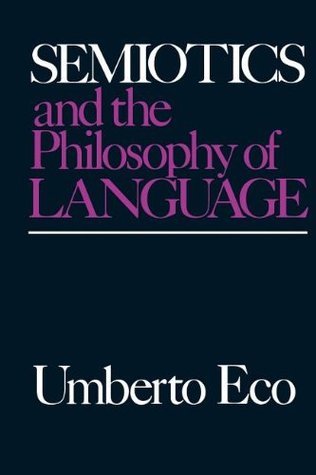
The learned philosopher can only marvel at the power of natural language to describe, if not verily to construct the world. Impressive enough as far as natural history and science go, but the epiphanic capacity of man’s faculty of language comes into its own when we turn to the social and cultural realms, where language plays a constitutive role. No wonder the ancient Greeks comprehended both language and reason itself under the single term, logos! Now, at the root of all this lies the significatory function of the word itself. Thus, the discipline of semiotics, which studies the nature of signs and the processes of their formation, must be exciting and key to a cultivated appreciation of knowledge and of the life of the mind, that which is highest in us. Or so one would suppose. Hence, one should welcome it when a celebrated literary figure such as the Italian novelist Umberto Eco takes it upon himself to write an exposition of these phenomena in the work presently under review, Semiotics and the Philosophy of Language.
The book does put forward some worthwhile conceits, at least to one new to the field of semiotics. The first chapter on signs in general is stimulating, with its discussion among other things of the Stoic semainon and abduction. Smoke is a sign of fire, and in a similar sense the ancients were disposed to look on the spoken word as a sign of what is on the speaker’s mind. In other words, an indicator of or clue to something else, to be interpreted and investigated with the methods of physics. Nowadays, we restrict signs to their linguistic usage.
The distinction between a dictionary and an encyclopedia, to which chapter two is devoted, is also provocative. A dictionary encodes the knowledge one could impart to an artificial intelligence. A computer program could interpret one thing as standing for another, in a finite chain leading back to the elementary notions. But of course, no real knowledge is thereby conferred. An encyclopedia, on the other hand, does embody knowledge. From an encyclopedia entry, one can gather the relevant contexts in which a term will appear and some narrative understanding of how terms relate to one another (he calls these ‘scripts’). Thus, one can expect an encyclopedia to convey stereotypes and commonsense knowledge of the kind that every native speaker of a language makes constant implicit use of. As such, an encyclopedia is potentially open-ended, unlike a dictionary, where the definitional chain is fixed and must eventually terminate. Eco likens the encyclopedia to a labyrinth. In his view, only the encyclopedia has semantic content, properly speaking, whereas a dictionary is best viewed as nothing but a pragmatic tool.
The most accomplished part of the entire book is Eco’s critique of the time-honored tree of Porphyry in chapter two. There is simply too much freedom of choice about what specific differentia to apply to what for the linear, hierarchically ordered structure of the canonical tree, such as was first adumbrated for taxonomical purposes by Aristotle in his biology and is presupposed by Porphyry’s Isagoge, to be adequate to the full range of human knowledge. Eco points out some of the alternate classificatory possibilities in diagrams, which go to show that it would be artificial to seek to compress everything we know into the stricture of a single tree. To this reviewer, what is really at stake here (although Eco does not remark upon it) is that conceptual space cannot be equipped with a strict total ordering, but at best partial orderings. To picture what this might mean, consider the set of subsets of a mathematical space, which is partially but not totally ordered by set inclusion. The implications for ontology of this observation strike the present reviewer as very profound, but Eco himself, not being much of a metaphysician, declines to pursue them.
Now to the main drawbacks. Eco gives the impression of being a typical scholar who has read too widely for his own good, in the sense that he ends up little more than an eclectic. Certainly, nothing here would prompt the reader to suspect him to have anything like assimilative power, the ability to forge his own views on the major topics he covers by drawing on the best ideas he can unearth in the literature and refashioning them into something stamped with his own genius. Rather, all he does is to take a scattershot approach and to treat his topics in isolation, without any organizing principle or overarching themes to connect them. In consequence, his writing is fragmentary, but not in the positive sense of early German Romanticism. There, a well-crafted fragment can serve as a window into an entire world and, moreover, exemplify the poetics of a Friedrich Schlegel, for whom the fragmentary form best reflects the limitations of human knowing when faced with the transcendent; here, in Eco we get merely a disjointed heap of pericopes on trendy present-day semioticians, some of whose names will be familiar while others are deservedly obscure. Illustrative example: the chapter on symbolism. In rapid-fire succession, Eco serves up a series of sections on Lacan, Freud, Peirce, Hegel, Jung, scriptural exegesis, the Kabbalah etc. but manifestly fails to arrive at anything like an adequate grip on his ostensible topic, what is a symbol? Yes, he recognizes that a symbol is more than a mere cipher or allegory, but just what this surplus consists in he cannot say, and neither can any of the authors to whom he adverts. For how could one possibly understand symbolism and its transporting force without a robust metaphysics and the analogy of being, which are foreclosed to an atheist such as Eco himself? Eco’s own allusions to mysticism and the patristic tradition are notably tone-deaf—what is very revealing. He cites Henri de Lubac’s excellent monograph, Exégèse médiévale, but most apparently has not profited at all from his perusal of it.
For the real deal on symbolism one would have to go back to the medieval scholastics. One could heartily recommend the fourth volume of Peter Lombard’s Sentences and Hugh of Saint-Victor’s De sacramentis, written during the heady days of the twelfth century when the sacramental vision of reality as strewn with supernatural grace first emerged into theoretical consciousness (only to be negated during the Protestant Reformation, leading to listless modern man’s disenchantment—but that is a story for another time). For a sacrament is a visible sign of an invisible spiritual presence, and in its beginnings sacramental theology did not limit itself to the seven canonical sacraments but saw literally everything as potentially sacramental. The mythopoetic consciousness of prehistoric man was saturated with sacramentality of this kind and the medievals wrought it into a state of high sophistication and artistry. This recensionist really must promise reviews of these two foundational works. Suffice it to say that the field of semiotics must become lifeless and inert when it forgets its religious roots, and Eco’s dry and unimaginative treatment of his subject, which by rights ought to be charged with vital concern, certainly confirms this a priori prediction.
Shortcomings such as those noted above are symptomatic of unoriginal thought; no trenchant argumentation, no coherence, no vision—surely it is easier to read widely and to bone up on the views of currently popular postmodern thinkers (Saussure, Derrida, Lacan, Barthes and so forth) and perhaps to excogitate a few clever rejoinders to their theories, than to undertake the hard effort of fleshing out an original, systematic perspective of one’s own on the subject. The academic journal literature is clogged with such scholarly infelicities, which nobody will remember a generation from now, once they have served their purpose of securing a comfortable career for their undistinguished authors. But don’t we have a right to expect more of an artist and public persona such as Umberto Eco? His little Art and Beauty in the Middle Ages is not all that bad, after all; it promises far more than he delivers in the present work on semiotics, which goes to show the difference between urbane erudition commonly met with and real speculative philosophical vigor, a rare gift indeed.
Second, this reviewer wishes to register his disappointment over discovering that Eco’s book scarcely contains what he thought he has the right to expect of it, given its title. In his naïveté, he anticipated a revelatory analysis of lexicalization, the mysterious collective process whereby new terms are introduced into a living language. Another catchword for this would be semiosis (which presumably denotes something broader, in that not all signs have to be verbal). Whatever the jargon one chooses to employ, the idea is evidently of the greatest interest from a philosophical point of view. Nevertheless, in Eco semiosis is poorly explained, or what would be more accurate, neglected altogether. Strictly speaking, there is no philosophy of language per se to be found in Eco’s book, which barely gets past discussion of terminological issues. It is all well and good to be clear on one’s definitions, of course, but isn’t one supposed to go on and to apply them to explain something? That would be a proper philosophy of language. But Eco doesn’t even make the attempt.
The disappointment thereby encountered recalls that which befell the present reviewer upon hitting upon the shocking superficiality of T.S. Eliot’s notion of culture in his Notes toward a definition of culture, which occasions wonder as to how the esteemed poet could possibly have won his reputation in the first place as a leading literary figure of the first half of the twentieth century. Eliot is certainly no Herder, to say the least. Perhaps the comparison of Eco to Eliot is apt; just as the avant-garde modernist poet could have brought forth a number of creditable productions, among them the Love Song of J. Alfred Prufrock, The Hollow Men, Ash Wednesday and the Four Quartets while at the same time being hopelessly shallow as a literary critic and would-be philosopher of culture, so too Umberto Eco has the well-received (at least among the general reading public) novels The Name of the Rose and Foucault’s Pendulum to his name while being inept as a philosopher and semiotician, as this review has shown.
The present work has been rated two stars, although from the point of view of the intellectual quality of Eco’s performance it deserves only one, because, as it were despite its author, the attentive reader cannot fail to glean from it some instructive insights into the current state of the literature on semiotics in the second half of the twentieth century. Would that we had a source to go to that could offer an orderly presentation of the same, and what is more a just valuation of it!