
Jump to ratings and reviews
Rate this book

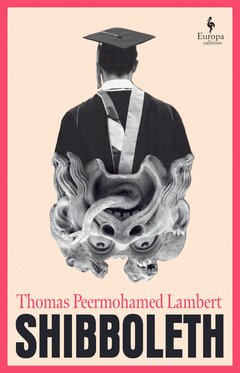
Shibboleth

Rate this book
Want to make it among the wealthy, upper-class students at the University of Oxford? Then you'd better have something interesting to say when people ask about your identity.

Luckily, Edward does. Though he can boast neither an expensive education nor a nice room in college, he does have a long-dead Muslim grandfather from an obscure African country... At the beginning of his second year, everyone wants to get close to him—including, to his astonishment, the beautiful and highly unstable Angelica Mountbatten-Jones. 

As Edward scrabbles to fit in, his new friends start to grow suspicious. How will they react when they realise he hasn't been entirely honest? What will Angelica do if she finds out about his complicated feelings towards a Jewish girl on his course? Will Edward manage to carve out a space for himself at Oxford, or will the truth get in the way?

A darkly comic debut, Shibboleth drags the English campus novel into the divided, multicultural, hyperactive present day.

"A talent for comedy is rare in fiction. Lambert has it, in abundance."—Tim Parks, author of Mr Geography

"Engrossing and thought-provoking."—Tomiwa Olowade, author of This is Not America

?"Gloriously impious and thrillingly alive."—Rob Doyle, author of Threshold

384 pages, Paperback

Published May 22, 2025

11 people are currently reading
352 people want to read

About the author

Thomas Peermohamed Lambert

1 book4 followers

Ratings & Reviews

What do you think?
Rate this book

Friends & Following

Create a free account to discover what your friends think of this book!

Community Reviews

5 stars
18 (24%)
4 stars
34 (46%)
3 stars
13 (17%)
2 stars
8 (10%)
1 star
0 (0%)
Displaying 1 - 18 of 18 reviews
Profile Image for Katia N.
711 reviews1,117 followers
Read
October 6, 2025
Thomas Peermohamed Lambert has got an African muslim heritage (as his name unambigooulsy points out) and was an undergraduate at Oxford himself. In fact he is still there doing his PhD. That might explain how he got away with such a pointy and daring satire on all things Oxford. The novel is a kind of a campus novel: we follow a second year student with the background borrowing a bit from the author's. However his protagonist, Edward is much more clueless at Oxford's student politicking as I would imagine the author was. The characters clearly stand for 'types'. The novel main target is weaponising identity politics and how this has often adds to the existing class power imbalances rather than creating more equal field. This aspect of the novel is brave and very funny as well. Though it is getting progressively darker as novel moves on. But also the novel is kind of a bullingsroman when Edward is learning what matters. Unexpectedly, I've found some of his romantic entanglements quite moving. In general, I've enjoyed reading this debut a lot even if it made me feel a little sad about the state of the young world yet again. It does not pretend on psychological depth, complexity of the characters or experiments with language. But what it does target, it delivers. I am happy I do not need to study at Oxford any time soon:-))

A few examples from the book:

This is from conversation between Edward and his new tutor named Pfister:

'Shouldn't I just choose the writers I like?'
'What?'
'For my essay, Writers I like. Writers I think are good.'
'Oh Edward. Pfister shorted. 'Whether they're any good doesn't come into it. Evaluative criticism is over. Themes - that's what you want. Ideas. Frameworks. Critical lenses. Between you and me...it's almost better if the text is a little ropey. Then you can upset one of the old guard. Coax one of them into a rebuttal.' He made a mysterious, waggling gesture with his fingers. 'Controversy. Citations.' ... 'Do you have any protests you can put on your CV?'


Another Edward interaction with the president of of Oxford student union, the daughter of American investment banker and an academic:

'Do you see an 'individual' (looking at me)? Or do you see just another black woman? Be honest.'
'You know maybe people are reluctant to view you as an individual because you go on about being a black woman literally all the time.'


Obviously all the characters are totally fictional. But recently the real incoming president of the Oxford Union was making headlines for wrong reasons unfortunately as well.

And the last except is from the conversation between Edward and his girlfriend who is an international student from Germany, ethnically Jewish with the some family Israel. She wanted to participate in the debate organised between the Jews and the Muslims on the campus. Edward tried to tell her off this reasoning that both sides who would volunteer to participate in that debate would have extremely intrenched views and act more aggressively and performatively than anything else. However, the girl still wanted to speak.

Not if I choose to do it. It's Jews I want to speak to anyway, as much as anyone else. Honestly, Edward, you have no idea what it's been like this week. It turns out there are actually some Jewish people-Americans, mainly-here who are a pretty bit weird about me going out with you.

They do know I'm not actually a Muslim, right? You can tell them. I really don't care.'
It doesn't make any difference, Edward. People aren't really interested in seeing someone like you as "not a Muslim." Not since what happened. In fact it's as if some of them have been waiting patiently all their lives for an excuse to see you as nothing but one.'
'But you want to try to convince them anyway? That doesn't make much sense either.'
'Maybe it doesn't. Anyway, I feel like I really can't win because I make the small point that, for example, and allowing for a fact that I don't have some stupid MA in international relations, I suspect killing everyone in the occupied territories might not be an excellent long-term strategy for Jews in Israel or abroad—I make this point and then I'm an outcast, an apologist, self-hating, not a real Jew, et cetera. Fine. Whatever. But then I go to the other side and say, for example, that there may be some people in Israel who are not bloodthirsty warlords and might be permitted to remain where they are-my ninety-year-old grand-mother, for example, who was a Tolstoyan anarchist and uses a breathing tube, or my cousin, who is four—I am an apologist, a racist, a coloniser. I just feel like everyone has gone mad. It makes me want to go home. But where even is home, now?' I'm sorry. But I just think you're expecting too much from these people. I mean why do you talk to them? It'll blow over.
We've been so happy this week, Rachel?
I've been happy with you. But you can't just be happy with one person, it's not enough?


A sad and thought-provoking stuff. I do not want to make any articulated conclusions based upon these examples. They (the conclusions, not the examples) seem to be kind of redundant.
Profile Image for sjb.
16 reviews3 followers
October 29, 2025
very enjoyable read (w varied satirical commentary; i’d been worried it wld all be v one note) up until the plot started kicking in, which in turn made all the characters feel more wooden and ridiculous.

at a certain point you get tired of edward being like “wait what’s happening? i don’t know anything?” for the 30th time. youssef was a very entertaining character & the relationship between angelica & liberty had great (very realistic) female friendship moments (eg their zine competition was particularly amusing). i think what lambert did best was portraying how the veil of ideology can be used to justify & enact interpersonal melodramas, but i felt that the point was clear to the reader much earlier than he expected

4 reviews
December 29, 2025
Pleasantly surprised by this. When I first picked it up, I was worried it would just be a slightly higher brow version of Titania McGrath or one of the Spectator’s more tedious columns.

In fact it’s rather well written and amusing. I was there just before TPL was, and a lot of the satire is bang on the money. The mocking depictions of the Oxford Union’s myriad scandals and the surprisingly mediocre statue of Cecil Rhodes, the loud anti-capitalists first in the line for vac schemes and summer analyst positions, the pious posturing of privately educated students with wealthy parents (they don’t tell you about the townhouse in Chelsea, the Cotswolds cottage and the holiday house in Provence but boy do they make sure you see it on Instagram) and the pomposity of JCR officers treating votes like vital parliamentary business: it’s all in there with a minimum of exaggeration. The dialogue and its wry observations make you laugh a lot and it is eminently quotable.

TPL’s satire isn’t exclusively limited to the left either: the “sycophants in polyester suits” worrying about cancel culture and the conservatives in “many shades of beige” are also briefly skewered.

However, to quote Sven Goran Eriksson - “first half good, second half not so good.” After a while the satire gets tiresome and repetitive. Yes, seeing wealthy St Paul’s Girls / Cheltenham Ladies alumni claiming oppression is ridiculous. Yes, student politicians are cringeworthy. Yes, being neither rich nor having an “interesting” (read: minority) background means at the larger Oxford colleges you’re invisible. Yes, rugby boys and lacrosse girls from minor public schools are scorned by the more upstanding and earnest superiorly-privately-educated members of the student body. Yes, the university’s own communications are prone to cliche and weasel words. Yes, some of the pastoral care and training borders on the ridiculous. Yes, posh kids effortlessly make you feel small. What of it? Eventually you need to say something more about it rather than just giving the same observations again and again. If you just want a satirical novel, this could easily be 100 pages shorter and probably should be.

There is a tenuous storyline running through the midst of the satire, which is rather patchy. At first it is barely explored, then suddenly crammed in but doesn’t quite work. TPL is great when writing satire and omniscient narratives: less so when writing direct - particularly romantic - dialogue. The novel moves from A-tier pure satire to a B-tier version of the Rules of Attraction to a C-tier version of The Secret History. There are also occasional snatches of philosophy when trying to get to grips with modern campus culture, and an abruptly shoehorned climax and happy(ish) ending. Precisely because the book isn’t quite sure what it wants to be (satirical, polemical, black comedy, philosophical, other), it loses its punch about halfway through, which is just when the satire begins to get repetitive, and isn’t replaced by anything of equal value.

It’s hard to rate this book given I’m not sure quite how to evaluate it. As a satire it’s very funny, accurate and eminently quotable - but a bit too long. As a campus/coming of age novel, it’s quite weak: if the characters are cardboard, then the plot is paper-thin. As a social commentary on contemporaneous issues (cancel culture, Islamophobia, anti-Semitism, identity politics), it’s weaker still.

3 1/2 stars seems a fair rating - one that Goodreads of course won’t let me award, so let’s say 4 stars. I look forward to reading TPL’s next book - I thought this was a good debut.
55 reviews
June 25, 2025
Shibboleth, set in Oxford, tells the story of Edward, an English literature undergraduate with a vague family connection to Zanzibar. Edward has grown up in a part of England to which things "like quinoa or Ayurvedic medicine" haven't quite made it. While a certain type of fellow student has chosen to study English literature "because he wanted a nice, clear proof of his own ability to read, before surrendering to the cosmic inevitability of a law conversion course", Edward claims his choice of the subject arises merely from his having liked it at school.

Edward is taken up by Youssef, a wealthy Egyptian who uses Islam as an identity, while cheerfully drinking alcohol, eating pork and doing whatever else he feels like. Through Youssef, Edward - who, from a social point of view, is from an average background - is swept up by the children of the wealthy, those who "already used all the right jargon, already knew all the best pubs, already felt in their bones which papers would condemn them to many tortuous evenings in the College library and which would allow them to cruise their way to a first if only they used the word 'hermeneutics' enough times". Soon he is dragged into university politics.

At the beginning of the book, Edward is a bit of an innocent - Chauncey Gardiner kept coming to mind as I read, although Edward is capable of developing and indeed, inasmuch as the book has a narrative arc, it is the arc of Edward's march towards some kind of semi-maturity. Thus, by the end of the book, having "become aware of the totemic status Palestinians had among people his age", having participated in the college rugby team, having had affairs with two women, having been wrongly accused of masterminding a very small terrorist incident, he has grown up slightly - as much as a caricature can.

For Edward and the other figures Lambert shifts about on his fictional chessboard are not fully formed, nor are they the book's main concern. What Lambert is aiming to do is satirise Oxford student politics - and by extension, I presume, activist politics across Britain and probably the whole of the west. It therefore doesn't matter that his characters are cardboard and their dialogue sometimes clunky - Shibboleth is a kind of literary version of cartooning, an attempt at a verbal Hogarth or James Gillray picture, a portrait in words of a world - or at least a university - gone quite mad and almost entirely anti-Semitic. I do hope it is a highly exaggerated vision, like Hogarth and James Gillray's images, a caricature and not a piece of realism.

Lambert has a nice turn of phrase at his best and a good eye for detail. When Edward goes to a poetry reading, Lambert describes the first participant as "a gruesome little haikuist with an earlobe stretcher". Shattering the romantic dream of Oxford so dear to Americans in particular, he describes the city centre thus: "It was a typical weekday in the centre of Oxford: there were homeless people strumming guitars, Muslims preaching from their pergolas." When Edward decides to change from the Shakespeare paper to something more "up-to-date", he is told by his newly-imported-from-America tutor: "Evaluative criticism is over. Themes - that's what you want. Ideas. Frameworks. Critical lenses" and advised that "Academia is a game" and the important thing is to identify the factions, "The Freudians. The digital humanities people. The affect theory lot. The textualists. The Comp-Litters. The people who work with the Department of Continuing Education. The old guys who are listed along with the buildings. There's nothing but factions in this place." At a college dinner, Edward's companions "all foraged in their wallets and one by one pulled out various dietary cards supplied by the College, Youssef with Halal, Conrad with various food intolerances he blamed on the Hapsburg strand of his lineage, and Angelica with a whole five poker hand that covered her newfound veganism, her seasonal eating disorders, the set of rules stricter than any known creed that governed her body." Lambert targets diversity training as often as possible. In the character of Liberty, he creates an ambitious and cunning monster who, despite being indifferent to study and deep thought, will almost certainly rise to the pinnacle of the academic world. To keep us from total despair, he also gives us Professor Burgess, a flicker of hope in the chaos; sadly though, she is old and almost blind.

He also gives us Rachel, a German girl who happens to be Jewish. I wonder if Lambert sees her as his most important character. In a way she is, for the not inconsiderable task of trying to articulate a way through the anti-Semitism in which the world of the book is steeped is given to her. She does quite a good job, but she is really just another mouthpiece for the author. In that capacity, she also provides some amusing commentary on English mores, telling Edward: "Here people lie. They lie like nowhere I've ever been before. They'll make those squealing noises when you walk in the room, and tell you they love your terrible outfit" and questions one of the most unassailable of contemporary shibboleths, the notion of “feeling unsafe”, declaring:

“I think, ‘I feel unsafe’ is just something people have learned to say because it gets the grown-ups to notice them. Most of the Jewish students who say they feel unsafe just say it because it’s the only way they can make their case without everyone calling them a fascist.”

I really admire Europa Editions for publishing something that attacks the fashionable idiocy of pro-Palestine, Islam-loving politics. However, one thing I don't admire the company for is their copy editing - the book is riddled with sentences where words are either repeated unnecessarily or totally left out - and sentences that are inelegantly tangled and in need of further work. Leaving that aside, I recommend Shibboleth. Like all satire it is horrifying - but it is also entertaining. I hope like really successful satire it will change things - but I am not optimistic.
Profile Image for remarkably.
173 reviews81 followers
September 27, 2025
promising but tedious, and I say this as a great defender of the David Lodge novel. not in fact without its charms (good line writing, some amusing jokes esp. wrt. character names and paper titles, and all generally put together with an ear for the language, which is high praise at this point in the history of literature) but too long, badly paced, and lacking in any real moral fibre and as such straining on the discount-Amis pot. of course woke students can be very silly while simultaneously subject to ideological capture by corporate (etc.) interests, nobody over twenty-five of any political persuasion does not think this, but I think an effective intervention in that regard would on the one hand satirise those people with a finer hand, and on the other hand not be so wrapped up in its weak-willed, cipherous central character's essential rightness.

perhaps most centrally, satirical or not, I think it's disingenuous to present a largely insincere and self-serving cast of pro-Palestine activists versus a sincere, reasonable character who says things like “Israel is what happens when novels come true.”; the touching scene involving Palestinian Saïd is too little, too late, and why the French orthography? ( of course it is tricky to complain about this kind of thing — take it too seriously and criticise it for essential lack of verisimilitude, of ring-of-truth-ness, and receive the response that you have missed the satire. but thus it seems to me that to criticise a satirical work, one needs to identify what it takes seriously, and what this work takes tremendously seriously, where its highest purpose and most earnest expression lies, seems to me to be Israel.) I enjoyed scene-stealing Falstaffian Youssef but I also thought he read like a ludicrous caricature (even modulo his intradiagetic hamming it up), and most of the rest of the characters were rather thinly-drawn such caricatures without as much verve.

there are two uses of the word ‘shibboleth’ in the book and both, due almost certainly to poor line editing, take the direct syntactic antecedent of 'conflict' rather than 'identifying position on conflict as a marker of group identity'. galling. editors do your jobs
Profile Image for Tag Bogo.
57 reviews2 followers
August 14, 2025
This has garnered some excellent reviews : Telegraph, The Times , TLS , The Literary Review amongst others and You can see Why . It takes place in Oxford University , it is Anti woke , takes pleasure in mocking Identity Politics supposedly lampooning and Skewering these misguided lefty protesters. Smacks of Old Fogeyism , hence excellent write up in the Telegraph. It’s old fashioned , expected Ian Carmichael to appear any time . Edward plays that very English Posh twerp out of depth , most of the characters are paper thin and stereotypes, The female characters are poorly written , Angelica especially , females Vamps , Fantasy figures or Schemers . I gave it four stars could have been 5 because he can write and he kept me engaged , on the whole a promising Start
36 reviews
June 18, 2025
'In all the world there is nothing so dangerous as a bright young man, or woman, who went to Oxford and thinks it's his job to fix it.'

Shibboleth takes you through the whirlwind that is modern day Oxford student politics through the eyes of Edward, a guy that is just trying to survive. Picked this up at a bookstore in Berlin, no less, and haven't regretted it. Nice read that keeps you hooked, with plot as well as characters (Youssef is by far the best character in this satire). Think 'Normal People' but less descriptions and more actual story.

Hopefully we'll hear plenty more from Thomas as an author!
Profile Image for Miles.
33 reviews1 follower
July 13, 2025
Quel amusement de lire ce roman satirique sur les différents courants "woke" au sein de l'université d'oxford. Tous les personnages dépeints ont tendance à agacer vivement, soit par l'extremisme de leur actions et points de vue, ou au contraire par leur passivité.
L'auteur réussit le tour de force de nous faire rire (exemple: les titres des livres) tout en évoquant et traitant un sujet brûlant d'actualité avec beaucoup d'intelligence.
Je recommande vivement.
36 reviews
August 5, 2025
The concept was excellent reflecting current challenges to Universities around topics of free speech , politics and religion. I felt the central female characters were somewhat typecast over exaggerated poor little rich girls. I liked the male lead, Edward, who seemed like a pinball bouncing around with little control over his own destiny. Enjoyable but I would like to read the toned-down version.
Profile Image for William Thompson.
164 reviews1 follower
October 3, 2025
Satire on academic identity politics. Guaranteed to amuse even those (like me) who pushed for, and still do, LGBTQ, etc rights, or those who pushed against them. It’s in the British context so class plays a large and different role here. The absurdity of all involved is brutal and funny ala Waugh in his Put Out More Flags mode. The character of Youssef is worthy of Waugh or Spark. Also, a clear nod to Voltaire’s Candide.
46 reviews
August 11, 2025
Timely critique of the identity politics pandemic that obscures just about everything else in culture and academia and becomes an excuse for discrimination and less harmony. But that makes the book sound too serious - it actually is an absorbing and darkly comical coming of age story set in Oxford and centered around a young man whose nebulous origins define his relationship to all others.
1 review
June 6, 2025
I really enjoyed this book which discloses the underlying power dynamics behind certain student movements. It was really funny and clever, I cannot recommend it more.
Profile Image for amb.
156 reviews4 followers
September 11, 2025
Would have been 5 if only it was a tiny bit longer… But I loved this a lot
63 reviews
October 11, 2025
I can see why it would be funny, but personally didn’t find it funny
Displaying 1 - 18 of 18 reviews

Can't find what you're looking for?

Get help and learn more about the design.