Jump to ratings and reviews
Rate this book

Snack

Rate this book
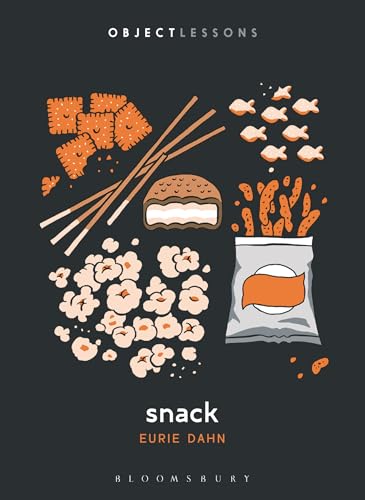
In the hierarchy of foods, snacks are deemed trivial-perhaps even juvenile—especially in contrast to meals, which are seen as substantial and necessary. The multiple aisles devoted to sweet and savory snack foods in supermarkets reveal the popularity of snacking. The availability of snacks at other non-food-focused stores like home improvement and department stores suggest that, at any point, a person may need a snack.

The ubiquity of snacks in our culture is a relatively new phenomenon, one that is not universal to all countries. Snack traces the story of how snacking culture came to be through investigations of specific snacks, including Flamin' Hot Cheetos, popcorn, and Pocky, and in the context of issues of ethnicity, class, gender, popular culture, and even parenting. Ultimately, Snack provides an idiosyncratic cultural history to offer new ways of looking at the grocery store snack aisles.

144 pages, Paperback

Published February 19, 2026

2 people are currently reading
24 people want to read

About the author

Eurie Dahn

3 books

Ratings & Reviews

What do you think?
Rate this book

Friends & Following

Create a free account to discover what your friends think of this book!

Community Reviews

5 stars
6 (26%)
4 stars
14 (60%)
3 stars
3 (13%)
2 stars
0 (0%)
1 star
0 (0%)
Displaying 1 - 21 of 21 reviews
Profile Image for Mai H..
1,387 reviews835 followers
December 2, 2025
"Where is the line between hors d'oeuvres and snack?"

1. Origin Stories

Starting off with Flamin' Hot Cheetos is a choice. The right choice.

I thought this was going to be a fun book about snacks. It's actually a very in-depth look at classism, racism, and the judgment that comes with what foods you like to eat. 10/10

2. Infantile Snacks

Goldfish are a mid snack. I said what I said. I will not be taking commentary.

French people should be less snobby about snacking. And basically everything else. And this coming from a former Francophile. Colonization, amirite?

3. Fruits and Vegetables

I hate PEPPA PIG with a fiery passion.

But also, can I say how great it is that this section is one page? Don't get me wrong, I love fruits and veggies. But we're talking snacks.

4. Guilty Pleasures

For a gender that makes significantly less money, why are women always targeted for extreme consumerism? And guilt?

Diet culture ruined my teens. I'm not being dramatic. Disordered eating is a real thing, and more of us experience it than necessary. For more, my review of HUNGRY GHOST.

Thinness does not equal purity. The "slender aesthetic among fashionable white Americans" should not be the global beauty standard. And yet it is.

5. Chocolate and Dried Squid

I'm eternally tired of white people complaining about MSG in Asian cuisine, yet "fine" eating Doritos and the like.

--

book pairings: BITING THE HAND, CRYING IN H MART, EATING MORE ASIAN AMERICA, MINOR FEELINGS

rep: Black, Chinese American, Japanese American, Korean American, Mexican American, Vietnamese American

tw: classism, colonization, diet culture, purity culture, racial slurs, racism, stereotypes

📱 Thank you to NetGalley and Bloomsbury Academic
Profile Image for Pamela.
1,133 reviews40 followers
February 26, 2026
Who doesn’t love snacks? This book explores the topic, but by no means exhaustive as there can be much said about snacks. The snack food category has become an explosion in recent years. Dahn provides some of the early history, such as the legend of the first potato chip in 1853, although it really isn’t the first.

Confusion around history of snacks continues with the first chapter discussing Flamin’ Hot Cheetos. There is some discrepancy on who invented this flavorful snack. Invented by Richard Montañez who rose in the Frito-Lay plant from janitor to manager? Or was it a bunch of scientists in a lab looking for a new flavor?

The second chapter was about snacks for children, which went a bit long, while the third chapter is an extremely short, labeled “Fruits and Vegetables” and Dahn says she will not discuss even though there are foods here that qualify as snacks. I loved that.

“Guilty Pleasures” discusses the ramifications of diet culture and who can be seen as eating snacks in public. And the last chapter is “Chocolate and Dried Squid” which discuss more of Dahn’s favorite snacks. Her ethnic snacks come up frequently in the book.

The blend of Dahn’s own history and experience of snacks growing up, to what she gives to her kids, was well meshed in with the history and culture aspect of snacks. The book was slightly fun, which is how snacks are often, or at least portrayed. And it left me wanting more.


Thanks to Bloomsbury Academic and NetGalley for an uncorrected electronic advance review copy of this book.

Profile Image for Violet.
1,003 reviews57 followers
Review of advance copy received from Netgalley
December 13, 2025
I love a book about something specific that I see and use everyday! This one is a mix of fun facts, personal anecdotes and history, and I enjoyed her comparison of snacks philosophy in various countries, having myself grown up with le goûter and being forbidden as a child to snack on anything between meals. It's a quick read at 160 pages but very entertaining.

Free ARC sent by Netgalley.
Profile Image for Siobhan.
Author 3 books122 followers
November 29, 2025
Snack is another instalment in the Object Lessons series, looking at the world of snacks and snacking culture. Dahn explores the history of snacks and of areas like diet culture, race, and parenting in relation to snacks, combining personal memoir with historical accounts and apparent origins of snacks.

As usual for the Object Lessons series, the book is a blend of personal essay and a more academic pop history of the topic, offering space to reflect yourself on your relationship to snacks. In the short format, there's not space to go deep into every kind of snack or different snacking cultures around the world, but Dahn uses her own experiences as a Korean American to share what snacks have meant to her. It's a fun read, though it will make you hungry!
Profile Image for Book Club of One.
561 reviews26 followers
October 30, 2025
Like the series it is part of, Snack is light and easy to read, but leaves you left wanting more. As with other entries of Object Lessons, its central theme is framed from the title, but it is a jumping off point for exploration, tangents and in this volume the blending of taste, memory and connections. Snacks are defined early in this book through a multiple point definition that marks them as food eaten not as part of a meal, needing minimal preparation or cooking, portable, "fun," small or possible to consume rapidly and primarily eaten with only fingers.

Eurie Dahn is an Associate Professor of English specializing in African American literature and periodicals of the Jim Crow era, and this background supplements examples of the way our hometown and region has shaped our tastes and approaches to foods. Snack is divided in to five sections, each centered on a specific type, category or organizational principle of different snacks. Dahn begins with her own life, snacks of her youth and the way her family eats. Section two focuses on the snack industries specific targeting of children, or by proxy, the aspirational ideals of their parents. The third section flits by as who actual gravitates to fruits and vegetables as snacks? The last two chapters consider the psychology, as well as how it has been represented in popular books and media. The last chapter uses two specific snacks to talk about the changes in American snacks and how the continual growth of the industry has led to the ethnicization (or cultural commodification) of foods in the quest to offer ever more flavors.

Dahn's tone is wonderful, being highly readable, almost like having a conversation with a friend about why people might eat a certain kind of snack. But it is more nuanced, with supporting evidence. Were Flamin' Hot Cheetos created by Richard Montanez? Or is that just a convincing narrative? Dahn doesn't definitively say either way, but does detail Montanez's version and results of a yearlong investigation published in the Los Angeles Times. A key point is that snacking is cultural, where one lived when young is key to the development of both tastes for foods and the likelihood of snacking. During the guilty pleasures section Dahn looks at how even Seinfeld had something to say about eating of snacks, that wasn't about what to do or not do about chips, as well as the failed 90s fat substitute Olestra. Dahn discusses the eating cultures of Americans, comparing or contrasting them to Korean and French.

Recommended to readers of American Foods, eating cultures, or those trying to recapture the tastes of youth.

I received a free digital version of this book via NetGalley thanks to the publisher.
Profile Image for Bookguide.
983 reviews60 followers
February 27, 2026
Like most snacks, this book left me wanting more.

Even though I enjoyed Eurie Dahn’s book about snacks and snacking. It wasn’t quite what I anticipated. As she is a Korean American, I was looking forward to learning more about Korean snacks. Although this is one of her main topics, together with her discomfort with eating Korean style lunches at her American school, she never fully explains what those foods are. She assumes a familiarity with Korean food which I do not have.

As an immigrant myself, I am particularly interested in what it’s like growing up bridging the divide vide between two cultures. In my case there’s not such a huge divide, as my family has moved from one European country to another, yet the tiny differences sometimes feel enormous.

Eurie Dahn explains this very well with examples from her own life. But she also relates it to the wider food-based cultural differences experienced by other people who are not part of the white majority. Immigrant children can feel shame when they eat differently from their classmates. Food can be a way of othering individuals, even when a particular culture’s food is considered acceptable as restaurant food, or welcomed as an interesting alternative to mainstream food options. Mainstream Americans use their disgust for immigrants’ food to paint the immigrant as outsiders and to cement mainstream community in a shared disgust.

As I’m British, I sometimes missed some of her precise food references, but they were clear enough in general, and her short case studies were fascinating, even though I’ve never eaten Flamin’ Hot Cheetos or moon pie, let alone kimchi or dried squid. [Ironically. since writing this sentence, I was served kimchi on crusty bread in a pre-set meal at a restaurant where u had no choice of what to eat. It was delicious!

As well as the immigrant snacking experience, Dahn discusses other aspects of snack culture such as which foods are deemed suitable for young children and the rise of snack culture when tobacco companies started to use their expertise to persuade people to eat snacks and become addicted to them; the same techniques they had honed in the promotion of tobacco products. She also explains how industrial food processing reduced flavour, leading to the introduction of stronger flavours. Hence the introduction of more highly flavoured foods from other countries. Interesting stuff that was just skimmed over.

My favourite chapter is Chocolate and Dried Squid which feels the most personal of all, and the one that feels like the author may have started here and expanded her book in new directions. In it she uses literary examples of people connecting viscerally to their heritage through the medium of food. Food can be comfort food, but that comfort often comes from nostalgia. In Ralph Ellison’s [book:Invisible Man|16981], the protagonist has the dual experience of being first reminded of home by a wonderful yam, then reminded of his exile when the second one is a disappointment. In Michelle Zauner’s Crying in H Mart, seeing Korean snacks reminds her of her late mother. For cross-cultural children, they can be pulled into directions between their drawn to both their parents’ heritage and the snacks provided by the mainstream.

“Eating Korean snacks in the US shrinks time and space, connecting Zauner to her childhood and to her Korean heritage. Ultimately it’s an expression of a mother’s love, a daughter’s love, and a longing for things forever out of reach.” The relationship may have been complicated, but “with snacks, she is able to focus on the simple truth of their love.”

There are so many fascinating aspects to snack culture. Eurie Dahn touches on a wide variety of topics, but was unable to follow up on many of them, simply because she was restricted by the format of this series. I would love to read about the subject in more detail. Like most snacks, it left me wanting more.

The version of the book I read was a free uncorrected pdf proof via NetGalley, provided for my honest review, so it may be edited in the final version. I hope that is the case because I found several instances where an example was referred to briefly then in more depth a few pages later. This made the chapters read like blogposts or magazine articles with an above-the-line summary and made for a disjointed feeling of déjà vu when reading.
Profile Image for Alan (the Lone Librarian) Teder.
2,753 reviews271 followers
Review of advance copy received from Netgalley
December 15, 2025
A Delightful Morsel
A review of the NetGalley eBook ARC released in advance of the Bloomsbury Academic paperback / eBook (to be published February 9, 2026).
What is a snack? First, the noun "snack" comes from Middle English, the English of Chaucer's Canterbury Tales. ... the meaning that we commonly associate with "snack": "[a] mere bite or morsel of food, as contrasted with a regular meal or repast."

Despite reading a considerable number of Bloomsbury Academic's 33 and 1/3 series about various music albums I had never run across their Object Lessons series prior to this. Snack is more than just an itemized sampling of various snack foods across cultures. It discusses issues around why, when and where we snack and how our cultural background influences our choices.

Not all the snacks here were previously known to me, but I found the histories throughout to be entertaining and informative. Along the way you'll learn about the contradictory origin stories of Flamin' Hot Cheetos and the invention of the potato chip among other treats. Warning: Reading this book may provoke snack cravings. 😋

My thanks to Bloomsbury Academic and NetGalley for the opportunity to read this advance ARC copy for which I provide this honest review.

Trivia and Links
Author Eurie Dahn is a professor in the English department at The College of Saint Rose. She is also the author of Jim Crow Networks: African American Periodical Cultures (2021) and the co-editor of a recent 2022 edition of the early Afro-Futurist novel Of One Blood: Or, The Hidden Self (1902) by Pauline Elizabeth Hopkins.

Object Lessons is a wide-ranging non-fiction series published by Bloomsbury Academic. It is described as:
Object Lessons is a series of concise, collectable, beautifully designed books about the hidden lives of ordinary things. Each book starts from a specific inspiration: an historical event, a literary passage, a personal narrative, a technological innovation—and from that starting point explores the object of the title, gleaning a singular lesson or multiple lessons along the way.

Explore the Object Lessons series at Bloomsbury here.
Profile Image for Kritikal Reading.
303 reviews33 followers
October 29, 2025
Thanks to NetGalley and the publisher for the Advanced Review Copy (ARC).
Snack by Eurie Dahn review — a bite-sized cultural study that’s surprisingly filling

Snack time: we’ve all been there. But what exactly is a snack? Breakfast, lunch and dinner come with rules, rituals and their own PR teams — but snack? Snack is an untamed, ambiguous little thing. It has no fixed time, no clear definition, and no one really knows when a nibble becomes a meal. Eurie Dahn’s Snack takes this everyday act and turns it into a sociological study, one that’s as crunchy and quick as its subject.

Dahn approaches snacking through an American lens, where the act is often private, almost guilty — furtive handfuls of chips in front of a glowing screen. Reading it, though, I couldn’t help but think how different that is from the Indian idea of snacking, which is almost always communal: stepping out for chai and pakoras, sharing street food outside college gates, the ritual of a mid-afternoon samosa break at work. Snack, here, is social glue; snack, there, is confession.

Across a handful of short, witty essays, Dahn traces the cultural, moral, and emotional life of snacks. She looks at origin stories of snacks, the politics of parenting and feeding (her essay “Infantile Snacks” is particularly delightful), and the way certain foods become “guilty pleasures.” She’s curious about everything: how snacks map onto class, how they’re policed by health culture, and how something as simple as a Cheeto can become a moral dilemma.

There’s plenty of humour here, and just enough nostalgia. Dahn doesn’t lecture — she observes, pokes fun, and lets you find your own meaning. A recurring thread is class: the quiet snobbery that divides those who reach for fresh fruit from those who reach for deep-fried comfort. She even jokes that fruits and vegetables, are not snacks for the purpose of this book — a stance that feels both cheeky and correct.

Snack is, fittingly, a snack of a book: slim, satisfying, and likely to spark conversation. It doesn’t offer a deep-dive into nutrition or food science; instead, it invites you to think about what, how, and why you eat between meals. You might finish it craving a packet of Flaming Hot Cheetos — or maybe a chocolate pie, or even kimchi — but you’ll also come away thinking about guilt, class, and culture with every bite.
499 reviews
Review of advance copy received from Netgalley
February 2, 2026
Eurie Dahn, Snack, Bloomsbury Academic, February 2026.

Thank you, NetGalley and Bloomsbury Academic, for this uncorrected proof for review.

Snack is another title in the Object Lessons publications that can be so much fun, as well as making a serious contribution to information about the wide range of topics they address. Snack is less entertaining than I expected, and although it is arguable that the somewhat serious approach is valuable it also presents challenges. Snacks have always suggested fun, something different from the three-course meal, or even fewer courses, but nevertheless a solid meal eaten at a table with the accoutrements associated with social environment, culture, and purpose. Eurie Dahn focusses on particular American and Korean snacks, embracing debates about the health aspects of snacks, their cultural importance, parental care and children’s responses to snacking, snacks and popular culture and types of snack.

The topic of school snacks sparks discussion about discrimination faced by children with unfamiliar snacks. The text covers various popular snacks, blending humour with serious commentary, and addresses concerns about dieting and the hidden health risks of eating small, tempting snacks in substantial amounts.

Snack provides detailed information about the topics it covers. However, the snack is so universal, it would have been useful to consider more examples from a wider range of countries. Childcare snacks, as well as the role of parents in providing snacks, would have been an interesting additional topic. Similarly, what snacks are provided in other public venues such as the school canteen or hospitals? Are they different from snacks available to a private citizen?

The material covered in Snack was detailed and informative, and the analysis thoughtful. However, I felt that a broader ranging narrative and adoption of a more entertaining approach providing a contrast with serious discussion would have produced a more engaging text.
Profile Image for Alexandra.
843 reviews139 followers
February 22, 2026
Read via NetGalley.

Like the other excellent Object Lessons books, this combines a deeply personal reflection on the topic along with some historical, cultural, and almost anthropological observations. It's such a short book - barely over 100 pages - but it covers a lovely range of topics. Chapters include: Origin stories; Infantile Snacks; Fruits and Vegetables; Guilty Pleasures; and Chocolate and Dried Squid. One of those chapters is only a page long.

The author is the child of Korean migrants to America, and so her story is one of figuring out where she fits - and of enjoying both deeply American and deeply Korean snacks. She explores what makes a food a snack, and changing attitudes to the whole question of snacking. There's an entire section about the relationship of diet culture to snacking (arguing that the diet industry actually promotes snacks, which when I thought about it for a whole 3 seconds I realised was staggeringly and twistedly reflected in my knowledge of advertising). And then there's the fact that Big Tobacco bought into the food industry when theirs was starting its downward spiral...

The book is very American, as Dahn herself recognises early on; she mentions some American snacks I've never come across, but of course much of it translates to Australia as well. I think it's a result of this focus, plus the question of migrants and snacks, that means some of the framing for the book is around the question of how invented Flamin' Hot Cheetos, and their subsequent place in the American psyche (do these exist in Australia? Certainly they're not ubiquitous. I assume I could find them in a speciality store, which is itself an amusing reflection given Dahn's discussion of finding dried squid in Korean speciality stores in her youth).

The personal side really works in this context. Discussing one's childhood snacking, the snacks one then foists on one's own child - all very relatable.

This is a delightful little book.
1,859 reviews35 followers
Review of advance copy received from Netgalley
February 16, 2026
Snack. We all do it and enjoy it. Food is essential to life but snacks generally aren't and as such are considered less important. Author Eurie Dahn describes snacks she connects with and breaks down the definition of snack(ing), unethical practices, artificially rewarding experiences, "ethnicizing" food, ultra-processed food, food as guilty pleasure, food corporations, potlucks and festivals...it's all neatly wrapped up in this little volume. Dahn's Korean background plays a role here. And I completely understand that. I live on a different continent than where I spent most of my life and firmly believe that food tells us a lot about culture, traditions, and history.

Snacks ("bites" or "morsels") are addictive and there's a reason for it. They're designed that way. So much valuable information stands out in my mind but one example is Goldfish crackers for children and the perceived importance and influence of using cute animal shapes. Dahl also details her six parameters for snacks. Food festivals and potlucks are mentioned as well. Where I live, food festivals are crucial to the culture and many weekends there is a choice of more than one, sometimes several, just in my small rural region. Foods also evoke a sense of nostalgia to many. When Canadians come to visit, my request is for the ubiquitous perfect snack, Cheezies. A red pepper or blueberries just don't cut it in every situation and the salty cheesy crunch irresistibly transports me back to my childhood. It's also a bit of a tradition as I associate Cheezies with travel snacking. That's what I liked about this book...not only did I learn new things but it made my heart smile.

Even the title of this book is one brief syllable, just like a snack, yet impactful. A great addition to the Object Lessons series!
Profile Image for Shari.
188 reviews13 followers
December 8, 2025
What do you think of Flamin' Hot Cheetos? For the author of this fun and informative book, they bring happy memories to mind and she opens the book with a discussion of their origin story, what role they played in her own life, and how this product illustrates larger cultural issues. But she doesn't stop there. She explores snacks from many different angles, including personal, economic, cultural, and in terms of gender. There is so much packed into this small, readable, thought-provoking, informative book. It's not meant to be a definitive history of snack foods, but rather "an idiosyncratic take on snacks and snacking" (p. 11) She points out that the book is primarily focused on the US, but through the lens of the author, "a middle-class Asian-American woman, a child of immigrants, who grew up in the 1980s and 1990s." (p 12) She does a fine job of starting with her own experiences and expanding out to look at the larger cultural issues they illustrate, while reminding readers that, "the category of snacks is capacious, changeable, and culturally, historically, and individually dependent." (p 12)

This book is part of the Object Lessons series, which aims to describe the hidden lives of everyday objects. I'll be seeking out more books in this series because I found this book to be fascinating and I wholeheartedly recommend it.

Thanks to NetGalley, the publisher, and the author for a digital review copy.
Profile Image for MoonlightCupOfCocoa.
188 reviews6 followers
Review of advance copy received from Netgalley
February 3, 2026
Thank you to Bloomsbury Academic and Netgalley for the advance review copy! As always all opinions shared in this review are 100% my own.

Snack by Eurie Dahn is an essay collection that is part-memoir and part-history where the author takes us on a journey through the snacks that shaped their life and explore them from a societal and cultural perspective. From childhood snacks to 'guilt-free' bites, the history of each snack (or group of snacks) to better explain how they came to back the status symbols they are today. And it isn't always pretty. In fact, the more I read through the essays, the more I realized once again just how corrupted the fast/ready food industry can be.

And, yet, we must admit that there are favourites that I don't think anyone can live without.

Overall, I found this a short, albeit fun, read. As an immigrant myself, I could relate to the author's experiences and attachments to certain foods. I admit that when I picked up the book, I thought it would be digging a bit deeper when it comes to the history of snacking, but I enjoyed the author's voice and the pacing so much that, had it been more history-focused, we would have lost out on.

And now I am excited to read the rest of the series!

You can also find me on: Instagram (MoonlightCocoa) and Instagram (MoonlightCupOfStories)
Profile Image for Mandy.
3,652 reviews336 followers
Review of advance copy received from Netgalley
February 17, 2026
This short, thoughtful volume in the Object Lessons series explores the surprisingly rich cultural meaning of snacks. Rather than treating them as trivial or incidental, Eurie Dahn shows how snacking reflects deeper issues such as identity, consumer culture, parenting, and globalisation. Blending personal reflections with cultural history, Dahn examines familiar snack foods—from cheese crackers to Flamin’ Hot Cheetos and Choco Pies—to reveal how they connect to memory, ethnicity, and changing social habits. The writing is engaging and intelligent, and encourages the reader to reconsider everyday foods that are usually taken for granted. Like the best books in the Object Lessons series, Snack is brief but rich in ideas. It’s less about food itself than about what snacking says about modern life—our pleasures, anxieties, and routines. It’s an enjoyable and thought-provoking read, especially for anyone interested in cultural history or the hidden meanings behind ordinary things, and for me one of the more successful volumes in this wonderful series, with not too many personal anecdotes to detract form the core narrative.
Profile Image for Sharondblk.
1,098 reviews18 followers
Review of advance copy received from Netgalley
December 19, 2025
I love this series, and this addition did not disappoint. It's the perfect mix of history and facts, set solidly in the context of the author's experience. Some of it is a bit (literally) foreign, since she is American and snacks are quite a regional thing. She also grounds the history in the context of herself as a Korean American. Eurie Dahn is not trying to cover the whole history of snacks and snacking, but to provide some insights into the influences and effects that this phenomena has. It's interesting, informative and covers a lot of ground, putting snacks and snacking in social, historical, gendered and other contexts. On top of the facts, this was enjoyable, interesting and entertaining.

Thanks to NetGalley and Bloomsbury Academic Publishers for the free eArc in exchange for an honest review.
Profile Image for Katrina.
157 reviews
November 2, 2025
This was my second time reading a work in the Object Lessons book/essay series. Dahn explores the culture and history of the snack through an accessible, and often personal, lens. I enjoyed the essays, which meandered from Flamin' Hot Cheetos to cheese crackers to deeper topics like race, class, ethnicity, etc. This was a quick, and often unexpected, read - perfect for curious minds.

Thank you to Bloomsbury Academic and NetGalley for the advance reader's digital copy. #Snack #NetGalley
Profile Image for Megan Beech.
253 reviews5 followers
November 6, 2025
This is my first time reading the Object Lesson series and Snack is a very fascinating read. As a fan of food science books, this reads more like a snack/junk food dissertation in the best way possible. Very informative with variable sources and examples, I quite enjoyed reading this and would definitely read it again!

I received this ARC book complimentary from NetGalley and the publisher in exchange for an honest review.
Profile Image for Anastey.
564 reviews9 followers
Review of advance copy received from Netgalley
December 13, 2025
Thank you Netgalley and Eurie Dahn for sending me this advance review copy for free. I am leaving this review voluntarily.

This was a really interesting read. I loved learning the history of different types of snacks! There was also a lot about how snacking is influenced by diet culture and also where you grew up in the world, and your family history too. It was educational, and very entertaining at the same time. Eurie has a great sense of humor, and it comes through well in their writing.
59 reviews
Review of advance copy received from Netgalley
December 18, 2025
I quite enjoyed this one. It's a short book that has a few essays on what snacks are and their place in our culture. She also brings in some of her own viewpoint as an Asian American women which I found quite interesting. It's not a detailed history, but it gave me quite a bit to chew on about class, race, marketing, and more.
The writing is easy and readable with a bit of charming humor. She's also able to convey her thoughts well.

ARC provided by Netgalley & Bloomsbury Academic
Profile Image for Annie.
20 reviews3 followers
February 22, 2026
Thank you to NetGalley and Bloomsbury for the advance copy of Snack by Eurie Dahn.

This was my first introduction to Bloomsbury’s Object Lessons series, though we have a number in the library already, and I really loved how personal and thoughtful Dahn’s exploration felt. Snack blends cultural history, memoir, and critical reflection in a way that makes something seemingly small feel surprisingly rich and complex. I especially enjoyed the discussions of snacks within popular culture, as well as the thoughtful looks at diet culture, class, and identity, which added depth without ever feeling heavy-handed.

There are some really interesting narrative threads woven throughout, and the chapter on fruits and vegetables made me genuinely laugh out loud. It’s a smart, engaging read that feels perfectly sized for its subject, and I would absolutely recommend picking up this snack-sized text.
Profile Image for Liralen.
3,402 reviews284 followers
February 19, 2026
—and there may indeed be people who snack on fruits and vegetables and, certainly, these foods qualify as snacks. However, this book will not take any part in this business. (loc. 709*)

Snacks are secondary...except maybe in their status as a cash cow, and except maybe in enjoyment of food. In Snack, Dahn examines the experience of snacking and some of the cultural considerations that make it what it is.

This isn't really a microhistory; snacking is so broad a topic that you'd need a much longer book (series!) to cover it all, and Dahn doesn't try. She defines snacks by six categories: absence of fire, lack of utensils, duration, portability, volume, and vibe. There are qualifications to most of these (for example, I won't be eating a tub of yoghurt with my fingers anytime soon), but on the whole it's a reasonable definition—though, as someone who is on the whole not too interested in cooking and perfectly happy eating some crackers and veggies and hummus for dinner (my partner despairs), I suspect that I have more overlap between meals and snacks than many.

I'm on record, repeatedly, as loving this series; that holds. How can you not love a reference to The Flamin' Hot Cheetos to academia pipeline (loc. 469)? And more than that, I appreciate that Dahn looks at the sociocultural implications of snacking—both the "back to childhood" sense that a particular snack can bring and the ways in which snacks, and (for example) playground reactions to snacks, can differ so widely.

I do not know if you know much about US public school culture in the 80s and 90s but dried squid and fish jerky were not necessarily hot commodities on the playground. (loc. 982)

Now I'm thinking that I'd like to see an anthology about snacks—essays from authors from different parts of the world, or different parts of a country, or who grew up in different eras, talking about the snacks they grew up with and how their relationship to snacking has changed...is that an odd thing to wish for? Probably. Now you'll have to excuse me while I go make myself a snack...

*Quotes are from an ARC and may not be final.

Thanks to the author and publisher for providing a review copy through NetGalley.
Displaying 1 - 21 of 21 reviews

Can't find what you're looking for?

Get help and learn more about the design.