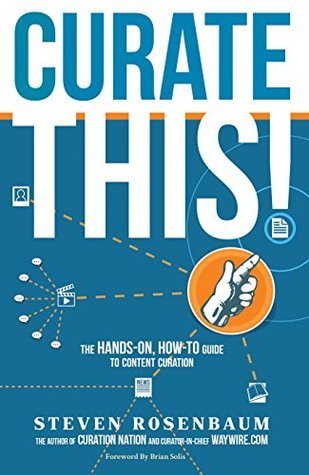
The concept of "Curation" has rapidly moved from museums to mainstream media. As the sheer volume of Tweets, Likes, Blogs, YouTube videos, and emails overwhelm the web, publishers and brands are increasingly being asked to provide a human face to content organization and editorial curation. With the right framework, curation can be a powerful tool to help editorial meet new challenges.
Steven Rosenbaum, Co-founder and Executive Director of the Sustainable Media Center, with a Masters Degree in Truth from the prestigious Gallatin School at NYU, THE FUTURE OF TRUTH, explores the concept of Truth, finds out why it matters now more than ever, and explains how seemingly objective technologies known as Artificial Intelligence are poised to take hold of the concept of Truth and replace human complexity with potentially catastrophic robotic certainty. Published by Matt Holt Books, an imprint of BenBella Books, distributed in partnership with Simon & Schuster, represented by Todd Schuster at Aevitas.
Curation is about selecting, organizing and presenting content. While algorithms can gather content too, a human touch is necessary for brilliant curation. There are several strategies you can use to get your content to your audience and keep them coming back for more, all while establishing your brand as a reliable source of great content.
Actionable advice: Use video!
Video is a great way to give your brand a dynamic presence. If you sell a product, why not curate videos provided by customers sharing their experience with your company? Here, the curation aspect is crucial – a video where a customer describes a negative experience could go viral quite fast! So take care to select video content that you feel reflects your brand at its best.
Suggested further reading:
Everybody Writes by Ann Handley
Everybody Writes (2014) gives you invaluable advice on how to create great content, from using correct grammar to crafting engaging posts, tweets and emails. With just a handful of simple rules, these blinks will help you gain a better understanding of how to use the right words to keep customers coming back for more.
I read this book for some enhancement on my knowledge on content creation, I would say I am not a complete beginner I have been creating content for quite some time.
The main points in this book can be found online and free, I would not recommend this book to anyone that already has knowledge of content creation but a complete beginner may find the explanations of how to go about content creation useful.
Key message - Curation is about selecting, organizing and presenting content. While algorithms can gather content too, a human touch is necessary for brilliant curation. There are several strategies you can use to get your content to your audience and keep them coming back for more, all while establishing your brand as a reliable source of great content. Actionable advice - Use video!
There are a few good ideas in this book, but they are probably available on the website. I read books for deeper investigation of ideas and this book never gets there. It also has quite a few typos and errors.
I started reading it because one of the main ideas I saw in reviews is that human curation is better than algorithmic curation, but it is a minor point, hardly explored.
You might find a few helpful tools listed but the anodyne descriptions didn't help me know the differences between each tool.