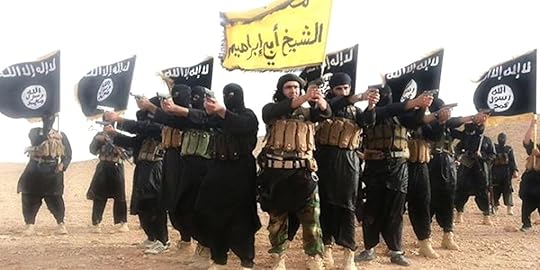
In her part heart-rending memoir, part expose of fundamentalist Islamic terrorism, finance expert Janet Tavakoli bears witness to the incompatibility of Western values and fundamentalist Islam.
In 1978, Janet Tavakoli moved to Tehran with her Iranian husband and witnessed the overthrow of the progressive Shan and the birth of the fundamentalist Islamic Republic of Iran. After fleeing Iran, she followed the expansion of fundamentalist Islam and the spread of terrorism promoted by religious leaders at the highest echelons in the Middle East.
In 1993, she worked in the World Trade Center complex when terrorists detonated a bomb in the parking garage of the North Tower. On 9/11, she watched the news from London as terrorist plane hijackers destroyed the World Trade Center's Twin Towers in New York on 9/11. She has followed multiple acts of terrorism by multiple fundamentalist Muslim terrorist organizations.
Sharia law, embraced by fundamentalists, allows forced "marriages" of female children, oppresses women, suppresses dissent, destroys freedom of speech, and promotes intolerance of other religions.
Tavakoli explains why the insistence of fundamentalist Muslims that sharia law is supreme over Western laws, including the United States Constitution, requires a response from those who believe in, and are willing to defend, the values of Western civilization.
Print edition: 144 pages including front and back matter, references, and 120 pages of text.
Janet Tavakoli is the founder and president of Tavakoli Structured Finance, a Chicago-based consulting firm established in 2003. Internationally recognized as a finance expert, Business Week called her the "Cassandra of Credit Derivatives" for predicting the financial crisis. This profile features her acclaimed nonfiction finance books and business expertise.
Fiction Writing: Author Janet Tavakoli has written the well-received financial murder mystery Archangels: Rise of the Jesuits. She also writes science fiction using the pseudonym Michael K. Clancy, creating the acclaimed Zombie Apocalypse series. She posts fiction updates at: Janet Tavakoli, Science Fiction and Mystery Author.
Media Recognition: She is frequently published and quoted in financial journals including The Wall Street Journal, The Financial Times, New York Times, The Economist, Business Week, Forbes and Fortune. Television appearances include CBS's 60 Minutes, CNN, C-Span, CNBC, Fox, CBS Evening News, Bloomberg TV, and BBC.
Education: Ms. Tavakoli earned a Bachelor's degree in Chemical Engineering from the Illinois Institute of Technology and an MBA in Finance from the University of Chicago's Booth School of Business, where she served as adjunct associate professor of finance.
Structured Finance & Collateralized Debt Obligations (John Wiley & Sons, 2003, 2008): an exposé of grave flaws in the structure, sales practices, and methodology for rating structured financial products.
Dear Mr. Buffett: What an Investor Learns 1,269 Miles from Wall Street (John Wiley & Sons, 2009): the causes of the greatest credit bubble in the history of the world, how we could have avoided it and how we can prevent it from happening again.
The New Robber Barons (2012): Janet Tavakoli's ongoing chronicle of the global financial crisis captured in her articles from the September 2008 meltdown through February 2012.
Nonfiction:Decisions: Life and Death on Wall Street: Janet Tavakoli's nonfiction account of Wall Street skullduggery.
Unveiled Threat: A Personal Experience of Fundamentalist Islam and the Roots of Terrorism: Janet Tavakoli's autobiographical account.
Fiction:Archangels: Rise of the Jesuits: Janet Tavakoli's financial fiction thriller debut.
I can't say enough about how highly informative this book was for me. In a little over 100 pages, I was able to grasp the roots of fundamentalist Islam. The author, Janet Tavakoli shares her personal story of living in Iran in a most dangerous time. How she escaped with a suitcase and $1000 and is grateful for it. Her book starts in the mid-70's in Iran. While I try to follow what's going on with the rise in Islamic extremism, I often feel overwhelmed. There are so many groups intent on "death to America," as well as killings between themselves. Well, there are 41 Islamic terrorist organizations in 24 countries! This book focuses on the beginnings of fundamentalism. From the Shah to Khomeini. From Sunni to Shia. Tavakoli explains just what took place. Why we are where we are now.
For me, one of the most important questions was how Iran reverted so quickly from an emerging modern society to that of the dark ages. The answer is Iran didn't put up a fight. It was inconceivable to imagine the horrors that were to follow. This sounds all too familiar to me. I sit back thinking, this could never happen to me, or to my country. I believe Tavakoli's quote "I am convinced that the worst thing that can happen to any country is to allow Islamic fundamentalists to have a say in government," is crucial. Both president Bush and Obama say Islam is peace, there is no Islamic State. Yet, the evidence is all around us. I certainly don't know what the answers are, but I do think it is time to open our eyes.
Honestly, this book is an important read. One that has given me a real foundation in my understanding of Islam. I highly recommend it!
Disclaimer: The author sent me a free copy of the book in exchange for an honest review.
I think I owe Janet M. Tavakoli an apology because when this book arrived and I took it out of the envelope, I had second thoughts. It’s the cover combined with the size; you can just see an idiot politician waving the book while he or she stands on some stage.
So, I am sorry.
And you know that adage about not judging a book by its cover – its true here. And not just because most idiot politicians (on either side of the aisle) would avoid Janet M. Tavakoli.
Tavakoli’s book is somewhat of a memoir in parts, but mostly a warning, an analysis, a cautionary flare of fundamentalist Islam. And let’s be clear, for Tavakoli is, it is Fundamentalist Islam she is speaking about. Her solution is one America’s earliest documents, so the book is geared towards Americans.
The book starts with fall of the Shah of Iran. It is to Tavakoli’s credit that she doesn’t white wash either the Shah or the interference of America and Britain in Iran’s politics. Tavakoli was in Iran at this time because she was married to Iranian, and she saw (and experienced) the changes that occurred when Khomeini came to power, in particular what those changes meant for women and freedom of speech. The television programming changed (thought Little House on the Prairie was fine) as well as acceptable clothing for playing tennis. Eventually, people are arrested and subjected to show trials. This people include some that Tavakoli herself knew. While Tavakoli does go into some more detail about some trials later in the book, glossing over them in this section seemed a little strange, and a reader can’t help thinking that at least one example wouldn’t be amiss here.
The memoir aspect ends, by and large, with the disintegration of Tavakoli’s marriage, and in her comments on this, I couldn’t help but think of the scene in Atwood’s Handmaid’s Tale when Offred wonders about her husband Luke after the government has transferred all women’s property to their closest male relative.
The rest of the book is largely an introductory look at how fundamentalist Islam affects the countries that have a high incidence of it as well as the dangers for other countries. While doing so, Tavakoli extends beyond Iran, and notes that not only do women in Iran have more freedom today than shortly after the Shah’s fall, but that Iran is liberal compared to some other regimes. She discusses the treatment of women, view on speech, and terrorism. When she refers to a news story, it is carefully end noted, and her information is recent.
There will be temptation by some people to simply describe this book as a thinly veiled hate filled attack on Islam and the Muslim word. Considering that Tavakoli at all times confines her criticism to fundamentalist Islam and actually defines the term, the argument really doesn’t hold. Furthermore, unlike some people that spring to mind, Tavakoli also points out that other nations (and in one case religion) are guilty of some of the same crimes. For instance, when Tavakoli is discussing rape under a fundamentalist regime, she refers to India and the rate of rape in the United States military. The difference, she concludes, is that India and the US contain challenges and corrections to such scandals. Those countries politicians and citizens battle against those conditions because there is third party oversight and no fear of government reprisal, at least not in the same way. She also does point out that in some areas Muslim is attacked for being Muslim. In fact, she gives more space to what is going in Burma (Myanmar) than most news casts.
Is it as well written or as detailed as the work Ayaan Hirsi Ali or Mona Eltahawy? No, and possibly a few books about Islam included in the footnotes would have been nice. If, however, you are looking to introduction into the debate or discussion, this book is a good place to start. It also would be a good companion read to works by Ali, Nawal al-Saadawi, Mernissi, Eltahway and others.
And I would love to read an actually memoir by Tavakoli; I have a feeling it would a fascinating story.
Janet Tavakoli published Unveiled Threat in 2014 based upon her personal experiences and her own research.
Ms. Tavakoli was living in Tehran in the late 70s when the Shah of Iran was overthrown, or caved in as is described, and she witnessed first had the almost overnight transformation of a modern nation to an Iron Age militant theocracy. The dominant theme of the book may be summarized in the following quote:
“The Shah’s biggest mistake was that he didn’t give Islamic religious leaders a cut of the swag. Mullah’s felt they weren’t getting their fair share of corruption, power and profits.”
While Tavakoli concedes that this is not a concise nor exhaustive analysis of the Middle East nor of Islam, this is a scathing and persuasive indictment of much of Islam and especially what seems like a very out front branch of Islam represented by Al-Qaeda, Taliban and ISIS.
To her credit, and contributing to the greater reliability of the book, the author makes concessions about what was wrong with the Shah’s regime and for the West’s self-serving and incomplete policies.
Well researched, but not always wholly objective, this remains a strident cautionary message for a global problem.
The author was born and raised in the United States and moved to Iran with her husband in 1978 as the country was starting to undergo the turmoil that would eventually lead to the Shah being overthrown. She experienced the dangers of being a Westerner in Iran as well as the excesses of the revolution, where the Muslim clerics took absolute power and declared all people not of their religion to be objects of persecution. Tavakoli gives a short history of Iran in the twentieth century before the Iranian revolution, where the Shah’s father rose from a poor man to a man of power. She recounts how the CIA engineered a coup against the elected government of Mohammad Mosaddegh in Iran and how this fueled the anger against the United States that continues into the twenty-first century. Most of the book is a recapitulation of the harsh rule of the Mullahs in Iran, the ongoing battles between Sunni and Shia Muslims, a fight that currently is being carried out in Iraq, Syria and to a far lesser extent Lebanon. Tavakoli openly takes the position that Islam is a harsh religion that oppresses women and advocates the persecution and even deaths of people that do not follow their faith. She describes the brutal practice of clitorectomy in the Muslim community, where the entire female clitoris, including the nerve endings, is removed. This renders the woman almost completely incapable of experiencing sexual pleasure and most of the time the surgery is done with simple tools and the “patient” receiving no painkillers. She also describes the horrific practice where girls as young as nine can be “legally married” in some Islamic countries. Tavakoli’s position is one that will anger many Muslims of both main branches; she expresses the same opinion of the leaders of Sunni Saudi Arabia as she does for Shia-led Iran. She notes that both regimes do the same thing, it is just that the United States is allied with Saudi Arabia and is an enemy of Iran. As an expert in global financial derivatives, Tavakoli understands financial markets, experienced the brutality of the Iranian Revolution firsthand and was in the World Trade Center when it was bombed in 1993. She makes many very valid points about how the Islamic world sees the west and other religions and how the United States should take great care when taking sides and forming alliances in the Middle East. The goals of what appears to be a staunch and loyal ally in that area may not be what it is publically stated to be. This is especially true when the United States is simultaneously opposing the Syrian regime of Bashir Assad as well as the entity known as ISIL. This book was made available for free for review purposes and this review was posted on Amazon.
A unique viewpoint into the struggle between the West and Islamists from the perspective of a woman who experienced first hand the Iranian revolution. The author pulls no punches and no one is spared the spotlight of reality. I really enjoyed this book and it puts current events into perspective.
The author was an Iranian-American who grew up in the US and later married an Iranian and moved to Iran. In this book, she gives us the unique perspective of a person who lived in Iran and had to divorce her husband and flee back to the US. She gives us a run-down on the middle east, Islam, and the terrorists who are spreading throughout the world. Especially noteworthy are her ending comments. She talks about how people chose to come to the US for a better future and freedom. She says that we do have the strength to resist and that we do have a choice. We have already chosen the United States Constitution and we should be prepared to defend it.
The book was very informative and well worth reading.
Interesting story showing the ordeal faced by women in Iran and other strict fundamentalist coutnries. Depressing, not surprising. A bit too depressing to finish.
Janet Tavakoli’s ‘Unveiled threat’ is her personal memoir in an Islamic country, not only it is her eyewitness account to the transition from one rule to other, but also an in-depth study of the fundamentalism in Islam. Before going into details of this wonderfully styled creative nonfiction, let us look into some background of Islamic fundamentalism. Fundamentalists are totalitarian. To them Islam is not a religion, but rather a ruling system without any compromise. Islam is observed as the best ideology, not the best religion and hence the shift is on power. To fundamentalists, tolerance is a word to be found in only dictionary! In countries, they assume power in the clout of democracy and make a mockery of the term afterwards. For example, in Iran Ayatollah Khomeini promised real democracy (an assembly’ based on the votes of the people’). Once in power, he partially fulfilled the promise. Elections were held and parliament didn't have any authority! He himself declared himself as supreme leader and couldn't be voted out of power. Other religious identities simply don’t have any identity under the fundamentalism and it is worse than dictatorship or tyranny! Under Islam woman is considered to be a second class citizen and considered no match with respect to man in terms of intellect, morality and faithfulness. The evil practices of polygamy, child marriage, hijab and degradation of woman in socioeconomic life are rampant under the Islamic law.