Office workers, cubicle squatters, and corporate drones everywhere read Dilbert in their morning papers and see their own bosses and coworkers in the frames of the strip, enacting on newsprint the weird rituals and bizarre activities that are conducted each day in the American workplace. The characters' names and hairstyles have been changed to protect their identities, but Dilbert's readers aren't fooled. After all, they spend every day with these idiots and lunatics.
Jargon-spewing corporate zombies. The sociopath who checks voice mail on his speaker phone. The fascist information systems guy. The sadistic human resources director. The technophobic vice president. The power-mad executive assistant. The pursed-lip sycophant. The big stubborn dumb guy. They're Dilbert's coworkers, and chances are they're yours, too. If you know them, work with them, or dialogue with them about leveraging synergies to maximize shareholder value, then you'll recognize this comic strip as a day at the office, only funnier!
Since 1989 Dilbert has lampooned not only the people but also the accepted conventions and practices of the business world. Office politics, management trends, business travel, personnel policies, corporate bureaucracy, irrational strategies, unfathomable accounting practices, unproductive meetings, dysfunctional organizations, oppressive work spaces, silly protocols, and inscrutable jargon are all targets of Adams's darkly goofy satirical pen. Dilbert strikes a deeply resonant chord with fans because it casts such a dead-on reflection of the realities of the white-collar workplace, even with its off-the-wall delivery.
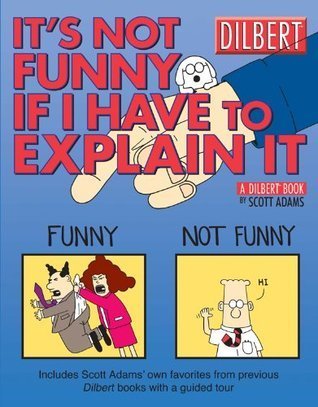
It's Not Funny If I Have to Explain It features Adams's personal all-time favorite selections, along with his own handwritten commentary about the strips.
Scott Adams was a defining voice of the American white-collar experience who transitioned from a prominent cartoonist into a polarizing political commentator. After earning an MBA from UC Berkeley and spending years in management at Pacific Bell, Adams launched the comic strip Dilbert in 1989. The strip’s sharp satire of corporate bureaucracy and the "Dilbert Principle"—the idea that incompetent employees are promoted to management to minimize their damage—resonated globally, eventually appearing in 2,000 newspapers and winning the prestigious Reuben Award. Beyond the funny pages, Adams explored philosophy and persuasion in works like God's Debris and Win Bigly, the latter of which analyzed Donald Trump’s rhetorical strategies during the 2016 election. His career took a dramatic turn during the mid-2010s as he shifted focus to his daily "Real Coffee" livestream, where he combined his background in hypnosis and corporate strategy to comment on the "culture wars." This period of independent commentary culminated in 2023 when he reacted to a poll regarding racial tensions with a series of inflammatory remarks. Labeling Black Americans a "hate group" and advocating for racial segregation, Adams faced immediate and widespread repercussions; hundreds of newspapers dropped his strip, and his publisher canceled his upcoming projects. Undeterred, he moved his work to the subscription-based platform Locals, rebranding his comic as Dilbert Reborn. In his final years, he faced severe health challenges, including stage IV prostate cancer and vocal cord issues, yet he remained a prolific presence on social media. He eventually announced the end of his hand-drawn work due to focal dystonia but continued to direct the strip's vision. Adams’s legacy remains a complex study in the power of branding, the evolution of digital influence, and the volatile intersection of creative genius and political provocation in the modern era.
While I grew up on the funny pages, Dilbert has always been a bit hard for me to understand, both as a kid and as an adult. Even though I've been gainfully employed for nearly nine years, I've never worked in an office; as a longtime library employee, I identify much more with the strip Unshelved. So, while somewhat enjoyable, a lot of the humor here was lost on me, and Mr. Adams' commentary was excessive, not to mention boring after a while. Plus, there were some crude moments, along with occasional bashing of the Christian faith and religion in general. Still, I only paid a dollar for it at a library sale; guess I got my money's worth.
Quite funny. The extra explanations from the author made this collection better that some of the others I've seen. Minor caveat: Too much Dilbert at a time can be depressing. It's just so frighteningly true sometimes.
A great little read. I had a weird obsession with Dilbert comics as a teenager and I particularly loved this volume. Scott Adams commentary gives it a little extra oomph.
Always a fan of Dilbert in general, I tend to prefer Scott Adams's non-comic books. This is a great mix of both - it's a collection of Adams's favorite Dilbert strips, with a little commentary mixed it. Very fun read.
I’m a Dilbert fangirl, so my reviews of Scott Adams’ cartoon collections must be read in that light. It's Not Funny if I Have to Explain It is a thick book (in my case an ebook containing lots of electrons {or bits or whatever an ebook consists of}) containing some of the writer’s own favorites* along with brief comments on each. I am usually bored or even annoyed by this kind of presentation - it’s like admiring someone’s Aran sweater or praising their chocolate cheesecake and being rewarded with an elucidation of the pattern or recipe - but some of the comments were themselves pretty funny. And Adams’ delight in getting an off-color word or reference or implication past the newspaper censors revealed more about him than did the actual cartoons. A must for Dilbert fans, highly recommended for readers who have fought bureaucracy and lost. Once again, it’s impossible to “quote” cartoons but I will cite three which I found funny each time I read them: Wally’s new computer, p115 (47%); Wally jailed, p147 (61%); tech support, p199 (82%).**
*of those published before 2004 **percentages & page numbers approximate.
Great collection, with commentary after each strip by Scott Adams. Mostly he either explains why the strip was funny, or explains what was his favorite thing about it. A few strips were repeats from other collections I’ve read, but there were some I didn’t remember either. Mostly pretty funny. Anyone who has worked in an office setting of just about any type can relate, as long as you had a boss and co-workers. I experienced some of this when I worked as a temp in a variety of office settings, but I could relate to some of it when I was working in a public library too.
Another hilarious scary take on the weird going ons from the office. This time, Scott Adams puts in a line after each strip to help us know what he was thinking when he came up with it.
Good color artwork and good black and white artwork presented in a sequential format. The author in red ink explains every joke. It should be unnecessary.
Hand selecting the strips raises the overall quality a notch. The comments give the sausage makers perspective. I found it mildly interesting. You might not.
A sharp, witty look at the quirks and absurdities of office life, though not quite as consistently hilarious as some of Adams’ best. The humor lands often, but a few strips feel over-explained or heavy-handed, slightly dulling the punch.
That said, the observations on corporate culture, management incompetence, and human behavior are still smart and relatable. Adams has a knack for finding the ridiculous in everyday work life, and most of the time, it hits hard… the kind of humor that makes you nod, laugh quietly, and wince simultaneously.
A solid, entertaining collection… not perfect, but worthwhile for anyone familiar with office absurdities or the Dilbert universe.
Everyone who is part of the corporate world knows how absurd and funny it can be at times.
Dilbert comics, based on office life, are funny because the situations are real. And give us all a voice.
It's Not Funny If I Have To Explain It is a compilation of Scott Adam's favourite Dilbert comics, with his own handwritten notes (tbh, it was just tedious to read the notes and yes, he is right, it's not funny if you have to explain it) After a while I just enjoyed the comics and forgot the notes. I advise you do that too!
Turns out, it really ISN'T funny if he has to explain it. I enjoyed the collection of Dilbert cartoons, but the gag of having cartoonist Scott Adams write a line or two about each strip lost it's charm really quickly. I wouldn't have minded if the practice had been discontinued after a couple of pages. Next time, I'll probably read a compilation without the accompanying commentary.
We all might have started out like Calvin with a great view of life. But after hitting the workforce we all somewhat become Dilbert. Everyone knows someone like one of the characters in the strips. Highly recommended
I've always enjoyed Dilbert books where Scott Adams jots down little notes about the strips. This book is both funny and entertaining on so many levels. If you're a fan of Dilbert, read this book!
Having worked in an office environment for over ten years, I can appreciate the humor of Dilbert. I actually "got" most of his jokes but having the commentary really added to the humor.