Louise Nevelson discusses her thoughts and experience as a sculptor, her travels, family life, and encounters, and the people who have most affected her life and work
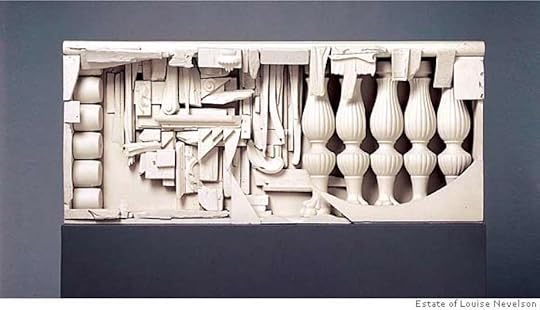
A lovely book with its sumptuous illustrations and extended personal insights and memories of the artist based on interviews. I share a lot of reactions to this 1979 book because it has only had 20 ratings and 5 reviews on Goodreads. But first let me just show you a couple of her works so you can recall her type of genius. If you’ve seen her work, you probably have experienced one of her intricate constructions of wooden forms or one her larger abstract sculptures. Her wooden compositions tended to be painted monotones of black, white, or gold. Here is one of her white ones, which is actually a small part of her room-sized, semi-architectural composition:
“Case with Five Balusters”, from “Dawn’s Wedding Feast” (1959; Museum of Modern Art, Manhattan).
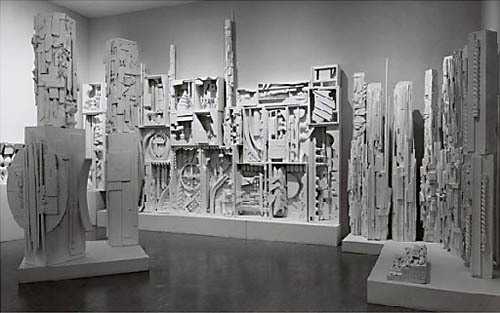
“Dawn’s Wedding Feast.” Though stuck on black for containing all color and being the “only aristocratic color” and calling herself the “Architect of Shadow”, she eloquently justified her move to white in this work” “I feel that the white permits a little something to enter. I don’t know whether it is a mood ..probably a little more light. Just as you see it in the universe. The white was more festive. Also the forms had just that edge. The black for me contains the silhouette, essence of the universe. But I feel that whites have contained the blacks with a little more freedom, instead of being mood. It moves out a little bit into outer space.”
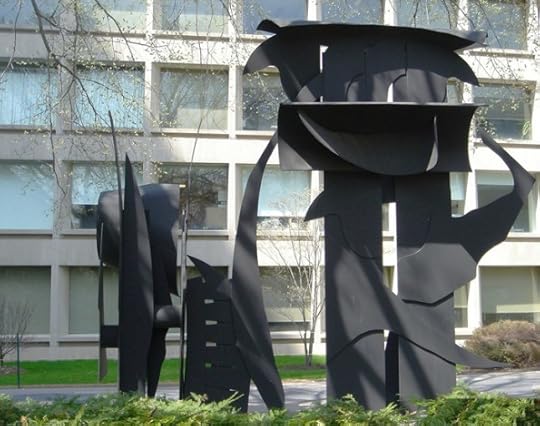
I had the pleasure of one of her large outdoor sculptures in Boston (on the campus of MIT where I was a postdoc; and where a famous professor there, Jerome Lettvin, had the gall to say that the appearance of such art on the grounds reminded him of “droppings from a B52”).
Transparent Horizon, Cor-ten steel, MIT (1975). Nevelson picked this as a favorite of her outdoor pieces. She was happy with how it integrated into the open environment, complemented a nearby piece by Calder, and expressed a playful, feminine perspective in the figures she saw as representing male and female principles.
What is the draw of reading what an artist has to say about her work and life? I found it refreshing to be immersed in such an exuberant, productive life. Though not artistic, I can’t help seeing creative expression in the visual arts as a pinnacle of human achievement. At the same time, the graceful, evocative horses made about 15,000 years ago in the cave paintings at Lascaux make me see such an activity as basic to our evolved human nature (and not an accidental side benefit of cognitive evolution as Pinker and Gould maintained—like “spandrels” in architecture). Thus, if I can’t really create wonderful art, I still might be able to tap into the nature of the creative process by learning of how great artists achieve what they do. From this book I did learn how an artist I admired came to her vision and themes and something of how she achieved it.
Born Louise Berliawsky, she grew up in Rockland, Maine, brought there with her Jewish family from Kiev, Ukraine, in 1903. Her talent in art was evident from a very young age, and already by age 7 she knew she wanted to be a sculptor. Her father’s shipping business brought her into contact at 17 with an older businessman from New York, Bernard Nevelson. After World War 1 she married him, thereby gaining the support she needed to pursue study at the Pratt Art Institute and music, drama, and dance lessons with masters. She had a son, which brought on a long post-partum depression. She eventually concluded her marriage was a prison and disembarked for rather bohemian lifestyle. She liked partying and having affairs, but her work was the core of her existence, as expressed in this set of statements:
I believe in the work and the joy of it. You have to be with the work and the work has to be with you. It absorbs you totally and you absorb it totally. Everything must fall by the wayside by comparison. … Nature—friendship, love, or anything—will not come to such a harmony or unity as you come to in your work. … I am closer to the work the to anything on earth. That’s the marriage. I’ve never had a day when I didn’t want to work. … I just feel that I’m in tune with the right vibrations in the universe when I’m in the process of working. … In my studio I’m as happy as a cow in her stall. That’s the only place where everything is right.
She worked as an assistant muralist for Diego Garcia for awhile, but she was drawn toward the abstract after being bowled away by the showings of Cubist work in galleries and museums. She saw her signature compositions with wood shapes framed in boxes as Cubism taken to the third dimension. Actually, Duchamp’s painting “Nude Descending Staircase” already brought in a third dimension with its timelapse vision, so she sought the fourth dimension. In 1931 she traveled to Munich for mentoring with Hans Hoffman. But already by then the Cubist movement had morphed into Abstract Expressionism while representional art had passed from Surrealism to varieties of Conceptual Art. Nevelson persisted in forging her own path and never associated explicitly with any group of artist or school of style:
My work is bound to be related to that of others. I think what we do is take what we understand of both ourselves and what we see around us. Our very nature makes a selection; it selects which things please you more.
I loved how she characterized the influences on her own work by others’ art, by architecture from modern New York to ancient works from Mexico or Egypt, and by modern dance, which she took lessons in for 30 years. For example, she admits that Picasso provided a foundation for her work and that she would have never found an audience without his precedence. It sounds that like me she sees his “Guernica” as especially seminal. Its showing at MOMA was a “big event” for her:
Because when I saw Guernica, I really feel it touched me as much as any creative painting. Now, why? First, the color. Black, gray, and white. And then the way he used form. The horses, and what he did with them. How he reconstructed the world. Second, that its content and what it told you about humanity was an essence of all times and all places.
Elsewhere she expands upon the meaning of an artist’s embedding in a culture: No matter how individual we humans are, we are a composite of everything we are aware of. We are the mirror of our times. But even if we don’t imitate, say in art, other people, what we have seen and what we have read, what takes place is bound to come through. You get it through books, you get it through the air … no one is in a shell all by themselves. …Whatever we are we breathe the air of the present, you see. … So if you can live in the present, recognize the past, and project a bit into where we are going, that’s great. And my recognition of this is that when I am working, I know that I am working back into time, through all civilizations, and so it gives me a whole foundation where my back can really move.
Here she speaks to her connection to the cityscape of New York: When I look at the city from my point of view, I see New York City as a great big sculpture. …you will see that many of my works are real reflections of the city. I visited Georgia O’Keefe …the mountains are her landscape. Well, New York City is mine.
Here she honors the impact on her of experiencing ancient architecture and sculpture of Mexico and Egypt: Just the visual, to look at the strength of it, the balance of it, the rightness of it, makes you feel that … in the past they would talk about primitive countries. But when you see their sundials and the way everything was done, truly, we are the primitive country. … They were the highly organized ones. They were the sophisticates. According to my book, Mexico and its sculpture and pyramids is number one. It will stand up to anything on this earth.
And here she explains the influence of doing modern dance on her activity when making art: When you know you are creating, you are aware of all life and not one piece of it. …I studied modern dance which uses the body. I became aware of every fiber, and it freed me. So that if I pick up a cup, or I put on something—that livingness is all with the same kind of thinking that I put in my work. It takes as much attention. In other words, I wouldn’t do anything carelessly. I don’t know of a thing that I am not giving attention to. And I do it as a creative act.
Nevelson was lucky to have financial support at the beginning and have enough steady commercial success that she could forge a lifestyle of freedom hard to come by for many women. Here is her take on the rarity of her success in the sphere of male-dominated sculpture:
I feel that through nature I’m totally female. … And then the work I do is feminine. When I work, I don’t work like males. I have never used a ruler to make one piece in my life. It’s too mechanical for me. …Now, most people feel that because of the abundance of work …and it’s rather monumental …they would like to say, you work like a man. Well, that isn’t true at all. That’s a preconceived idea. I don’t think of myself as a strong woman. … I always thought bluntly that I was a glamorous goddamn exciting woman. I didn’t want to be strong at anything. I wanted to have ball on earth. But I wanted it through the channels I want.
She often resorts to a feminine metaphor for the creative process: I think most artists create out of despair. You know, when you’re pregnant, there are the physical pains of labor. But if labor pain is for physical birth, then there is a psychic pain and spiritual for creation.
In discussing her pursuit in marriage by Celine and the oddity of a man who hated Jews to consider wedding a Jewish woman, she reveals some deeper elements of her feminist outlook: I also think we haven’t yet … I haven’t yet, anyway, solved the relationship—the phrase—the battle of the sexes. Now they tell you to love but there’s a constant battle of the sexes. I think that in the sexual act, as delightful as it can be, the very physical part of it is, yes, a hammering away. So it has a certain brutality. I think that is what women are really trying to do, solve that problem. Not to solve it, but to get a closer understanding it. Because even when men have been good to women, well, we’re good to our animals, too.
As I seem to be clinging on her words, I have to remind myself how artists are not often a fount of wisdom on why their work sings compared to the responses and opinions from those in the population of viewers. But like in the Greg Brown song about a man climbing a tough mountain to ask the wise swami what the sacred knowledge was and being told that it would cost $800, I would be the one to ask how much it would cost for half of the sacred knowledge. The following seems on the path to part of that sacred knowledge, and if it does not represent objective wisdom, at least it captures the joy she finds in creation:
I think creation is living. Now one breathes day and night. …Breath and life are together. Well, when I’m working it’s like breathing. …and if I don’t work, I’m not breathing. I have to breathe to live. It was always a relationship—my speaking to the wood and the wood speaking to me. …I’m always there to guide it, but I don’t superimpose, say, a blueprint and it has to be precision and all. I hate that, because that to me is what is what you call dictating. I permit it to move to how I feel, how it weighs and how it moves. In other words, my feeling and the sculpture become one. It’s a love affair, and it becomes one. I feel in principle or in the deep relationship of the vision and the object and the subject that there is a unity and that is is fresh constantly. You make a living thing through your livingness. You move, you live, you breathe, so it enters …enters…enters. Each piece seems to have a life of its own. …It is a new center. Life in total at that particular time. And that’s why it’s right. That reaffirms my life.
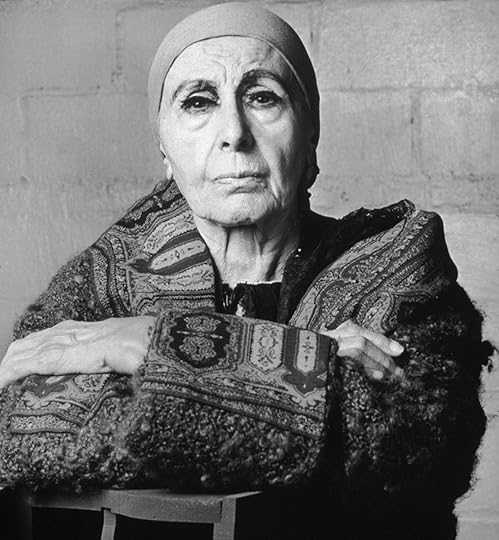
Louise Nevelson in her typical flamboyant make-up and clothes. I love how she explained her style: “My whole life has been a big collage. Every time I put on clothes, I’m creating a picture, a living picture, for myself. …For me clothes and presentation of self is a projection of a total personality. Personally, I’m dramatic, it seems. I like a whole thing …Because if you’re going to put on a show like I do, they don’t know beneath that façade there’s something else. …Why should I be naked before everyone? Let me put it this way, dear, in life you cannot dig for truth in every area. Must there be an answer? You take a flower, and you take every petal, and you won’t have a flower. Keep the flower.”
John Canaday in the Introduction states that Nevelson was "a woman whose presense in a rooom enhances everyone else's sense of his own life." And I recall this as one of my favorite lines" "It's a hell of a thing to be born. And if we're born we're at least entitled to our self." I trust that I am recalling this quote in it's correctly. It's been some years since I've read this rich "gift" from an artist who, for me, is as enduringly monumental as her ouvre. Gotta love Louise!!
"I think that if a woman is gifted and she’s attractive she’s going to have a great time on earth. Why would she want to be anything else? I don’t think of myself as a strong woman. I never even heard that word about me until recently. I always thought that bluntly I was a glamorous goddamn exciting woman. I didn’t want to be strong at anything. I wanted to have a ball on earth. But I wanted it through the channels that I want.”
Nevelson is a genius. I own an old copy of this book, it feels like it was printed in the late 70s or early 80s and the layout and type is reflective of that--in such a good way. I watched a documentary about her in highschool? as a college freshman? It was full of her hacked-into-wood-masterpiece installations and mammoth (and great, which is rare with public art) public art pieces and she is old and chainsmokes and bats huge false eyelashes through the whole thing. She is an endearing and enduring favorite of mine.
To experience the world from the point of view of a major artist is a revelation. Nevelson is one of my favorite artists--her sculptural walls of stacked assemblages of cast off wood--all painted monochromatic black or less frequently, white or even gold to further distance the utilitarian aspects of their provenance--create environments of the imagination even a small child can revel in. But the opportunity to understand how she viewed them, why she made them, and the personality behind the creation, the sacrifices and ferocious focus it takes to be an artist at this level--was mind-blowing.
AS a series of taped interviews, this book gives us the artist's reasons for doing things, the flavor of her mind, the elements of her life that are most important to her. Having read the Nevelson biography "A Passionate Life," I have some idea of the exterior framework of her life, the whens and wheres of her artistic development, her marriage and her relationship with her son--but to see all that from her perspective, what she mentions and what she doesn't--gives a unique portrait of a fascinating woman, the flavor of her great energy, the roaring furnace of her creative mind. Her focus and resistance to the demands of others, her absolute faith in her own vision and willing to sacrifice everything we would call a 'normal life' for the transcendence of art.
I never realized she considered herself a cubist--but of course she was. The influence of Picasso, and the way her art would never be understood if she hadn't been preceded by him. It's not so much about her struggles as the force of her vision.
My impression was also colored by my recent reading of "Monsters: A Fan's Dilemma"--because, having read the biography, I know that Nevelson is nothing if not one of those art monsters. Yet this is her life and reasons as seen from her own point of view. She's aware of her monstrousness--but the urge to create takes precidence over anything else, a willingness to shed everything else in its service of her work, how it feels to be so devoted, committed and plugged into the universal creative life, gives nuance to that charge. This book definitely fits on the shelf with works like The Art Spirit, as well as the biographical and autobiographical work by and about Marina Abramovic, Patti Smith, Georgia O'Keefe and other significant women artists. Art is a grand project, and this offers a unique insight into the mind of art.
Really enjoyed reading this. It's autobiographical. Loved the many examples of how Nevelson "followed her star," believing in herself even when others were not sure what she was up to. I credit Nevelson as an artistic influence and hope that I can one day, through perseverance and quality artwork, join her at the pinnacle of totemic sculpture.
What a delight!! I love artists talking about their lives, philosophies and the way they work. This had all of that plus loads of personality. It is composed of transcripts of interviews and they did a great job editing this in to a very readable book. It feels very personal. Like her or not, you will come away feeling like you know Louise Nevelson.
Torn from what she felt was a safe existence in Kiev, Ukraine and taken to Rockland, Maine which seemed to her to be an alien planet, four year old Leah Berliawsky's name and mother tongue were discarded. She refused to speak for a year and mistrusted language ever afterwards.
Seventy Years later, as world renowned artist and sculptor Louise Nevelson, her words were recorded for posterity by her friend and confidante, Diana MacKown, who transcribed them and created 'Dawns + Dusks'. If you are interested in Modern Art, if you are interested in Abstract Art, If you are interested in what can make a great artist tick, read this fascinating book.