This is the story of how a small SOE unit led by Patrick Leigh Fermor kidnapped a German general on the Nazi-occupied island of Crete in 1944. For thirty-two days, they were chased across the mountains as they headed for the coast and a rendezvous with a Royal Navy launch waiting to spirit the general to Cairo.
Rick Stroud, whose Phantom Army of Alamein won plaudits for its meticulous research and its lightness of touch in the telling, brings these same gifts to bear in this new project. From the adrenalin rush of the kidnapping, to the help provided by the Cretan partisans and people, he explains the overall context of Crete's role in World War II and reveals the devastating consequences of this mission for them all.
There have been other accounts, but Kidnap in Crete is the first book to draw on all the sources, notably those in Crete as well as SOE files and the accounts, letters, and private papers of its operatives in London and Edinburgh.
Mountainous, sunny Crete, birthplace of Zeus and provenance of one of the more unusual ancient Mediterranean cultures, was along with Sicily and Malta a place for European and African cultures to merge in a mix unique to each, and, again with Sicily and Malta, also a strategically crucial location essential in the great battle for the Mediterranean between the Allies and the Axis powers. For the Russians and the Americans this battle was a sideshow; for the British it was a fight to save an empire (and to provide the Russians with some semblance of encouragement in their fight to the death with most of the Axis' military might); and for the Greeks it was a fight for their lives.
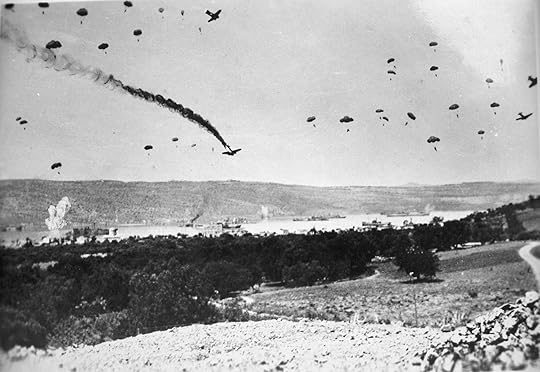
Though paratroopers had played a role in the invasions of Holland and Norway, on May 20, 1941, the Germans set loose the first airborne invasion in history when the initial wave of 17,000 troops dropped out of the early morning sky on an island defended by the ragtag Allied troops that had been able to escape the Greek mainland in yet another Dunkirk. The Germans expected an easy time of it, but they had not anticipated the Cretan people's willingness to sacrifice all to resist the Wehrmacht's intent. It was the first large scale civilian resistance the Germans had faced in the war, and they didn't take it at all well.
Crete, May 20, 1941
Men, women and children hunted Germans with guns, farm implements, even broomsticks with knives tied to the end, evincing a fervor previously reserved for occupying Turks, even though after centuries of Turkish occupation they had a good idea of what the consequences would be. First carpet bombing and then mass executions. After, yes, another Dunkirk the Greeks were left alone with the vengeful Germans, who had direct orders from their commanding general (with Göring's approval) for thoroughgoing reprisals.
Well, not quite alone. There were some 1,000 British and Commonwealth soldiers stranded on Crete by the evacuation (not counting the thousands who had been captured), and various efforts were made to smuggle them out. And there was the British SOE (Special Operations Executive) who were tasked in Cairo to hurt the Axis but also to prevent the Greek communists from coming to power. Amongst this band of classicists, linguists, buccaneers and adolescents past their expiration date was the gifted author Patrick Leigh Fermor. He had already made the long trek from Holland to Constantinople that would later be transformed into the trilogy beginning with A Time Of Gifts (1977), but he wouldn't publish his first book until 1950.
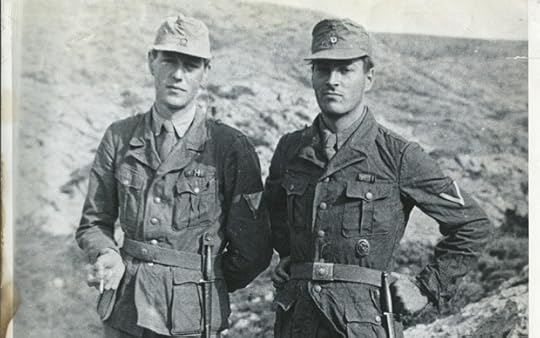
Leigh Fermor (right) and "Billy" Moss disguised as German military policemen on Crete
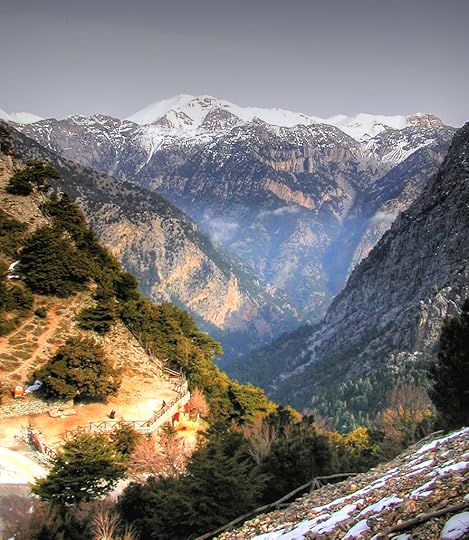
Smuggled in by submarine, the SOE officers began to throw their weight around in the Cretan resistance which had gathered in the most inaccessible mountainous regions of the island whence Icarus once launched his doomed flight (see first photo). But some of them, like Leigh Fermor, had been on Crete during the invasion and had proven themselves to the Greeks sufficiently to be taken seriously. Information collecting and sabotage(*) were the general order of the day, but Leigh Fermor thought up, planned and carried out, with the help of the Greeks, the abduction of the second in command of the German forces on Crete,(**) then whisked him away to Egypt after some very close calls for some intensive interrogation.
With a novelistic story-telling verve and density of detail that speaks well for his research(***) Rick Stroud relates the invasion and occupation of Crete as well as the activities and personalities of the main players in the Cretan underground in Kidnap in Crete (2014). The planning, execution and aftermath of the kidnapping is at least as gripping as the best thriller. Unlike many thrillers, however, the operation does not go off smoothly at all, and Stroud does not overlook the heavy, heavy costs to the Cretan populace. Crete wasn't completely liberated until May, 1945, after VE Day!
(*) The Germans answered each act of sabotage with the execution of groups of Cretan civilians, including a seventy year old priest. The SOE eventually discouraged sabotage; as one of them wrote after the war, "Sabotage was virtually impossible, not because of the difficulty, but because of the small value and the disastrous atrocities which the Germans carried out after the act." The intelligence gathering activities proved to be the most valuable, particularly after the Germans made Crete their main base for supplying Rommel's Afrikakorps and the underground managed to get a brave young woman into the German Kommandantur who smuggled secret papers out to be copied and then smuggled them back in again.
(**) On the way back to his quarters in the Villa Ariadne, built by the archaeologist Arthur Evans during his epoch making excavation of the remains of Knossos!
(***) Much of the German allegedly spoken is ungrammatical, though, which makes me wonder...
Very readable account of the kidnap of General Kreipe in 1944.
Rick Stroud has put together a very accessible account of the initial battle of Crete in 1941 and subsequent SOE instigated kidnap of General Kreipe in 1944.
Stroud’s writing style lends to being able to pick up the book at different times and still be able to pick up the storyline relatively quickly.
I don’t think there’s anything particularly new here, but what you do have is an impartial account of the kidnapping that rightly brings the bravery of the Cretan people to the fore.
The first few chapters of this book started out well, showing the brutality of a forgotten part of WWII, the battle for Crete, but after that the book bogs down in an endless sea of hard to follow details (so many names!) until by the time you get to the actual kidnapping you’re exhausted and are just hoping it will just end soon. A good dose of less is more might have helped.
Thank you to the publishers for providing this book in exchange for an honest review. This did not alter my review in any way.
I feel like when I read I am constantly learning something. This is even more true when I read historical non-fiction. I would consider myself pretty learned on World War 2, my dad being pretty much an amateur historian on the subject, but I didn’t know about Crete’s part in the war, how it was used as a German base and how the Cretan people fought back, built a resistance with the help of some dedicated Brits and then kidnapped a Nazi general from practically outside his house.
The courage and dedication of the Cretan people during the war was outstanding to read. Rick Stroud really brought to life all the key players in the saga, even the abducted general Kreipe, and the Cretan people stood out to me in their quest to protect their homeland. They weren’t going to submit quietly to the Germans even as their threats and devastating actions against the locals increased, but kept building the guerrilla resistance with each Cretan helping out in any way they could, no matter what the repercussions could possibly be.
The writing did, in places, get a little bogged down in details and I found it best and easiest to read when I had absolutely no distractions and enough time to really immerse myself in the narrative. Then I found myself really involved with firstly the set up of what’s happening on Crete at the time of the war (REALLY essential to understanding what happens later on), the characters – real people who actually existed, and the complexity of the plan for the kidnapping of General Kreipe. It’s been argued over the years since whether the kidnapping really achieved anything, but it was the moral booster for the Cretan people (over 400 were involved in the entire operation!) and was considered to be worth the trouble. Stroud explores all details surrounding the kidnap and what came after with clarity and honesty, incorporating multiple primary sources into his research, and leaves it up to the reader to decide what part this kidnap plays in World War 2 history. I was fascinated by the whole affair and in awe of what was accomplished in the rugged mountains of Crete by everyday men who became heroes.
I really enjoyed this read but I also found it easy to put down and leave for a day or two before I felt compelled to go back to it. I found myself reading only small amounts at a time even when I wanted to read more. But it is a fascinating part of World War 2 history and definitely worth the read. Three and a half stars.
This is not a pretty story. The bad guys are depraved Nazis (literally), and the good guys are reckless drunks. That the drunks managed to pull off this caper is a miracle best expressed by one of their Cretan Resistance helpers:
"‘What are you doing boys, you ought to be dead! How did you get through? There are hundreds of Germans crawling all over the mountains, especially where you came down.' He made the sign of the cross and said, ‘God exists and you ought all to build churches—No! Cathedrals! You are lucky to be here my children.'"
And this was still two weeks before the kidnap party made it through the ever-tightening snare of Nazi soldiers advancing on them with machine guns, grenades, whips and torches, murdering villagers when innocent humanity was all they were able to find.
The book reads like a thriller, although it is marred by way too many typos that slipped by the editors like the kidnappers slipped by their pursuers. Another vexing omission was marking on any of the three small maps the locations of all of the village names cited in the text. I commend the final follow-up chapters telling us what later happened to the men who survived the abduction event. But we are left with more sadness than hope about what war does to people—both those who impose it, and those who must defend against the first.
If this book had been my introduction to this story, I'm sure I would have found it very exciting. As it was, having seen multiple documentaries and read numerous accounts from different perspectives, it was mostly a review of events I had already been astonished by. If, though, you haven't learned about what happened in Crete in World War II yet, this is a well researched and well told account of some of those events. Stroud has done some artful crafting in how he unfolds the events. For example, the first death during the Nazi attack that he recounts in detail happens from the point of view of a British soldier watching a paratrooper on a fence disappear as he is dragged behind it. I won't spoil what happens behind that fence but I will say the Cretans in World War II were seriously bad ass.
OK. Stroud wrote an interesting story out of rather irrelevant episode from WW2. But then it is in hindsight. Only if the British, with US support, could have send more substantial forces to back the Greeks and Cretans.. Maybe he should have discussed more about diplomatic defeat on the part of Britain in 1944, with the US singularly focusing on Overlord. Ultimately, the kidnapping only brought German reprisals, with grave humanitarian consequences and did not change anything strategically. Also, as Crete was used as the air base for the Luftwaffe, making British naval communication between Egypt and Malta almost impossible in the years 1941-42, I wonder if there was any attempt or even planning to hit airfields in Crete, which could have made real difference. Wish the author had investigated on this point too.
This book goes hand in hand with Chris McDougal’s Natural born heroes. I love the island of Crete so it’s easy for me to picture the scenarios painted in this book. It is a great tale of heroism, perseverance, endurance and…..well… Britishness. An easy to read gripping war story of a daring raid in the Nazi lair.
Interesting because not many remember the Nazi occupation of Crete and how brutally the Nazis treated and killed the inhabitants. But the Crete people are strong and determined. Some of the later chapters bogged down with the running and hiding but a good piece of history
A true story. Lots of historical and general information. Weaponry, transportation (ie: German Junkers Ju 52s) and locations on Crete are mentioned often. A few lines in other languages too.
German parachute and air landing forces landed on Crete. * = villages destroyed in reprisals. Invasion Group West (Marlene, Kondomari * Chania, Suda, Kandanos * and the White Mountains) - airfield which was crucial. Invasion Group Centre (Rethymnon, and the Kedros Mountains). Invasion Group East (Heraklion, and the Dikiti Mountains). The kidnapping of a German general occurred on the night of 26 April, 1944.
Germans landed on Crete via parachutes, where if the impact didn't kill them they were met with furious Cretan civilians with any weapons they could find. Stuck knives to the ends of broomsticks, dug out old guns from graves and gardens. The Cretans hated the Germans, whereas they treated the British officers with much care, food and hospitality. Even risking their lives to help the British.
"Cretan's stalked out wells, waiting for the soldiers, who they knew would be desperate for water; it was a trick their grandparents had learnt in the uprising against the Turks."
"These people were fighting with farming tools. Even broomsticks. They would tie kitchen knives to them and use them as spears."
German World War II Codenamed Operations: Operation Mercury: 20 May 1941. Unternehmen Merkur - the conquest of Crete. Operation Sealion: September 1940. Seelöwe - the invasion of England. --- Operation Husky: 9 Jul 1943 – 17 Aug 1943. The Allied invasion of Sicily, codenamed was a major campaign of World War II, in which the Allies took the island of Sicily from the Axis powers.
British World War II Organisations: ISLD: Inter-Services Liaison Department. SOE: The Special Operations Executive. RAF: Royal Air Force.
Andartes: Greek Resistance, from 1941-1944.
Guerilla: a member of a small independent group taking part in irregular fighting, typically against larger regular forces. - synonyms:freedom fighter, underground fighter, irregular soldier, irregular, resistance fighter, member of the resistance, partisan.
Morse: an alphabet or code in which letters are represented by combinations of long and short light or sound signals.
Aera: Like the Wind - the battlecry of the Evzones, the elite troops who had fought for Greece since the middle of the nineteenth century.
Drachma was the type of money used.
Deutsche Wörter (German Words): Fallschirmjäger: paratroopers. Fallschirmjäger Adler - Storming Eagle jump badgeinfantryl wreath of oak leaves. Kapitän: Captain. It is also a shortened version of several ranks in the German navy, ranging from Korvettenkapitän to Kapitän zur See. RZ2O Ruckenpackung Zwangauslösung 'rucksack packed to open.' Luftlandesturm: Airborne Assault. Gebirgsjäger: The light infantry part of the alpine or mountain troops (Gebirgstruppe) of Germany and Austria. The word jäger (meaning "hunter" or "huntsman") is a characteristic term used for light-infantry or light-infantryman in German-speaking military context. Luftflotte: air fleet. Festungskommmandant: Fortress commander. GHQ: German headquarters. German NCO: Feldwebel, literally "field usher", is a non-commissioned officer rank in several countries. The rank originated in Germany and is also used in Switzerland, Finland, Sweden, and Estonia.
Un petit peu... Langues. Français: "Mon cher ami, permettez moi de vous appeler moi" = My dear friend, allow me to call you friend.
I was hoping it would be more descriptive of the island that I will be visiting next year, but it was all just war stories, which doesn't interest me much. Interesting history lesson though.
This book provides a valuable, short history of the German invasion and occupation of Crete, and the islanders' fierce and effective resistance to that occupation, and then (for my purposes, as a Patrick Leigh Fermor obsessive) gives a good overview of Leigh Fermor and Billy Moss' operation to capture General Kreipe, commander of the Heraklion garrison, second in command of the German forces. As I noted in my review of Abducting a General: the Kreipe Operation in Crete, the whole operation, especially as recounted by Leigh Fermor, smacks of an "Asterix and Obelix" comic, but in this version, the Gauls get tortured and shot, and the Romans get their throats cut. While the whole operation had zero strategic value, and certainly led to increased reprisals, it seems that it was wildly popular with the Cretans themselves.
James Bond antics come to life in a real life escapade.
At the beginning of WWII, Britain had approximately 40,000 soldiers on the island of Crete. The British were waiting for the Nazis to invade the island by sea but were surprised by the air assault. Britain retreated to the sea and escaped on boats to Egypt. This is the unknown Dunkirk. Unfortunately, 17,000 British soldiers were left behind. Most were captured but many others fled to the mountains to hide. The Cretans were British allies and hid the soldiers and formed a powerful resistance force.
Patrick Leigh Fermor was an SOE British agent/soldier. He had been on Crete before. It was the SOE plan to kidnap the barbaric Nazi general on Crete, but he left the island. In his place was another Nazi General Kreipe. The plan was the same. Kidnap him with the aid of the Cretan resistance fighters and whisk him to Cairo. In 1944 the plan was executed. Patrick Leigh Fermor and Billy Moss, both British SOE agents/soldiers landed on Crete and with 10 Cretan fighters kidnapped the General. Then for a month (or so?) they hiked across the mountains of Crete to a beach where the British navy would rescue them. As Leigh Fermor stated, it was "as if Sheriff of Nottingham was being led bound into Robin Hood's lair in Sherwood Forest". There were more than 400 Cretans who knew of the plan and assisted the raiding group with shelter, food, and guides. At times, they were close, too close, to German soldiers who were looking for them.
Exciting story of espionage and bravado. The author used many of the participants story as the source, and when they conflicted, he used that as well.
The battle for Crete between Allied Forces and Germany ' s invaders in 1941 was one of the low points of WW2 from a New Zealand perspective. I had a personal connection as I opened the story that is called Kidnap in Crete as my father was a member of New Zealand's 22nd Battalion. Their role was to defend Maleme airport at the Western end o the island. However they were poorly served by their commanding officers and the fall of Maleme was the critical ingredient that allowed for a German success, following their early efforts by parachutists and gliders which resulted in a high toll of casualties. Although this battle for Crete is only the entree to the kidnapping of a German General it u probably the best and most objective telling of what happened at the end of May 1941. The abandonment of resources and thousands of men certainly wasn't the Allies finest hour, what followed was a cruel and hard nosed occupation by the Germans over the Cretan population, the Allied prisoners of war, the uncaptured soldiers and the resistance fighters. The rule of thumb enacted by the Germans was the slaying of ten locals for each German casualty. A plan against this back drop was mooted and subsequently approved to kidnap General Kreipe and spirit him off Crete. The second half of the book details the planning and execution of this daring mission. While this is a true story it can't help but read like an Alan Furst or John Le Carre novel.
I am unfamiliar with the Cretan campaign in World War 2 but after reading this book have really wanted to learn more. The Cretan resistance to the initial German invasion is covered well , though was left unsure why the Germans hadn't anticipated vehement opposition. Was it arrogance or bad intelligence? The parts about the kidnap of General Kreipe on 24th April 1944, by a joint working party of SOE and Cretan resistance, and being on the run with him as a prisoner of war, then smuggling him off the island , is a jolly exciting reading. Really felt that the writer knows the geography of Crete well. It was courageous venture and it's a tribute to the people of Crete that the abductors were not betrayed. General Kreipe fell off a mule injuring himself and seemed to have the wrong shoes on for having to march over mountains, and other such details make the book a lively read. Yet I kept feeling that I missed a section of the book somewhere- what was the military advantage in kidnapping Kreipe? He was not another Heydrich -Kreipe was not about to unleash the Einzatsgruppen .The abductors left a note maintaining that no Cretans were involved in the operation, hoping to deflect reprisals against the civilian population...though the German authorities did in fact retaliate. The consequence was that the Cretan resistance was certainly boosted and German prestige damaged but was still left unsure why the operation begin in the first place. Comment Comment | Permalink
The Nazis occupied Crete during World War II. The Cretans courageously did not just allow the Nazis to overcome. They fought back and suffered retaliation for it. This story is about how a resistance group called the "Andartes." and some Brits kidnap a German general and the perils they faced. The Andartes supported the current government, and at the same time they were fighting the Nazi's there was a civil war against Communists who were tired of the corrupt elite government. But this story focuses on the kidnapping.
I selected this book because I am going on holiday in Crete and I wanted to know a bit more about this Island before to go. This book is very well written, with some maps to localise the cities mentioned. The story is interesting and well describe. Nice book if you want to know more about the histrory of Crete.
A dashed good re-telling, certainly more comprehensive one, of a story that has already been told by two of its main protagonists.. where Mr Stroud scores in is telling the Cretan side of the story too..
Great book about the island I called home for 2 years. So, glad I got to learn more about the history of the people of Crete. Amazing people, amazing spirit!
A true account of the struggle of all the inhabitants of Crete during Nazi occupation after being left to defend themselves after the British retreated, not unlike Singapore. Many British servicemen left on the Island became POW’s. The account gives great insight into the Cretan resistance, a constant source of angst to the Nazis. The account also gives wonderful descriptions of the mountainous terrain and obvious beauty of this country. Any reader not familiar with Crete will be enriched and more knowledgeable about Greek Mythology which is deemed to have had some of its beginnings in Crete. Whether the abduction of this German not so important Officer bore any real results is debateable. Rather, the English Soldiers involved in the kidnap appear to be in the main men one could describe as “adventurers” and with little concern regarding the hundreds of people killed in retribution. After all, the war in its entirety was coming to an end with Allied victory well insight. Like many returning soldiers who had experienced thrilling and dangerous lives during the war returned home to a mundane unrewarding existences. Books are written and some acknowledgement is recognised by the wider public, however each persons memory can differ so much.