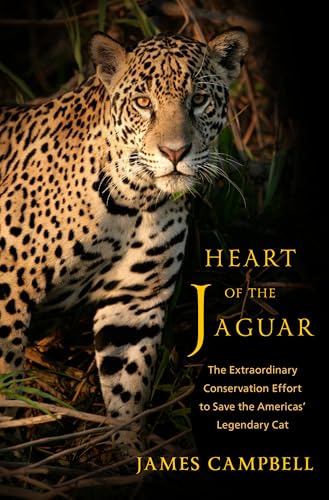
A fascinating story of the movement to protect the jaguar, and the man who devoted his life to saving the species.
Once indigenous to North America, the jaguar is the largest cat in the Western Hemisphere. A resilient and efficient predator, it is one of the wildest creatures left on the planet. However, one million years after it appeared in the New World, the species is struggling to survive.
Heart of the Jaguar tells the story of the extraordinary undertaking to save the jaguar, which began in the jungles of Belize in the 1980s, and more than a decade later became the Jaguar Corridor Initiative. James Campbell tracks the legacy of Alan Rabinowitz—“the Indiana Jones of wildlife ecology”—a formidable but damaged man who fought for the corridor that now extends 8,000 latitudinal miles. From the Bering Land Bridge to pre-Columbian jungle temples adorned with jaguar sculptures to the internet, ferias, and jaguar preserves, Heart of the Jaguar takes readers across two continents in search of the jaguar’s past and present—and its future.
When El Jefe, as the big cat became known, crossed the border from Mexico and entered Arizona, he was only the fourth jaguar to be sighted in two decades in what was once prime territory for the animal. What was even more remarkable was that he stuck around until at least 2015 despite reported encounters with hunters and their dogs, wildlife biologists, and even possibly a few eager conservationists who kept silent about their sightings. The name, El Jefe (which means Boss in Spanish), evolved from a contest conducted with the help of students of a Tucson middle school from five proposed by the voting public. Twenty-one million viewers in the U.S. saw a video of the jaguar produced by an Arizona conservation group. The final trail photo sighting of El Jefe was taken in the fall of 2015. Most authorities believe he headed back to Mexico in search of a mate. These magnificent big cats once ranged from the western United States and down through Mexico and Central America to the tip of South America. Predation, encroachment on habitat, and other factors continue to endanger the survival of the jaguar. As Campbell notes, "Currently, a quarter of all mammals, and an eighth of all birds, are classified as threatened with extinction." Campbell's book is an engrossing story of adventure, science, and the efforts of dedicated conservationists and individuals working against great odds to save the jaguar from extinction. The author was inspired by the work of individuals like the late Alan Rabinowitz, Howard Quigley, as well as others who follow in their footsteps, continuing the fight. Campbell took personal risks, venturing from the deserts of the American Southwest and Mexico to the steaming swamps and jungles of South America, for an opportunity to glimpse a jaguar himself and to document the work of those striving to save the talismanic creature once feared and worshiped by indigenous peoples throughout the Americas. It's a story well-told and worth telling.
Much ink has already been spilled in books about jaguar conservation and the late great Dr Alan Rabinowitz's pivotal role. In fact, the man wrote a book all about it An Indomitable Beast: The Remarkable Journey of the Jaguar, which I highly recommend if you had to choose just one book about the subject. Campbell is also the second person to write extensively about the man, the other being Rabinowitz's close friend Jane Alexander. Thus, it were the parts about the author's own journeys into jaguar territory in Costa Rica, Bolivia, Brazil and Mexico that are novel and more captivating. Obviously Campbell's accounts of his experience following researchers doing field work aren't anywhere as dramatic as Rabinowitz's personal adventures, but there are beautiful descriptions of landscape that make it worthwhile.
There was quite a great deal about the appearances of jaguars in Arizona and the political infighting with the government and NGOs over what to do that was overly detailed for me. I also wished that the author had visited Argentina's jaguar reintroduction program, but this was only mentioned briefly at the end when the idea was broached for reintroduction into the U.S. Lastly, Campbell isn't a biologist, so there are occasional factual errors. Some maps would also have helped orient the reader on locating the stories told.
For the Lovers of Jaguars and other big cats, this is an amazing journey through the history of the preservation efforts dedicated to these majestic animals. from the very first exploration of their territories, to more modern attempts at learning everything we can, this book has it all, along with enchanting takes of jungles, heartbreaking stories of loss and failure, and the ever indomitable spirit of the magnificent big cat. you'll learn of one of the most famous ones, El Jefe, a jaguar that once made it's home in Arizona before vanishing as if it had never existed, to the animals hidden away in the deepest Mexican jungles. there is no denying that the Jaguar is one of the most elusive, beautiful, and mysterious animals on our planet, and this book sheds light on the years of struggles to preserve, protect, and change the fates of these amazing animals.
I wanted a book on jaguars, and ended up with a book on a jaguar scientist, that I'm not gonna lie, I did not particularly enjoy very much. The author did acknowledge that these stories were connected, but I feel like they could have been connected slightly less. I'd have much rather still gotten more about the jaguars.
I also think that the writing felt slightly confrontational, and slightly dismissive of some of the native peoples of the lands that this conversation is taking place in. I can't say I particularly liked many of the people in the book either, although that one isn't the author's fault. I had to basically force myself to finish it, and only because I was doing a reading challenge.
Mention big cats and most people think of African lions, leopards, and Asian tigers. The American version is the elusive and mysterious jaguar. I love how James Campbell weaves together the past and present history of the iconic species, and the international efforts to protect and preserve the jaguar in its native habitats. One of the first books on jaguars was Jaguar: One Man's Struggle to Establish the World's First Jaguar Preserve (Alan Rabinowitz). Rabinowitz figures prominently in Campbell's book, and his accounts provide insight into the trials and tribulations faced by Rabinowitz and others as they sought to study and track jaguars in the wild. Those men persevered and survived against great odds. Like the Rabinowitz book, Heart of the Jaguar is a must read.
El Tigre it's called, a mystical and charismatic wild cat of the animal kingdom. In Heart of the Jaguar, Jim Campbell captures the magic through hard-nosed research as he unravels the mysteries of Panthera onca. The author invests years in tracking jaguar movements in stressful conditions with biologists in South America,Central America, and the U.S. Southwest, many who dedicate their careers to jaguar preservation. The book captivated me as the author knows how to write, threading the needle between the jaguar's biography, the science, and personal narrative. A+ and then some.
absolutely loved this book. I learned a lot about jaguar ecology, conservation, and the efforts of many people and organizations to save this species and its habitat across its range. it was a fascinating story with amazing characters who have dedicated their lives to this incredible and secretive animal. also, I went to grad school with Allison devlin, who is not only highlighted in this book, but who now serves as Panthera's deputy director of the Jaguar program. so cool.
I would like to thank Netgalley and the publisher for providing me with an audio ARC.
This was a fantastic book. It was very fascinating to listen to. I really felt that I could walk away with more information on jaguars, the conservation of these animals, and the history of the conservation efforts. I felt that information that was provided was clear and presented in an interesting way. The narrator also did a great job on this book and I thoroughly enjoyed listening to this book.
I can't remember discussing jaguars in any of my wildlife biology classes. Some of the conservation efforts were similar to those done for the Florida panther. It was an interesting book and now I have another big cat to be fascinated with. Read my full review at Girl Who Reads.
Meticulously researched & superbly written, the author draws on ecological, historical and political influences for a fascinating account of efforts to save this beautiful animal. Highly recommend.
Wildlife biology might be my favorite genre, but this fell a bit more into wildlife biologist biography, and left me wanting a lot more knowledge of the cats themselves.
Great read! I learned a lot about the plight of the jaguar in the modern world. I also loved learning about the life of Alan Rabinowitz who went to my Alma mate McDaniel College (Western Maryland College). It was truly inspiring!
I really liked this book in the beginning. I loved reading about jaguars and other big cats. There is also a lot of other information in the book, which, I understand why it's there and it's important but I really wished there were more stories of the big cats in it. About halfway through, I noticed less about jaguars and more about other people anf places. It's a really good information book and I recommend it to those interested in the topics talked about. Thank you to the author, James Campbell, W. W. Norton & Company and Goodreads for my free advance reading copy. Happy reading! 😻