Jump to ratings and reviews
Rate this book

Nietzsche na Itália: A Viagem que Mudou os Rumos da Filosofia

Rate this book
"Como posso ter suportado viver ate agora!" A reação de Nietzsche logo que chega a Sorrento resume de forma categórica a importância da sua primeira viagem ao sul.

O impacto da descoberta da sensualidade e alegria despreocupada das pessoas, da luz, da força solar da região, em contraposição ao que chamou de "almas artificiais" do norte, é uma revolução em sua vida, em seu pensamento e na filosofia em geral.

Ele chega à cidade italiana como um jovem professor de filologia, com esgotamento mental, e parte revigorado, um filósofo de espírito livre. É na viagem a Sorrento que Nietzsche rompe intelectualmente com Wagner e começa a escrever Humano, demasiado humano.

Especialista na obra de Nietzsche, Paolo D'Iorio refaz - através de cartas, documentos e anotações suas e de seus companheiros de viagem - a trajetória do filósofo alemão na viagem que mudou sua vida e os rumos da filosofia.

"D'Iorio nos oferece um dos melhores livros já feitos sobre Nietzsche, cheio de aromas e cores." L'Express

"O livro é a descrição detalhada de uma metamorfose, uma pausa na vida e no pensamento de Nietzsche, uma 'crise' da qual nasceu a 'filosofia do espírito livre'." Libération

"A metamorfose de Nietzsche apresentada em termos simples, concretos, sem jargão; em todos os aspectos um livro digno do filósofo dos espíritos livres." Valeurs actuelles

216 pages, Paperback

First published June 7, 2012

7 people are currently reading
108 people want to read

About the author

Paolo D'Iorio

8 books1 follower

Ratings & Reviews

What do you think?
Rate this book

Friends & Following

Create a free account to discover what your friends think of this book!

Community Reviews

5 stars
14 (25%)
4 stars
24 (42%)
3 stars
15 (26%)
2 stars
2 (3%)
1 star
1 (1%)
Displaying 1 - 12 of 12 reviews
Profile Image for Philippe.
765 reviews728 followers
October 11, 2019
In this study, D'Iorio zooms in on a pivotal episode in Nietzsche's biography. His 6-month sojourn at the Villa Rubinacci in Sorrento - from late October 1876 to early May 1877 - followed shortly after the grave disappointment of the first Bayreuth Festival.

Bayreuth, August 1876, is when Nietzsche dropped the mask and gave free reign to his anti-Wagner, anti-metaphysics, anti-Schopenhauer and anti-establishment sentiments. These mental upheavals, compounded by chronic ill-health, prompted him to ask for an extended leave from his university post in Basel. For the very first time, he travelled to the South to rebuild his strength and give birth to his 'Philosophy of the Free Spirit'.

D'Iorio takes great care to put the emergence of this naturalist way of thinking in a proper perspective. He dismisses the three-phase chronology that is frequently used to summarise Nietzsche's intellectual development and which relegates the 'positivist', free spirit middle period to the status of an intermezzo between the dithyrambic fervour of the early 'Birth of Tragedy' and the late 'Zarathustra'. Instead, he argues that Nietzsche's philosophical opening gambit, as evidenced by his writings before his Basel appointment, took its cue from the materialism of the ancient Greek philosophers such as Democritus. Seen from that vantage point, it is Nietzsche's metaphysics of art that is out of tune with the long-term guiding spirit of his philosophical project.

This is a revealing point, but the book offers more. It gives readers a feeling for the way Nietzsche's thinking emerged from the images and sensations that he absorbed during his sojourn. At Sorrento, Nietzsche spent his days mostly in the company of just three friends: Malwida von Meysenbug, Paul Rée and the young Albert Brenner. They passed the time reading, writing, walking, and indulging in excursions along the Amalfi coast. It gave Nietzsche plenty of exposure to the genius loci of his Mediterranean abode. It is almost moving to see how hurried jottings - numerous examples included in the book as facsimiles - were polished and deepened in Nietzsche's drafts and correspondence. As an example, this is one of the entries in the Sorrento notebooks:
"Sunlight glistens on the ground and shows what the waves flow over: craggy rocks. What matters is how much breath you have to plunge into this element: if you have a lot of it, then you'll be able to see the ground.
The glistening sunshine of knowledge cascades through the flux of things, down to their ground."

And this is how it appears in Human, All Too Human:
"The free spirited, men who live for the sake of knowledge alone, will find they soon attain the external goal of their life, their definitive position in relation to society and the state, and will easily be content with, for example, a minor office or an income that just enables them to live; for they will organize their life in such a way that a great transformation of external circumstances, even an overturning of the political order, does not overturn their life with it. Upon all these things they expend as little energy as possible, so that they may dive down into the element of knowledge with all their accumulated strength and as it were with a deep breath. Thus they may hope to dive deep and perhaps get a view of the ground at the bottom."
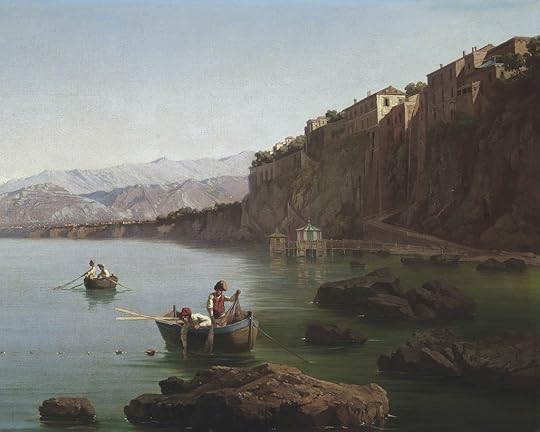
Images emerge that assume a role as a motto theme in Nietzsche's later works. He found inspiration for the Blessed Isles, prominent in Zarathustra, in the Isle of Ischia, visible from the terrace of the Villa Rubinacci. D'Iorio devotes a full chapter to the bells of Genoa, a potent, aurally mediated epiphany that struck Nietzsche during his journey back to Basel. It's a startling image that resonates through the whole of Nietzsche's mature oeuvre.

Nietzsche's extraordinary sensibility, his poetic and dramatic gifts and mastery of language turn this book into a genuine treat for all readers interested in how philosophical ideas take root in the crevices of thinkers' daily lives.

description
701 reviews78 followers
August 18, 2016
Muy interesante ensayo biográfico sobre el periodo en el que Nietzsche estuvo en Sorrento. El libro es muy bueno relacionando los datos biográficos del filósofo con sus escritos, justo en un momento en el que cambia su línea de pensamiento y concibe el Zaratrustra, cuyo concepto del eterno retorno está muy bien explicado aquí.
Profile Image for Clarke Bolt.
50 reviews5 followers
February 1, 2021
Wow. A true mountaintop. A beautiful work.

“‘Just now my world became perfect; midnight too is noon.’ The eternal return thus unites the perfect world, filled with happiness of noon and its reassuring bell of immanence with the nihilism of midnight: if you have said Yes to a single instant of pleasure, then you have also assented to the midnight bell and to all of the woe that it carries with it. Day is stronger than night, affirmation than negation, pleasure than pain. It is for this reason that the phrase, ‘the world is deep, deeper than day had been aware’ is first uttered when Zarathustra speaks of the azure bell, in the chapter ‘Before Sunrise’ and is later repeated in the round of the midnight tenor bell.”
Profile Image for mary.
1,472 reviews34 followers
January 9, 2022
eh um ensaio bibliografico interessante e contribui bastante p quem se interessa p obras de nietzsche. o conteúdo apesar de não ser o mais interessante de todos tem sua profundidade necessária e na medida em que eu esperava encontrar. gosto do autor e gosto da italia, foi interessante entender sua passagem.
Profile Image for Macarena Castro.
9 reviews
Read
October 6, 2024
Así es como se escribe un libro sobre Nietzsche.

Los italianos sí que lo saben leer: Montinari, Colli, Barbera, Campioni, D'Iorio, Brusotti.

En este estudio sobre el viaje de Nietzsche a Sorrento, en el 1876, se examina, a través de primeras fuentes, un año decisivo en el camino espiritual del filósofo, en que la biografía es siempre un instrumento de interpretación de la obra.

Después de años ejerciendo como académico de filología clásica en Basilea, después de la desilusión que significa Beyruth y el inicio del quiebre con Wagner, en un ambiente de libertad y afinidad intelectual, junto a Malwida von Meysenbug y Paul Rée, entre otros, un Nietzsche buscando la salud, aquejado hace años de migrañas que lo postran y ciegan, rompe con Schopenhauer y la metafísica de artista que caracteriza El nacimiento de la tragedia, las intempestivas y su rol propagandista de Wagner –que lo incomodaba– para abrirse paso, desconcertando a sus amigos, hacia el espíritu libre, fase de su pensamiento inaugurada por Cosas humanas, demasiado humanas (la explicación de esta traducción en desmedro de la habitual es muy persuasiva), que representa, según D'Iorio, "su verdadera naturaleza espiritual", y no simplemente un paréntesis en su desarrollo.

Una gran investigación, que, siguiendo un trabajo filológico serio, y con una escritura amable, ubica la vida y la obra de este pensador tan caricaturizado (sí, es verdad, partiendo por él mismo), en una relación que eleva su pensamiento al tiempo que lo vuelve, a él, más humano.
Profile Image for Haymone Neto.
330 reviews5 followers
November 12, 2023
O livro não é exatamente sobre a viagem de Nietzsche à Itália, mas sobre como o autor rompe com o seu pensamento inicial e com o círculo wagneriano para desenvolver a filosofia dos "espíritos livres" a partir da passagem pelo país.

D'Iorio mostra de que modo a viagem à bota, em especial os dias em Sorrento, foram cruciais para o desenvolvimento das ideias que mais tarde estariam em Humano, demasiado humano e em Assim falou Zaratustra, e marcariam uma guinada no pensamento do filósofo (que, até então, se via como filólogo).

As fontes do autor são principalmente as cartas enviadas e recebidas por Nietzsche no período e os cadernos de anotações preservados. É um trabalho de muita profundidade, realizado por um grande especialista na obra de Nietzsche, mas que foi "empacotado" quase como um livro de viagens. Em todo caso, vale muito a leitura, especialmente para quem já conhece a obra do filósofo (infelizmente, não é o meu caso).
Author 20 books23 followers
January 20, 2019

Following his disillusionment with Wagner at Bayreuth, Nietzsche renounced the redemptive metaphysics of Art and traveling south to Italy, began to develop his mature philosophy of immanence. It is within the transient, the mortal, the historical, the embodied that meaning and value is to be found- down with the eternal and the transcendent! "Evil I call it and misanthropic: all this teaching of the One and the Plenum and the Unmoved..All that is imperishable - that is only a symbol! ...it is of time and becoming that the best symbols should speak: let them be a praise and justification of all that is perishable!" (Thus Spoke Zarathustra)
Profile Image for Sue.
325 reviews4 followers
October 9, 2020
Recommended to help "understand" Nietzsche and the period in his life that gave rise to his writing The Gay Science, currently the subject of our seminar's study. Is there such a thing? To the extent that the work proceeds chronologically, that it has characters who are recognizable as real people and act the way real people act, and that it is set in a landscape of which I'm tremendously fond, at least this was readable and a pleasant way to pass an autumn afternoon. Would that Nietzsche's own writing were so.
Profile Image for Caroline.
123 reviews
October 1, 2021
a careful exploration of Nietzsche's transition from Wagnerian/Schopenhauerian aesthetic thought to his own brand of the free spirit/will to power, looking at his letters and his friends' memories of a trip to Sorrento during which this transition began in earnest.
420 reviews
January 23, 2020
The last 50 pages were brilliant and worth reading all those personal letters that came before. Brilliant enlightening analysis. Fantastic.
Profile Image for Ietrio.
6,948 reviews24 followers
December 23, 2016
A nationalist bureaucrat has chosen a well known name and that name's relation with some place the author also had some remote relation, like the place where his dog has drowned or something. In large, this is a rewrite of N's notes about his time in Italy, interlaced with some academic farts.

This volume might be nice if you are in love or simply fascinated with N.
Displaying 1 - 12 of 12 reviews

Can't find what you're looking for?

Get help and learn more about the design.