Jump to ratings and reviews
Rate this book

That Book Is Dangerous!: How Moral Panic, Social Media, and the Culture Wars Are Remaking Publishing

Rate this book
An alarming exposé of the new challenges to literary freedom in the age of social media—when anyone with an identity and an internet connection can be a censor.

In the past decade and a half, there is no doubt that American literature, especially children’s and YA literature, has become more inclusive—an important gain for social justice and minority representation. However, the movement for more diverse and sensitive books has also resulted in unintended and disastrous outcomes. In That Book Is Dangerous!, Adam Szetela investigates how well-intentioned and often successful efforts to diversify American literature have also produced serious problems for literary freedom. While progressives are correct to be focused on the Right’s attempts at legislative censorship, Szetela argues, what is happening on the Left should be equally, if not more, disturbing, given the Left’s greater influence inside publishing itself.

The author draws on interviews with presidents and vice presidents at the Big Five publishers, literary agents at the most prestigious agencies, award-winning authors, editors, marketers, sensitivity readers, and other industry professionals to examine the new publishing landscape. What he finds is mandatory sensitivity reads, morality clauses in author contracts, even censorship of “dangerous” books in the name of antiracism, feminism, and other forms of social justice. These changes to acquisition practices, editing policies, and other aspects of literary culture are a direct outgrowth of the culture of public outcries on Twitter, Goodreads, Change.org, and other online platforms, where users accuse authors—justifiably or not—of racism, sexism, homophobia, and other transgressions. But rather than genuinely address the economic inequities of literary production, the author shows, this current moral crusade over literature serves only to entrench the status quo. “While the Right is remaking the world in its image,” he writes, “the Left is standing in a circular firing squad.”

Compellingly argued and incisively written, That Book Is Dangerous! is a much-needed wake-up call for anyone who cares about reading, writing, and the publication of books—as well as the generations of young readers we are raising.

288 pages, Hardcover

Published August 12, 2025

30 people are currently reading
2788 people want to read

About the author

Adam Szetela

4 books16 followers
Adam Szetela earned his Ph.D. from the Department of Literatures in English at Cornell University. Before that, he was a visiting fellow in the Department of History at Harvard University. He writes for The Washington Post, The Guardian, Newsweek, and other publications.

Ratings & Reviews

What do you think?
Rate this book

Friends & Following

Create a free account to discover what your friends think of this book!

Community Reviews

5 stars
21 (35%)
4 stars
23 (38%)
3 stars
11 (18%)
2 stars
4 (6%)
1 star
0 (0%)
Displaying 1 - 16 of 16 reviews
Profile Image for J.
171 reviews3 followers
August 15, 2025
Pros:
- a look into the growing left-wing censorship of books and how the social media firestorm intended to help promote more diversity in publishing is actually doing the direct opposite
- Szetela draws mostly from interviews of students, teachers, editors, acquisitions agents, vice presidents and presidents of publishers, and of sensitivity readers to form a comprehensive picture of what the literary landscape looks like now
- I rarely see discussions of class and wealth and how that fits into the picture of publishing, and it is clearly something Szetela feels very strongly about. He spends a good amount of time showcasing how these people are getting left behind, regardless of any other identities they might have
- there are a lot of interesting points that are made, including how the majority white editors and publishing agents are now "experts" in what is/isn't an authentic minority experience and often bar the door to anyone who doesn't fit in their pre-conceived notions of race/queerness/disability
- I also really valued the discussion of how many authors/editors are forced to out themselves as queer/disabled/etc. to have a seat at the table when many are not ready to come out yet (and that's okay!). Conversely, as somewhat stated above, others are denied access for not being "queer/disabled enough" (shoutout to all my bi folks in straight passing relationships: you're still queer!)
- the book doesn't just show what issues there are but also relates them back to broader political patterns and why the right is so ascendant; I personally think the use of the phrase "circular firing squad" is particularly apt
- calls out all the social media "activists" who believe that just saying "this is so wrong and this person is terrible" is the end all, be all of political action. Get wrecked.
- similarly, I have yet to see such a comprehensive analysis of how so much of moral purity culture is rooted in self-flagellation (as the author puts it) or self-reflection, neither of which encourage people to go out and administer change anywhere but in their own heads
- if the author wants you to take one thing away from this book, is that we should always be encouraging more reading, not less, and that no one should be purporting to talk for a group of millions, and more voices are better than micromanaging what one person says

Cons:
- the author very clearly is passionate about this subject and from his acknowledgements section likely just an irreverent and sarcastic type of person. Because of this, his tone and language throughout is very caustic and even rude, which I personally don't have too much issue with since same, but folks who are more used to more formal language will likely find this very jarring
- there are parts that you can see the author just really doesn't like a Thing or Concept and those sections become more heavy on his opinions than the evidence he has discovered. Luckily, these are relatively few (man this dude hates sensitivity readers. He does mildly have a point, but calm down lmao) and if anything, served to keep me actively engaged going "is this him or is this something that he has evidence for"
- the book does get repetitive at points; it is after all discussing a political ideology and as such things tend to circle back
- seriously tho why the hate for sensitivity readers and trigger warnings lol (he does have examples of how these things can be harmful that I do agree with, I just found it so funny how annoyed you could see he was lol)
- from the way he quoted it I think he really liked The Coddling of the American Mind which is uhhh not a good book lol (don't take my word for it, I do recommend listening to the If Books Could Kill episode on it. I will say, while I agree with Michael and Peter about most things, I have heard someone say that feelings are the most important thing, sadly.)

Overall:
I think this is a very important book, especially in this political climate, with so many issues immediately at hand. The core thesis of this novel is to let people read what they want and instead of just decrying things as harmful and needing them to be removed, rewritten, or flat out burned, fostering discussion about WHY these things are harmful, about HOW to avoid those sorts of things, and most importantly of all, to leave the damn kids alone.
Profile Image for Darnell.
1,462 reviews
August 27, 2025
My impression of this started somewhat negative and improved throughout. There were some early sections where I thought, "Yes, I also read that Kat Rosenfield article about YA Twitter" but the book began to distinguish itself with its various interviews within the publishing industry. They're all anonymous for obvious reasons, but he claims to have gotten time with some high-powered people in the publishing industry.

Then the class chapter begins with strong quotes from James Baldwin and Cornel West, and things ramp up from there. Some of this is preaching to the choir, albeit an ill-served choir, but I thought he also did a good job of specifically dismantling how certain social crusades are very mercenary, serving only their leaders and not the people they claim to represent.

The author quotes extensively from minority writers and it isn't (solely) a defensive maneuver; he's picked some insightful quotes. I didn't realize that bell hooks wrote so much about class, which may itself be indicative of her positioning in the modern field, and the quotes shifted my opinion of her.

On the other hand, this book already reads as outdated in some ways. The clearest is that it extensively discusses Twitter, even though it was renamed to X and the publishing industry decamped to BlueSky. Now, I know the publication process is slow, and research takes time, but Elon bought Twitter in 2022 and I'd really like an update on these elements.
Profile Image for Burpee Bibliophile (Ty).
19 reviews4 followers
November 10, 2025
Quick read but an excellent one! Blew through this over the weekend. Considering that I’m a huge book nerd, I may be a little biased when I say this but this book is one of the best examinations of the rise of ideological capture by the radical left that I’ve read. That’s not hyperbole. We get a clear as day picture of the utter insanity and ridiculousness that has damn near completely taken over the publishing industry. This book is incredibly well-researched and exposes the depth of far-left censorship and why this movement is both detrimental and destructive. Some of the shit in here will blow your mind while leaving you extremely frustrated and angry. Legit batshit crazy and nonsensical. As someone who constantly condemns and exposes the ignorance and insanity with the far-right, I absolutely must do and will do the same with the far-left. Both of these toxic parasitic extremes are destroying so many facets of our society and more people need to be outraged by it. This book is absolutely a must read. Highly recommended. Happy reading!
Profile Image for I.D..
Author 18 books22 followers
December 27, 2025
Yup, pretty much bang on stuff here. I especially appreciated how few fucks the author gave and his total disdain for certain people and types he wrote about. It’s pretty much all one angry rant backed up with research and makes some good points.
Unfortunately, the focus on Twitter might seem passé already since the x murdering of the platform but the results still live on with other platforms so it’s still applicable. Good stuff.
Profile Image for Keith.
946 reviews13 followers
November 22, 2025
“Reading is a social experience, and today the experience is circumscribed by suspicion and groundless moral accusations” (p. 103).

I feel as if books are under attack in my country. Lula Dean's Little Library of Banned Books by Kirsten Miller gives a dramatic, albeit fictionalized, account of how conservatives in the United States are censoring works under the excuse that they are protecting children. That Book Is Dangerous! is a well-researched nonfiction account of how forces on the left are similarly censoring literature within the publishing industry.

Adam Szetela describes how much of the politically progressive censorship is done with the best of intentions—increasing diversity in young adult (YA) and children’s literature is a laudable goal—but the use of "morality clauses" in author contracts and "sensitivity readers,” along with social-media driven cancellation campaigns on novels before they have even been published—have been actively limiting free expression and literary creativity. This, in turn, has resulted in the publication of countless books in the last ten years that are bland and dull, with a “written by committee” feel. And while he focuses on literature designated for kids, Szetela makes clear that this cultural environment impacts readers—along with writers—of all ages:
“According to Bowker Market Research, young adults are not the biggest market for YA literature: ‘55% of buyers of works that publishers designate for kids aged 12 to 17—known as YA books—are 18 or older, with the largest segment aged 30 to 44, a group that alone accounted for 28% of YA sales. And adults aren’t just purchasing for others—when asked about the intended recipient, they report that 78% of the time they are purchasing for their own reading.’ Other sources estimate that ‘nearly 70 percent of all YA titles are purchased by adults.’ In large part, what people call the field of YA literature is a field of adults writing books for other adults. Given the reality that children under 12 are even less likely to buy books for themselves, and the other reality that some of these children cannot read books by themselves, the percentage of adult consumers is likely much higher for children’s literature. What I call the moral crusade over children’s and YA literature is, in large part, actually a moral crusade over literature written for adults.” (p. 116).

That Book Is Dangerous! is based on interviews with dozens of industry professionals, although many insisted on anonymity out of fear that their informed opinions could negatively affect their careers. Szetela also makes use of social science research that he conducted as a part of his graduate and doctoral education to back up his arguments. Still, there is no doubt a level of bias. In Chapter 3, the author expresses clear frustration at how the publishing industry, for all its posturing about social justice based on factors such as race and gender, ignores the role of class and economic inequality. He comes across as positively Marxist at times in his criticism of capitalism and almost certainly is left leaning in his own political belief system, although he never explicitly states what his positions are. In the Acknowledgements section, Szetela does point out that he grew up in poverty, living in “housing projects” (p. 203) and being the child of an immigrant father “who blew out his back and knees on the job before he died” (p. 203) and a mother who earned the family a meager income by washing “dishes in an old folks’ home’” (p. 203).

Overall, That Book Is Dangerous! is an excellent read and I recommend it to anyone who cares about books. The author writes that, “Above all, That Book Is Dangerous! is a case for reading books. That one has to make a case for reading books should indicate the stakes of this moral panic” (p. 182).

The Structure:
Introduction (p. 1).
Chapter 1: The Ideas of the Sensitivity Era (p. 9)
Chapter 2: The Behavior of the Sensitivity Era (p. 65)
Chapter 3: The Political Economy of the Sensitivity Era (p. 123)
Chapter 4: The Future of the Sensitivity Era (p. 169)


Additional Quotes:
“Because the prophets of presentism carve the world into simple moral categories—following [Ibram X.] Kendi’s dictums, authors and their fictional characters are either racists or antiracists, sexists or feminists, and so on—both their lack of nuance and their disdain for classical literature are understandable. ‘In what is considered the first major literary theory in the history of Western ideas,’ writes Philippe Richat, ‘Aristotle (Poetics, 335 BCE) proposes that the essence of tragedy as a major literary genre is the main character’s moral ambiguity.’ Moral ambiguity is not just a feature of Dr. Faustus, Oedipus Rex, and other tragedies. It is a feature of countless plays, poems, and novels that belong to the Western canon, what Harold Bloom calls ‘the school of the ages.’ To use Romeo and Juliet or Grimm’s Fairy Tales as cheap props in the modern theater of moral finger snaps is to avoid the discomfort of trying to understand the moral complexities of these complicated works” (p. 41).
*
“Unlike Einstein, whose research was scrutinized and debated by other scientists, many sensitivity readers require authors, their agents, and their publishers to sign nondisclosure contracts. This prevents public evaluation of a sensitivity reader’s work. If public evaluation of one’s work is central to fields of expertise, then it is unclear how sensitivity reading is a field of expertise. It is especially unclear how it is a field of expertise on par with physics. Yet the science analogy extends from physics all the way through medicine. As author Natalia Sylvester explains, ‘Much like one might ask a cardiologist to read their story about a cardiologist for accuracy, a sensitivity read helps ensure that the portrayal of characters and worlds unknown to the author ring true.’ Other authors believe that there is no difference between sensitivity readers and medical professionals at all. As a contributor to #WritingCommunity reflects, 'If I were writing about a doctor, I’d get a doctor to beta [read] it to make sure I got it right. Same difference.’” (p. 57).
*
“If a reader wants to purchase Keira Drake’s debut YA novel to form their own interpretation of it, like a thinking person, it means they support racism. If, however, they rate an unpublished novel based on a short Tumblr post and some screenshotted tweets, like an unthinking person, it means they are against racism. What one agent of color described to me as the ‘contingent of people taking issue—whether they read the book or not’ is what antiracism looks like on Twitter, Tumblr, and Goodreads. When ‘real lives’ are on the line, there is no time for reading. There is no time for thinking. Above all, there is no time for different interpretations. Like the moral crusade over comic books [in the late 1940s and early 1950s], there is only time to damage a writer’s reputation.” (pp. 71-2).
*
“Many sensitivity readers earn more per hour than public school teachers, daycare workers, bus drivers, firefighters, dentists, and doctors. According to one University, ‘As of March 2019 the average pay for a sensitivity reader was $0.0005-$0.01 per word. For a work of 60,000 words, you can expect to receive between $300 to $600.’ At an average reading speed of 250 words/minute, a 60,000-word manuscript will take four hours to read. This means sensitivity readers can make an average of $75 to $150 per hour. If they work 40 hours/week, they can make between $156,000 and $312,000 per year.” (p. 131).
*
“When moral entrepreneurs are not demanding a ‘seat at the table,’ they are pushing Sensitivity Inc.’s products. The biggest products are new definitions of racism, homophobia, patriarchy, and other buzzwords.. It is no coincidence that the largest redefinition mills—journalism and academia—cannot function without new content. Despite their dignified postures, journalists are just as much a part of capitalism as people who sell Air Jordans, iPhones, and pornography. They have to constantly produce new content.
This is especially true in the era of fast journalism where op-eds have taken the place of long-form, reported stories that take months to research and write. When a journalist, and I use that term loosely, purports to ‘unpack’ what Stephen King’s newest novel really means, by redefining what ableism or misogyny really mean, they are able to meet their Monday morning deadline. [...] At newspapers and magazines with slashed budgets, where fewer writers are responsible for more content, cultural criticism is grist for the mill. At websites where writers have to churn out a dozen or more op-eds per day—this is the model for click-driven advertising dollars—they only have time to write op-eds like ‘This Fantasy Novel is Fatphobic.’” (p. 144-5).
*
“There is a similarity between this ‘antiracism’ and the New Age spiritual circles one finds in San Francisco, Brooklyn, Madison, Boulder, and other places where affluent white liberals in gentrified neighborhoods gather to talk about their feelings. Throughout, one gets the impression that white people are more interested in looking in the mirror—a perennial source of embarrassment for ‘whiteness studies,’ given its aspiration to decenter ‘whiteness’ —than doing anything that even vaguely resembles political activism.” (p. 147).
*
The author acknowledges that in the United States, conservatives “are leading the legislative fight to censor books they dislike. Even a cursory glance at data from the American Library Association (ALA) will familiarize readers with the conservative crusade to ban children’s and YA books in libraries and schools. Whereas many liberals are driven by essentialism and presentism, many conservatives are driven by nostalgia for a moment when books were less progressive and authors and their characters less diverse.” (pp. 165-6).
*
“The prevalence with which people freely admit they never read, nor have any intention of reading, books they passionately criticize is another indicator of how decrepitly anti-intellectual literary culture has become. In the past, publicly announcing that you have no idea what you are talking about, because you have never encountered the object of discussion, would have been an embarrassing omission. Even the food critics of Yelp stick to reviewing restaurants they ate at. Today, the omission is worn as a badge of pride. Above all, That Book Is Dangerous! is a case for reading books. That one has to make a case for reading books should indicate the stakes of this moral panic.” (p. 182).
*
“13. I do not capitalize ‘black’ for the same reason that other writers do not capitalize ‘black.’ In his preface to Revolutionaries to Race Race Leaders: Black Power and the Making of African American Politics, political scientist Cedric Johnson, himself a black writer, elaborates: ‘My usage reflects the view that racial identity is the product of historically unique power configurations and material conditions. This view contradicts the literary practice common to much Black Power activism, where racial descriptors are capitalized to denote distinctive, coherent political community and assert affirmative racial thinking.’ Cedric Johnson,Revolutionaries to Race Race Leaders: Black Power and the Making of African American Politics (Minneapolis, University of Minnesota Press, 2007), xvii.” (p. 206).
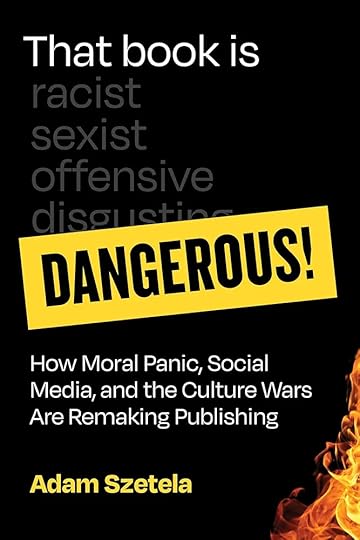

***************************************************************************

[Image: Book Cover]

Citation:
Szetela, A. (2025). That book is dangerous!: How moral panic, social media, and the culture wars are remaking publishing. The MIT Press.

Title: That Book Is Dangerous!: How Moral Panic, Social Media, and the Culture Wars Are Remaking Publishing
Author(s): Adam Szetela
Year: 2025
Genre: Nonfiction - Contemporary Events, Social Studies
Page count: 288 pages
Date(s) read: 11/14/25 - 11/17/25
Book 244 in 2025
***************************************************************************
Profile Image for Jason.
Author 23 books79 followers
September 17, 2025
Adam Szetela's 2025 book That Book Is Dangerous! looks at the phenomenon of social justice activism in the field of young adult literature, particularly some of the absurd cancellations that occurred in the late 2010s and early 2020s over notions of authenticity and cultural appropriation. To be clear, these two concepts aren't on the whole absurd--they're certainly conversations worth having--but the outrage mobs that led books not to be published and drove authors offline (or to make coerced apology videos reminiscent of ISIS hostages) over tenuous accusations of harm are illiberal and...well, anti-intellectual. Szetela covers this topic thoroughly, yet at times, as snarkily as possible. I get it, but the tone sometimes makes this itself feel like yet another culture war screed.

Where the book really shines is in the second section, where Szetela makes the case that modern concepts of diversity are largely superficial: privileging superficial racial and ethnic identity markers over diversity of social class and life experience, with the effect that diverse voices in literature often amount to people with differing skin tones who pretty much all went to the same elite schools and universities, inhabit the same handful of coastal cities, and extol the same progressive values. Reading modern literature and seeing just how uniformly bourgeois much of it is, it's hard not to think he's correct. It's probably a cliché in reviewing a nonfiction book to say this might have worked better as a few shorter articles than a full-length book, but that's indeed the case with That Book Is Dangerous!
Profile Image for Edward.
322 reviews42 followers
Want to read
January 30, 2026
The Wall Street Journal reviewed this book here: https://archive.is/YHSIp

Barney Rosset risked violence and insolvency so that his Grove Press could print unexpurgated American editions of such forbidden works as “Lady Chatterley’s Lover” in 1959 and “Tropic of Cancer” in 1961. To publish “Ulysses” in 1934 without risking prosecution, Random House first had to orchestrate a court case to prove the book innocent of obscenity.

Today’s publishers aren’t much constrained by obscenity laws. Instead, the pressure comes from staff members and social-media mobs wielding their “militant fragility,” in the words of Adam Szetela, to remake our book culture into an anodyne enterprise that puts “safety” first. Mr. Szetela lays bare this remarkable phenomenon in “That Book Is Dangerous! How Moral Panic, Social Media, and the
Culture Wars Are Remaking Publishing.”

The result is a devastating work of scholarship that commits the ultimate transgression of failing to include the trigger warnings so cherished by the targets of the author’s indictment. Readers might well feel they deserve a warning too, for sane lovers of literature who read this book are likely to experience fury and even despair by the time they finish.

The industry transformation the author chronicles here—much of it premised on the need to avoid feeling unsafe and the trauma attendant to not being a straight, white man—will be familiar to anyone who has followed the online purity crusades of the past few years. But even jaded readers will be startled by the scope of the self-organizing tyranny besetting the book world. Hardly anyone has the temerity to stand up to it.

Courage, in the author’s account, is scarce in a literary culture circumscribed by sanctimonious bullies and in thrall to identitarian grievance mongers. Again and again his terrified sources, after bemoaning the Orwellian climate of the book business, beg him for reassurance that they will not be named in print.

Mr. Szetela describes vicious (and semiliterate) pile-ons in response to imaginary transgressions, abject apologies akin to hostage statements and gleeful attacks on the apology until the victim has been shunned by publishers, editors and agents—and branded with a seemingly indelible digital scarlet letter. “Years later,” the author explains, “the first page of Google will continue to advertise their polluted moral status to the world.”

The problem seems to begin on campus. The author notes that when he searched the Modern Language Association job list one day in 2022, 72 out of 74 positions in North America sought “applicants who specialize in race, ethnicity, sexuality, disability, indigeneity, and other identities.” The desired identities are often part of the job: “Assistant Professor of Latina/o/x Literatures and Cultures” or
“Assistant Professor of Race, Diaspora, and Indigeneity.”

The master-of-fine-arts programs that produce so many of today’s writers are part of this revolutionary higher-education landscape. Students in writing workshops are loath to honestly criticize each other’s work, especially if the writer belongs to a sacrosanct group. Professors are subject to obsessive student surveillance and called out for deviations from approved terminology. As one graduate student tells Mr. Szetela, there are “social points awarded for each identification of something problematic.”

Graduates who embark upon a literary life will find the book industry policed by an army of sensitivity readers, members of identity groups paid to make sure their group isn’t misrepresented. As the author says of one such reader, “his job is to make literature inoffensive.” But this pursuit of authenticity can end up reinforcing stereotypes.

The business of sensitivity readers is booming even as recreational reading wanes. Mr. Szetela notes that some agents demand that authors hire them before the agency tries to sell the manuscript. For writers, hiring such readers is a badge of good “literary citizenship” and a chance to flaunt their virtue as well as their success by boasting of how many they can afford. “As a straight white male who’s spent the past four years writing a queer love story,” says one preening author, “I’ve used nearly a dozen sensitivity readers so far, and I will no doubt use several more once my agent and I go on submission.”

Obscure literary journals that might once have published new and transgressive writing now prioritize work that “avoids the risk of harm,” in the words of Hunger Mountain Review, which has vowed to combat “the cis-heteronormative white-supremacist ableist patriarchy.” Denver Quarterly evidently bars material that lays bare social evils, since “we do not tolerate submissions that contain hate speech, bigotry, discrimination, or racist, sexist, homophobic, transphobic, or ableist language or violence of any kind.”

Mr. Szetela also reports that, starting with children’s books but now more widely, publishers have begun including “morality clauses” in contracts with authors, clauses so vague that some of them could permit cancellation for nearly any behavior anyone finds objectionable. The Authors Guild, likening this trend to the McCarthyism that destroyed the careers of writers, filmmakers and others in the 1950s, asserted that “morals clauses chill free speech.”

Mr. Szetela is a courageous and capable chronicler of the publishing industry’s nervous breakdown, highlighting the new intolerance that has replaced the old and using a class-based critique to expose the contradictions and hypocrisy of “woke” publishing. But he fails to situate publishing in the context of the larger network of liberal cultural institutions that in recent years have congealed into a single, neurotic political enterprise obsessed with gender, race and, lately, the vilification of Israel.

The spread of this new orthodoxy shouldn’t be surprising, for as the author notes, “insatiability is a defining feature of moral crusades. As crusaders achieve victories, they expand the scope of their crusade.”
Profile Image for N Rizkalla.
114 reviews16 followers
October 16, 2025
THAT book is GREAT!

It is a brilliant exposé of the destruction of free speech and innovation by the WOKE madness.

The author, a self-described progressive, methodically analyses how WOKE crusaders are savagely censoring the writing and publishing of books for children and young adults (YA).

Over the altar of political correctness, books are prohibited, authors cancelled, and careers destroyed. Children and YA are deprived of reading except what is filtered through troves of “sensitivity reviewers” and censors who dictate their myopic and distorted view of the world (and make a lot of money out of it, of course). This is a danger that if not curtailed could creep into adult literature as well!

This is a valuable addition to the growing literature- from right and left- which exposes the idiocies of the dark WOKE culture.
Profile Image for Samantha.
487 reviews18 followers
November 10, 2025
There does seem to be quite a bit of groupthink right now in publishing, an industry largely populated by educated and super liberal white women acting partly with good intent, and - if this book is to be believed - partly in terror of social media users. Szetela has a definite "wokeness has gone too far" viewpoint, and I think he set out to write this book so he could express it. He gets big props for some of the interviews he secured though, and for identifying something that's clearly a problem. The publishing world has become less experimental and more risk averse, and readers are dropping off as a result.
223 reviews
November 7, 2025
Really well done look at the little talked about leftwing movement for literary censorship. People easily talk about right wing censorship, but this is more innocuous and disturbing.
Profile Image for Greg Talbot.
703 reviews22 followers
October 10, 2025
One of the remarkable challenges of the disinformation age is the weaponization of speech and fragmentation of a shared reality. As Jonathan Haidt lays out in his phenomenal essay about our modern Babel, "social media deputizes everyone to administer justice with no due process". It has exacerbated some of the themes that Adam Szetala lays out here such as presentism and safetyism. Publishers and readers have pushed back on writer's creative experiences if they do not align to a paritcular identity or pre-conceived nottion of what the story should be. There are always some individuals who push their judgements of acceptability back on the creator, and threaten to cancel or punish. It eschews the championed free speech idea - free speech protects the speech we don't want to hear.

Szetela provides some compelling examples of political-correctedness gone awry. One of the most compelling is the story of Amélie Wen Zhao's "Blood Heir". The author was targeted with a viral campaign and pushed into having rewrites with sensitivity readers. All of this because her fantasical novel had pushed some people's buttons. She had written in pieces that some readers felt she didn't have the experience to write on. Some accused her of supporting human tracking (p.69). Some accused her of color-blind racism, due to the ambiguity of evil characters. Some objected to it being harmful for readers. Zhao is not alone, we've seen many writers and performers punished by audiences through bans, cancellations and student protests. It's an example that shows the narrowing of creativity and criticism - a limitation of the author and reader to exchange in a meaningful way.

One of the challenges of "That Book is Dangerous!" the examples are uniformly about progressive overreach. Almost every example I came across is about a traditionally liberal voice being "cancelled" by a more progressive one. Cancelling "Toni Morrison" becomes a feminist action. Cancelling Shakespeare becomes an anti-western action. Cancelling Mark Twain, or any writer before 1950 becomes an anti-racist action. Those are valid examples, but it seems to be less than half the story in our current poltiical climate. In the midst of his zeal, he neglects to show the state level censorship of free speech. Consider Trump's 2nd administration, and the fragility to free speech. We've seen silencing of Palestinian student groups. Extortion efforts against college campuses, museusms, and civic institutions. Proclaimations that free speech does not exist for burning flags . That of course is in opposition to the long-standing Supreme Court decisions (Texas vs Jonhson). Comedians must be nice or will be cancelled. The fealty is not only a betrayal of conservative values - it's an admission that free speech is less acceptable from the political class.

Long chapters without tonal shifts for humor or narrative, leans the writing into jeremiads. Conservatives like Ben Shapiro and Charles Murray at least have good wit and writing chops to engage the reader. The screed of outrage grows a bit dull when the growth of those ideas do not lead to a construstive approach. For all the snide humor at liberal pieties, Szetala spends little consideirng the metrics he would use to fairly criticize a new novel.

Despite giving examples of how tweets and social media have been the source of moral panics, Szetela never really explores how social media platforms optimize for engagement. I think most people would agree that social media has a prominent role in reactionary politics. Szetela is quick to target young progressives for illiberal reactionary politics, but it seems short-sighted when one considers how firms have monetized the attention economy This book may be about publishing houses - but the outrage is downstream from large tech firms platforms.

Even well meaning ing communities can limit artists and artifacts from finding an audience. Censorship is often a reminder of the power of a work ("Ulysses", "Hucklberry Finn", "Lolita", "Fight Club"), and our limited trust of young people to make up their own minds. An artist revered today, can be reveiled tomorrow. Just look at J.K. Rowling's story. First she was condemned by Christian fundamentalists for the magical worlds she created for children. Now she is a target by liberal commmentators who villify her for her politics on transgender issues. Nevertheless the art remains. Maybe the best solution is to take back the word "problematic" as badge of pride. Why bother feeding the trolls when you can just work on your creations. Ultimately we judge a book by its cover at our own peril - it not only limits the book's potential, but limits our ability to be challenged. Our growth, in ourselves and with others, depends on free expression for all.
439 reviews3 followers
February 5, 2026
I loved this book. Explained alot to me about the culture wars and literature. Since, I am having trouble finding anything modern to read. Its all woke crap!!! Hence, why I usually head to the classics for things to read, these days.

Also, what's in this book, isn't just happening to the literature world, rather also in movies, education. Its everywhere, people to whom have become to sensitivity, get defended over everything. Hence, want to control things. Also, the issue of D.E.I is mentioned in this book, which is about hiring people more for there characteristics, than are they skilled for it. Hence, this is why we are getting a lower and poor standards for literacy that is now being punished.

So, many issues, in which is quite a small book, nearly 300 pages long. So, not a long read, but still full of so much information, you will want to take notes like I did.

A must read, for anyone wanting to know, what's causing the culture wars, the terrible effects of the culture wars, and what we can do about it. Hence, the reason for the increase of independent and self publishing. Since, if your a white - straight - male, don't bother seeking out getting your book published in one of the big publishing companies, go another route.


Profile Image for Patrik Sampler.
Author 4 books23 followers
November 19, 2025
A few quick words upon just reading This Book Is Dangerous! It's brave, detailed, and often funny. I'd say it's necessary reading for anyone in the book industry, broadly speaking. It's depressing to read the extent to which the rot now extends through USAmerican books, Anglosphere books, and even beyond. Thanks to Adam Szetela for acknowledging, even if in passing, even if not by that name, US cultural imperialism. At least the USA has a critical mass of people, allowing more diversity of ideas in books, even if not in works of fiction promoted in the mainstream. In my native Canada, even a small number of influencers can put a near totalizing chill on the publishing industry. There is a very anti-literary monomania, here, for circumscribed notions of identity to the exclusion of all other things fiction can be about and moreover do. It has made writing stale, simplistic, and boring. It's heartening to read someone punching back.
31 reviews
January 6, 2026
eu meio que tinha e ao mesmo tempo não tinha muita familiaridade com esse assunto - já entendia e tinha uma boa familiaridade com dinâmicas de cancelamento (do meio progressista) nas redes sociais no geral - principalmente no mundo dos filmes e do audiovisual como um todo, todavia, todo esse universo da 'ya' (literatura infantojuvenil) ainda me era um pouco distante. a despeito disso, eu achei o livro simplesmente espetacular na sua forma de expor o tema de forma tão envolvente e densa a partir de um referencial teórico multidisciplinar (óbvio que, como estudante de pscicologia, adorava especialmente quando esta era traziada para o debate). ademais, a escrita por vezes sarcástica e afiada do autor é muito boa, não imaginava que eu ia literalmente rir lendo um livro como esse. enfim, o timing pode não ser o mais perfeito e oportuno de todos, mas ainda acredito que o que é dito aqui é de suma importância para o nosso momento atual, apesar do tempinho transcorrido desde muitos dos acontecimentos descritos no livro até o momento atual ter trazido consigo algumas mundanças de cenário (e o próprio autor reconhece isso). de qualquer forma, ótimo terminar o ano com uma leitura 5 estrelas.
Profile Image for Angel .
1,541 reviews46 followers
November 20, 2025
Quick impressions: In the end, I would consider this book to be optional for libraries. It does provide a counterbalance to the usual banned and challenged books narrative.

(Full review on my blog soon.)
Displaying 1 - 16 of 16 reviews

Can't find what you're looking for?

Get help and learn more about the design.