Mervyn Laurence Peake was an English modernist writer, artist, poet and illustrator. He is best known for what are usually referred to as the Gormenghast books, though the Titus books would be more accurate: the three works that exist were the beginning of what Peake conceived as a lengthy cycle, following his protagonist Titus Groan from cradle to grave, but Peake's untimely death prevented completion of the cycle, which is now commonly but erroneously referred to as a trilogy. They are sometimes compared to the work of his older contemporary J.R.R. Tolkien, but his surreal fiction was influenced by his early love for Charles Dickens and Robert Louis Stevenson rather than Tolkien's studies of mythology and philology.
Peake also wrote poetry and literary nonsense in verse form, short stories for adults and children ("Letters from a Lost Uncle"), stage and radio plays, and Mr Pye, a relatively tightly-structured novel in which God implicitly mocks the evangelical pretensions and cosy world-view of the eponymous hero.
Peake first made his reputation as a painter and illustrator during the 1930s and 1940s, when he lived in London, and he was commissioned to produce portraits of well-known people. A collection of these drawings is still in the possession of his family. Although he gained little popular success in his lifetime, his work was highly respected by his peers, and his friends included Dylan Thomas and Graham Greene. His works are now included in the collections of the National Portrait Gallery and the Imperial War Museum.
"I can dream...." So I wrote a few years ago when I added this book to my GR shelves. I did dream, and eventually a copy of this utterly gorgeous and sensual volume landed in my lap.
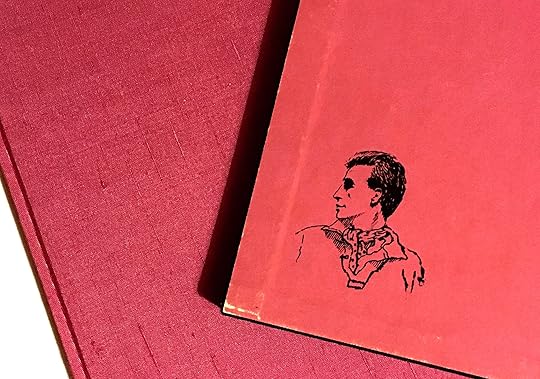
I stroked the silken-smooth fuchsia slipcase, bearing a small ink portrait of Wilde on the lower corner of one side and Peake (photo above) on the other, both by Maeve Gilmore (Peake's widow).
The colour conjured Fuchsia Groan, the sister of Titus, 77th Earl of Gormenghast. Floods of memories of ancient stones, a labyrinthine castle, Dickensian figures, bizarre rituals... and of epic flood.
I eased the book out of its snug case. It sighed softly as it submitted to my gentle grasp, emanating a teasing whiff of the faintest mustiness.
The book is the same fuchsia as its case, but in coarsely textured silk, and the pages are thick, stiff, lightly ridged, succulent, and creamy. It is a joy for tender fingers as much as for the eyes and mind.
There is a foreword by Gilmore, eleven poems or extracts by Wilde, sixteen black and white illustrations in a variety of styles by Peake, and a few excerpts of the poems, in Peake's wild handwriting. (So different from his wife's elegant and golden signature at the front.)
It may seem odd for a poet to illustrate the poems of another poet, but Peake was a great artist in multiple media, and the pairing is inspired and inspiring. As a wordsmith, he was perfect to pick out a few words, interpret, and illustrate. All but one were done with a Chinese brush and solid ink, and the result is often a tremendous sense of immediacy and movement.
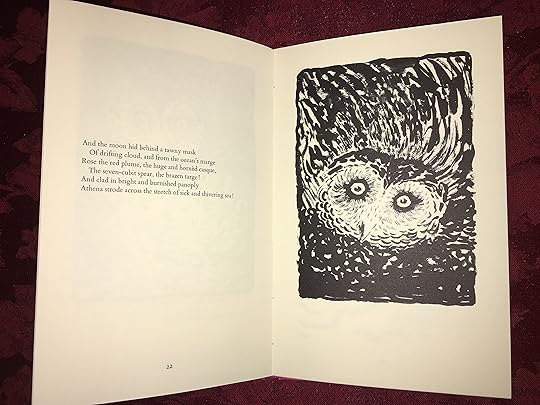
Photo above: The final excerpt of Wilde's "Charmides", with a falling owl reminiscent of Sepulchrave's almost mystical demise.
It may seem odd to write so little about the poems or the pictures. But the whole experience was so intimate, it would feel like a betrayal to write more.
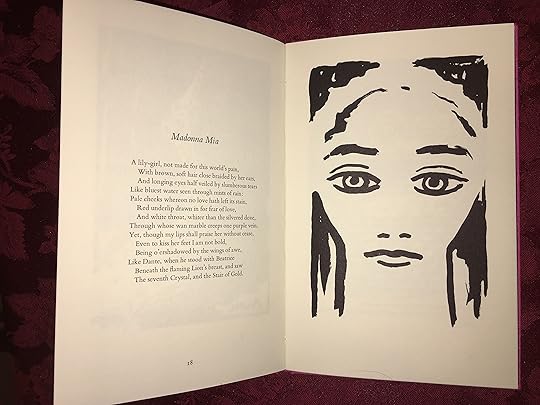
Photo above: Wilde's "Madonna Mia" with Peake's Matisse-like illustration.
All My Peake Reviews
All my Peake/Gormenghast reviews (including biographies/memoirs and books about his art) are on a shelf, HERE.
I fell in love with this book as soon as I saw it on the shelf of an antiquarian book shop in Bern, Switzerland. The section of books in English was about 4 feet long and I doubted I would find anything to pique my interest, but it turned out that I might easily have bought six titles. Well, not easily, in fact. I wonder whether a book such as this would mean so much to me if I had the funds to buy it easily? It was only after much soul-searching and an international telephone discussion with my wife that the purchase was made. Some successful haggling by my sister eased my conscience somewhat, and it was bought as a combined Christmas and birthday present.
Bound in magenta silk, in a slipcase decorated with portraits by Maeve Gilmore of Peake and Wilde, a limited edition of 200, of which mine is 153, and signed by Maeve Gilmore in gold ink, this is a beautiful artefact. Then, the illustrations by Peake (the principle element in my desire to own it) are both powerful and sensitive, rendered with a Chinese brush and solid ink-block.
What I know of Wilde is a play here, a short story there and a few witty mottoes. My initial scan of the poetry was enough to convince me that I would enjoy them, though I was at that point more excited by the illustrations. When I came to read the book, I wondered if Peake's selection of Wilde's poems might reflect his own fondness for wit, wordplay and nonsense, but I found that he had delved into a darker and deeper vein of Wilde's work, as echoed in his own Gormenghast books and his 'serious' poetry. I'm inspired to explore Wilde more extensively.
How do I sum up? If it's not too pretentious (and it probably is, but enthusiasm outstrips my reserve): A Literary Jewel.