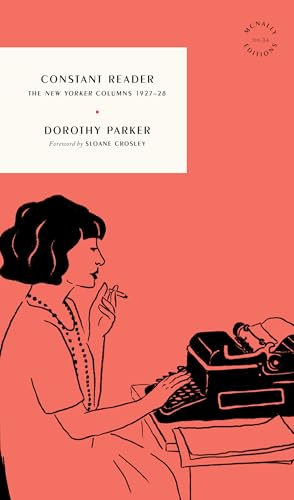
Dorothy Parker’s complete weekly New Yorker column about books and people and the rigors of reviewing.
When, in 1927, Dorothy Parker became a book critic for the New Yorker, she was already a legendary wit, a much-quoted member of the Algonquin Round Table, and an arbiter of literary taste. In the year that she spent as a weekly reviewer, under the rupic “Constant Reader,” she created what is still the most entertaining book column ever written. Parker’s hot takes have lost none of their heat, whether she’s taking aim at the evangelist Aimee Semple MacPherson (“She can go on like that for hours. Can, hell—does”), praising Hemingway’s latest collection (“He discards detail with magnificent lavishness”), or dissenting from the Tao of Pooh (“And it is that word ‘hummy,’ my darlings, that marks the first place in The House at Pooh Corner at which Tonstant Weader Fwowed up”).
Introduced with characteristic wit and sympathy by Sloane Crosley, Constant Reader gathers the complete weekly New Yorker reviews that Parker published from October 1927 through November 1928, with gimlet-eyed appreciations of the high and low, from Isadora Duncan to Al Smith, Charles Lindbergh to Little Orphan Annie, Mussolini to Emily Post
Librarian Note: There is more than one author by this name in the Goodreads data base.
Dorothy Parker was an American writer, poet and critic best known for her caustic wit, wisecracks, and sharp eye for 20th century urban foibles. From a conflicted and unhappy childhood, Parker rose to acclaim, both for her literary output in such venues as The New Yorker and as a founding member of the Algonquin Round Table. Following the breakup of the circle, Parker traveled to Hollywood to pursue screenwriting. Her successes there, including two Academy Award nominations, were curtailed as her involvement in left-wing politics led to a place on the Hollywood blacklist. Dismissive of her own talents, she deplored her reputation as a "wisecracker." Nevertheless, her literary output and reputation for her sharp wit have endured.
Dorothy Parker's writing is much more important than her subject matter. The way she says or writes is clearly the star of the review. It is not essential what the book is or the author, but more of her thoughts on the role of a book reviewer for a magazine like The New Yorker. I would never read a review by her to know about the book, but I would read the review to know more about Dorothy Parker.
Loved every word that came from under this woman’s pen & can’t believe her snarky comments, self-deprecating tone, and the absolute iconic [dry, smart, mean but oh so lovely to read] ways she drags others are over 100 years old!
- There is poetry, and there is not. You can't use the words good or bad, about it. You must know for yourself. Poetry is so intensely, so terrible, personal. A wise man, a very wise man, once said to me that if you have any doubt about a poem, then it isn't a poem. Poetry is for you, for you alone. If, for you, it's poetry, it will deluge your mind, drain your heart, crinkle your pin. It doesn't matter whose it is. "Constant reader" is a compilation of the The New Yorker columns written by Dorothy Parker between 1927 and 1928. Despite talking about works that are now practically obsolete, there is something that encourages you to continue reading. With a witty writing, Parker points to really engaging topics, among them: the intimacy of a diary, the unattainable separation between the woman and the writer, the narration of a human being who cannot detach himself/herself from his/her experiences and, lastly, the emotions that can lie behind a messy prose.
By her mid-20s, Parker had established her reputation as theater critic for Vanity Fair, standing in for a vacationing P. G. Wodehouse. Fired for her outspoken views, she was later taken on by the newly-launched New Yorker, writing self-referential, wise-cracking book reviews in the Constant Reader column from 1927 to 1933. A selection of reviews from 1927-28 is presented in this handsome McNally publication (albeit with typos sufficient for Parker’s ghost to fling the book back at its editor).
Perhaps one-third of Parker's reviews are positive, ranging from the iconic (Hemingway) to authors now in oblivion (Zona Gale, Elinor Wylie...). The bulk of her attention, however, is given to roasting the most hapless writers of her time: tawdry pulp fiction, the overly-cute, and the egregiously pompous. She savored an especial contempt for soppy children's fiction.
Arguably, she chose easy targets, authors whose readership must have been limited even in the 1920s, rather than tackling the decade's heavy-hitters (Faulkner, Fitzgerald). This misses the point, though: the Constant Reader is about Parker and her wit. She wins our trust through her intelligence (so modestly, jadedly presented) and our loyalty because her writing is so addictively funny. I'm not a demonstrative reader, but broke out in giggles several times and into helpless tears trying to read one passage to my wife. Yes, Parker is that funny.
In more than 30 columns, Parker strikes out dramatically just once - in her treatment of A. A. Milne and The House at Pooh Corner. A century later, when most authors are forgotten, Milne and his cast of characters (Pooh, Piglet, Eeyore, Tigger...) continue to pull in the royalties. That said, even when she misses, Parker is hilarious:
She starts her column with Pooh's "hum":
"The more it SNOWS-tiddely-pom, The more it GOES-tiddeley-pom The more it GOES-tiddely-pom On Snowing..."
She then moves into her review:
"The above lyric is culled from the fifth page of Mr. A. A. Milne's new book, The House at Pooh Corner, for, although the work is in prose, there are frequent droppings into more cadenced whimsy. This one is designated a "Hum", that pops in the the head of Winnie-the-Pooh as he is standing outside Piglet's house in the snow, jumping up and down to keep warm. It "seemed to him a Good Hum, such as is Hummed Hopefully to Others." In fact, so Good a Hum did it seem that he and Piglet started right out through the snow to Hum it Hopefully to Eeyore. Oh, darn - there I've gone and given away the plot. Oh, I could bite my tongue out."
As they are trotting along against the flakes, Piglet begins to weaken a bit.
"Pooh," he says at last and a little timidly, because he didn't want Pooh to think he was Giving In, "I was just wondering. How would it be if we went home now and practiced your song, and then sang it to Eeyore tomorrow - or or the next day, when we happen to see him." "That's a very good idea, Piglet," said Pooh. "We'll practice it now as we go along. But it's no good going home to practice it, because it's a special Outdoor Song which Has To Be Sung In The Snow." "Are you sure?" asked Piglet anxiously. "Well, you'll see, Piglet, when you listen. Because this is how it begins. The more it snows, tiddeley-pom-" "Tiddeley what?" said Piglet." (He took, as you might say, the very words out of your correspondent's mouth.) "Pom," said Pooh. "I put that in to make it more hummy."
And it is that word "hummy," my darlings, that marks the first place in the House at Pooh Corner at which Tonstant Weader Fwowed up."
200 pages of Dorothy Parker ripping authors to shreds (“She was no writer, God knows. Her book is badly written, abominably written. There are passages of almost idiotic naïveté…”). Except for Hemingway. She really loves Hemingway.
It’s probably better to pick up and put down this book over time rather than reading all the way through in one go.
Dorothy Parker’s reputation of being funny and at times caustic precedes her. this is exactly why i picked this up, i still need to dive into her poetry but this was an absolute treat. i read this before bed at times for the first half and then all together for the second half. i enjoyed both ways. Dorothy is undoubtedly the GOAT of book reviewing to me. She makes it an art. i loved this for a number of reasons. I think it is a different kind of book, a collection of her articles on the new yorker for a period of one year. And in spite the majority of the books reviewed didn’t make it to our day and age it is so much more than just about the books. Dorothy writes about society, about herself - it is obvious her famous relationship with alcohol. She writes about the controversies of her own time and got me doing research on some of the topics (i.e. the president’s daughter and all that shenanigan). It was looking into a window to the past. This book also made me get a Hemingway book i did not know about and she raved about. And i did have to get it as the totally positive reviews were truly scarce. This got me chuckling out loud and I cannot wait to read more by Dorothy Parker. And if you know of anyone just as funny and of today let me know I think we are in dire need of more Dorothy Parkers.
Quick, name an author whose book reviews from the 1920’s have merited republication in 2024, nearly 100 years following their initial publication (okay, other than Virginia Woolf and Willa Cather). Maybe it should be “an author whose book reviews from the 1920’s have been republished because they are as sharp and funny as anything you’ll read today.” The author is Dorothy Parker, whose 1927 and 1928 book reviews from the column “Constant Reader” in the "New Yorker" have recently been reprinted with a new terrific introduction by Sloane Croseley. This is not the first time that savvy publishers have reprinted the “Constant Reader” columns. Not long after her passing in 1967, Viking Press published a version of these columns that was lightly edited and included helpful background information on many of the writers and events alluded to in the columns. When Viking republished “The Portable Dorothy Parker” in 1973, it added the “Constant Reader” reviews to the content of the original 1944 “Portable.” When her biographer Marion Meade edited a new edition of “The Portable Dorothy Parker” for Penguin in 2006, she included a “best of” selection of these book reviews along with theatrical reviews and other works missing from the original. Why reprint these now? If Mrs. Parker is forever quoted (and misquoted) for her wit and wisdom, I think readers seek out her poetry, short stories and reviews for not only clever, smart humor, but a sense of the sadness and urgency behind that humor. In these columns, Parker takes the task of the weekly book reviewer into something else, a humor column where she often has to drag herself through finishing a misguided piece of writing while (often) fighting a hangover and impending deadline. A few other writers have since tried to turn book reviews into personal comedy gold, but they all follow in her considerable footsteps. The best news is that this 2024 edition is the first time the “Constant Reader” columns have been available as an ebook. No more having bleeding highlighting and worn page corners needed to guide readers to their favorite passages. Here’s a sample from one column: “That gifted entertainer, the Countess of Oxford and Asquith, author of “The Autobiography of Margot Asquith” (four volumes, neatly boxed, suitable for throwing purposes), reverts to tripe in a new book deftly entitled “Lay Sermons”….The affair between Margot Asquith and Margoth Asquith will live one as one of the prettiest love stories in all literature…A compilation of her sentiments, suitably engraved upon a nice, big calendar, would make an ideal Christmas gift for your pastor, your dentist, or Junior’s music teacher…Through the pages of “Lay Sermons” walk the great. I don’t say that Margot Asquith actually permits us to rub elbows with them ourselves, but she willingly shows you her own elbow, which has been, so to say, honed on the mighty.” So, you see the temptation to quote and quote from these reviews. Just do yourself a favor and buy “Constant Reader.” You’ll find yourself returning to it time and again when you need a hearty laugh.
Over the years there have been bylines in the New Yorker Magazine which readers eagerly looked forward to. Joseph Liebling writing on the press, Janet Flanner from Paris, or Roger Angell on baseball, all made an edition fun.
From October 1, 1927 to November 17, 1928 Dorothy Parker wrote the New Yorker Constant Reader book review column. It would have been exciting back then to open an issue and see that it had one of her columns. McNally Editions has released an elegant collection of the columns.
The gag is that she doesn't really want to be a book reviewer. She doesn't have the patience to review the big literary books of the day. She gives a paragraph or two on Hemingways new book but does a whole article on a book of amateur poems about Charles Lindberg.
She is just fun to read. "The Counterfeiters (by Ande Gide) is just too tremendous a thing for praises. To say of it "here is a magnificent novel" is rather like gazing into the Grand Canyon and remarking, "Well, well, well; quite a slice."
She spends a fair amount of the columns complaining about her hangovers. She has a column on books she could not finish. She takes a look at comic stripes. She has a very funny article on Emily Post's "Etiquette".
She takes an elaborate shot a James Branch Cabel, a very popular author of the day. She describes the rave reviews for his new book. She says about his books that "his is a transcendent imagery, a lacy slyness, a frosty irony. None other has such wit, such erudition, such delicacy.......And I couldn't read all the way through one of them to save my mother from the electric chair." (That line hit home with me because I have also tried and failed to get through his elaborate stuff.)
Parker had fun with the form of book reviewing. She mocked the seriousness of the enterprise and enjoyed using it as an excuse to exercise her wit. This book is a treat.
Constant Reader: The New Yorker Columns 1927-28 by Dorothy Parker. She practiced "snarky" in the years before snarky was invented. Reminds me very much of Fran Liebowitz. She is clever and gives you what you were not expecting. Most of the articles in this book are short, which is good because they are now so dated I would not be able to agree or disagree with her reactions. Sometimes... she takes a view of her subject from 10 miles up, which can be fun and truly gives her a place from which to place the book or other subject in its proper perspective. Other times I suspect she actually is just covering up that she did not read the book, but has to write a review anyway. But now I can see why she is so well known for her style and ability to turn a cutting remark against someone she believes is a fool.
I wish I was witty enough to review this in Dorothy Parker’s style, but, alas I am not. I have wanted to read some Dorothy Parker, but this was probably not the place to start. This is a collection of her book reviews in The New Yorker in 1927 and 28. The forward by Sloan Crosley sums up these reviews nicely: “I can’t imagine being one of these people…receiving a call from my publisher that my book is being reviewed by the Dorothy Parker, running to the nearest newsstand, forking over the requisite 15 cents…only to war through six hundred words on the weather before getting to my own obituary.” Maybe one day I’ll take the time to look up some of the books she reviewed, but not right now.
"That gifted entertainer, the Countess of Oxford and Asquith, author of 'The Autobiography of Margot Asquith' (four volumes, neatly boxed, suitable for throwing purposes), reverts to tripe in a new book deftly entitled 'Lay Sermons'. It is a little dandy if I have ever seen one and I certainly have." (p.23)
"'Oh, is that so?' I said, drawing the mantle of Whistler more closely about my shoulders." (p.59)
"There is youth to my game, youth and hope and fearlessness and a wild, hungry seeking." (p.132)
"He dies at the end of the book. It was a toss-up, as I staggered toward the conclusion, as to whether it would be him or me." (p.164)
I am now convinced that no one has ever been as funny as Dorothy Parker, and no one ever will. I haven't laughed out loud so many times while reading something ... maybe ever? I need to read it again and jot down or underline every brilliantly funny line, which will probably result in me underlining a good 80% of the book. I'm a little sad that these weekly columns only lasted for about a year, and even more sad that she's no longer with us. We need someone who will cut people down to size and hold them to higher standards -- but in a funny way, not a self-righteous way. I'm going to read more Dorothy, ASAP. And I'm going to revisit this whenever I need a pick-me-up.
This gem of a book is a collection of book reviews for The New Yorker, written by Dorothy Parker over a bit more than a year, 1927 to 1928. Parker has high literary standards and most of the books she has to read and judge fall far below them. She is laugh-out-loud funny. Parker doesn't stint when commenting on the books she's reviewing: "Crude is the name of Robert Hyde's first novel. It is also a criticism of it." Parker is equally hard on herself, her mock-confessional approach making these columns as entertaining as any literary commentary could be: "Well now you see what my life is. But don't you mind. You go ahead and enjoy yourself and never mind about me."
This was my first foray into Dorothy Parker's work, and I loved it! I picked it up in London because I liked the idea of a review collection and the feel of the book, but I wasn't familiar with Parker as a person before this. really loved her witty reviews and from looking her up she seems like an incredible person. Since most of the reviews are short, it feels like you're making progress very quickly reading through them. I can't look at this cover for too long though or I become tempted to get a drastic haircut.
Dorothy Parker’s wit is legendary. She is concise, sharp, and holds back no punches — whether she’s reviewing popular authors, unknown/up and coming writers, or even Mussolini himself. I recited “Resúmé” for an English class once, and her columns actually gave me more context for how I could’ve interpreted it differently looking back now. I am a huge admirer of Parker’s prose and verse. I think I would’ve been more interested if I was reading those books at the time (and could give my own take) but this was an interesting read even almost a century later.
Tons of fun. The way Parker set up her jokes and critiques is fascinating to me as a writer, but I also got so much pleasure out of going oooooh at her slams. And the books featured introduced me to wild facts I knew nothing about--books that were buzzy, but had no longevity, include a romance novel by Benito Mussolini and an autobiography by a radio evangelist accused of faking her own kidnapping!
Such a riotously funny and stunning read. Parker’s prose flows so easily from her pen. There were multiple moments (many of them!) where I found myself laughing out loud at her witty and ingenious expressions. It didn’t matter that I’ve never heard of any of these books; all that matters was her reaction to them, and boy did she REACT! I wish more people allowed themselves the freedom to write so openly and intelligently with humor nowadays.
As much as I am a great! fan of Parkers writing, and as much as I plan on reading more of the publishing houses ‚forgotten works‘, this one was a disappointing read. Even with the columns/reviews on books I know, it was just boring ramblings with a few witty sentences in between but it looses its spark quickly. Maybe this is one of the cases where it actually is best to let the past stay in the past…
Parker is a well known prose stylist and well known for good reason. She was also a funny and acute commentator on books. This collection is also a useful entree to the literature of the period. I’ve been purchasing some of the books she reviewed, not the ones by authors we know today but the ones she liked and which we have somewhat or utterly forgotten.
Probably not the best choice for my first Dorothy Parker read. Her caustic wit shines through but it seemed a bit much most of the time. Many of the books she mentioned are now obsolete. I think this book is best for hardcore DP fans or anyone like me who is dead set on reading every McNally Edition.
Dorothy Parker went so hard in the paint that at least three of the writers she so savagely lampooned in this collection died mere weeks after her reviews of their work were published in The New Yorker.
Reading this was a real lesson in the ephemeral nature of notoriety. Nearly every book review she wrote in here is about some author from the 20s whose name has been lost to time. In the rare instances she mentioned Upton Sinclair or Hemingway I became the Leo pointing meme.
These reviews are almost 100 years old and I haven't read any of the books she's talking about. I still laughed out loud throughout! I appreciate having this new release, as my copy is very old and beat up but I'll be holding onto both because it is one of the greatest works of humour ever written.
These were sooo funny anytime I need a pick me up I’ll just go back to read one of these! Some of them were a bit too meandering for me but I still enjoyed it immensely. Dorothy Parker is an under appreciated writer of that era!