

What do you think?
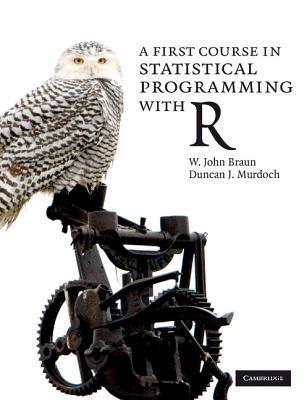
A First Course in Statistical Programming with R
This is the only introduction you'll need to start programming in R, the open-source language that is free to download, and lets you adapt the source code for your own requirements. Co-written by one of the R Core Development Team, and by an established R author, this book comes with real R code that complies with the standards of the language. Unlike other introductory books on the ground-breaking R system, this book emphasizes programming, including the principles that apply to most computing languages, and techniques used to develop more complex projects. Learning the language is made easier by the frequent exercises and end-of-chapter reviews that help you progress confidently through the book. Solutions, datasets and any errata will be available from the book's web site. The many examples, all from real applications, make it particularly useful for anyone working in practical data analysis.
172 pages, Paperback
First published January 28, 2007
Ratings & Reviews
Friends & Following
Create a free account to discover what your friends think of this book!
Community Reviews
Displaying 1 - 2 of 2 reviews

April 23, 2019
Parts of the book provide a solid introduction to R and R Studio, especially regarding elements of the software. The authors seamlessly move from one aspect to the next.
Nonetheless, once things get into the nitty gritty of actually employing statistics using R packages and R command language, glossing over rapidly becomes the norm. I would have expected a book titled “A First Course in Statistical Programming with R” to start readers off with gradual easement into the GLM. Certainly, there are parts of the GLM brought into middle chapters, yet they are so abruptly examined before the authors delve into more intermediate-advanced statistical methods.
Before you know it, later chapters are diving into simulation models and complex algebra that utilize very specific (and arguably very esoteric) packages designed for narrowly focused fields of research; not exactly a keen idea for an introductory level book of such accessible length. In parallel, I was coincidentally proceeding through an online R tutorial designed by biomedical professionals – they did a much better job sticking to basics and avoiding coloring the lessons with their own proclivities.
Some parts of chapters unexpectedly dive into some really good tips on programming R scripts, managing R Studio routines, and reducing unnecessary code complexity. Yet those parts didn’t flow with the other sections surrounding it. Therefore, only the first few chapters flow well together, with bits & pieces of following chapters being of relevance to the beginner.
Nonetheless, once things get into the nitty gritty of actually employing statistics using R packages and R command language, glossing over rapidly becomes the norm. I would have expected a book titled “A First Course in Statistical Programming with R” to start readers off with gradual easement into the GLM. Certainly, there are parts of the GLM brought into middle chapters, yet they are so abruptly examined before the authors delve into more intermediate-advanced statistical methods.
Before you know it, later chapters are diving into simulation models and complex algebra that utilize very specific (and arguably very esoteric) packages designed for narrowly focused fields of research; not exactly a keen idea for an introductory level book of such accessible length. In parallel, I was coincidentally proceeding through an online R tutorial designed by biomedical professionals – they did a much better job sticking to basics and avoiding coloring the lessons with their own proclivities.
Some parts of chapters unexpectedly dive into some really good tips on programming R scripts, managing R Studio routines, and reducing unnecessary code complexity. Yet those parts didn’t flow with the other sections surrounding it. Therefore, only the first few chapters flow well together, with bits & pieces of following chapters being of relevance to the beginner.
February 28, 2022
R is a package that allows the user to use pre-existing packages to perform some mathematical operations. It is very easy to install and use with a user window that is very similar in appearance to that of Maple and Mathematica.
However, even the most intuitive of packages still presents some points of confusion, but with this book, you can be up and running, doing very advanced work with R in a matter of minutes. Using a series of code examples, the authors take you through many of the basic capabilities of the package. All that is needed to follow the examples is a basic understanding of control constructs such as the if-then, loops and functions as well as knowledge of the underlying mathematics.
Areas of mathematics that are supported by the basic R package include:
*) Statistical graphics
*) Computational linear algebra
*) Monte Carlo simulations using several different random number distributions such as the Poisson distribution
*) Numerical optimization
*) Linear programming
Windows versions also allow you to set the locale so that languages other than English can be used.
While it is rare to see in a book, denseness does not have to be difficult, and this book is an example of that. The authors are terse and effective as they clearly demonstrate how to use the R package. If you lack the budget for the purchase of a commercial computational mathematics package, then R with this textbook provides a very low cost alternative for many classes.
However, even the most intuitive of packages still presents some points of confusion, but with this book, you can be up and running, doing very advanced work with R in a matter of minutes. Using a series of code examples, the authors take you through many of the basic capabilities of the package. All that is needed to follow the examples is a basic understanding of control constructs such as the if-then, loops and functions as well as knowledge of the underlying mathematics.
Areas of mathematics that are supported by the basic R package include:
*) Statistical graphics
*) Computational linear algebra
*) Monte Carlo simulations using several different random number distributions such as the Poisson distribution
*) Numerical optimization
*) Linear programming
Windows versions also allow you to set the locale so that languages other than English can be used.
While it is rare to see in a book, denseness does not have to be difficult, and this book is an example of that. The authors are terse and effective as they clearly demonstrate how to use the R package. If you lack the budget for the purchase of a commercial computational mathematics package, then R with this textbook provides a very low cost alternative for many classes.
Displaying 1 - 2 of 2 reviews