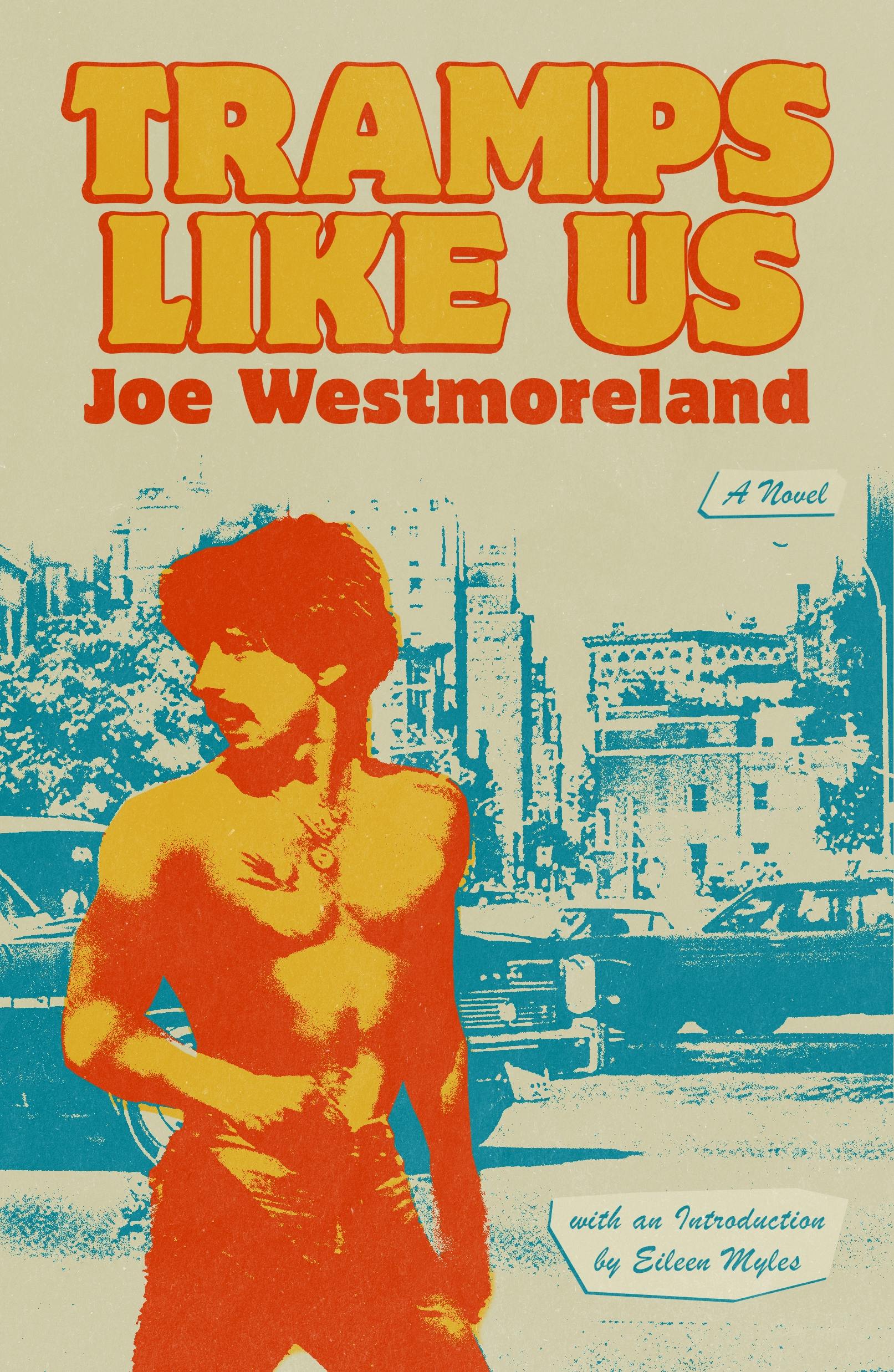
Tramps Like Us is a modern day Huckleberry Finn. It's an all-American story about the search for home, for a better life, feeling like a refugee in one's own country. It's about creating a family from a group of misfits. It tells what it was like to come of age in the era between gay liberation and the beginning of the AIDS crisis.
Some books you pick up and immediately realise that this is going to hurt. And oh boy, was this expectation proven to be right in this case. Tramps like us invites the reader to witness the journey of narrator Joe, who navigates through the US, various cities, a very formative decade (the 1980s) and his own drive to find a home among misfits. With glimpses of his past, the narrator eases the reader into his present and allows him to tag along on a wild ride through the entirety of the United States, making friends, falling in and out of love, finding home among the unexpected company and always, always finding the high side of life (pun, unfortunately, intended). He allows us, the readers, to bear witness to wonderful moments of companionship, heartbreak, the loneliness probably only few readers can relate to and twists and turns of a life lived not on a linear schedule. Something that left me really impressed was the factual style of storytelling the narrator uses, yet never creates a distance to the reader. Even if there was not much of a descriptive style of writing, I noticed myself quickly falling in love with this band of societal outcasts, minorities and misfits. Through narrator Joe’s eyes, he painted with clear and precise strokes a picture of this family he found in various cities, with members adding to the bunch and some leaving to their own fates at some point. This clear, concise storytelling was a stark contrast to an unreliable narrator under the influence of substances, heightened emotions and on the journey to find love, for others and himself, and companionship. It was fascinating, how easily I was dragged into this world that is so foreign to me in more than one sense and started to understand more and more with each chapter, what formed the narrator, his troubles and strengths as well. This is a story of friendship, of celebrating the high life even if in darker places, of finding new people, of family that is not blood related, of heartbreak, of loneliness, of searching for substitutes, of friendship and companions for a while, of uprooting life, of never standing still, of depression, of life altering diseases and life ending pacts between the people who love each other in more than the romantic sense. This also is a story of utter tragedy. And of comedy, at points. This is a story of life fully lived. I would love to talk about this book on and on, but I probably would just be reiterating the same few points over and over, which is why I truly recommend reading this yourself. I was not ready for the final chapter, and it did leave me sobbing. As a final note, I would like to extend my thanks to the publisher and netgalley, for providing me with a digital copy of this book prior to its re-release. To the author, I would like to express my utmost gratitude not only for a copy, but for the book itself, for sharing his story with us through narrator Joe and for letting us witness the life he led with all its bends and twists. I hope you’re as well as can be and I hope you are surrounded by love for many more years to come. Thank you.
"I ran away from home the first time when I was four years old."
Originally published in 2001, Tramps Like Us by Joe Westmoreland is an epic‐style semi-autobiographical novel about his life as a gay man during the 1960s through to the 1980s in the USA. In less than 30 pages, the reader gets the real sense of Joe's intense life.
Growing up in a conservative and strict household, we soon learn that closeted Joe was abused by his father, his mother rendered powerless, and his siblings equally diminished (many trigger warnings here). This novel shines in its sincerity and vulnerability, with its life lessons in self‐discovery and belonging. Westmoreland does not shy away from the most harrowing descriptions of his life, with some choking and emotional moments that might upset the reader (it is a difficult topic), but without sensationalism. Early in the book, in his teens, after much beating and witnessing, Joe leaves his home and hitchhikes from Missouri to Florida where he starts his nationwide backpacking. Crisscrossing through New York, New Orleans and San Francisco, he is exposed to the glamorous and sexual queer life, where drugs and men are never lacking. The author's descriptions of clothing, music and cultural aspects are truly encyclopaedic in queer culture, and I can imagine this novel's imagery of a fabulous period full of glitter and pain (wait until the AIDS crisis) that will appeal to many readers interested in the gay identity and pride in the USA.
Unfortunately I could not connect with the history on a deeper level, perhaps due to the fact that my upbringing was completely different, and the matter‐of‐fact narration is not to my taste, or the memoir-style of a novel that does not experiment (like Catherine Airey and Maria Reva). One must really question certain aspects when reading a memoir-style novel. The use of language and the personal struggles of an individual might sometimes be exaggerated, misleading the reader. As an example, at some point in the book the author expresses he is bored and depressed. Well, depression is deeper and more damaging than being bored (it is nitpicking, but you get the point). Another aspect I wish were different: he tells the story too quickly, with not enough depth to the characters or even his thinking (at least initially). Joe was an intense teenager/young adult who apparently lived his life as a dare, placing himself in dangerous situations that were common at that age. Bear in mind his upbringing, time and place that led his almost nomadic life to find his chosen family, identity and meaning. Each journey is individual, but in our individuality we can create a beautiful community, a chosen family, many LGBTQ+ people strive for.
Ultimately, I failed to connect with the narrative style and story in general, even though I have an interest in queer culture and history. Nonetheless, Joe Westmoreland's story deserves to be told and read. His story must survive. It is an important period in time of queer history in the USA during the AIDS crisis. I suspect this memoir can be engrossing in understanding this period, as well as exploring musical and queer references from the USA.
Rating: 2.0/5
Disclaimer: I received an Advance Reader Copy (ARC) of this book from the publisher via NetGalley in exchange for an honest and unbiased review. All thoughts and opinions expressed are my own.
Quotes might differ slightly from the final printed version:
Thank you, NetGalley, for providing me with a copy of this book.
Part memoir, part fiction, Joe's amazing book takes us on a joyride of running away from home to preserve his life from his father's anger, hitchhiking along parts of the American East, finding a safer place in Saint Louis where he shares a home with good friend, Ari, with whom he moves to San Francisco, and where he starts experiencing the devastation of the AIDS crisis. Together with it all comes a plethora of drugs, he and his friends share to make life feel more bearable and enjoy the moment, not to mention the wild sex scene of the 1970s and 1980s.
All along the book, I usually felt as if Joe was always looking for a place to belong and be able to find peace of mind, something he couldn't find while growing up back in his native Missouri, always in rage with his father abusing his sister and threatening him with death. Not only a place to belong, but also someone to share his life with. And maybe, isn't it what many misfit boys and girls of those years were yearning for, running away from home and making a new life possible? The AIDS crisis brought a sense of setback and moralism, and it is no wonder it was first called "gay cancer". I tend to see the 1960s to the beginning of the 1980s movements as a way to break away from all the turmoil and fear brought up by the Cold War and the wars the USA and the Soviet Union were playing around the world, killing thousands of young people, when not discarding the combatants as garbage when back home. The Hippies, the heavy Rock'n'Roll, the Punks, the Black Panther Party (aimed to challenge police brutality and systemic racism), the gay liberation movement, the feminist movement etc., all born from the urge of groups within society to question long-held assumptions of right and wrong, of morality, but also a need to bring out voices to express and demand respect and freedom, a way to speak up.
There were excesses, many, and Tramp like us is quite an interesting vision of those times. But as the saying goes, "you can't make an omelette without breaking eggs".
Westmoreland's writing is both tender and wild. And he truly speaks up!
The Eileen Myles introduction is appropriate, because, although, of course, quite different, Westmoreland has written a superior variation on Chelsea Girls. Tramps Like Us, at first, seems slight slight slight. Unadorned style. Quick pace. Fly-by characters. But then these happenings and the ghosts accumulate. What this becomes is an engrossing adventure/road-trip/picaresque novel of extreme honesty about the gay 70s/80s through solipsism. The protagonist's world always feels small and insular, though, looking back, there are people coming in and out constantly, so many different types. You get to people watch through the astute, colloquial text. The end gutted me (as many AIDS narratives do, but, again, it's a product of the pile-on of detail rather than simply tugging at the AIDS crisis heart strings), and I could have read three hundred more pages with ease. So glad this has been brought back into print. MAJORLY UNDERRATED.
I loved Joe’s conversational voice. It read as if we were good friends and he was telling me stories. When it was finished, I felt like I had lost a buddy.
A matter-of-factly told story about growing up in the USA in the years just before and at the beginning of the AIDS epidemic. What struck me most was, on the one hand, the style, which, while naturalistic, has a cumulative effect, so that at some point all the drugs, violence and death are described with the same calm attitude as the weather report. On the other hand, I was constantly amazed at how different the times were, when you could just get up and go, travel around, work wherever and somehow not only survive but actually enjoy life a little. Quite a different picture compared to today.
Like Chelsea Girls, this is sort of a novel, sort of a memoir about a young queer guy in the 70s and 80s. If you like Michelle Tea's writing, you should check this out.
this is easily the best book I have read this year and definitely an all time top. I have not had a book captivate or make me sob like this is so long it was so refreshing. The last chapters I had to put the book down and collect myself before continuing because I was such a mess. Queer-chosen family is so important
“Tramps Like Us” is a semi-autobiographical novel telling the partially fictionalised story of author Joe Westmoreland’s life, from growing up in 1960s and 70s Missouri to moving around the United States, living in places such as New Orleans and San Francisco. Along the way we watch the narrator, Joe, come into his identity as a gay man, learn what he likes and dislikes, find friends and lovers and of course do a whole lot of drugs. But despite the prevalence of scenes of him and his friends going from club to bar and bar to club, at the heart of this novel is the story of queer people and social underdogs coming together and building their own family units, their own support systems, which are there for them even in death.
As someone born in the 2000s I have absolutely no way of even imagining the gay experience of the 70s and 80s, but I really liked the way this book portrayed both the ups and downs of this time. It showed how many people were alienated from their families and how they found their own, new families, it showed the fun of drugs and partying, but also how those things could drain you, and it showed a great variety of different ways of getting through (and sometimes ahead in) life.
Of course one can’t talk about a gay book set in the 80s without also mentioning AIDS. While this book does discuss and show the effects of the mounting AIDS epidemic on our narrator and his friends, I certainly wouldn’t say it is the focus of the book. It is, however, much of the focus of the last 20% or so, as the narration enters the mid-80s, and these last 20% filled me equally with dread and heartbreak, but also with genuine warmth as we watch these characters care for each other through the last months of someone’s life, doing everything to be there for the sick and for each other. As I cherish friendships over any other relationships, reading these scenes meant the world to me.
Another element I felt was very important to this book’s identity were the many references to music – the music the narrator likes, the music his friends like, the music playing in the clubs and bars they go to, the concerts they go see. I unfortunately have near zero knowledge of 60s-80s New Wave (?) music, but if you do I imagine this book will hit even harder for you, especially in the nostalgia department.
Really the only thing I feel I must mention before someone reads this book (and I think everyone should) is its writing style. I am someone who tends to prefer purple prose, so the very simplistic writing style with short sentences was a bit difficult for me to get into, but if that is something you prefer you’ll probably fly through this even more quickly than I did.
Overall I would recommend this book to anyone who wants to know more about queer life in the 70s/80s, one person’s experience of the AIDS epidemic, or if you really love this period’s music and want to have a fun (but heartbreaking, keep that in mind) ride down memory lane.
I didn't understand why I'd never heard of this book, which should be up there in defining queer literature, until I read the afterward by the author. Tramps Like Us was published in April 2001. A week later, its publisher suffered a heart attack, and the author and his team decided to push the book's official launch until Westmoreland's birthday—September 11. Tramps Like Us never really stood a chance, especially once the author's own HIV-related health issues became pramount.
You could say that the book's story mirrors that of its narrator. Joe is on the run from childhood trauma that he never really escapes. From Kansas City to New Orleans to San Francisco in the early 80s, he is always looking for home, which he finds in the troop of fellow queer misfits he gathers along the way. He says, "We were all refugees from one kind of torment or another and could never go back home. Home was something in the future that had yet to be created, not someplace in the past."
Of course, while the family he forms is forever, the peace Joe finds is fleeting. The chapter that begins after these words is called "How I Got HIV" and, soon after, the realities of the AIDS epidemic become terrifyingly clear. What I liked most about this book was that it isn't just about the trauma of the 80s; instead, it blends that trauma with very real joy that you'd think couldn't coexist (along with a killer soundtrack). It's never been more important to learn from our communities' struggles past to help inform our path forward today, and I'm so glad that Tramps Like Us was given new life to help us do just that.
Good read but a little too diaristic - a lot of “this happened, then this happened, then I went here.” Still effective but I need a little more poetry! Would probably be 3.5 if Goodreads allowed half stars.
A book that, after 24 years in the making, finally finds itself within the canon of gay literature. I'm once again awestruck by gay culture as it was in the 70s and 80s, not with feelings of envy or FOMO (at least I think so); rather, I'm awestruck by the resilience of our cultural progenitors, as most cultural progeny ought to be (in my opinion). This illustrates a time when the threats our community faced were more concrete than its future, a reality that contrasts our present, when our threats seem multifaceted and existential but our future unnervingly preordained and bound for one outcome, the loss of rights.
Lots of melodrama coming from a young, white, gay man, but, as this book so elegantly demonstrates, that's one of the few things we're good for! I loved this book; it made me cry and seems to have reignited my interest in queer history. A history that is more dangerous and analog, seedier, freer, and less commercialized than right now. Naturally, one of the highest praises a book can receive is that it sucked you in or "transported" you somewhere. I could smell and taste this book, I felt my shoes catching on the sticky drag club floor, and I heard queens squealing in the Tenderloin (and I've never been to SF!).
As I assume it happened in real life, the HIV/AIDS epidemic sneaks into the narrative, first in a background role as Gay Cancer; then it forces its way into Joe's life and cements itself as a supporting character in its final form. The crux of my interest in queer history is centered around HIV/AIDS; it stole an entire generation, and the horror of that theft is on full display in this book.
Maybe time will temper my thoughts on this book; who knows!
This one feels old school, but fresh. The writing is beautiful and has such an ease. The characters are flawed and so flawlessly written. It's funny and savage and cruel and heartbreaking. An absolute delightful surprise!
HEDONISM UNCHECKED OR AN ENDLESS LOOP OF DRUGS, SEX, and ROCK'N ROLL
I am a contemporary of Joe Westmorland both of us born on the "trailing edge" (or the "Generation Jones" faction) of the Baby Boomers (1946-1964). He graduated high school in 1974 and me one year later. Westmorland penned this autobiographically base fiction novel in the late 1990s and, after some effort, finally saw it published in 2001. The book has recently been re-released in 2025 with a new afterward from the author.
Perhaps a more significant milestone marker for this novel is the Stonewall Riots of 1969. Westmorland and I were both young gay men coming of age after this revolution that birthed the Gay Liberation movement, and before "the plague" that surfaced in the early 1980s which significantly retarded its energy. That, however, is where the similarities in our "coming of age" stories end. Coming from a broken home and a physically and sexually (toward his two sisters) abusive father, Westmoreland leaves his family shortly after high school, and except for a few occasions where reaches out to his sisters and mother, he never really ever looks back.
All the characters in the book except the narrator, no coincidence, also named "Joe," have fictious names but are based on Westmoreland's circle of friends he meets and becomes close to as he begins a nomadic life around the country lasting from the mid-seventies through the end of the eighties. He lives in Miami, New York, and New Orleans, before settling in for a long stay in San Francisco. In his afterward, Westmorland says that while some of the scenes in the book are entirely fictional, most of what he recounts actually happened. His purpose, he states, is wanting to capture these personal experiences to lay a foundation for focusing his novel on the impact the AIDS epidemic had on life as it did so many others. While he acknowledges that much has been written already about the impact of the AIDS, his intention was to show the outright devastation the disease had at a personal level detailing the destruction of "family" (his close friends) that he built around himself as a surrogate for his real one.
The 5-Star rating, I give this novel is due solely to the writing style Westmoreland uses telling his tale. There are very few compound sentences. The effect is akin to an almost staccato voice to the prose. It's also brutally direct and honest. There is no embellishment, judgement, nor pontification. Imagining, sitting at a kitchen table and a gay man who has survived AIDS begins telling you a story, or really "stories," of his days doing drugs, and lots of them, over and over again, on literally a daily basis with his friends, while also engaging in promiscuous sex with multi-partners many of them these same friends, also over and over again. You become mesmerized and find some of the details almost impossible to believe! How could he possibly have survived it? Sure, he tells of their pipe dreams to start a band, a singing career, or securing some lucrative position by achieving a college degree but getting high always came first and foremost.
It would be cliche for me to say, "this could have been me!" It also would be a complete and total lie. I never would have had the courage or strength of character to have lived so authentically... and destructively.
One of the first lessons I learned as a child was that what people tell you isn’t necessarily the way it is. (p. 46)
But, the way I did things was to run it into the ground. I’d try to squeeze every bit of fun out of everything even when it was obvious the good time was way over. (p. 231)
“‘But deep down inside I feel the need to share myself with someone. Sometimes I think I'm better off alone. I mean, think about how much time we waste wandering the streets looking for someone who has your name stamped on their forehead. Like that's really going to happen. I think being gay means being alone. I mean, you might find someone to satisfy you sexually for a while, but it's rare that you find someone that will satisty you emotionally too.’"
Thank you to NetGalley and the publisher for the eARC!
Tramps Like Us feels like a confessional, a celebration, and reflection, and a love letter all rolled into one. We follow Joe, our narrator, as he brings us through his life. From beginnings in the south, hitchhiking across the country, and his years in San Francisco.
The novel is full of booze, drugs, anonymous sex, finding chosen family, and, at its core, hope and love - even in the midst of what will become the AIDS crisis in the 1980s. Joe’s chosen family only grows with each passing page and some of these characters you come know and to love as if they could be your own friends. The new forward and afterward further enrich the story told within the pages between them.
I am so glad this is being republished! I cannot recommend this enough for anyone who reads gay literature. Tramps Like Us feels like it will be a classic, cornerstone piece of gay literature among the likes of Giovanni’s Room and Stone Butch Blues.
4.5 Stars. A beautifully detailed telling of gay life in the 70s and 80s. It’s funny, sexy, and tragic. The naivety and youthful spirit of the first half of the novel is incredibly relatable yet almost haunting with the crisis you know these characters are about to endure in the 80s. I’m so happy this got a reprint and highly recommend!!
I actually really enjoyed reading this book, we need more stories about this era of queer history. This outflow of liberation love and ecstasy that was met with so much fear disease and death. All these stories. I just wish the book had more prose to it. The writing is a little bit too much strictly narrative. 3.5⭐️
Tramps Like Us is a raw, riveting ride through queer life in the ’70s and ’80s—unapologetic, told with ease, and absolutely brimming with heart. Joe Westmoreland crafts a semi-autobiographical, modern-day Huckleberry Finn for the queer outsider, pulling readers across decades and state lines in search of freedom, identity, and something like home.
This book is a real page-turner. I couldn’t put it down.
At its core, Tramps Like Us is about the chosen families we build when the world refuses to make space for us. It captures what it was like to grow up gay in the shadow of American conservatism, navigating desire, danger, friendship, drugs, and music. Westmoreland doesn’t shy away from the messy stuff—in fact, that’s where he lives. And when the AIDS crisis begins to close in, the narrative doesn’t sensationalize or flinch; it holds space for grief and love in equal measure.
The writing is deceptively simple—unfussy, conversational, and often cutting—but it works. It feels like someone you trust telling you the truth, straight up, no frills. Readers nostalgic for queer life in the pre-digital age will find themselves swept up in the world of clubs, records, long nights, and louder dreams. And for younger readers, this book is essential: a firsthand lens into what it meant to survive, to search, and to be seen during a time when so many were lost.
Highly recommend this one—especially if you care about queer history, found family, or just a damn good story.
This is one of those books that slyly finds its way into your consciousness, almost unnoticed. The sentences are simple, and the story *seems* simple, just a succession of events in a young life. But there is something else going on beyond the narrator's unsentimental, no-drama account of his early years as a gayling in Nola and San Francisco.
What is that something?
I don't know. But since I am simultaneously reading The Science of Storytelling by Will Storr, I'll hazard this guess: Westmoreland's narrator offers his life in unjudgmental detail, inviting us to pay close attention to small changes in the his life (he seems to be getting more confident meeting people in bars, he has a lot of friends now, he's doing more drugs, etc), which in turn invite bigger questions - who is he, really, and when is he gonna become that person in real life?
By avoiding all (or almost all) mention of Carter, Reagan, polyester, the oil crisis, Westmoreland also brings the time to life in a way that feels original and all his own.
2 stars Thanks to NetGalley for the digital copy. I wanted to like this and I did conceptually, but I didn’t enjoy the writing style at all. I was close to giving up on this at many points and I’m still unsure on why I didn’t do just that, but I spent over a month forcing myself to read at least a few pages of this every few days just for it to end up not becoming any more enjoyable and leave me feeling a little like I wasted my time, which feels a little rude to say about a fictionalised memoir, but like I said, it’s mainly the execution of this that’s bothering me. I’m still a little surprised I even managed to finish this book before the e-copy expired.
I’m giving this book a 4.5/5. The author Joe Westmoreland writes at the perfect pace, tone, and focuses in on the important stuff. The plot is honestly really interesting, and as chaotic as the main characters life. I have read plenty of books that speak about HIV but this one really painted a picture of what queer life was like BEFORE the HIV epidemic began.
I really enjoyed the character development, and one off stories he would share. There were some times that the scenes were so intense or vivid that I debated skipping the page to stop myself from getting sick.
Overall, I really enjoyed the storyline, and hadn’t really anticipated how this book was going to end before it was too late.
I just can’t vibe with the writing. It feels like a collection of half-formed memories than an actual cohesive novel. “I did this, then I did this, and after, we went here and did this.” It all started to just meander and felt lifeless.
Hell even in the beginning the author is talking about how his sister was sexually raped by their father but it was written so poorly and without actual care I felt it was just added for the sake of being edgy or raw.
Shock factors were thrown in and expected to do all the heavy lifting without any real substance to back it up. At 32% I’d had enough. My thanks to NetGalley for the DRC.
While I think this novel is an important addition to the canon of gay AIDs crisis literature, the writing reads like monotone reportage. I did not feel emotionally involved. I should have been more affected than I felt.
Thanks to NetGalley for the eARC for the upcoming rerelease of this book in 2025
** A lot of Trigger warnings for this books ** Be careful before starting if you have any issues with them **
When beginning this book I didn’t expect any of this, I thought this was going to be a little book about sex, drugs and rock n roll.
Little did I know it would open up to be a fictional style retelling of Joes life. My heart broke though out, there was a lot of really sad moments with the childhood, during his teenage and young adult years things got worse.
Having Joe’s final chapter be so raw and emotional really made me understand his passion and importance of chosen family.
The book was lighthearted yet had lots of dark undertones and showed how back in the day, young people could be careless without understanding the consequences but slowly started to learn and grow from them.
Honestly Tramps like Us was a great book, it was slow burn and felt like reading a biopic you’d see on television.
I suggest reading it but again be careful if you are sensitive to topics of abuse, substance abuse and more.